
Two things Clayton homeowners ask first
Why does my Clayton yard hold water when my neighbour's doesn't?
Usually the finish grade, not the soil. You and your neighbour sit on the same Piedmont clay, so soil is the constant and something else is the variable. On a production build the last few inches of shaping are set to pass inspection, which is a lower bar than draining well in a real storm. Diagnose the grade before you buy a drainage system.
Do I need a permit to fix drainage in Clayton?
Possibly — and the trigger is not what most people expect. Clayton's stormwater permit keys on increasing the impervious area on your property, not on how big the job is. So a regrade might not need one while the patio, concrete swale, or widened driveway you add to solve the same puddle does. That permit comes from the Town, not the county.
Standing water in a Clayton back yard almost never means what homeowners assume it means.
The assumption is soil: this clay won’t drain. The clay is real — the same Piedmont red clay under Raleigh and Smithfield — but it sits under the whole neighbourhood, and your neighbour’s yard drains. Soil is the constant. Something else is the variable.
That something is usually the finish grade, and it was set by whoever built the house.
Clayton has been one of the fastest-growing towns in North Carolina, which means a great many lots here were finish-graded fast, at scale, by crews working to a schedule. That’s the diagnosis half of this page.
The second half is the part that surprises people, and it’s specific to this town: the permit follows what you build, not how much you dig.
First, diagnose — grading or drainage?
They are different problems with different prices, and the wrong diagnosis is expensive.
| Reading standing water on a Clayton lot | What you see | What it usually means |
|---|---|---|
| Water sits in one low corner after every rain | A grading problem — the lot has nowhere to send it | Regrade to establish fall. A drain here treats the symptom and keeps filling. |
| Water sheets toward the house, not away | A finish-grade failure at the foundation | The most urgent one. Positive fall away from the wall comes before anything else. |
| Whole yard is soggy for days, no single low point | Compaction — construction traffic on wet clay | Decompaction and soil work, not a pipe. |
| Water arrives from uphill neighbours | A conveyance problem you can't regrade away | Now you need somewhere legal to put it. This is where the outlet question starts. |
Water sits in one low corner after every rain
- What you see
- A grading problem — the lot has nowhere to send it
- What it usually means
- Regrade to establish fall. A drain here treats the symptom and keeps filling.
Water sheets toward the house, not away
- What you see
- A finish-grade failure at the foundation
- What it usually means
- The most urgent one. Positive fall away from the wall comes before anything else.
Whole yard is soggy for days, no single low point
- What you see
- Compaction — construction traffic on wet clay
- What it usually means
- Decompaction and soil work, not a pipe.
Water arrives from uphill neighbours
- What you see
- A conveyance problem you can't regrade away
- What it usually means
- Now you need somewhere legal to put it. This is where the outlet question starts.
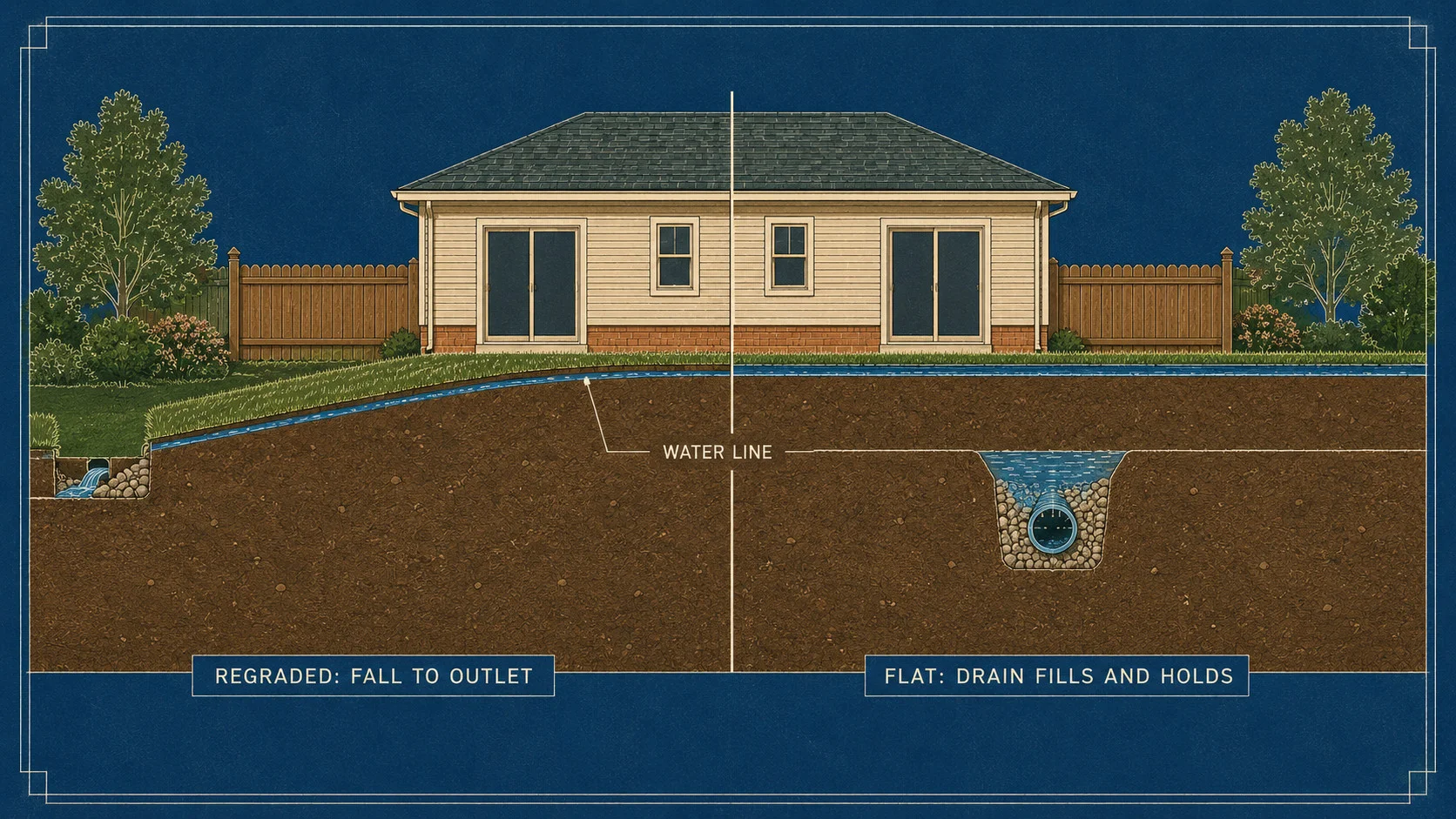
The common mistake is buying a French drain for the first row. A drain moves water that has somewhere to go; if the lot has no fall, the drain fills and stays full.
The Clayton rule: the permit follows the hard surface
Clayton’s stormwater permit triggers on increasing impervious area — not on project size.
This is the sentence that matters, taken from the Town’s own stormwater permit application:
“Prior to commencing construction activities that propose to increase the impervious area on a property as outlined by Chapter 158 of the Town’s Land Usage Ordinance within the Town of Clayton, a stormwater permit must be obtained.”
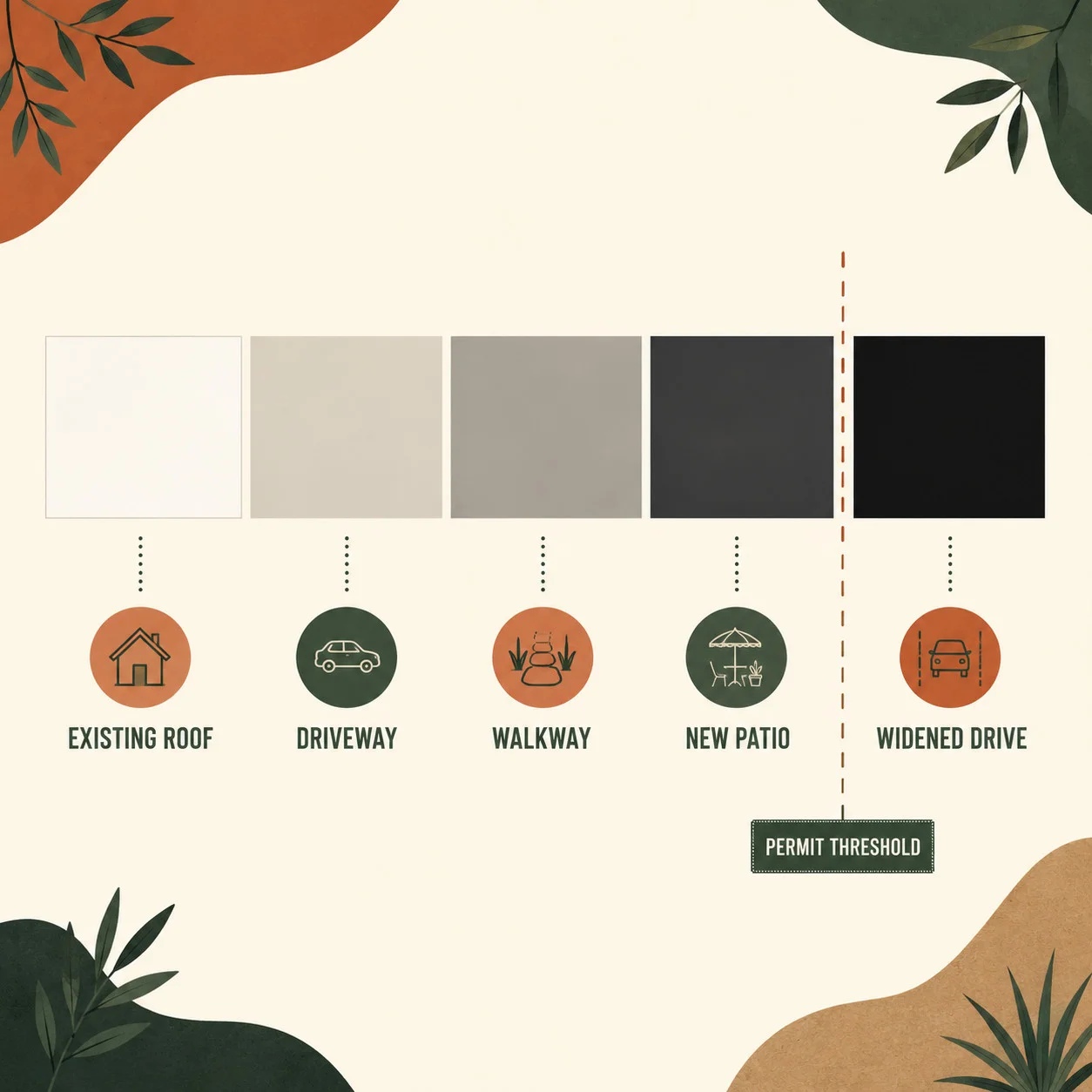
Read that against a drainage project and the implication is immediate. Impervious means hard surface — roof, driveway, walkway, patio, concrete. The regrade that fixes your low corner may add none of it. The patio you pour so the corner is usable, the concrete swale, the extra parking pad, the widened drive — every one of those is added impervious area.
So the fix can need a permit the problem never would have.
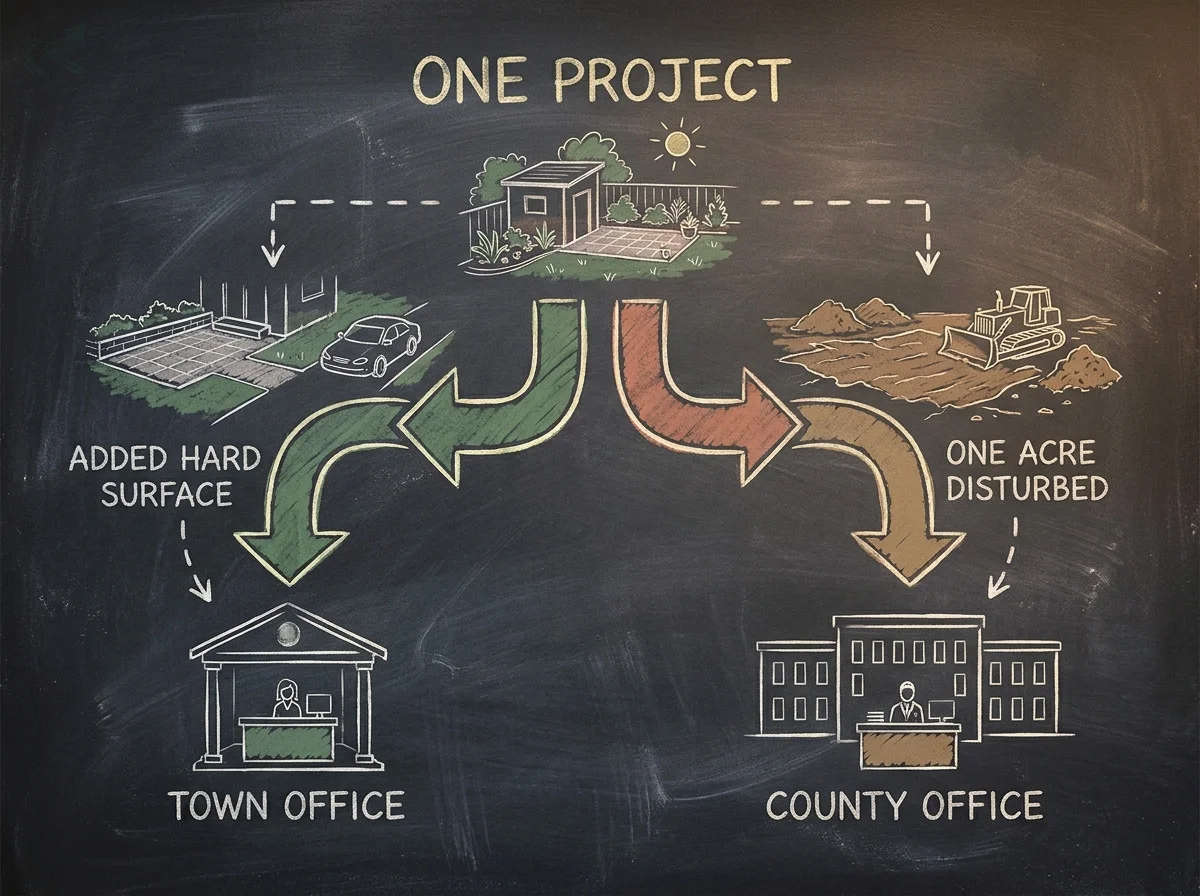
And it’s a different office from the one the county page sends you to. Land-disturbing activity in Johnston County goes to County Public Utilities. This stormwater permit is the Town of Clayton Engineering & Inspections Department, 111 E. Second Street, 919-553-5002. Two triggers, two counters.
The nitrogen budget nobody mentions
Clayton drains to the Neuse estuary, and new development here carries a hard nutrient cap.
Per the Town’s stormwater program, nitrogen loading from new development must not exceed 3.6 pounds per acre per year. That is not guidance. The Town’s permit application carries a Nitrogen Loading Requirement field, a line for a Nutrient Offset fee receipt, and performance securities set at the stormwater control measure’s construction cost plus 25%.
The offset line is the tell: when a project can’t meet the cap on its own, the remedy is to buy the difference. That’s a real cost attached to a real ceiling.
For a single back-yard regrade this rarely comes into play. It matters when a project starts adding meaningful hard surface, and it explains why Clayton’s paperwork asks questions a smaller town’s wouldn’t.
Two other numbers worth knowing, from the same source: erosion and sediment control measures are designed to handle runoff from a 10-year storm, and stormwater control measures must achieve 85% average annual removal of .
Land-disturbing activity of more than one acre needs a plan regardless — that’s the separate county-level trigger covered on the Johnston County page. Riparian buffer widths inside town limits aren’t stated in the Town’s stormwater materials, so they aren’t stated here; confirm any watercourse setback before planning work near a channel.
What a complete Clayton quote includes
- The diagnosis, in writing. Grading problem or drainage problem, and why. If a contractor prices a French drain without walking the fall, that’s the gap.
- The outlet. Where the water actually goes, and whether that’s legal. On clay this is the project.
- Any added hard surface, named. Patio, pad, concrete swale — each one is the permit question above. A quote that doesn’t mention it hasn’t asked it.
- Who pulls the permit, and which office. Town for added impervious area; county for an acre of disturbance.
- Ground cover restoration. Does the price end at bare clay, or at established cover? The most common invisible gap between two quotes.
- Erosion control during the work. Silt fence and inlet protection aren’t optional and aren’t free.
A useful question to ask: “Does anything you’re proposing add impervious area, and if so who pulls the Town permit?” A contractor who works Clayton regularly answers it immediately. One who says “it’s just a yard, there’s no permit” has answered a different question than the one Clayton asks.
What this means for your project
If you’re regrading a wet corner and adding nothing hard, you’re likely outside the Town’s stormwater trigger — but the grade still has to send water somewhere legal, and that’s the harder half.
If the fix involves a patio, a pad, a concrete channel, or a wider drive, the hard surface is the permitted part. Establish that before the quote is signed, not after the concrete is ordered.
And if the job crosses an acre of disturbance, that’s the county’s separate threshold, at a different office, on the Johnston County page.
We’re a directory, not a permit office — we can’t file or expedite anything. What this page can do is make sure you walk into the right one already knowing which question you’re asking. When you’re ready to price it, the contractors we’ve verified in Clayton each link straight to their own NCLBGC record.
From our directory
Verified contractors near Clayton
Every listing is cross-checked against the NC Licensing Board public record before it appears. Pick your city:
Or browse the full NC contractor directory.