Two questions people often ask
Why does the quarry sell by the yard but the delivery invoice says tons?
Yards measure volume. Tons measure weight. They are not the same unit. One cubic yard of Aggregate Base Course weighs roughly 1.3–1.5 tons depending on moisture. If the quote is in one unit and the invoice in the other, ask for the conversion in writing before the truck rolls.
What's "fill dirt" actually made of?
Depends entirely on who's selling it. Clean fill is screened red clay or sandy loam with no debris. Structural fill is spec'd material that compacts to engineered density. A cheap "load of fill" off Craigslist can be construction debris with topsoil sprinkled on top. The price gap is real because the material is not the same.
Buying fill dirt or gravel in NC is an exercise in opaque units. The quarry posts prices per yard; the invoice arrives per ton; the conversion is never written down. Probably not overcharged — but you can’t tell, and that’s the problem.
This hub maps the hauling we do, the conversions that matter, the gravel specs in plain English, and the scams to watch for.
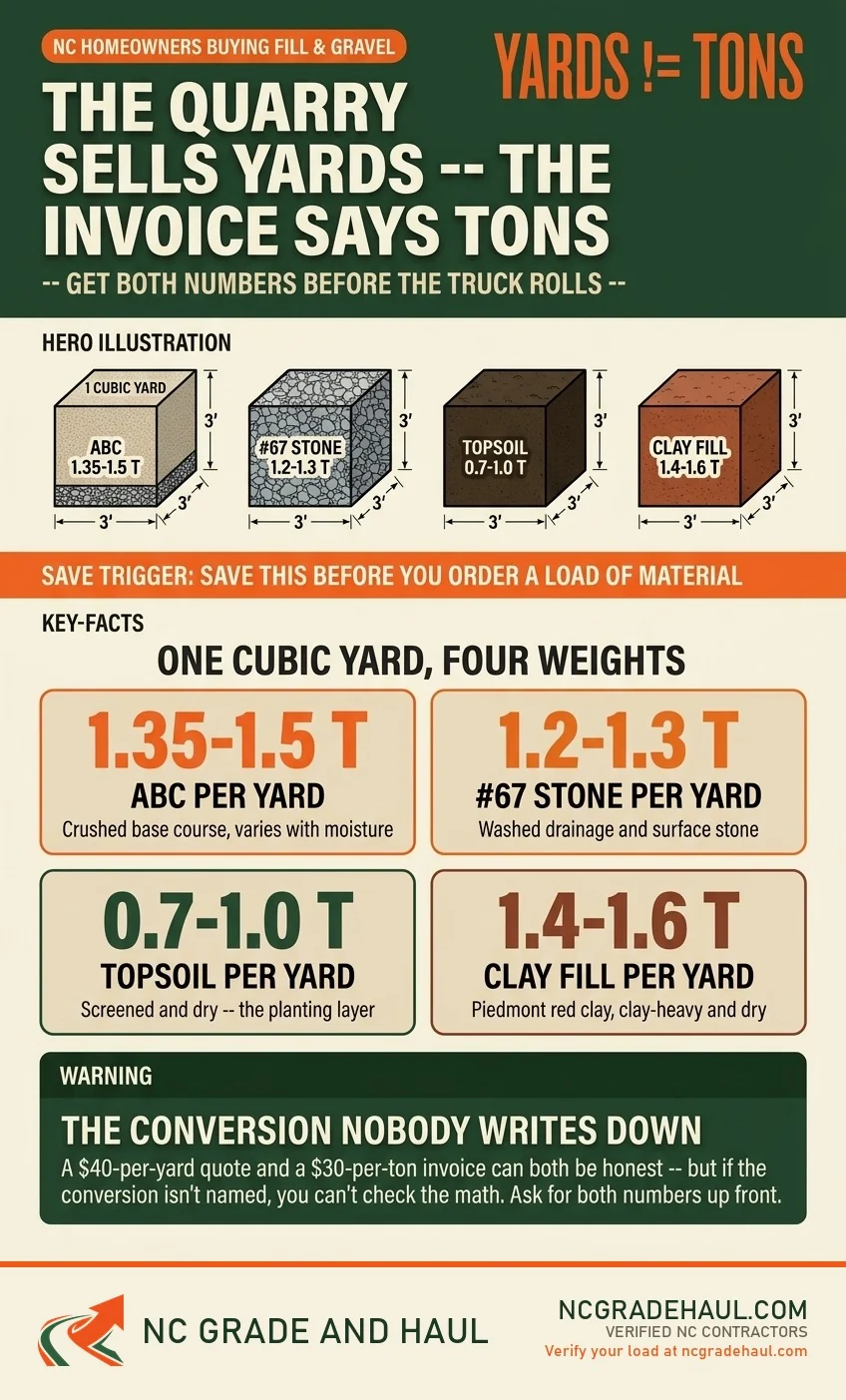
Same volume, four very different weights. Field estimates only — get the supplier’s actual unit-weight test for precision jobs.
Yards vs Tons — The Conversion Nobody Posts
Yards are volume. Tons are weight. The conversion depends on the material and how wet it is.
Quarries price by the cubic yard because that’s what a loader bucket holds. Trucks invoice by the ton because that’s what the gate scale reads. Both correct. Neither is what the homeowner is holding when the dump bed lifts.
Working numbers for NC materials:
- 1 cubic yard of ABC ≈ 1.35–1.5 tons (varies with moisture; wet clay-bound fines weigh more)
- 1 cubic yard of #67 washed stone ≈ 1.2–1.3 tons (~2,410 lb/yd³ is the commonly cited figure)
- 1 cubic yard of topsoil ≈ 0.7–1.0 tons (screened, dry)
- 1 cubic yard of clay-heavy fill (Piedmont red clay) ≈ 1.4–1.6 tons (true clay-heavy, fairly dry). Lighter general fill — mixed dirt, sandy soil — runs closer to 1.0 ton/yd³.
A $40/yard quote and a $30/ton invoice can both be honest — $30 × 1.4 tons/yard = $42/yard, close enough nobody flags it. But if the conversion isn’t named in the quote, you can’t check the math. Ask for both numbers up front.
Walk through the full math at how to verify your NC gravel load or run the numbers yourself with the cubic yard to ton converter.
What NC Haulers Move
Five categories. Each one has a different spec, a different price band, and a different way to get burned if the quote is vague.
- Fill dirt — clean fill, structural fill, and topsoil are three different materials. A “load of fill” with no spec attached can be anything from screened red clay to mixed demo debris. Get the source named in writing — quarry name, pit name, or “screened clean clay from a residential excavation,” not just “fill.”
- Gravel delivery — ABC for driveway base, #67 for surface and drainage, CABC as a base alternative. Spec drives the price; substituting unwashed crusher run for #67 washed stone saves the contractor money and costs you a clogged French drain in two seasons.
- Topsoil and soil amendments — when a regrade needs the planting layer rebuilt. Screened topsoil is not the same as the dirt that came out of the hole. Sub-detail at the NC fill dirt types and hauling options.
- Demolition and debris removal — post-demo hauling for renovations, lot prep, or storm cleanup. Dumpster vs roll-off vs tandem dump — the right rig depends on what’s in the pile and where it’s going. C&D landfill fees are passed through, not built in.
- Flowable fill — self-compacting low-strength concrete mix for utility abandonment, void filling, and tight-access trench backfill. Specific job, specific spec; don’t let a contractor talk you into it for general fill work.
Gravel Spec in NC, in Plain English
The four specs you’ll see on most NC residential quotes are ABC, #57, #67, and CABC. They are not interchangeable.
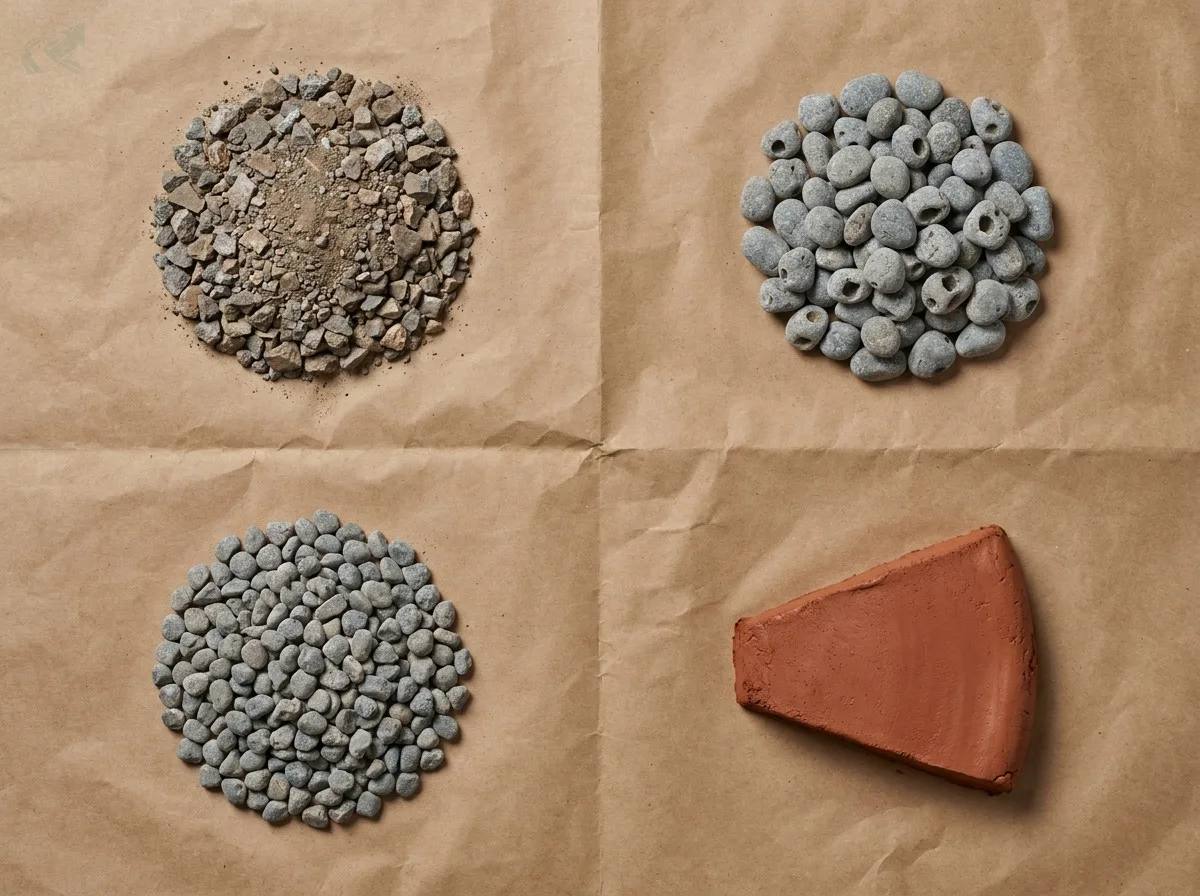
- ABC (Aggregate Base Course) — graded crushed stone with fines mixed in. Compacts tight under load. The standard driveway and pad subbase across NC.
- #57 stone — 1” to 1.5” washed stone. Drainage layer under foundations, septic field stone, large French drains. Drains fast, doesn’t compact.
- #67 stone — 3/4” washed stone. The all-purpose drainage and surface stone. French drains, driveway top course, walkway base. The single most common drainage stone in NC residential work.
- (Crusher Run) — mix of larger stone and fines. Compacts similarly to ABC. Cheaper per ton in some markets; gradation varies more pit to pit.
- Washed vs unwashed — washed stone has the fines rinsed out. Drainage applications need washed stone; if water can’t move through the voids, the drain isn’t a drain.
Full glossary with photos at ABC, #57, #67, CABC material specs.
NC Hauling Regulations — Short Version
DOT weight limits cap what a single delivery can legally bring. County haul-route ordinances cap which roads heavy trucks can use to get there.
A standard tandem dump in NC tops out around 14–16 tons of payload. Tri-axles carry more but can’t fit every driveway. The number of trips on a volume job is set by the largest truck that can physically reach your address — not by what the quarry can load.
Municipal haul-route restrictions matter on heavy deliveries to subdivisions with weight-posted streets. Permit notes for commercial-scale fill imports live at hauling regulations and the NCDOT reference.
How to Order a Delivery
Four pieces of information let us write a real quote on the first call.
- Delivery address — for haul distance from the closest quarry and to check truck access (driveway width, overhead clearance, turnaround room).
- Volume — in either yards or tons. We’ll convert and put both numbers on the quote.
- Material spec — if you don’t know, describe the job (“base under a 12×24 shed pad,” “top course on an existing gravel drive”). We’ll spec it.
- Access constraints — gates, soft yards, septic lines under the drive, low-hanging power. A truck stuck in a wet yard is a bad day for everyone.
The quote comes back itemized — material cost per ton, haul cost per trip, dump fee if applicable, total. Not a single round number.