If you’ve called three grading contractors and gotten three completely different answers, that is not your fault. The grading industry in NC has almost no consumer-facing transparency. There is no Yelp for site work. The portal is public but few homeowners know to use it. County permit data is fragmented across four different systems.
This page is the checklist you wish someone had given you before your first call.
The service-specific hiring pages go deeper — yard drainage, driveway grading, builder accountability. What follows is the universal vetting framework that runs underneath every one of them.
NC Licensing Thresholds — When a License Is Required
A North Carolina General Contractor license is required for any project where the total cost of the undertaking — labor and materials, excluding land — is $40,000 or more. The threshold was raised from $30,000 to $40,000, effective October 1, 2023 (Session Law 2023-68). Below that, the state doesn’t require a license. The county or city often still requires permits.
The threshold is set by NC General Statutes §87-1 and administered by the NCLBGC. Two things follow from that single number:
- Above $40,000. The contractor must hold an active NC General Contractor license in the right classification. For most residential grading work, that’s the Building classification with a Grading & Excavating specialty, or a standalone Highway or Public Utilities classification depending on scope.
- Under $40,000. No state license required. But your county may still require an control plan, a land-disturbance permit, or a stormwater submittal regardless of project cost. See county permit requirements for Wake, Mecklenburg, Durham, and Guilford.
| Factor | Limited | Intermediate | Unlimited |
|---|---|---|---|
| Project value cap | Up to $750,000 per project | Up to $1,500,000 per project | No cap |
| Bond / net worth | Lower threshold — verify at NCLBGC | Mid threshold — verify at NCLBGC | Highest threshold — verify at NCLBGC |
| Typical residential fit | Single-lot grading, driveway work, yard drainage | Small subdivisions, multi-lot residential, commercial pads | Subdivisions, road work, large commercial sites |
| What it tells you | Operator is properly credentialed for most homeowner work | Operator handles bigger jobs — overkill is fine, not a red flag | Operator's normal work is bigger than yours — confirm they actually want a residential job |
Project value cap
- Limited
- Up to $750,000 per project
- Intermediate
- Up to $1,500,000 per project
- Unlimited
- No cap
Bond / net worth
- Limited
- Lower threshold — verify at NCLBGC
- Intermediate
- Mid threshold — verify at NCLBGC
- Unlimited
- Highest threshold — verify at NCLBGC
Typical residential fit
- Limited
- Single-lot grading, driveway work, yard drainage
- Intermediate
- Small subdivisions, multi-lot residential, commercial pads
- Unlimited
- Subdivisions, road work, large commercial sites
What it tells you
- Limited
- Operator is properly credentialed for most homeowner work
- Intermediate
- Operator handles bigger jobs — overkill is fine, not a red flag
- Unlimited
- Operator's normal work is bigger than yours — confirm they actually want a residential job
A professional grading operator usually carries a license even on jobs that don’t strictly require one, because their typical job size crosses the threshold and maintaining the license year-round is cheaper than letting it lapse and renewing.
If the contractor quoting you can’t give you their license number when you ask, you know something the quote itself can’t tell you. Verify the number at portal.nclbgc.org — free, no account required, searchable by company name or license number.
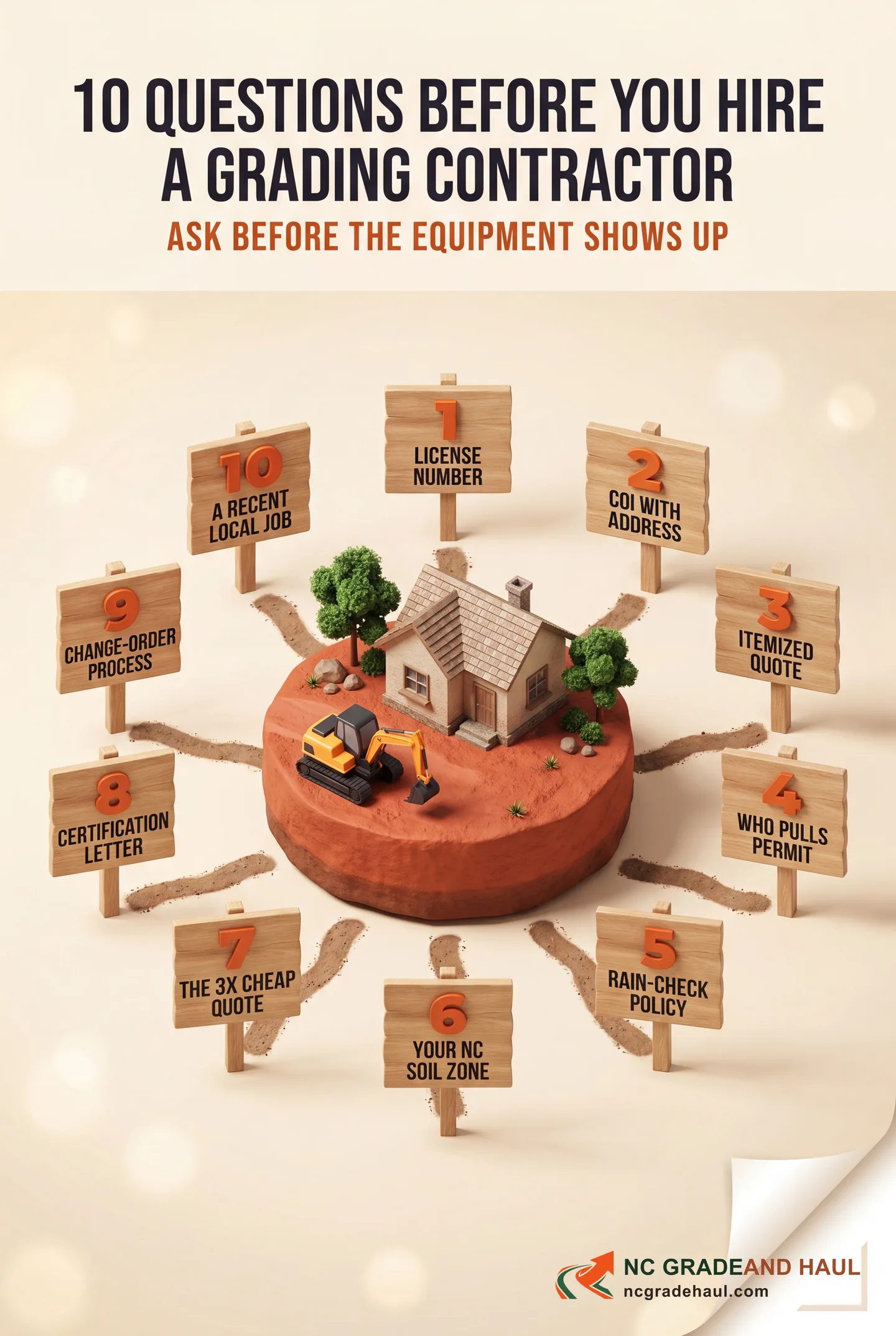
The 10 Questions to Ask Any Grading Contractor
These questions separate the operators who run a real business from the ones who own equipment and answer the phone. Each one has a “good answer” shape and a “bad answer” shape. You don’t need a technical background — you need to listen for whether the answer is specific or vague.
-
What’s your NC general contractor license number? Good: They give you the number on the spot, often before you finish asking. Bad: “We’re licensed and insured” with no number, or “I’ll have to look that up.” Verify whatever number they give at the NCLBGC portal before you sign.
-
Can I see your current COI with my project address added? Good: They forward a Certificate of Insurance from their carrier with general liability + workers’ comp coverage and your address listed as the project site. Bad: A photo of an old certificate, or “we’ll send it later.” The address listed matters — it’s how the policy actually responds if something happens on your property.
-
Is this quote itemized or lump-sum, and can I get it itemized? Good: Either it’s already itemized, or they’ll itemize it without resistance. Bad: “We don’t break it out that way.” A lump-sum number with no line items is a number you can’t compare to anything. See itemized vs lump-sum quotes.
-
Who pulls the permit — you or me? Good: “We pull it” — every time, on any project above the county threshold. The contractor’s license number goes on the permit; their bond is what makes the county whole if something goes wrong. Bad: “You’ll need to pull that yourself.” That’s liability transfer — see county permit requirements for the per-county thresholds.
-
What’s your rain-check policy? Good: “We come back after the next significant storm and verify the drainage is behaving the way we said it would.” That’s a rain-check. Bad: No rain-check at all, or a vague “if there are issues, call us.” On NC clay, drainage that looks right on a dry day can fail in the first 2-inch rain.
-
What NC soil zone are we working in, and how does that change your methodology? Good: Specific answer — Piedmont red clay, coastal sand, or WNC rock. They name how it changes their compaction approach, their gravel spec, or their drainage routing. Bad: “Soil’s soil.” If they can’t name the zone, they can’t engineer for it.
-
If I get a quote for 3x less than yours from another contractor, what’s the most likely reason? Good: “We’re probably solving different problems. Ask the cheaper guy what he thinks is actually wrong, then ask me, and compare the diagnoses.” That’s diagnostic-variation framing — the right answer. Bad: Defensive pricing talk. The bid spread isn’t usually about price; it’s about what each contractor saw on the walk.
-
Are you comfortable writing a certification letter if my builder is disputing the problem? Good: “Yes. We’ve done that.” A certification letter is a signed, dated document on company letterhead stating what the operator observed and what’s required to fix it. Builders take it seriously because it’s discoverable in arbitration. Bad: “We don’t get involved in disputes.” That tells you they’re not equipped to back you up.
-
What happens if we find something unexpected during excavation? Good: They walk you through their change-order process — written change order, you sign before any extra work proceeds, the additional cost itemized the same way the original quote was. Bad: “We’ll figure it out as we go.” That’s a verbal blank check.
-
Can you name one recent local project I can look at? Good: County, service performed, rough month — sometimes an address if the homeowner agreed. Bad: Vague references with no specifics. A real operator can name three projects from the last 90 days inside any county they routinely work.
For the full vetting list including site-walk red flags, see red flags in NC grading quotes.
Red Flags in NC Grading Quotes
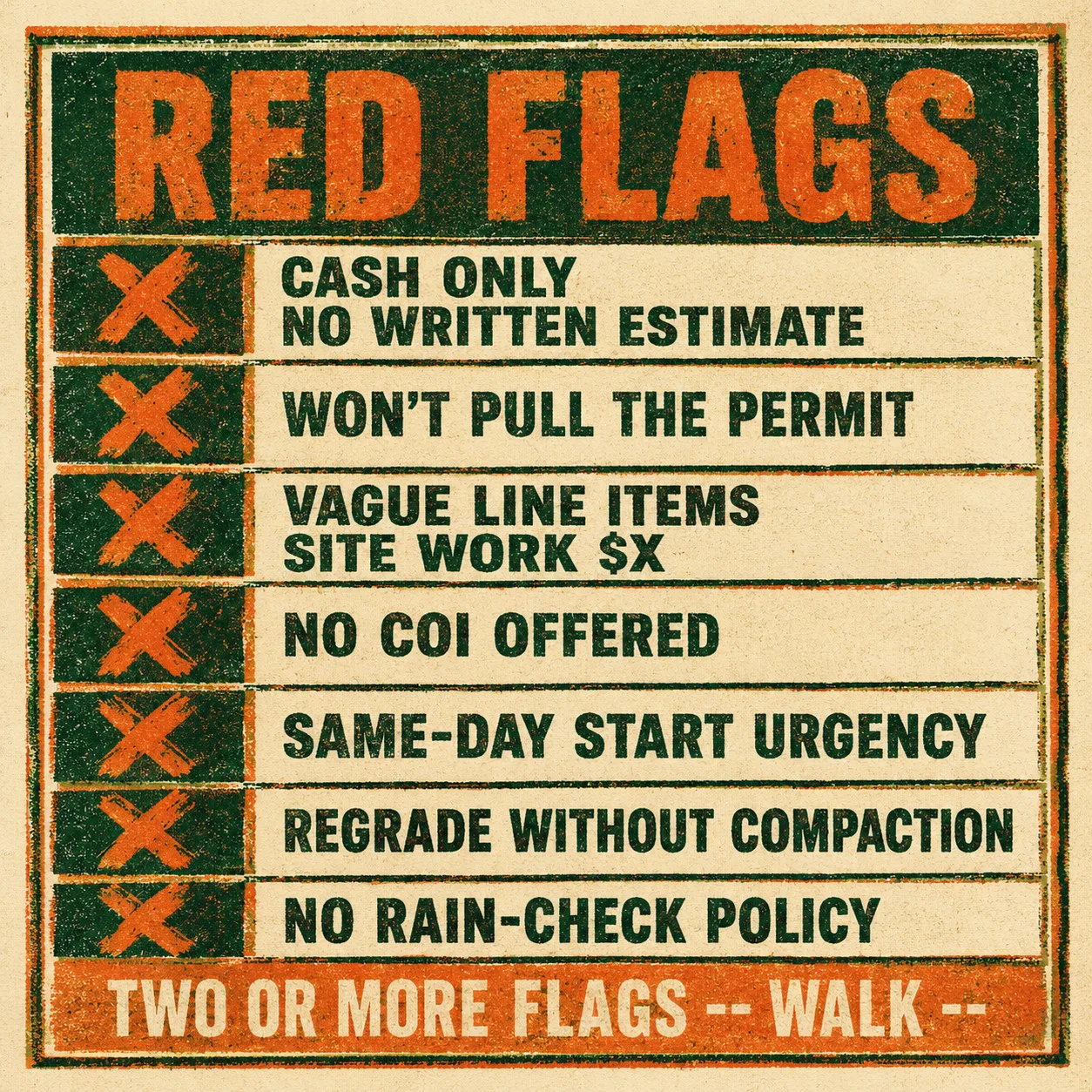
A quote that fails any one of these on its own isn’t a deal-breaker. Two or more on the same quote means walk.
- Cash-only or no written estimate. A real operator writes everything down. Cash-only is a tax-and-liability tell — there’s no paper trail if work fails or the contractor disappears.
- Resistance to pulling permits. “We can do this without a permit” on a project that’s clearly above the county threshold means either the operator can’t pull one or doesn’t want their license attached to the work.
- Vague line items. “Site work — $X” is not a line item. Real itemization names equipment time, materials with spec ( gravel, #67 stone), labor by role, permits, disposal/hauling, and contingency separately.
- No willingness to share a COI. A working contractor’s COI is a routine document their carrier reissues with new project addresses on request. Anyone in business has done this dozens of times.
- Same-day start urgency. “I can have a crew here tomorrow” on a project that needs a permit means they’re skipping the permit. Permits take days to weeks depending on the county.
- “We’ll regrade” without mentioning compaction or proof-roll. Regrading without compaction is just moving dirt around; it’ll settle. Ask how they verify compaction — a real answer involves a with a loaded vehicle.
- Unwillingness to return after rain. No rain-check means no accountability. NC clay drainage has to be tested in real water, not at job-acceptance walkthrough on a dry day.
The full vetting framework with site-walk additions lives at red flags in contractor quotes.
Itemized vs Lump-Sum Quotes
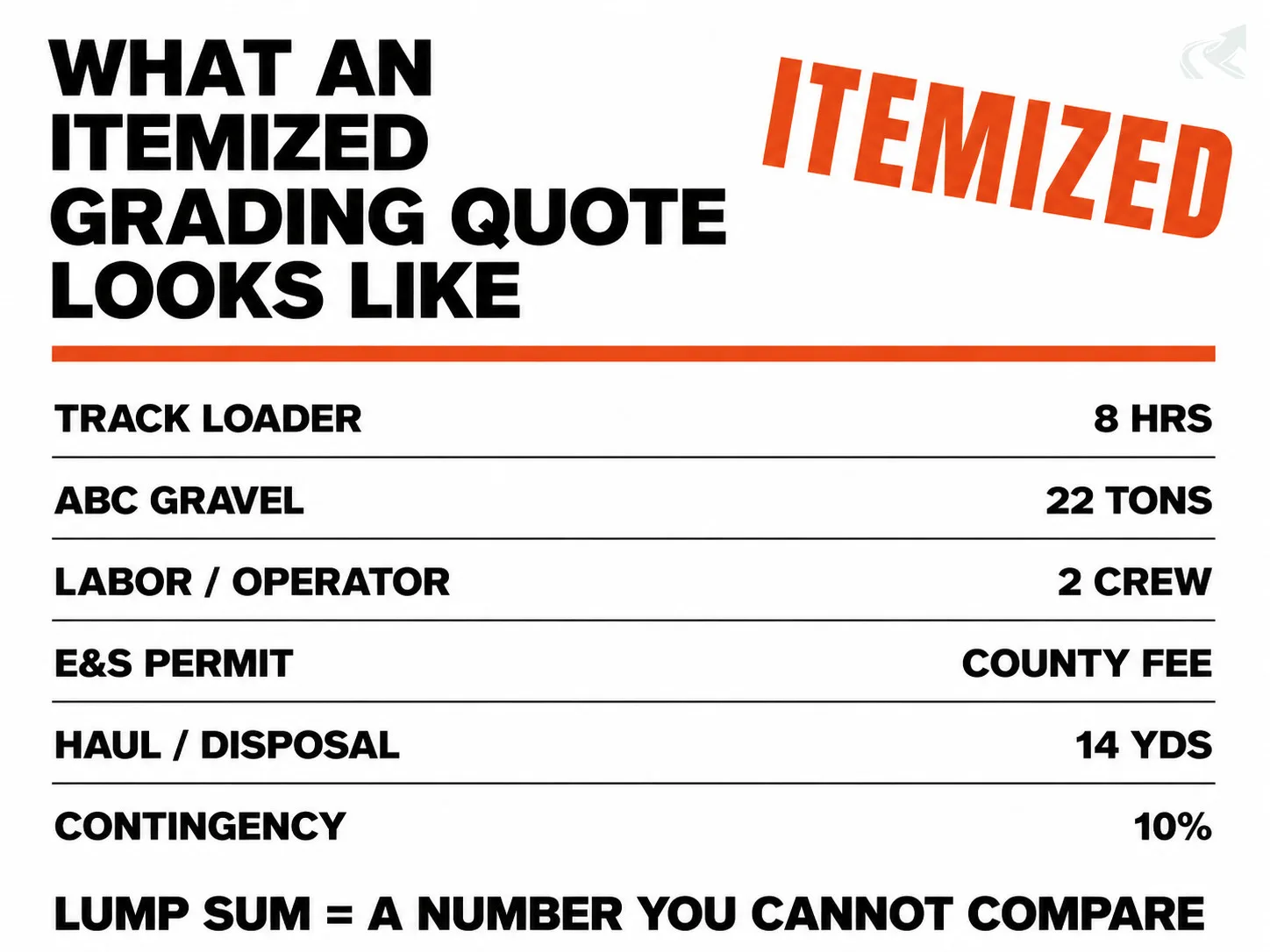
An itemized quote is the single most useful piece of paper in the hiring process. It tells you what you’re paying for line-by-line, which means you can compare two contractors on the same line items instead of two opaque totals.
A real itemized grading quote names:
- Equipment by hour or day — track loader, excavator, skid steer, dump truck, with hours estimated
- Materials with spec — gravel by tonnage, #67 stone, if used, fill dirt by yard
- Labor by role — operator hours, ground crew hours, foreman time
- Permits — line item, scaled to county fee schedule
- Disposal / hauling — yards or tons offsite, by truck
- Contingency — typically called out separately so you know what’s reserved vs spent
A lump-sum quote rolls all of that into one number you can’t dispute and can’t compare. Two lump sums that look the same can be solving completely different scopes. Two itemized quotes can be compared row-by-row even when the totals look different.
For why this matters and how to ask for itemization without losing the contractor, see itemized vs lump-sum quotes.
Service-Specific Vetting
The 10 questions above apply to every grading job. The follow-up questions change with the service.
Yard drainage hiring. Drainage diagnosis is where the diagnostic-variation problem hits hardest — three contractors will name three different causes for the same standing-water symptom. The vetting question that separates them: ask each one to walk you through what they think is happening upstream of the wet spot, not just at the wet spot itself. Real diagnosis follows water back to its source. See yard drainage hiring and the foundation drainage QN for the diagnostic framework.
Driveway grading hiring. Driveway-specific vetting centers on compaction, base depth, and crown — not the surface course. The most expensive driveway repair is the one done a year after a cheap install when the base fails. Ask about base prep, ABC gravel tonnage, and crown spec before you ask about the gravel or asphalt finish. See driveway grading hiring.
Residential / new-build hiring. New-build grading often means working against a builder’s existing site work that’s already failed — finish grades sloped wrong, swales never installed, downspouts dumping at the foundation. The vetting question: ask the contractor whether they’re comfortable writing observations into a certification letter suitable for builder warranty disputes. Most won’t be. The ones who will are the ones you want. See residential vetting and builder accountability.
NC Service Areas
This vetting framework applies anywhere in NC. The contractors who can meet it are concentrated in the metros where the volume supports a professional operation.
- Triangle (primary). Wake, Durham, Orange. Highest concentration of vetted residential grading operators in NC. Start at Raleigh / Wake County grading contractors or Durham County grading contractors.
- Charlotte metro. Mecklenburg, with surrounding Cabarrus / Union / Gaston as the cohort grows. Start at Charlotte grading contractors.
- Triad. Guilford anchors — Greensboro, High Point, Jamestown all route through different jurisdictions per Guilford permit notes. Start at Greensboro grading contractors.
- WNC recovery. Buncombe, Henderson, Rutherford — 18+ months into Helene cleanup, post-disaster grading demand still books months out. Earliest call wins. Roster is thinner; expect a longer lead time to find a verified operator.
- Other NC. For counties not yet in the verified cohort, the framework above still works. Use the grading contractor near me county aggregator to see current coverage.
When to Book
NC grading has real seasonal windows. Booking aligned to the windows costs less and finishes cleaner.
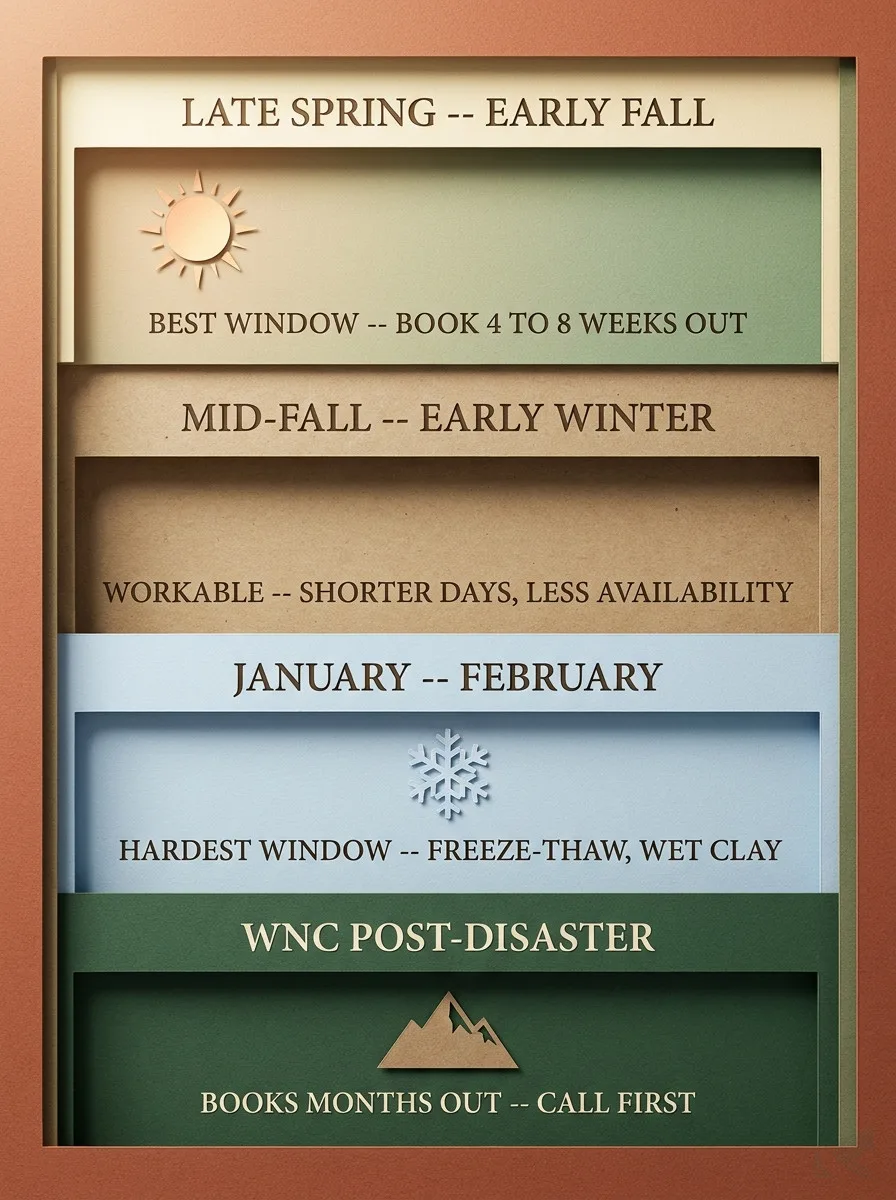
- Best window — late spring through early fall. Ground has dried from winter saturation; rain events are predictable enough to schedule around. Most operators run at capacity; book 4-8 weeks out.
- Workable but harder — mid-fall and early winter. Shorter days, occasional saturated days, but compaction is achievable on most sites. Operator availability often improves.
- Hardest — January and February. Freeze-thaw cycles plus saturated Piedmont clay make compaction inconsistent and proof-rolling unreliable. Some operators stop residential grading entirely in this window.
- Post-disaster surge — WNC. The Helene-affected counties remain on a different timeline. Driveway and access-road work books months out; the operator who answers your first call is often the one who’ll do the work.
For a fuller seasonal breakdown including how to think about scheduling against rain forecasts, see when to book.