
“Licensed and insured” is the phrase every North Carolina contractor puts on their business card. It is also meaningless unless you know what license they hold, what it covers, and how to verify it is current.
This page gives you the tools to do that in about a minute. If you have a quote in hand right now and want to verify the contractor before signing, skip straight to the NCLBGC license lookup walkthrough. If you want the framework first, keep reading.
The $40,000 Threshold
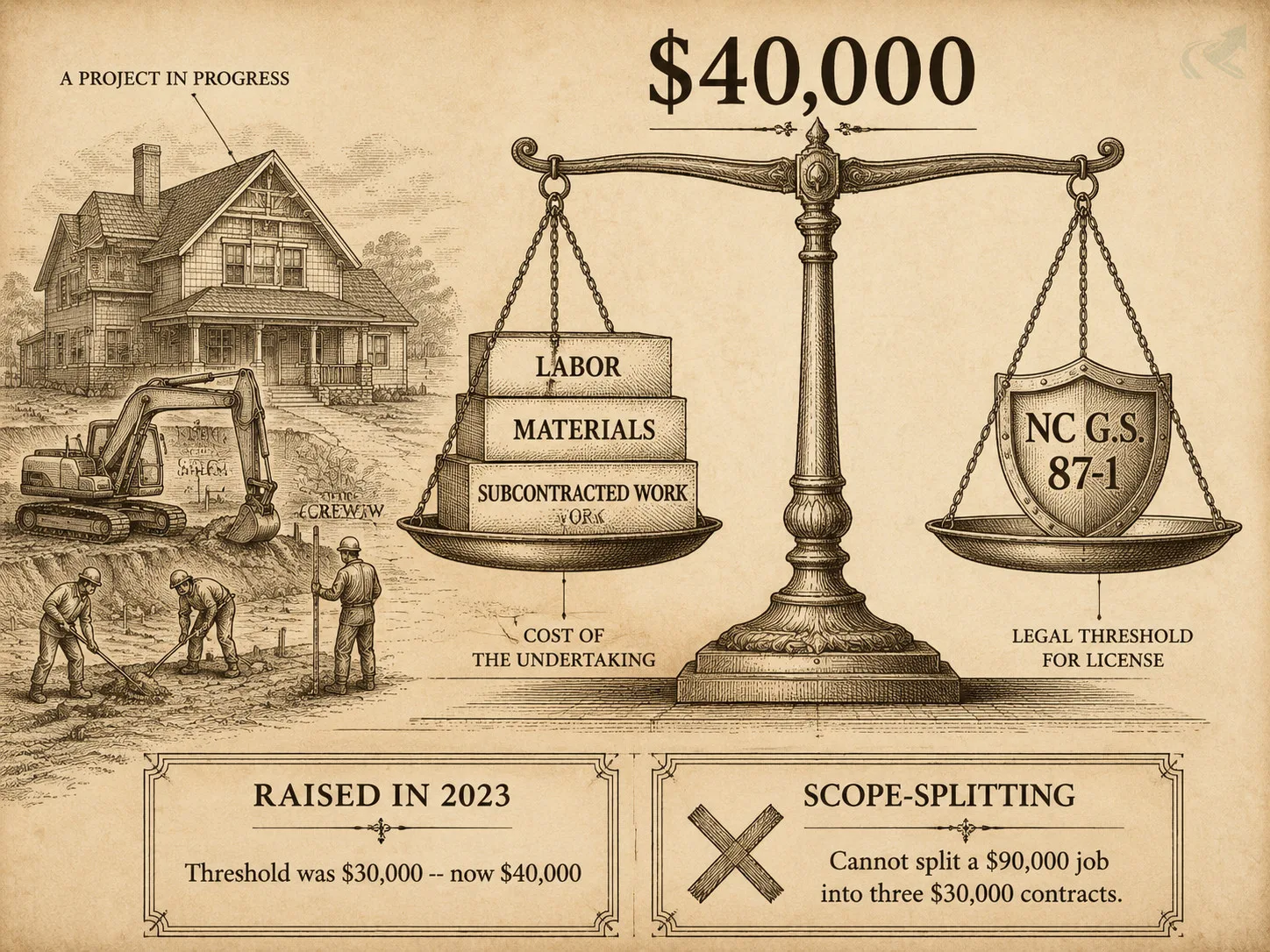
NC requires a general contractor license for any single project with a total value of $40,000 or more — the full “cost of the undertaking,” not labor alone.
North Carolina General Statutes Chapter 87 is the governing law. The statutory phrase is “cost of the undertaking,” which the courts read as the full construction cost: materials plus labor plus subcontracted work. Land cost is excluded. The threshold was raised from $30,000 to $40,000 in 2023 — older articles still citing $30,000 are using stale numbers.
Three things homeowners consistently get wrong:
Total project value includes materials. A $25,000 labor quote with $18,000 in gravel, fill dirt, and pipe puts the project at $43,000 — over threshold. Contractors who quote labor-only and ask the homeowner to purchase materials separately sometimes do so to keep the number under $40,000 on paper. The state looks at the full cost of the undertaking, not how the paperwork is structured.
Scope-splitting doesn’t work. A contractor cannot legally break a $90,000 grading job into three smaller phases with separate contracts to dodge the threshold. That is a Chapter 87 violation, and the NC Licensing Board treats it as one.
The consequences are real. Under G.S. 87-13, performing general contractor work above threshold without a valid license is a Class 2 misdemeanor. Beyond criminal exposure, NC courts treat the underlying contract as illegal and unenforceable by the contractor. Mechanic’s lien rights are tied to lawful contracts — so lien enforcement is also off the table. If you end up in a dispute with an unlicensed contractor on a $60,000 grading job, you hold leverage they cannot match.
Below $40,000, a state GC license is not required. County and city trade permits — for grading, plumbing, electrical, septic — may still apply and have their own thresholds. See the overview of NC construction site regulations for the layered picture.
NC License Classifications
The license alone is not enough — the classification has to match the scope of your project.
A contractor licensed in “Building” is not licensed to bid highway grading. A “Residential” license does not cover commercial structures. The classification on the record tells you what scope the NC Licensing Board for General Contractors has actually approved.
| Classification | What It Covers |
|---|---|
| Building | General residential and commercial structures |
| Residential | Single-family and small multi-family only |
| Highway | Roads, highways, bridges — includes major grading scope |
| Public Utilities | Water, sewer, drainage, stormwater infrastructure |
| Specialty (Grading, Pipeline, Concrete, etc.) | Limited-scope licenses for specific trades |
For grading, drainage, and hauling work in North Carolina, the contractor typically holds Building, Public Utilities, or Specialty-Grading — and confirming that classification match is step one of any NC contractor vetting checklist. Septic-to-sewer conversion usually requires a Public Utilities classification, and sometimes an additional utility-specific endorsement.
Within each classification, the NCLBGC also issues the license at one of three monetary tiers: Limited (projects up to $750,000), Intermediate (up to $1.5M), and Unlimited. For most residential grading work this distinction rarely matters. On larger commercial jobs — a site-prep contract above $500,000, say — confirm the tier covers the contract value.
The rule of thumb: read the classification before you read anything else on the record. If the classification doesn’t fit the scope, the rest of the fields are beside the point.

How to Look Up Any NC Contractor
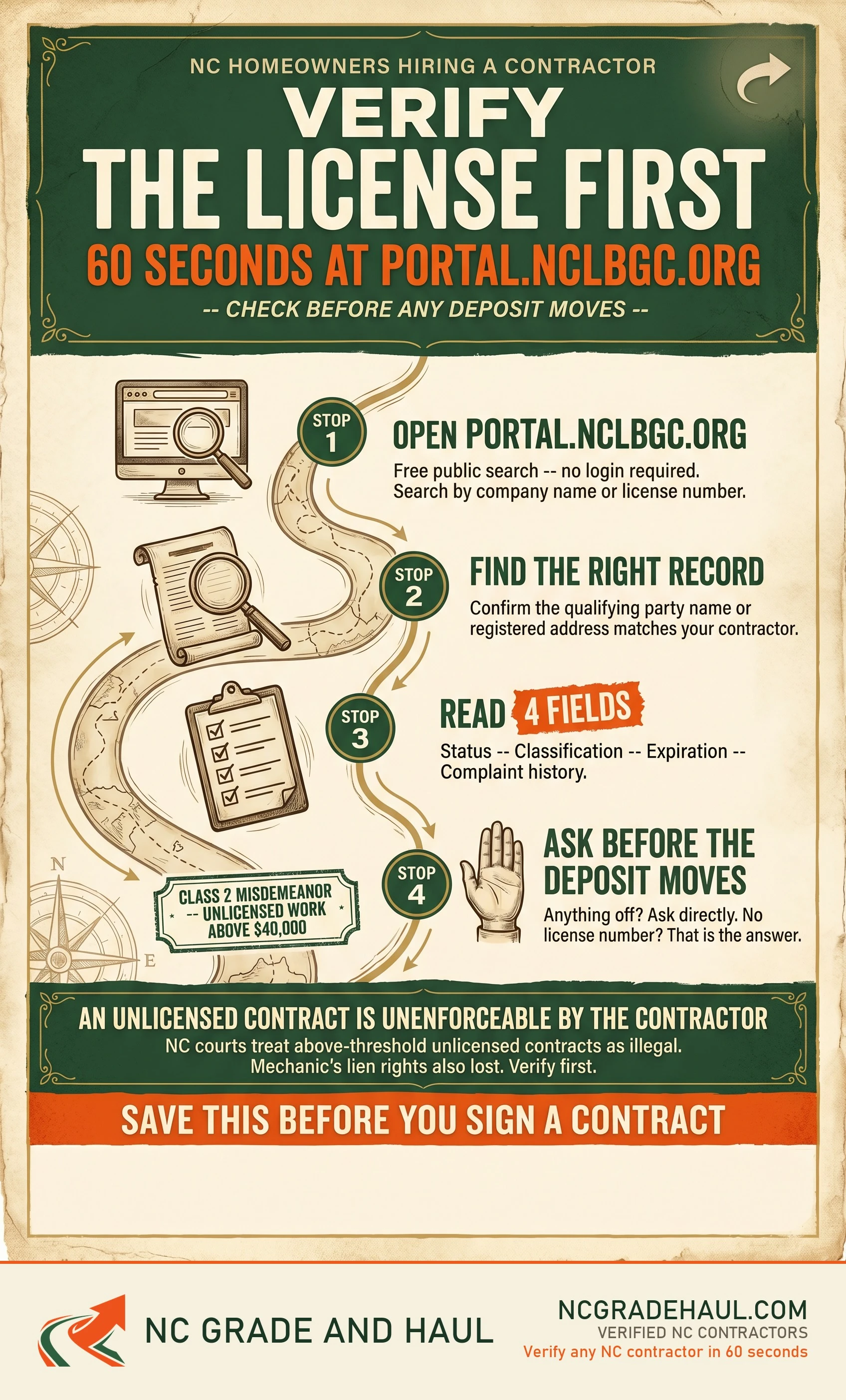
Go to portal.nclbgc.org, search by company name or license number, and read four fields off the record.
The NC Licensing Board for General Contractors maintains a free public lookup at portal.nclbgc.org. No login required. Step by step:
- Open the public license search. Company name or license number both work. If the contractor’s legal entity name differs from their marketing name, try both — “Piedmont Site Work LLC” and “Piedmont Site Work” can return different results.
- Identify the right record. Multiple contractors can share similar names. Confirm the qualifying party’s name or the registered address matches the person who gave you the quote.
- Read the four fields that matter: license status, classification, expiration date, and disciplinary/complaint history.
- If anything looks off, ask the contractor directly before the deposit changes hands.
How to verify any NC contractor at portal.nclbgc.org
1. Open the public license search -- Go to portal.nclbgc.org -- no login required. Search by company name or license number. Try both the legal entity name and the trade name if the first search returns nothing. 2. Identify the right record -- Multiple contractors share similar names. Confirm the qualifying party name or the registered address matches whoever gave you the quote before reading the status fields. 3. Read the four fields that matter -- Status (Active?), classification (matches your project scope?), expiration date (in the future?), and complaint history (empty or fully resolved?). 4. Ask before the deposit changes hands -- If anything looks off, ask the contractor directly. A contractor who refuses to provide a license number -- or whose number returns no result -- is giving you the answer.
-
Open the public license search
Go to portal.nclbgc.org -- no login required. Search by company name or license number. Try both the legal entity name and the trade name if the first search returns nothing.
-
Identify the right record
Multiple contractors share similar names. Confirm the qualifying party name or the registered address matches whoever gave you the quote before reading the status fields.
-
Read the four fields that matter
Status (Active?), classification (matches your project scope?), expiration date (in the future?), and complaint history (empty or fully resolved?).
-
Ask before the deposit changes hands
If anything looks off, ask the contractor directly. A contractor who refuses to provide a license number -- or whose number returns no result -- is giving you the answer.
A clean record: Active status, correct classification, future expiration date, empty complaint history. Takes about 60 seconds.
What a clean record looks like: Status reads “Active.” Classification matches the scope you are hiring for. Expiration date is in the future. Complaint history is empty or shows only old, fully-resolved items.
What a flagged record looks like: Status reads “Inactive,” “Suspended,” or “Expired.” Classification does not cover your project scope. Recent unresolved complaints. A contractor whose license expired last month is not licensed today — regardless of what the truck door says.
One more check: if a contractor refuses to provide their license number, or the number they provide returns no result, that is the answer. You do not need a second opinion on that one.
What “Insured” Actually Means
Three separate coverages — all verifiable through a Certificate of Insurance, not a verbal claim.
A license proves the state has tested and approved the contractor. Insurance is a separate question. “Fully insured” is a phrase, not a document. The three coverages North Carolina homeowners should verify before any grading work begins:
1. General liability. Covers property damage the contractor causes on your site — a Bobcat through a retaining wall, a dump truck that clips the garage. Typical minimum is $1M per occurrence. Anything thinner on a five-figure grading job is underinsured.
2. Workers’ compensation. Covers injuries to the contractor’s crew while they are on your property. NC requires workers’ comp for any employer with three or more employees. An uninsured worker hurt on your land can become your liability.
3. Auto and equipment. Covers the contractor’s trucks, excavators, and heavy equipment on your site. Often bundled with general liability — but not always. Confirm it is listed separately on the certificate.
The three coverages a COI must show
1. General liability -- Covers property damage the contractor causes on your site -- a Bobcat through a retaining wall, a truck that clips the garage. Minimum $1M per occurrence for a five-figure grading job. Anything thinner is underinsured. 2. Workers' compensation -- Covers injuries to the contractor's crew while they are on your property. NC requires it for any employer with three or more employees. An uninsured worker hurt on your land can become your liability. 3. Auto and equipment -- Covers trucks, excavators, and heavy equipment on-site. Often bundled with GL -- but not always. Confirm it is listed separately on the certificate, not assumed from the GL entry.
-
General liability
Covers property damage the contractor causes on your site -- a Bobcat through a retaining wall, a truck that clips the garage. Minimum $1M per occurrence for a five-figure grading job. Anything thinner is underinsured.
-
Workers' compensation
Covers injuries to the contractor's crew while they are on your property. NC requires it for any employer with three or more employees. An uninsured worker hurt on your land can become your liability.
-
Auto and equipment
Covers trucks, excavators, and heavy equipment on-site. Often bundled with GL -- but not always. Confirm it is listed separately on the certificate, not assumed from the GL entry.
Ask for a current COI with your project address as the certificate holder. A legitimate contractor has it emailed to you within 24 hours.
Ask for a current with your project address added as the certificate holder — and review it against the full certificate of insurance request checklist to confirm all three coverage types are listed. A legitimate contractor contacts their insurer and has the document emailed to you within 24 hours. A contractor who stalls, sends a photocopy of last year’s policy, or refuses outright is giving you an answer — just not the one they intend.
The COI is the only verification that holds. Verbal claims, handshake assurances, and website badges are not documents.
When License Requirements Get Gray
Four edge cases where the $40,000 rule alone does not give a clean answer.
Most projects are straightforward. But these situations come up enough in NC that they are worth naming:
Projects right around $40,000. Contractors sometimes propose splitting scope or shifting materials cost to the homeowner to keep the contract number under threshold. A genuine owner-furnished-materials arrangement is sometimes legitimate; a paperwork-only split on identical work is a license dodge. Ask whether the project scope would change either way — if not, the split is cosmetic.
Post-Helene emergency work in WNC. Some classification requirements were temporarily relaxed for storm recovery in Buncombe, Henderson, Rutherford, and surrounding NC mountain counties. The emergency relaxation is narrow and time-limited. Verify current status at the site before assuming a contractor who arrived after the storm qualifies for an exception.
Homeowner-labor arrangements. If you are providing labor and the contractor is providing equipment and oversight only, the licensing analysis shifts. This is uncommon in residential grading; when it does arise, get the arrangement in writing and confirm with NCLBGC directly if uncertain.
Landscapers doing grading. Landscaping companies frequently take on grading scopes that exceed both their license class and the $40,000 threshold. The NC Landscape Contractor license (Chapter 89D) is a separate credential — it does not authorize structural grading or drainage installation that would otherwise require a Chapter 87 General Contractor license. If a landscaper is proposing to install a French drain system or regrade a yard to correct a foundation drainage problem, ask which license covers that specific scope — and request an itemized vs lump-sum grading quote so the line items can be matched against the classification they claim.
The Complaint Process
File through the NC Licensing Board’s online portal. Bring your contract, all communications, and photos.
If a licensed contractor has wronged you and refuses to make it right, the state has a process. It is not fast, but it is real leverage that most homeowners do not know exists.
Required evidence: signed contract, all written communications (texts and emails count), photos of the work in question, and an itemized record of what was promised versus what was delivered. The Board cannot investigate a dispute it cannot read.
Realistic timeline: 60 to 120 days for a typical complaint to move through the process. Outcomes range from a warning letter to license suspension to a restitution order. The Board does not award civil damages directly — for monetary recovery beyond what the contractor agrees to, civil court is the route. But the threat of a suspension or revocation changes a contractor’s posture faster than most people expect.
The fuller dispute playbook — including the certification-letter lever that often works before a complaint is filed — lives at NC builder accountability and the NC builder certification letter guide.
Verify Before You Sign
Look up the license at portal.nclbgc.org, request the COI with your address as certificate holder, and get an itemized quote — before any deposit changes hands.
Most bad contractor experiences are preventable. Pull the license number from whoever quoted you. Search it at portal.nclbgc.org. Confirm the status, classification, and expiration date. Request the with your project address listed as certificate holder. Then read the itemized quote against the license scope — if the described work falls outside the classification, the license does not cover it, regardless of what the cover letter says.
For the broader hiring framework, start at the hiring a grading contractor page and the contractor red flags checklist. Pricing context at itemized quote vs lump-sum bid explains why a single-line quote cannot be verified against a license scope. If the work has already gone wrong and you need the dispute path, the NC builder accountability hub and the transparency page have what you need next.