Two questions people often ask
Do I need a permit for grading and excavating in NC?
Usually yes — but it's three separate programs, not one. NC's E&S Act triggers at 1 acre of disturbance. Charlotte/Mecklenburg's post-construction stormwater permit triggers at 5,000 sq ft of new built-upon area — even on under-1-acre sites. And watershed-overlay buffers can apply at any size. Your contractor should know all three before the bucket touches dirt.
How do I tell a real grading contractor from a guy with a tractor?
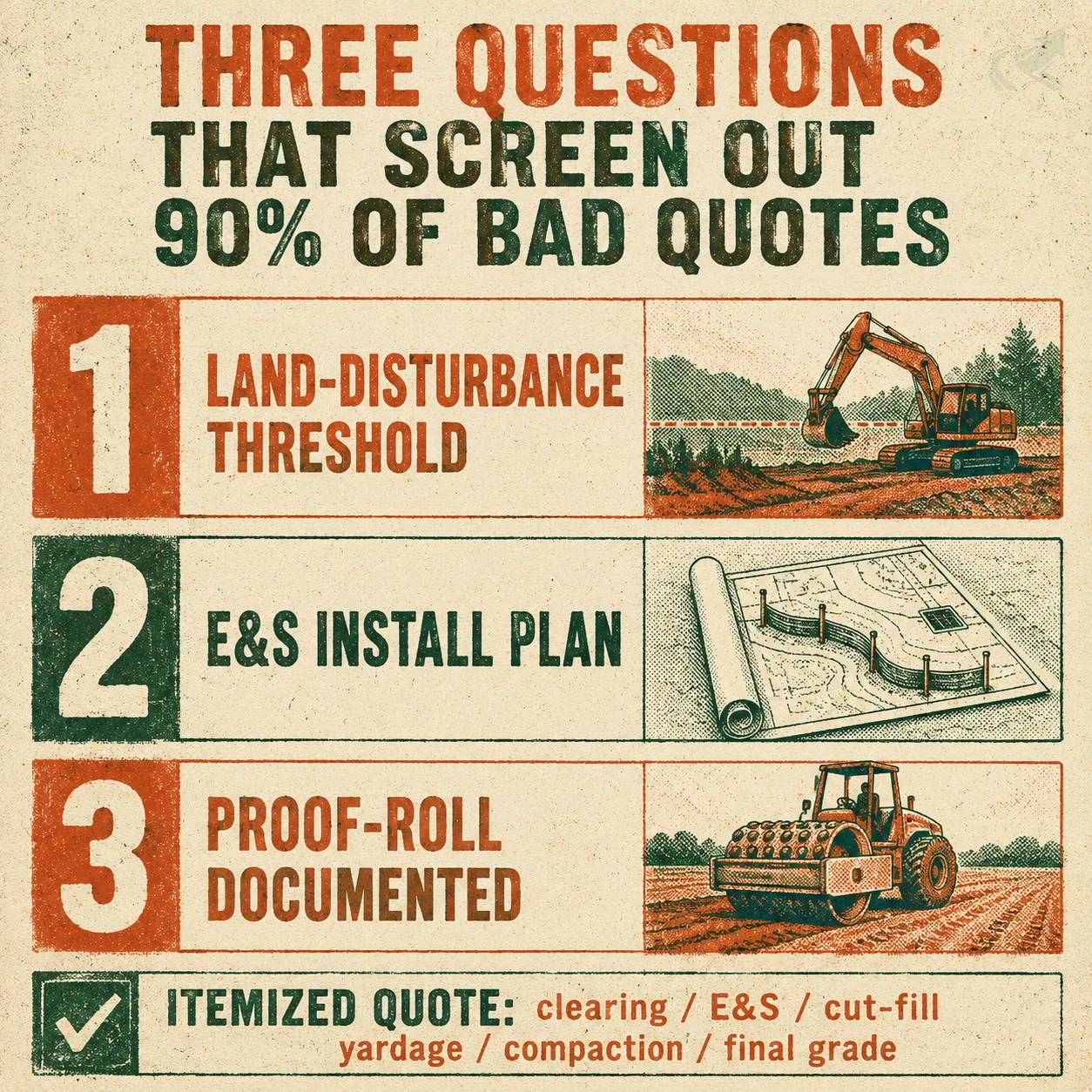
Ask three things. (1) What's the land-disturbance threshold in my county. (2) How will you handle silt fence and the stabilized construction entrance. (3) Will the proof-roll be documented. A legitimate operator answers all three without hesitation.
Grading in NC covers everything from a single new-home pad to an acre of lot prep to a small commercial site. What they share: if you disturb more than a threshold amount of soil, the NC E&S Act applies, and ignoring it is how contractors end up with a stop-work order taped to the silt fence.
This hub maps the site-prep work we do, the NC regulations that apply, and where to start based on what you’re actually trying to build. The regulatory section comes first on purpose — most contractor sites pretend it doesn’t exist, then leave the homeowner holding the enforcement bag.
What “Grading” Actually Means in NC
Five different jobs share the word. Pad grading, lot prep, regrading, driveway grading, and erosion control — different scope, different code, different price.
A homeowner asks for “grading” and means one of five distinct things. A contractor who quotes all five the same way is either inexperienced or rounding up. Here’s the breakdown:
- Pad grading — preparing the building pad under a new home or addition. Cut, fill, compact, proof-roll. Spec’d to engineering, not eyeball. → building pad preparation in NC
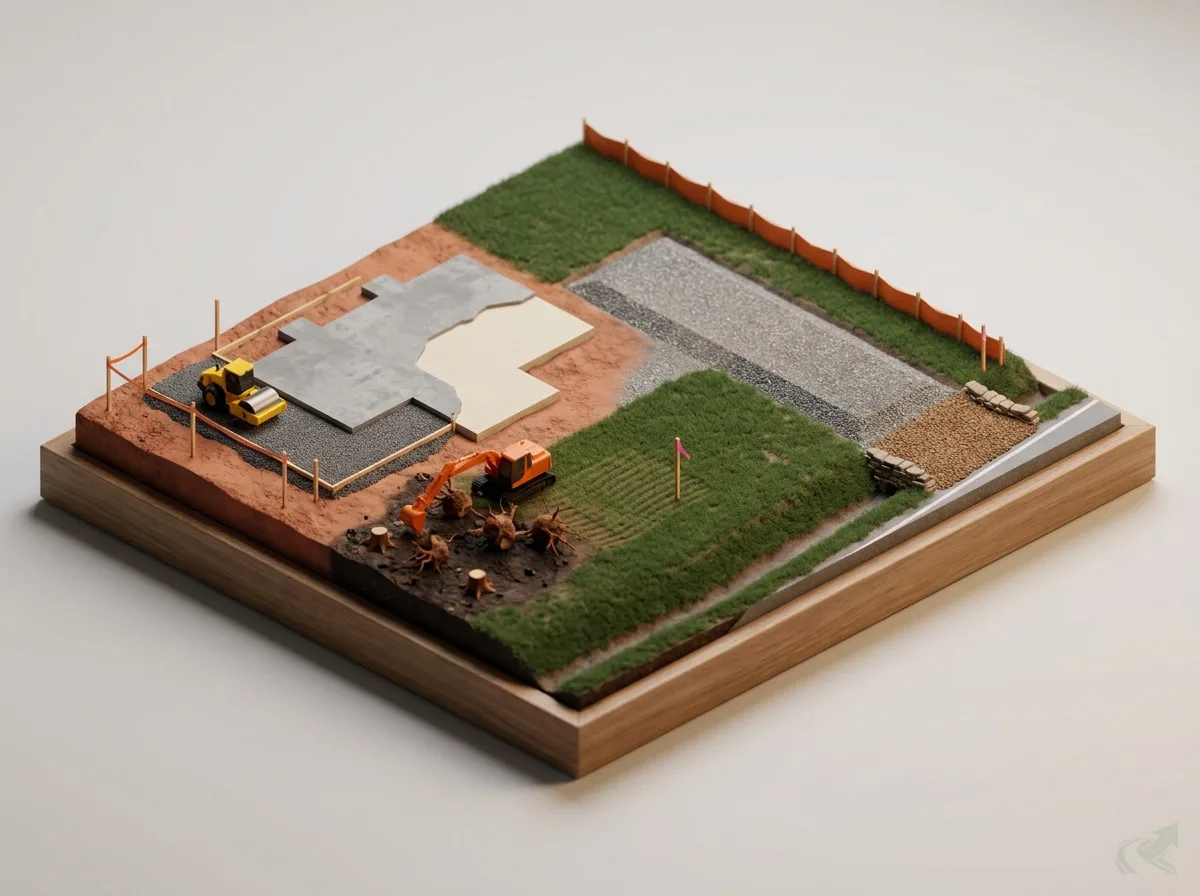
- Lot preparation — clearing, grubbing (pulling stumps and root mass), and rough grading to get raw land ready for construction. Usually paired with E&S install on day one.
- Regrading — fixing existing bad grade. Almost always drainage-driven: water sits, the yard floods, the crawl space smells. The fix is positive slope away from the house. → yard regrading to match addition pad levels
- Driveway grading — shaping the subgrade for ABC gravel or asphalt. Different geometry from a building pad — crown matters, edges matter, daylight matters. → how NC driveway grading works
- Erosion control — required by NC law above the disturbance threshold. Silt fence, check dams, inlet protection, stabilized construction entrance. → what erosion controls NC requires before grading
Pad grading and driveway grading are not the same thing. If a quote treats them as interchangeable, that’s the first signal to slow down.
NC Erosion & Sediment Control — The Rule Most Sites Skip
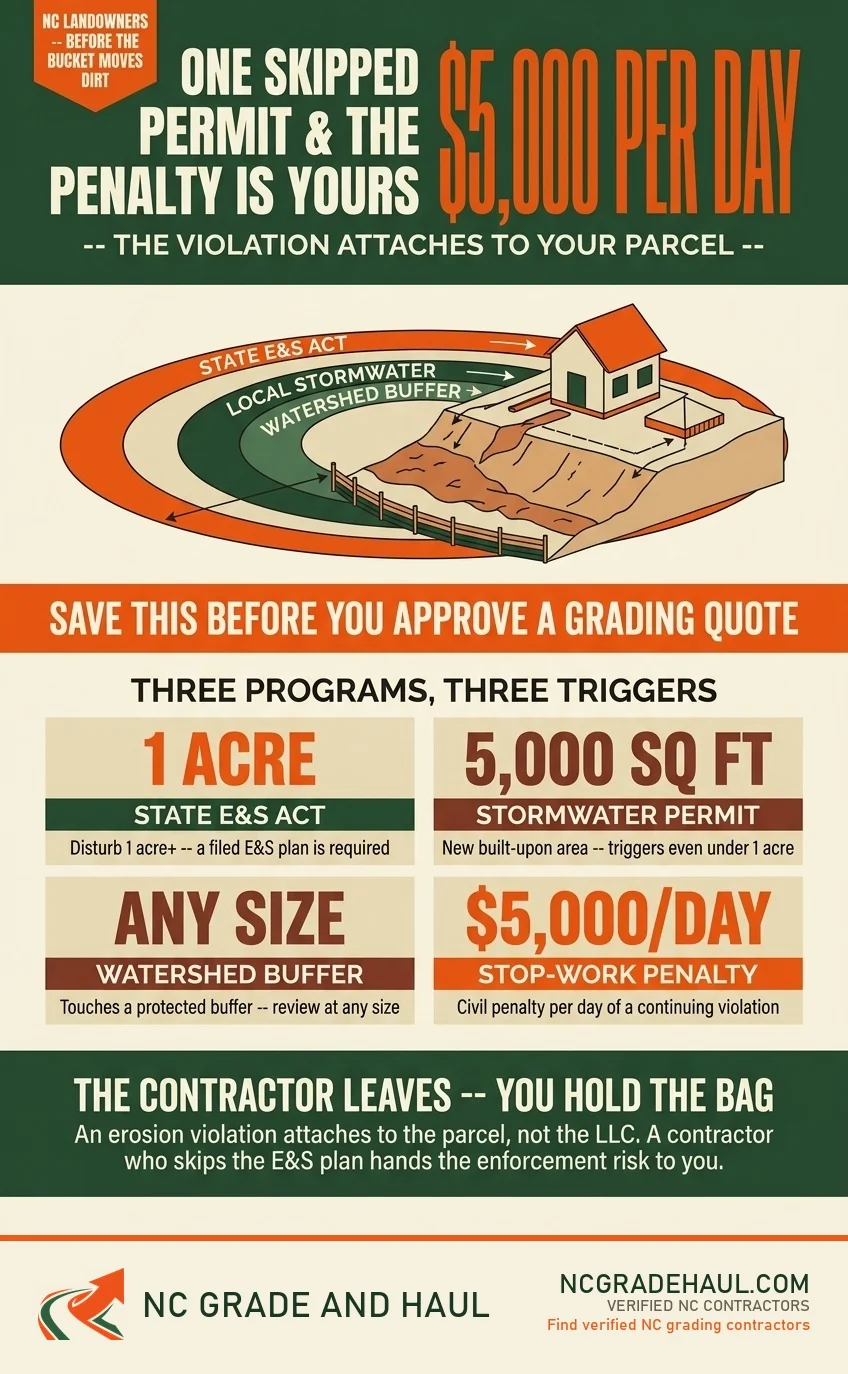
The NC Sedimentation Pollution Control Act requires an approved E&S plan for any land disturbance of 1 acre or more. Many counties trigger sooner. Skipping it exposes you — the property owner — to enforcement.
The state floor is one acre. That’s set by the -administered Sedimentation Pollution Control Act. But “1 acre” is the ceiling for ignoring it, not the floor — most counties set lower local triggers under their own ordinances:
| Factor | State erosion control (E&S Act) | Charlotte / Mecklenburg post-construction stormwater | Watershed overlay buffers (state-wide) |
|---|---|---|---|
| What triggers it | Disturbing 1 acre or more (43,560 sq ft) on a tract | Creating 5,000 sq ft or more of new built-upon area (even on under-1-acre sites) | Any disturbance within a designated water-supply or critical-area watershed buffer (varies by overlay) |
| What's required | Erosion & Sediment Control Plan filed with DEMLR or delegated local authority 30+ days before work starts | Stormwater Management Permit through local stormwater services (SCM design, runoff calcs, post-construction inspection) | Buffer-impact review + density/BUA caps; mitigation or SCMs required for buffer impacts |
| Who enforces | NCDEQ DEMLR regional office or delegated local program | Charlotte-Mecklenburg Stormwater Services (Article 25); county equivalents elsewhere | Local zoning / watershed administrator; state oversight via 15A NCAC 02B .0211 et seq. |
| Stop-work risk if skipped | Stop-work order + civil penalty up to $5,000 per day of continuing violation (G.S. 113A-64) | Stop-work + permit hold + as-built submittal + per-day enforcement | Stop-work + buffer-restoration order + watershed-violation surcharge |
What triggers it
- State erosion control (E&S Act)
- Disturbing 1 acre or more (43,560 sq ft) on a tract
- Charlotte / Mecklenburg post-construction stormwater
- Creating 5,000 sq ft or more of new built-upon area (even on under-1-acre sites)
- Watershed overlay buffers (state-wide)
- Any disturbance within a designated water-supply or critical-area watershed buffer (varies by overlay)
What's required
- State erosion control (E&S Act)
- Erosion & Sediment Control Plan filed with DEMLR or delegated local authority 30+ days before work starts
- Charlotte / Mecklenburg post-construction stormwater
- Stormwater Management Permit through local stormwater services (SCM design, runoff calcs, post-construction inspection)
- Watershed overlay buffers (state-wide)
- Buffer-impact review + density/BUA caps; mitigation or SCMs required for buffer impacts
Who enforces
- State erosion control (E&S Act)
- NCDEQ DEMLR regional office or delegated local program
- Charlotte / Mecklenburg post-construction stormwater
- Charlotte-Mecklenburg Stormwater Services (Article 25); county equivalents elsewhere
- Watershed overlay buffers (state-wide)
- Local zoning / watershed administrator; state oversight via 15A NCAC 02B .0211 et seq.
Stop-work risk if skipped
- State erosion control (E&S Act)
- Stop-work order + civil penalty up to $5,000 per day of continuing violation (G.S. 113A-64)
- Charlotte / Mecklenburg post-construction stormwater
- Stop-work + permit hold + as-built submittal + per-day enforcement
- Watershed overlay buffers (state-wide)
- Stop-work + buffer-restoration order + watershed-violation surcharge
These are three separate programs with three different triggers. A site can be under 1 acre and still need a stormwater permit if it creates 5,000+ sq ft of new built-upon area. A site can be 0.5 acre and still need buffer review if it touches a protected watershed. A contractor who only checks one program is checking a third of the regulatory surface.
Three independent gates
Each program has its own trigger. They do not nest — one job can trip any combination.
State E&S Act
Triggers at 1 acre or more disturbed
Local stormwater permit
Triggers at 5,000+ sq ft of new built-upon area — even on under-1-acre sites
Watershed buffer review
Applies at any project size if your lot touches a protected watershed
A project can trip one, two, or all three at once. A contractor who checks only one is checking a third of the rules.
A proper E&S plan, executed on the ground, includes the predictable kit:
- Silt fence along the downslope perimeter — installed before dirt is moved, not after.
- Stabilized construction entrance — coarse stone pad at the road, so trucks don’t track mud onto the pavement.
- Inlet protection at every nearby storm drain — the catch basin in the road counts.
- Check dams in any ditch carrying concentrated flow.
- Temporary seeding on disturbed soil that won’t be worked within 14 days.
A contractor who skips this isn’t saving you money. They’re handing the enforcement risk to you as the property owner — the violation attaches to the parcel, not the LLC. For the full code walkthrough see NC erosion code and the NC Sedimentation Pollution Control Act reference. Other NC regulations that touch grading work live at NC regulations.
Pad Grading for New Homes — Where Production Builds Fail
The most common new-build drainage failure starts at the pad. Backfill compaction gets rushed, the perimeter drain is under-spec’d or missing, and the grade is set after the sod truck shows up. The drainage problem you’re calling about a year later started here.
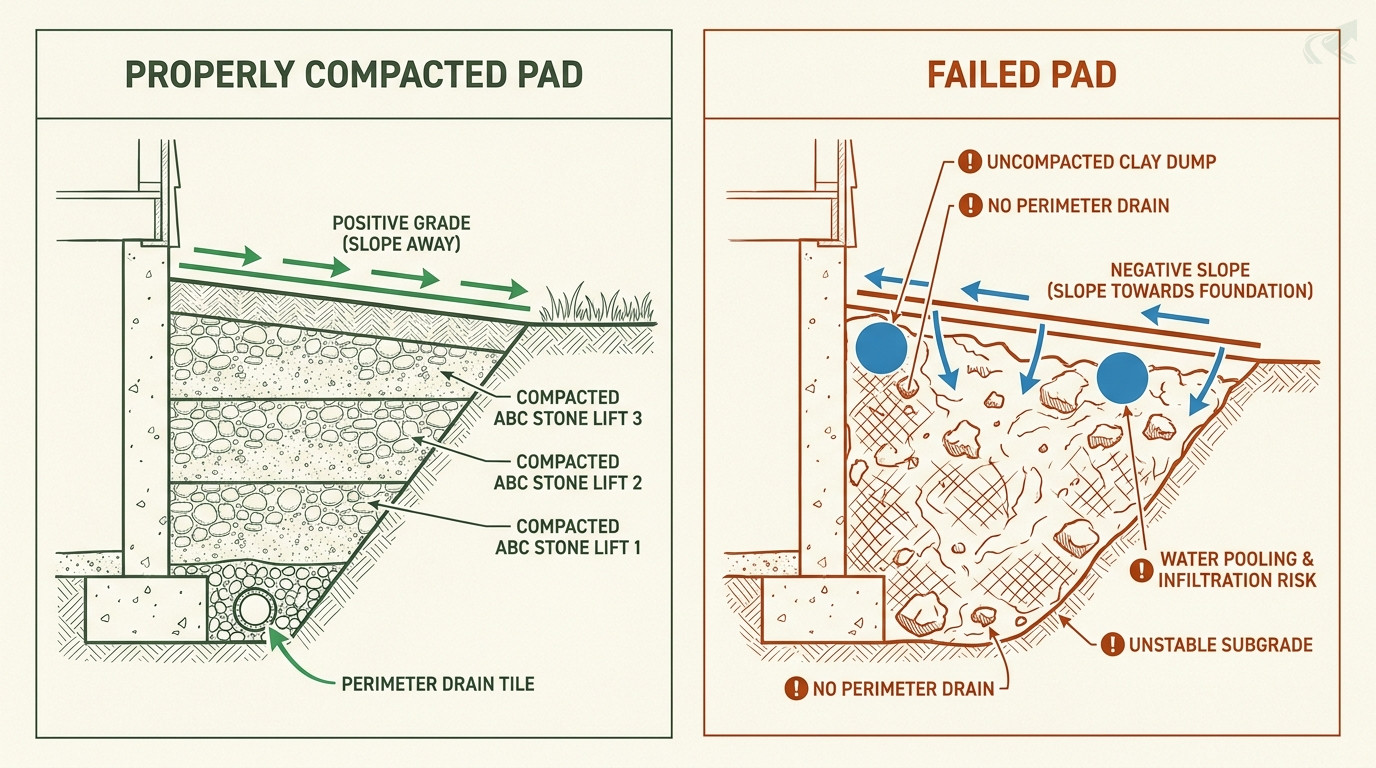
A pad graded right is unglamorous: cut and fill to engineered elevation, compaction in lifts (not one big dump), proof-roll with a loaded truck or roller, and final grade sloped at minimum 6 inches in the first 10 feet away from the foundation per NC Residential Code. The or structural fill is placed in the right thickness for the soil — Piedmont red clay punishes shortcuts here, because clay swells when wet and shrinks when dry, and a poorly compacted lift moves with the seasons.
The production-build failure pattern is consistent across Triangle and Charlotte-metro neighborhoods: backfill against the foundation is the same red clay that came out of the hole, dropped in by trackhoe, barely tamped. Six months later the homeowner has standing water at the garage corner and a musty crawl-space smell.
The grading subcontractor is gone. The warranty contractor is unhelpful. The homeowner pays twice — once in the original price of the house, once to fix what should have been done right.
If this is the call you’re about to make, start at the new-home pad page for the spec, then the foundation drainage playbook for the enforcement levers when the builder won’t respond.
Hiring a Grading Contractor
Three questions screen out 90% of bad quotes. Land-disturbance threshold for the county. E&S install plan. Proof-roll documentation.
A real operator answers all three on the first call. A real operator also gives you an itemized quote — line items for clearing, E&S install, cut/fill yardage, compaction, and final grade — not a single round number. Single-line quotes hide what you’re actually paying for and make change orders inevitable.
Walk through the full hiring checklist, including what an itemized quote should look like and what a Certificate of Insurance must show before any equipment hits your lot, at NC grading contractor services and vetting guide.