
Two questions Wake County homeowners ask
How do I find a verified grading contractor in Raleigh?
NC Grade and Haul verifies contractors against NC Licensing Board records, OSHA inspection history, and workers' comp certificates before listing them. Verified contractors currently serving Wake County are listed here. Get an itemized quote -- not a ballpark, not a lump sum.
Do I need a permit for grading in Raleigh, NC?
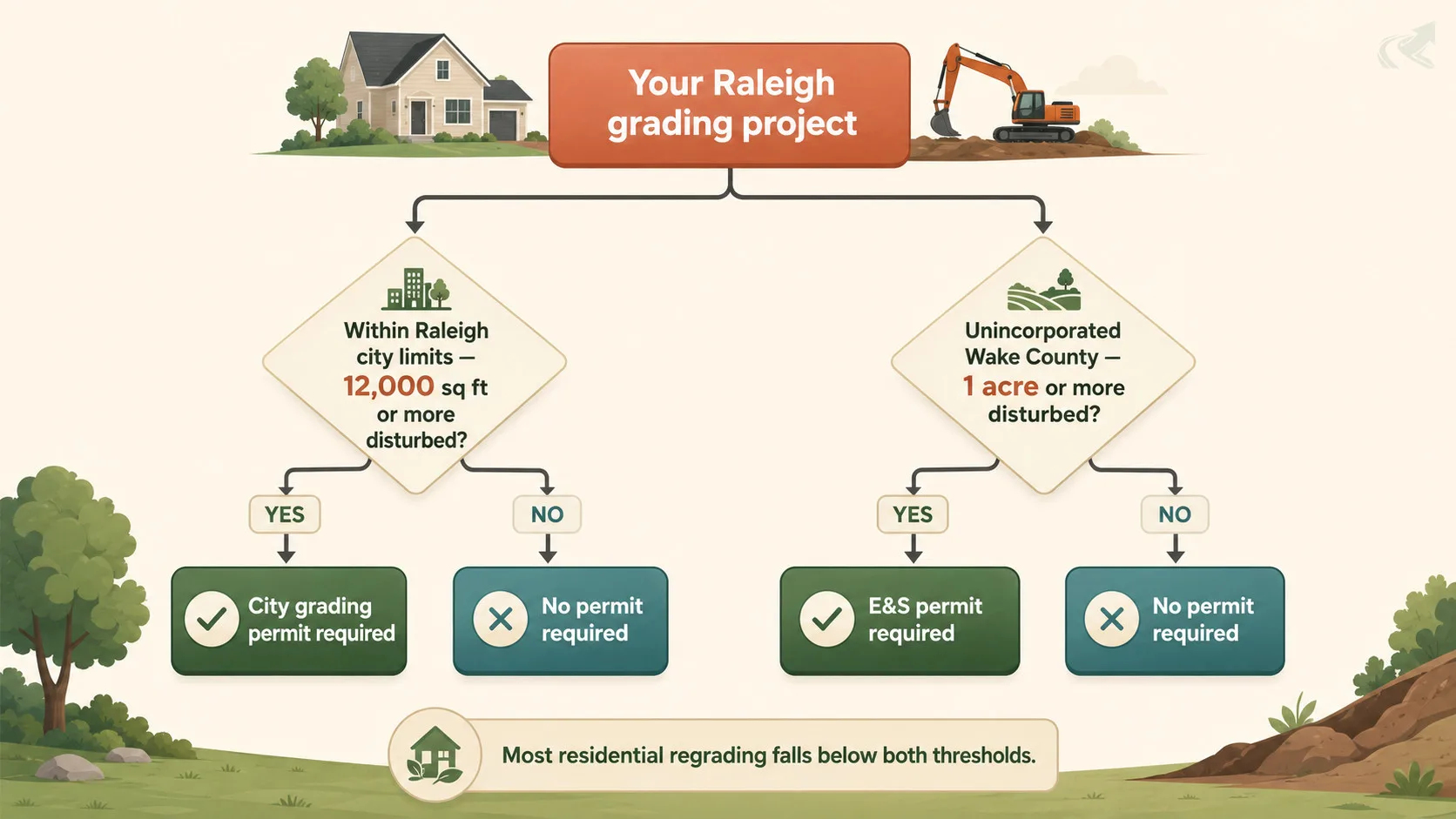
Most residential regrading projects fall below the threshold. In Raleigh city limits, land disturbance of 12,000 sq ft or more triggers a city grading permit. Unincorporated Wake County: 1 acre of disturbance triggers an E&S permit. A contractor who doesn't know these numbers is a warning sign.
Picture a common Holly Springs scenario: you close on a 2022 production build and watch the backyard flood every rain cycle for two years. The original grading sub is long gone — optimizing for build speed on the next lot, not drainage on yours.
This is the Triangle production-builder reality. North Carolina’s residential permit volume has made Wake County one of the fastest-growing construction markets in the state. That growth brought verified operators and unverified ones, in roughly equal measure.
This page tells you how to tell the difference and where to find grading contractors in Raleigh who have cleared the credential checks.
Why the Triangle Production-Builder Market Changes How You Hire
Raleigh’s new-construction boom brought a surge of grading subs — not all of them are verified or licensed in North Carolina.
Wake County consistently ranks among the highest residential building permit volumes in NC. Builders like DR Horton, Ryan Homes, and Lennar typically use their own grading subs on first pass. Those subs are optimizing for build speed across a hundred lots, not drainage performance on your specific parcel.
What that means when you hire independently: you’re operating in a market where unverified subs still get steady work because the builder pipeline covers them. They don’t need your repeat business.
The verification gap to close before you book: ask to see an active license number. Ask for a with your name added as additional insured. Ask for a reference from a residential project in Wake County — not a commercial site, not a subdivision-scale grading job.
Wake County Permit Thresholds: What Your Project Triggers
Most residential grading projects in Raleigh don’t require a land-disturbance permit — but the threshold in Raleigh city limits is specific.
Within Raleigh city limits, 12,000 sq ft or more of land disturbance triggers a city grading permit. In unincorporated Wake County, the threshold is 1 acre for an permit from Wake County Environmental Services.
Subdivision-lot regrading and drainage correction almost always fall below both thresholds. But your contractor should know the numbers and be able to tell you whether your scope crosses them.
A contractor who can’t answer “does my project need a permit?” without guessing is a contractor who hasn’t pulled permits before. That’s a warning sign. See Wake County permit requirements for grading projects for the full regulatory layer.
What Verified Grading Contractors in Raleigh Are Listed Here
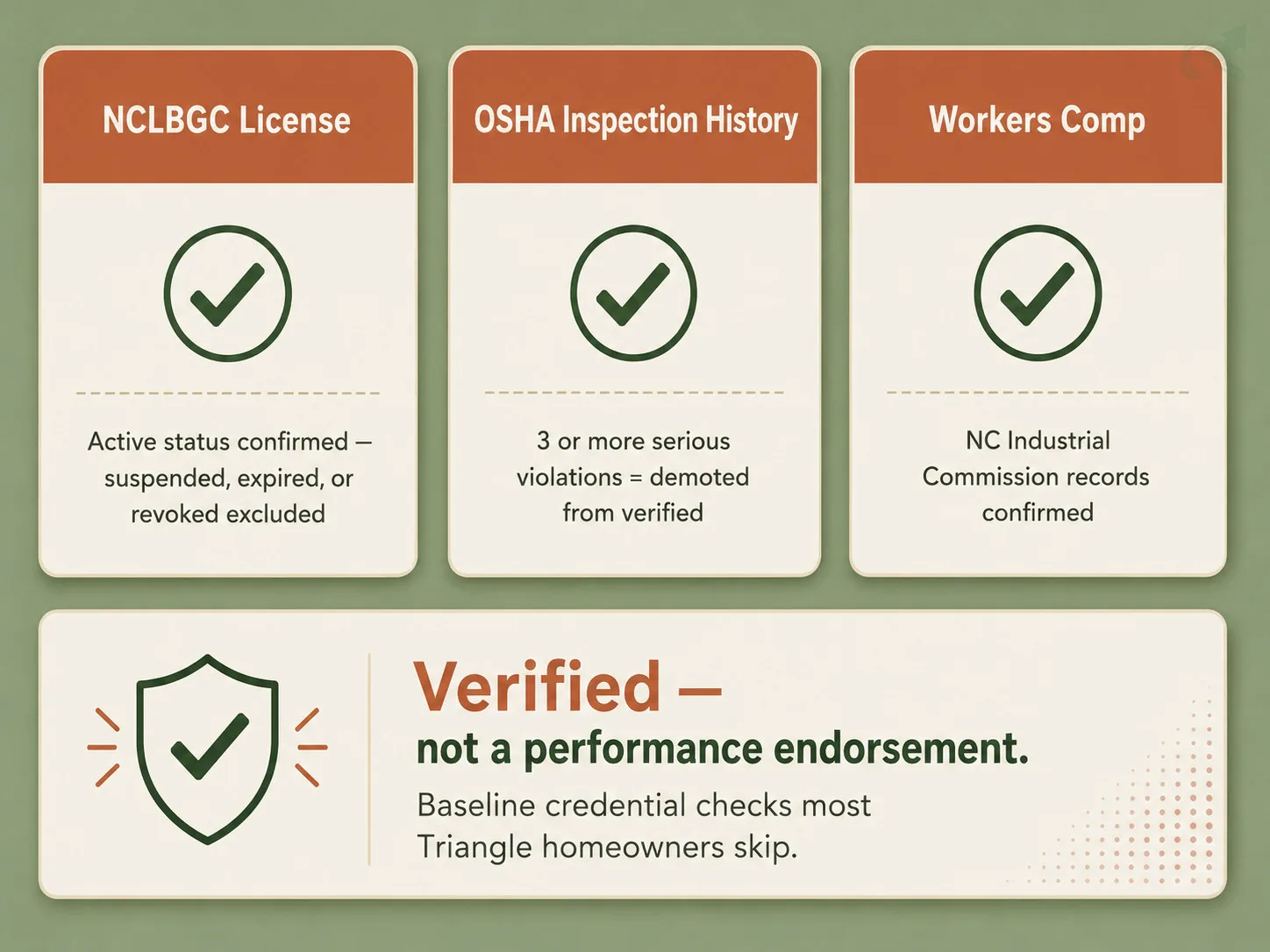
NC Grade and Haul lists grading contractors who cleared three verification checks — NCLBGC license active, OSHA record reviewed, workers’ comp confirmed.
The three-check process:
- License board lookup — NCLBGC license status confirmed active at time of listing. Suspended, expired, or revoked licenses are excluded.
- OSHA inspection history — OSHA federal inspection records reviewed. Contractors with 3 or more serious violations are demoted from verified status.
- Workers’ comp certificate on file — NC Industrial Commission records confirmed or certificate submitted directly.
“Verified” is not a performance endorsement. It means the contractor passed the baseline credential checks that a surprising number of Triangle homeowners skip because they assume builders vetted the sub.
To hire a grading operator in North Carolina serving Raleigh, start with the directory and request an itemized quote — never a round number.
What Services a Raleigh Grading Contractor Actually Handles
Grading covers more than leveling — it includes drainage correction, pad preparation, driveway regrading, and land clearing on most Wake County residential projects.
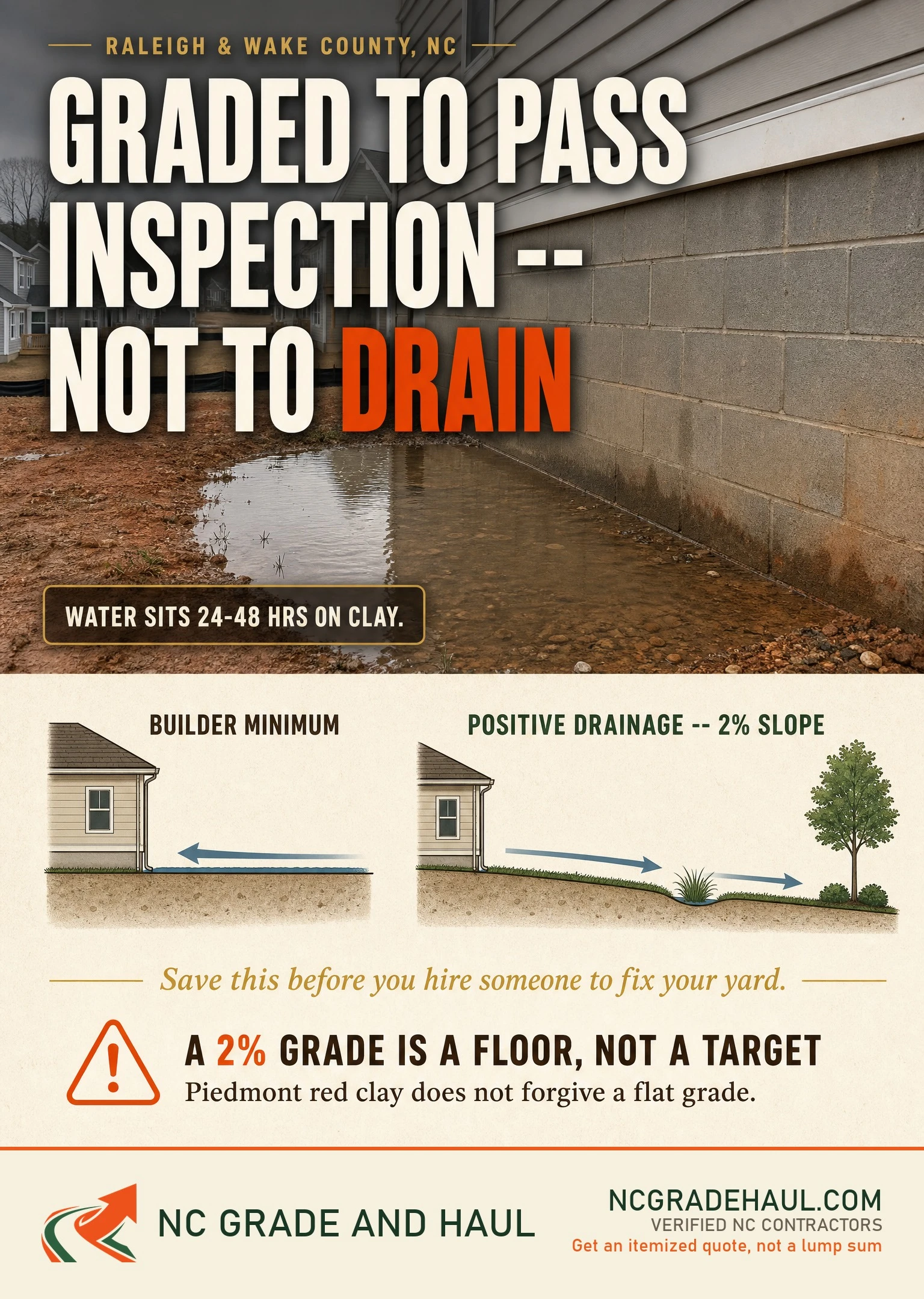
Yard regrading in Wake County: positive drainage vs builder minimum-spec
Comparison. Regraded for positive drainage: Minimum 2% slope falling away from the foundation; A shaped swale carries concentrated flow off the lot; Water has a clear path to the street or storm infrastructure; Foundation stays dry after a 1-inch rain on clay. Production-builder grade left as-is: Flat or negative slope pitched back toward the house; No swale -- runoff has no channel to follow; Standing water pools against the foundation for 24 to 48 hours; Graded to pass inspection, not to drain Piedmont red clay.
- Minimum 2% slope falling away from the foundation
- A shaped swale carries concentrated flow off the lot
- Water has a clear path to the street or storm infrastructure
- Foundation stays dry after a 1-inch rain on clay
- Flat or negative slope pitched back toward the house
- No swale -- runoff has no channel to follow
- Standing water pools against the foundation for 24 to 48 hours
- Graded to pass inspection, not to drain Piedmont red clay
The NC 2% standard is a floor, not a target -- Piedmont red clay does not forgive a flat grade.
- Yard regrading — correcting negative slope toward the foundation. Piedmont red clay doesn’t forgive flat grades. Water that can’t move away from the house will find another way in. Positive drainage at a minimum 2% slope away from the foundation is the standard.
- French drain installation — paired with regrading when clay soil is the root cause of standing water, not just surface grade. Raleigh French drain installation alongside grading services is typically a single-scope project in Wake County.
- Pad preparation — for additions, pools, outbuildings. Compaction matters more here than anywhere else. Ask if the contractor will proof-roll before final grade — that’s the test that catches soft spots before the slab goes down.
- Driveway grading — crown correction, slope repair, gravel base work. Driveway grading in Raleigh NC follows a different scope than drainage correction; get separate line items.
- Land clearing — lot prep for new construction or outbuildings. Scope boundary: if your project involves septic system work, that’s a licensed specialty — not a grading scope.
If the problem is foundation waterproofing rather than surface drainage, that’s a different trade. Raleigh yard drainage services from the same contractor may be the right starting point if you’re not sure which issue is driving the flooding.
What to Ask Before You Book
Three questions separate verified operators from whoever shows up with a bobcat.
- “Can you provide an itemized quote with unit costs per task?” — If the answer is a single lump-sum number with no breakdown, walk away. You can’t evaluate whether the scope is right if you can’t see the pieces.
- “Is your NCLBGC license current — what’s the number?” — Look it up at the NC Licensing Board site before the crew arrives. Takes 90 seconds.
- “What’s your outlet plan for water from this site?” — If they can’t answer without saying “depends what we find,” ask them to explain their clay-soil experience specifically. Positive drainage isn’t optional in Piedmont red clay.
Bonus: ask whether your project requires pulling permits. A contractor working in Raleigh who doesn’t know the 12,000 sq ft city threshold is working on guesswork.
Common Mistakes
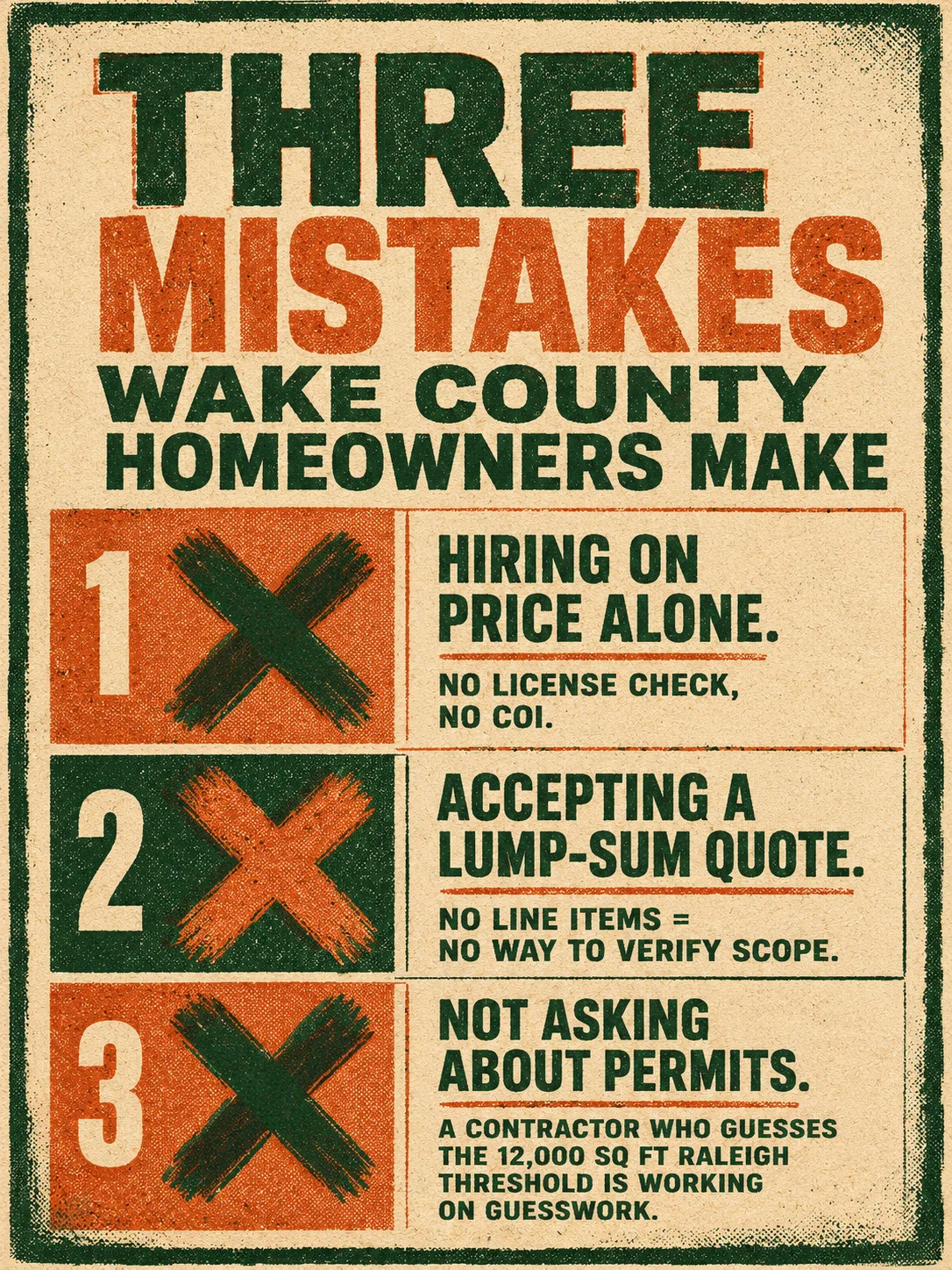
Hiring on price alone. The lowest quote in the Triangle market often reflects missing credential checks, not efficiency. A contractor without active NCLBGC licensure and workers’ comp coverage leaves you holding the liability if something goes wrong on-site.
Skipping the itemized quote requirement. A lump-sum quote with no unit breakdown means you can’t verify whether the scope matches your project. Compaction, proof-roll, final grade, drainage outlet — each is a separate line item from a verified operator.
Not asking about permit thresholds. A contractor who doesn’t know the Raleigh 12,000 sq ft trigger — or the unincorporated Wake 1-acre threshold — is working on guesswork. That guesswork can cost you a stop-work order mid-project.
Before You Book: Copy These Questions
Ask every Raleigh grading contractor before signing
- Can I see your NCLBGC license number?
- Will you provide an itemized quote with unit costs per task?
- Where does the water outlet after grading — and what’s your plan for Piedmont clay?
The Triangle-area grading and drainage project gallery shows scope examples — useful for calibrating whether the quote matches the job.
A Wake County grading contractor serving all of Wake is the county-aggregator page if you’re outside Raleigh city limits.
From our directory
Verified contractors near you
Every listing is cross-checked against the NC Licensing Board public record before it appears. Pick your city:
Or browse the full NC contractor directory.