
If your driveway has potholes, bumps, or spots where water pools after rain, you’re describing symptoms. The causes are more specific — and usually it’s one of four things.
This page teaches the four cause words so you can read a driveway quote intelligently instead of nodding when a contractor says “we’ll regrade it.” There are real fixes for each of these, and they cost different money. Knowing which one applies to your driveway is the difference between a real repair and another year of patching.
The Four Causes
Crown loss, compaction failure, wrong gravel spec, or washout from bad drainage. Most NC driveways fail for one of these. Some fail for two at once.
1. Crown Loss
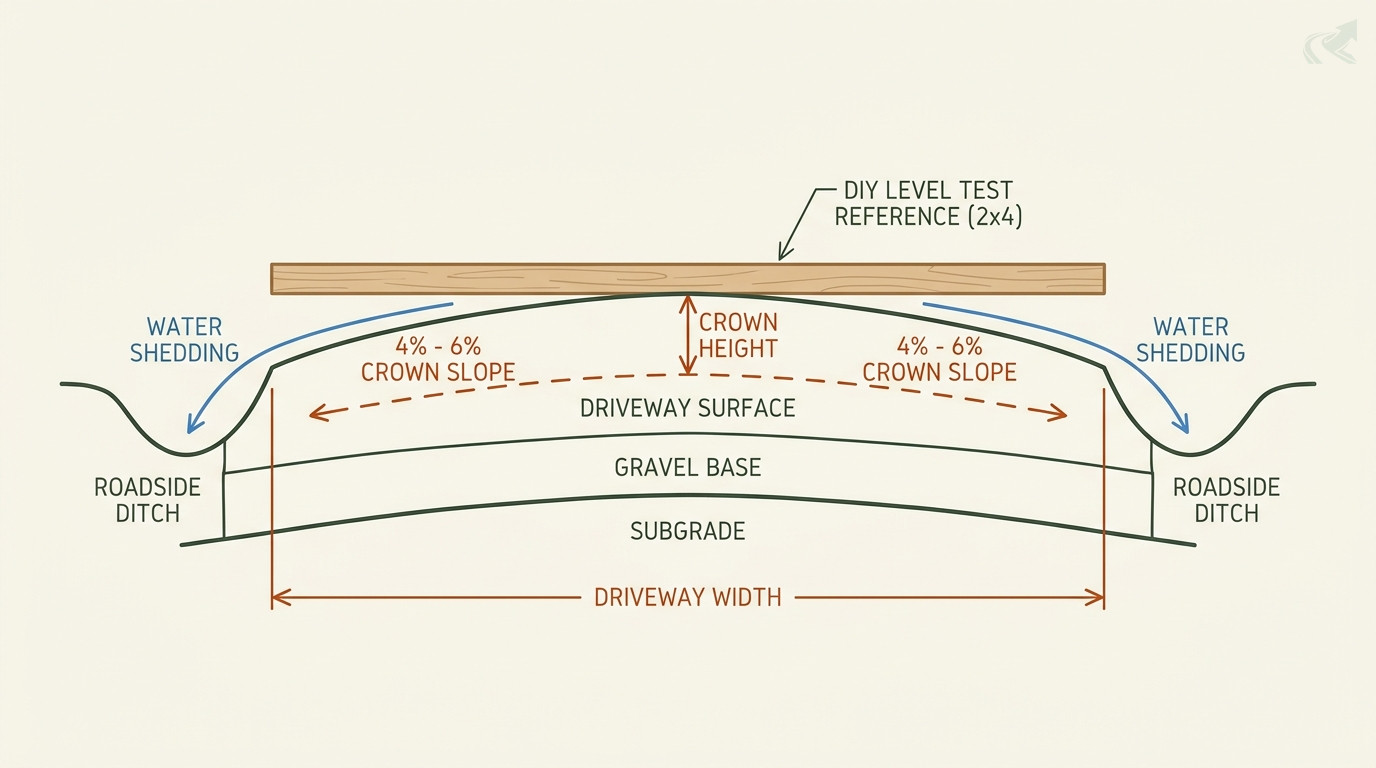
The middle of a gravel driveway should sit slightly higher than the edges. That high center — the crown — sheds water to both sides so it never sits on the surface. Over time, especially under tire tracks, the crown flattens. Water now pools, soaks the base, and accelerates every other failure mode.
How to tell: lay a straight 8-foot 2×4 across the driveway in three or four spots. If the middle is not visibly higher than the edges, you’ve lost crown.
Fix: regrade with proper crown — for gravel driveways, 4% to 6% cross-slope from centerline is the standard target (about 1 inch of rise per 2 feet of half-width at 4%). The 2% figure you’ll sometimes see is paved-road geometry; gravel sheds water less efficiently and needs more slope. Done correctly, a regrade lasts years. Done with no crown spec written into the quote, it lasts one rainy season.
More on this at driveway crown restoration and maintenance.
2. Compaction Failure
The subgrade — the native soil under the driveway — and the base course above it both have to be compacted properly during construction. When they aren’t, traffic loads displace material unevenly. The result is bumps, soft spots, and gravel that won’t stay put no matter how often it’s raked.
How to tell: walk the driveway after a hard rain. If sections feel spongy underfoot, or water sits in your tire tracks instead of draining, the base failed. Proof-roll testing — running a loaded truck across and watching for deflection — confirms it.
A driveway base compacted in lifts vs one laid loose
Comparison. Compacted base: Subgrade compacted before any stone goes down; ABC base built in lifts to the NCDOT density spec; Dense stone matrix sheds water instead of holding it; Wearing surface stays locked under tire traffic. Loose base: Subgrade never compacted -- displaces under load; Fluffy ABC base full of voids that absorb water; Wearing surface sags into the soft base; Depressions and tire-track ruts pool water.
- Subgrade compacted before any stone goes down
- ABC base built in lifts to the NCDOT density spec
- Dense stone matrix sheds water instead of holding it
- Wearing surface stays locked under tire traffic
- Subgrade never compacted -- displaces under load
- Fluffy ABC base full of voids that absorb water
- Wearing surface sags into the soft base
- Depressions and tire-track ruts pool water
Gravel is the surface, not the problem -- adding stone over an uncompacted base buys 12 to 24 months before the ruts come back.
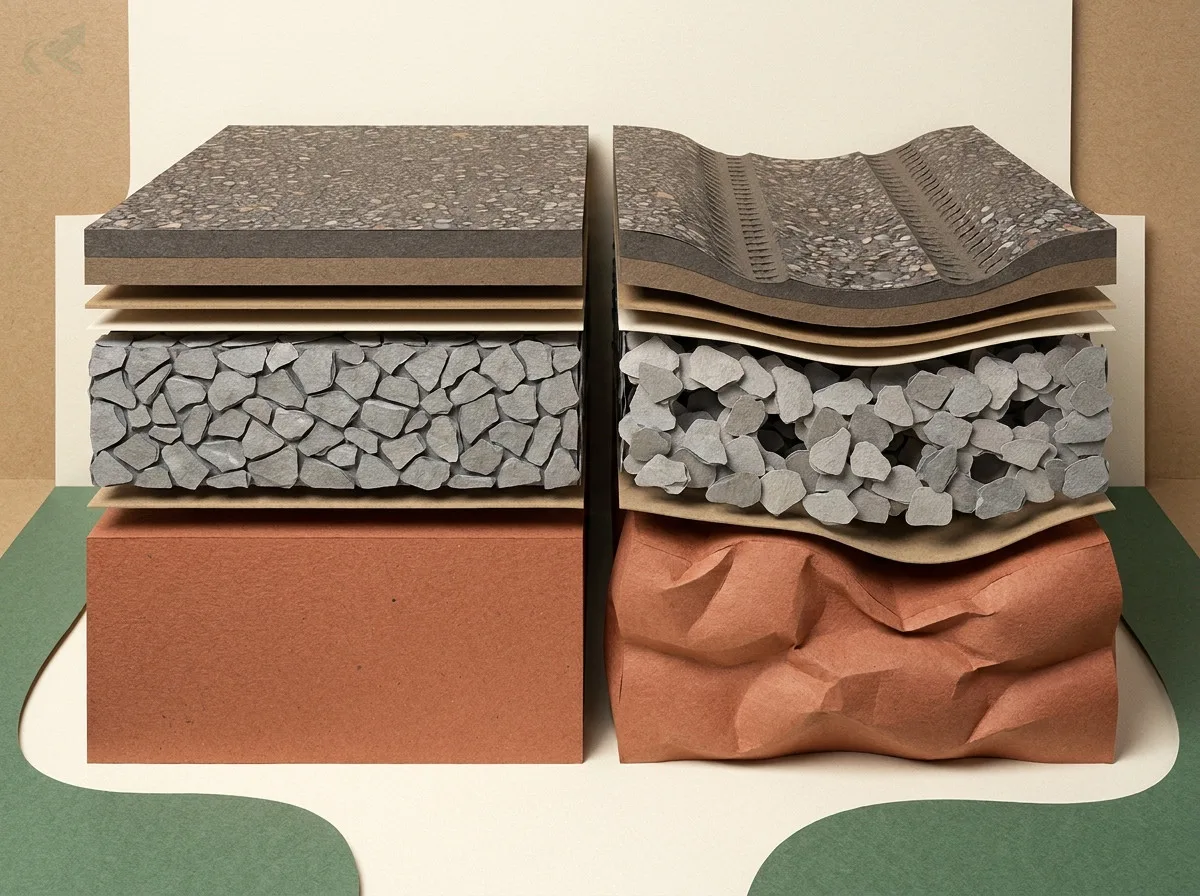
Fix: strip the surface gravel, re-compact the base to proof-roll standard, then re-lay the wearing surface. General-earthwork shorthand for the target is “95% Standard Proctor,” but NCDOT’s actual aggregate base course acceptance (Section 520) ties to AASHTO T 180 modified and uses nuclear-density testing — your engineered spec should follow the NCDOT section, not the shorthand. This is a real repair, not a refresh. Walk through what proof-roll means and what it costs at proof-rolling and compaction for building pads.
3. Wrong Gravel Spec
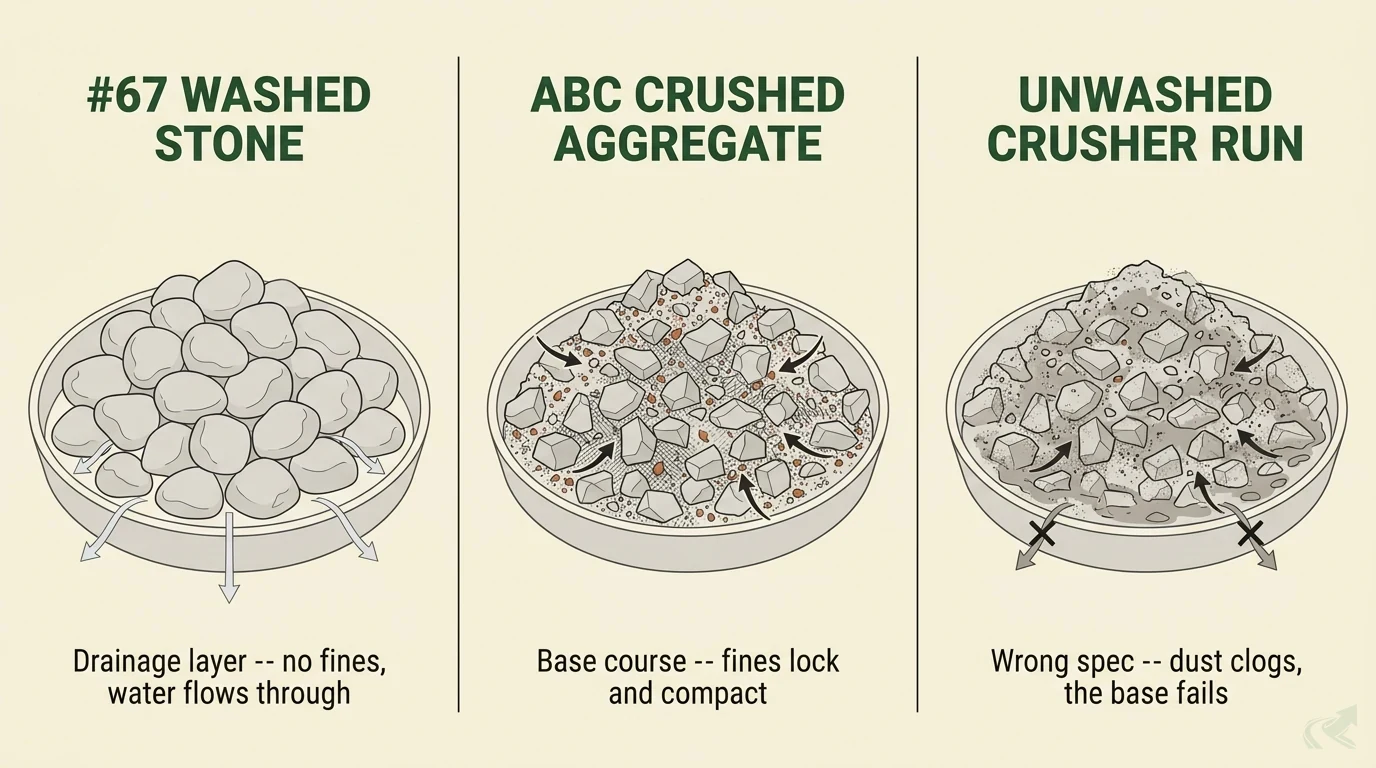
The gravel on your driveway might be the wrong material for the job. Common mistakes: pure #57 washed stone laid as a surface (migrates under wheels because the fines that lock it in place aren’t there), pure sand, screenings only over uncompacted clay, or unwashed crusher run sold as .
Correct for most NC residential driveways: ABC base course (NCDOT Section 520/1010) compacted in lifts, with a wearing surface of NCDOT #67 gradation stone or a CABC (crusher-run aggregate base course — field shorthand; specify the NCDOT gradation in the contract) on top.
How to tell: if gravel migrates to the low side or off the edges no matter how much new stone you bring in, the spec is wrong. The material is doing what its physics tells it to do.
Fix: pull the surface gravel, lay a proper ABC base, top with the correct surface stone. Full spec glossary at ABC, #57, #67, CABC material specs and gravel selection at driveway gravel types and installation.
4. Washout from Bad Drainage
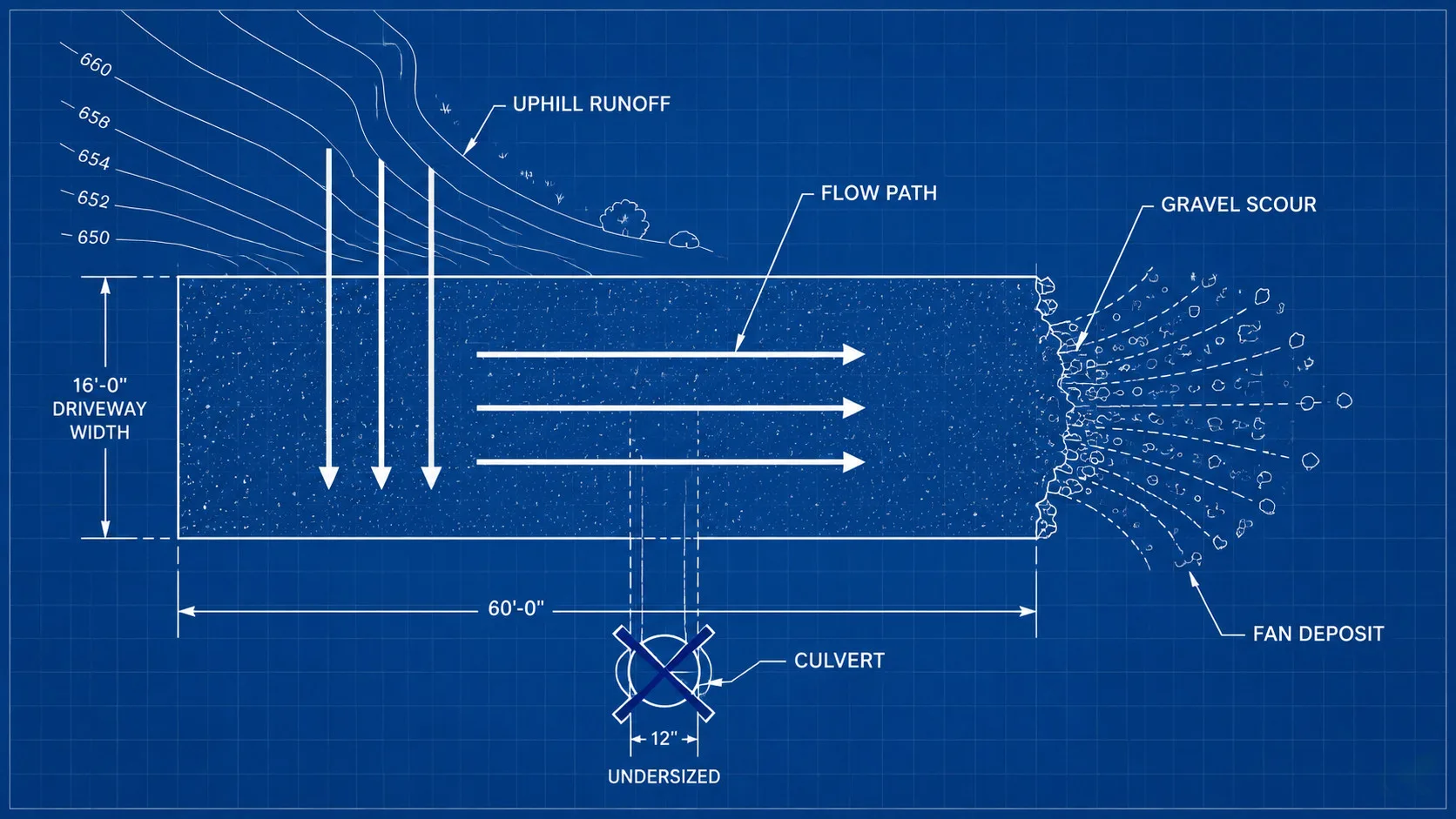
Water running across the driveway from the yard, from the street above, or from a culvert that’s undersized or collapsed will cut channels straight through your gravel. Once a channel forms, every storm makes it deeper.
How to tell: after storms, look for cut channels running perpendicular or parallel to the driveway. Look for fan-shaped gravel deposits where the water exits. Look at the culvert — if it’s crushed, silted, or undersized for the upstream watershed, you have a washout problem, not a driveway problem.
Fix: the drainage gets fixed first — culvert resize, swale redirection, or yard regrading to keep water off the driveway in the first place. Then the driveway gets repaired. Doing it the other way around wastes money. See driveway washout repair in NC and driveway culverts and NCDOT permits.
How the Four Causes Compare
Same four causes show up across NC. The diagnostic test, the typical fix scope, and the price band are different for each.
| Factor | Crown loss | Compaction failure | Wrong gravel spec | Washout |
|---|---|---|---|---|
| What you see | Water pools in middle | Spongy spots, tire-track ruts | Gravel migrates to edges | Cut channels after storms |
| DIY test | 2×4 across driveway | Walk it after rain | Track gravel migration | Inspect after a storm |
| Root cause | Lost 4-6% crown from center | Base never compacted to spec | Material is wrong for the load | Water source upstream of drive |
| Fix scope | Regrade with crown spec | Strip, re-compact, re-lay | Strip, new base + surface | Drainage first, then driveway |
| Surface gravel alone fixes it? | No | No | No | No |
| Price band (typical residential) | $$ | $$$ | $$$ | $$$$ |
What you see
- Crown loss
- Water pools in middle
- Compaction failure
- Spongy spots, tire-track ruts
- Wrong gravel spec
- Gravel migrates to edges
- Washout
- Cut channels after storms
DIY test
- Crown loss
- 2×4 across driveway
- Compaction failure
- Walk it after rain
- Wrong gravel spec
- Track gravel migration
- Washout
- Inspect after a storm
Root cause
- Crown loss
- Lost 4-6% crown from center
- Compaction failure
- Base never compacted to spec
- Wrong gravel spec
- Material is wrong for the load
- Washout
- Water source upstream of drive
Fix scope
- Crown loss
- Regrade with crown spec
- Compaction failure
- Strip, re-compact, re-lay
- Wrong gravel spec
- Strip, new base + surface
- Washout
- Drainage first, then driveway
Surface gravel alone fixes it?
- Crown loss
- No
- Compaction failure
- No
- Wrong gravel spec
- No
- Washout
- No
Price band (typical residential)
- Crown loss
- $$
- Compaction failure
- $$$
- Wrong gravel spec
- $$$
- Washout
- $$$$
The “surface gravel alone fixes it” row is the load-bearing line on this page. Contractors who quote a few loads of gravel as the answer to any of these are quoting a patch — and patches on a failed driveway don’t survive a wet NC winter.
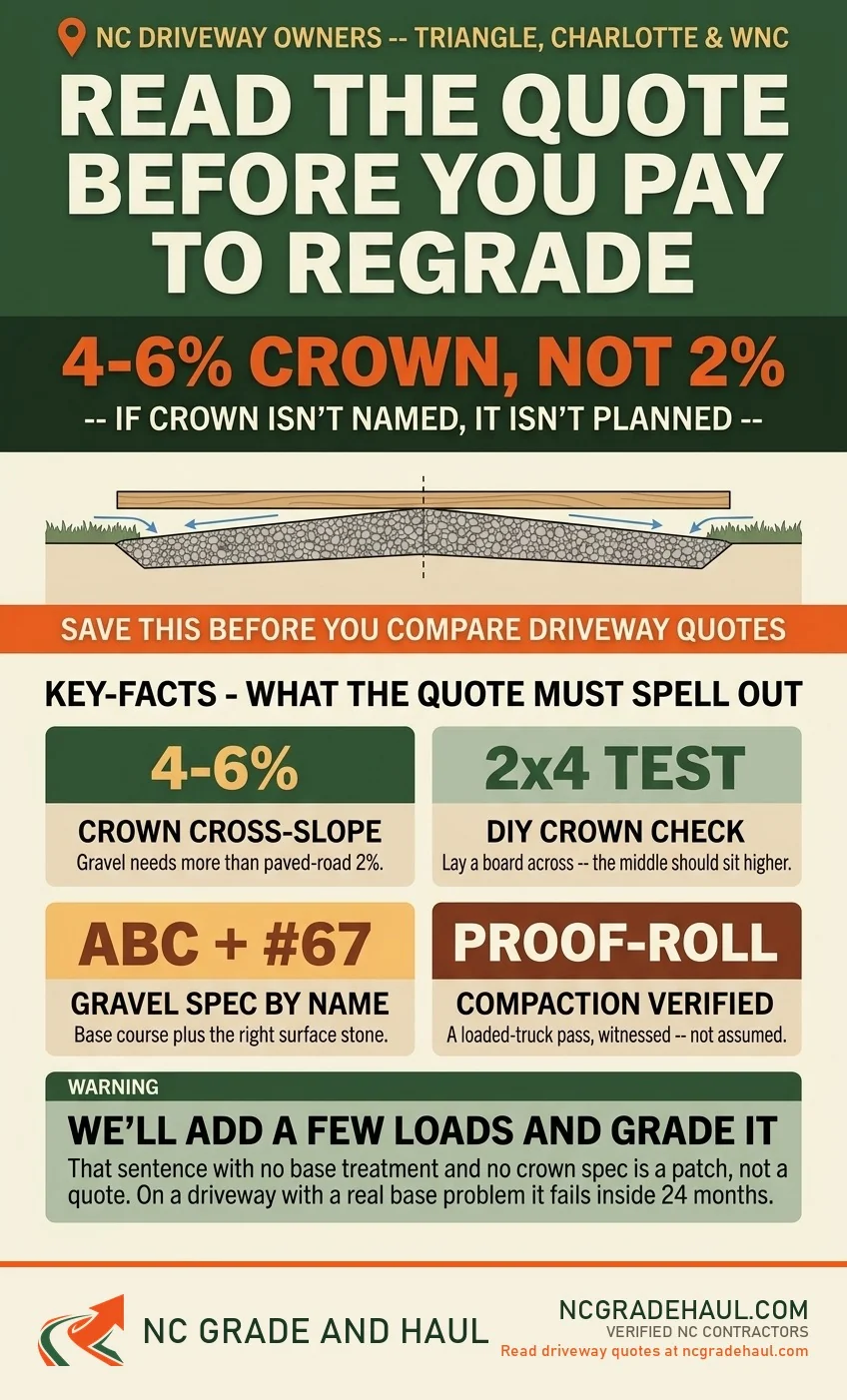
Evaluating a Driveway Quote
A legitimate driveway quote names the cause, the base treatment, the gravel spec by tonnage, the crown specification, and any drainage work. If the quote is one line that says “regrade and gravel,” it isn’t a quote yet.
Here’s what should appear on the page:
- Cause diagnosis. The contractor should name which of the four causes applies. “Your crown has flattened in the middle 30 feet and there’s a washout cutting in from the upslope side” is a diagnosis. “It needs work” is not.
- Base treatment plan. Re-compact the existing base? Add 4 inches of new ABC? Full excavation to subgrade and rebuild? Different scope, different price.
- Gravel spec by tonnage and type. “12 tons of ABC for base, 6 tons of CABC for the wearing surface” beats “20 yards of gravel” — different materials and the conversion to tons depends on which.
- Crown specification. 4-6% cross-slope from centerline is the gravel-driveway standard (2% is paved-road geometry — too flat for gravel). If crown isn’t named, assume it isn’t planned.
- Drainage adjustments. If washout is part of the problem, the quote should include culvert work, swale grading, or yard drainage — not just driveway repair.
- Proof-roll or compaction verification. For base work, how is the contractor confirming the compaction is real? A loaded truck pass with a witness, a density test, or photos of the rolling operation.
Red flags. Any of these means you don’t have a real quote yet:
- “We’ll add a few loads of gravel and grade it” with no base treatment — this fails inside 24 months on a driveway that actually has a base problem.
- No mention of crown.
- Gravel type unspecified, or “gravel” used as a single word.
- Cash only, no written scope of work, no quantity-by-spec breakdown.
More on what to demand at red flags in NC contractor quotes and itemized quote vs lump-sum bid.
NC-Specific Considerations
Soil, terrain, and climate change what fails first. Piedmont red clay, post-Helene WNC, and rural Guilford long-driveways are three different problems.
Piedmont Red Clay Subgrade
Most Triangle and Charlotte driveways sit on Piedmont red clay. Clay swells when wet and shrinks when dry — the subgrade is moving with the seasons. A driveway built on uncompacted clay with thin base course will telegraph that movement to the surface within a year. The fix is depth: enough ABC base, properly compacted in lifts, that the seasonal clay movement gets absorbed below the wearing surface.
A 2-inch gravel layer over uncompacted clay is not a driveway. It’s a thin coat of stone the clay will eat.
WNC Driveways After Helene
Helene destroyed driveways across Buncombe, Henderson, and Rutherford counties — washouts, culvert blowouts, mountain-grade slope failures. WNC driveway repair is its own discipline because the failure modes layer (washout + slope erosion + culvert undersize all at once) and access for heavy equipment is often the limiting factor. The mountain-grading playbook lives at Helene WNC washout repair.
Rural Guilford and Wake — Long Driveways
When the driveway is 400 feet of compacted gravel running from the road to the house, every problem scales. Crown loss happens unevenly across the length. Culverts get added at every low point. NCDOT permitting kicks in where the drive meets the state road. Length is the variable that changes what a quote should look like — get tonnage broken out by 100-foot section, not as one bulk number.
Permits and NCDOT
If your driveway connects to a state-maintained road, the NCDOT driveway permit applies. If it connects to a county or city road, local rules apply instead.
Three pieces to know:
- NCDOT driveway permits. Under NC driveway-access rules, residential driveway connections are “normally excluded” from the formal permit requirement — but NCDOT can still require a permit when the connection raises safety, grade, drainage, or culvert-sizing concerns, when a highway project is active in the area, or when local ordinances are stricter. For most plain residential reconnects you won’t trigger a permit; for new connections involving a ditch crossing, sight-distance issue, or culvert installation, the local NCDOT district office is the call to make before the dirt moves. The contractor should know which side of that line your project falls on.
- Culvert sizing. Driveway culverts have to handle the upstream watershed without backing water onto the road or your property. Undersized culverts are the leading cause of long-driveway washouts in NC. Sizing is a calculation, not a guess.
- Drainage easements. Some NC counties (and most subdivisions) restrict what you can do where stormwater easements cross your lot. Re-routing drainage as part of driveway work can run into rules the contractor needs to read before they dig.
Full breakdown at NCDOT driveway permit.
DIY vs Contractor
DIY scope: surface gravel refresh, raking, cosmetic pothole fill. Contractor scope: anything that touches base, crown, or drainage.
If your driveway has minor surface migration and the base is still sound, a few tons of the correct surface stone plus a rake is real DIY work. Buy washed #67 or CABC, not whatever is cheapest at the bulk yard. Don’t dump it as a single pile — spread it in 2-inch lifts and drive over it to seat the stone.
If the base is failing, if the crown is gone, or if a storm cut a channel through the surface, you need a contractor with a compactor, a grader, and the equipment to move base material. The DIY version of those repairs collapses within months because the homeowner can’t reach proof-roll compaction with a hand tamper. That’s not a skill gap — it’s a physics gap. Hire the work at driveway-specific grading contractor.