A homeowner in Wake County hires a grading crew. Work starts Monday. By Wednesday a county inspector is on site with a stop-work order.
The project halts three weeks while the contractor files an plan that should have been filed first. The contractor knew. The subcontractor knew. The homeowner — paying for all of it — was the last to find out.
That happens because NC grading permits are county-administered, not state-administered. No single portal. No standardized acreage trigger. No universal terminology. Four counties, four separate systems.
Below is the matrix. After that, each county gets a quick-read card with its threshold, portal, and the local gotcha.
How NC Permitting Layers Work
State permit triggers at 1 acre of land disturbance. County permits trigger much sooner — and apply to most residential projects.
State layer. administers the statewide permit under NC General Statute Chapter 113A. The trigger: 1 acre of land disturbance. Below 1 acre, no state permit — but the county layer usually applies.
County layer. Each county sets its own lower land-disturbance threshold. Some trigger at a specific square footage. Some at any grading near a stream buffer. Some at any alteration of positive drainage. A project that’s clear in one county can need a full E&S review in the next one over.
The terminology problem. Wake calls it a Land-Disturbance Permit. Mecklenburg calls it a Grading Permit. Durham uses Grading/E&S Plan. Guilford uses the same name as Wake — different agency, different thresholds. Same category of approval; different paperwork.

Two-layer NC grading permit decision tree — state DEMLR triggers at 1 acre; counties set lower thresholds independently. Both layers can apply to the same project.
For broader context see the NC Regulations hub and the stormwater ordinances reference.
Wake vs. Mecklenburg vs. Durham vs. Guilford — Side-by-Side
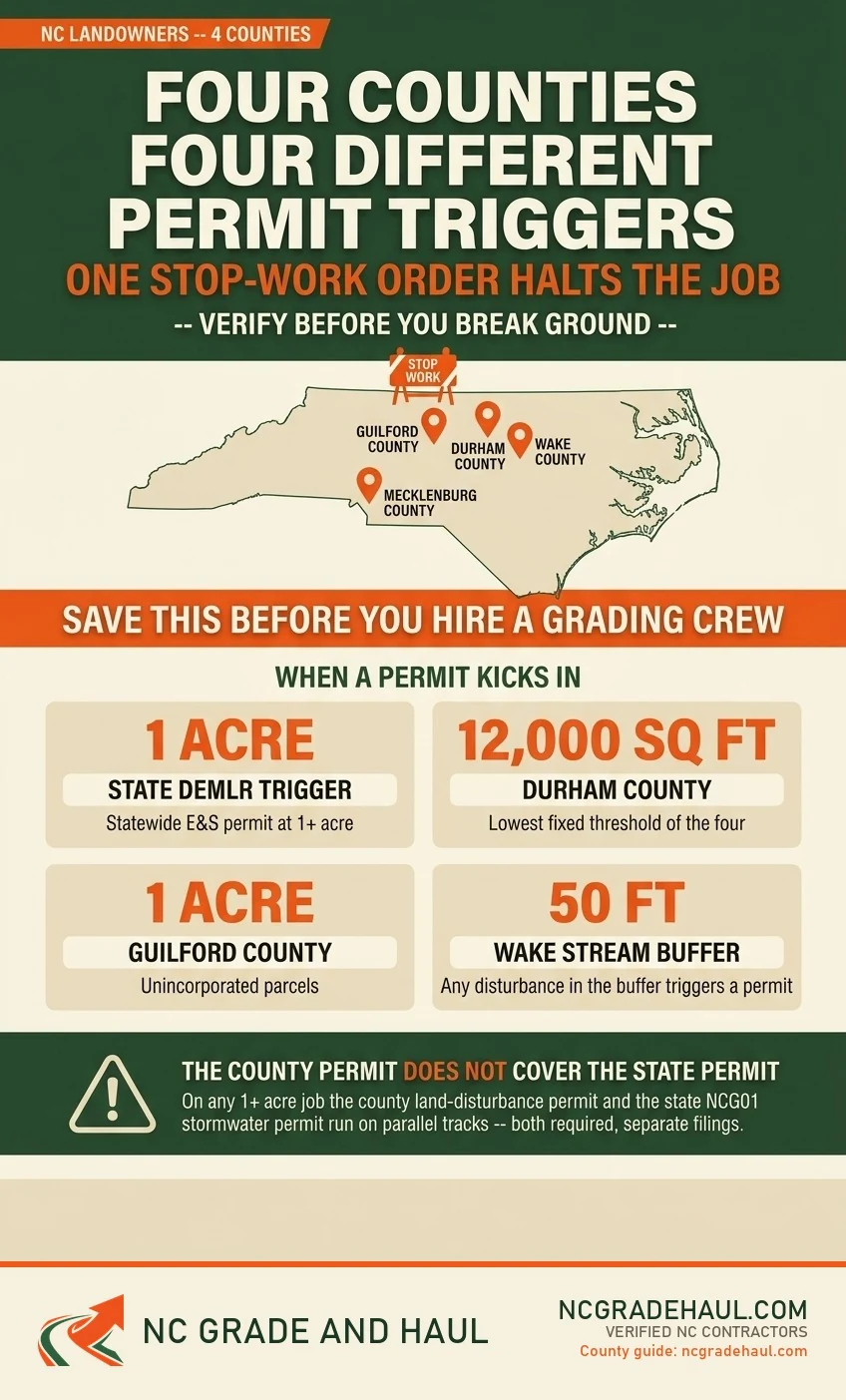
Four counties. Four different thresholds. Wake (unincorporated): any lot in a subdivision, or 1+ acre outside one; Raleigh city limits: 12,000 sq ft. Durham: 12,000 sq ft (UDO § 12.10.2). Guilford: 1 acre. Mecklenburg: verify at LUESA — threshold not publicly indexed in county ordinance text.
| Factor | Wake County | Mecklenburg County | Durham County | Guilford County |
|---|---|---|---|---|
| Agency | Wake Environmental Services — Stormwater & E&S | Mecklenburg LUESA | Durham City-County Planning Dept. | Guilford Planning & Development |
| Permit name | Land-Disturbance Permit | Grading Permit | Grading/E&S Plan | Land-Disturbance Permit |
| Residential trigger | Subdivision lot: any area; outside subdivision: 1+ acre; Raleigh city: 12,000 sq ft; stream buffer: any disturbance | Verify at LUESA — threshold not publicly indexed in county ordinance text | 12,000 sq ft (UDO § 12.10.2); full E&S plan required at 20,000+ sq ft | 1 acre (unincorporated county); Greensboro, High Point, Jamestown administer independently |
| Who applies | Licensed contractor | Licensed contractor | Licensed contractor | Licensed contractor |
| Portal | Wake ePortal at wake.gov | LUESA Accela / WebPermit | Durham Permits & Inspections | Guilford Planning & Development; Greensboro routes through city |
| Review time | Verify at portal | Verify at portal | Verify at portal | Verify at portal |
| Permit fee | Scaled to acreage — verify at portal | Scaled to project scope — verify | Verify at portal | Verify at portal |
Agency
- Wake County
- Wake Environmental Services — Stormwater & E&S
- Mecklenburg County
- Mecklenburg LUESA
- Durham County
- Durham City-County Planning Dept.
- Guilford County
- Guilford Planning & Development
Permit name
- Wake County
- Land-Disturbance Permit
- Mecklenburg County
- Grading Permit
- Durham County
- Grading/E&S Plan
- Guilford County
- Land-Disturbance Permit
Residential trigger
- Wake County
- Subdivision lot: any area; outside subdivision: 1+ acre; Raleigh city: 12,000 sq ft; stream buffer: any disturbance
- Mecklenburg County
- Verify at LUESA — threshold not publicly indexed in county ordinance text
- Durham County
- 12,000 sq ft (UDO § 12.10.2); full E&S plan required at 20,000+ sq ft
- Guilford County
- 1 acre (unincorporated county); Greensboro, High Point, Jamestown administer independently
Who applies
- Wake County
- Licensed contractor
- Mecklenburg County
- Licensed contractor
- Durham County
- Licensed contractor
- Guilford County
- Licensed contractor
Portal
- Wake County
- Wake ePortal at wake.gov
- Mecklenburg County
- LUESA Accela / WebPermit
- Durham County
- Durham Permits & Inspections
- Guilford County
- Guilford Planning & Development; Greensboro routes through city
Review time
- Wake County
- Verify at portal
- Mecklenburg County
- Verify at portal
- Durham County
- Verify at portal
- Guilford County
- Verify at portal
Permit fee
- Wake County
- Scaled to acreage — verify at portal
- Mecklenburg County
- Scaled to project scope — verify
- Durham County
- Verify at portal
- Guilford County
- Verify at portal
Thresholds confirmed May 2026. Best-effort values based on historical practice. All four counties updated their between 2022 and 2025 — verify directly if you’re reading this 12+ months after publication.
What Every NC County Requires
Every county on this page wants the same four-piece submission. Per-county differences are in the threshold, the portal, and the local gotcha — not the package contents.
Wake County
Land-Disturbance Permit required for any lot within a subdivision (any area) and for projects disturbing 1+ acre outside a subdivision. In Raleigh city limits (separate jurisdiction), the trigger is 12,000 sq ft. Stream buffer grading triggers a permit regardless of area. Contractor pulls via Wake ePortal.
The trigger figure on the Wake ePortal supersedes any number here — confirm the effective date before bidding.
The gotcha: The stream-buffer rule catches a significant share of older Wake subdivisions where lots back up to mapped streams. Even a small backyard regrade can trigger a full Land-Disturbance Permit if it falls within the buffer. Verify the buffer map before signing any contract. For vetted Wake County grading contractors, this lookup is routine. Thresholds, the subdivision rule, and the impervious cap in one place: our Wake County permit guide.
Mecklenburg County
Grading Permit at ~5,000 sq ft for new residential — the lowest threshold of the four counties here. Contractor pulls it via the Accela portal.
A backyard regrade that flies under Wake’s radar can still require a Mecklenburg Grading Permit. The Mecklenburg LUESA Accela portal is at aca-prod.accela.com/CHARLOTTE — account registration required, no public open-data lookup. The county-level picture — thresholds, stream buffers, and process — lives on the Mecklenburg County page.
The gotcha: Unlike Wake, Mecklenburg does not publish permit data to a public catalog. Verifying whether previous work on a property was permitted requires the Accela portal or a direct call to LUESA. There is no shortcut here. Mecklenburg/Charlotte contractors familiar with Accela handle this routinely.
Durham County
Land-Disturbance Permit at 12,000 sq ft (Durham UDO § 12.10.2). Projects over 20,000 sq ft also require a full E&S plan submission. The lowest fixed threshold of the four counties — most residential regrading projects cross it.
Projects disturbing more than 12,000 sq ft need a Land-Disturbance Permit. Projects over 20,000 sq ft also require a full sedimentation and erosion control plan. Apply through Durham Permits & Inspections at durhamnc.gov/915. For the fuller picture — the joint city-county program and what clay changes — see Durham County’s permit rules.
The gotcha: Durham’s 12,000 sq ft floor is the lowest of the four counties here — lower than Wake’s subdivision-lot trigger at the margins, and much lower than Guilford’s 1-acre threshold. A contractor moving to Durham from another county may underestimate how quickly the permit requirement kicks in. When in doubt, the answer in Durham is almost always yes. Durham contractors used to the system file conservatively.
Johnston County
Erosion control permit at one acre, or below an acre for any lot in a subdivision or common plan. Administered by Johnston County Public Utilities — not Planning or Inspections.
The distinctive rule isn’t the threshold, it’s the water: Johnston lies in the Neuse River Basin, so mandatory riparian buffers apply — and they reach intermittent streams. Full detail on the Johnston County page.
Guilford County
Land-Disturbance Permit at 1 acre of disturbance for unincorporated county parcels. Greensboro, High Point, and Jamestown each administer their own processes independently — confirm jurisdiction before applying. Plus state at 1+ acres (parallel tracks, not either/or).
Apply through Guilford Planning & Development for unincorporated land. Same permit name as Wake, different agency, different process. The watershed tiers that make Guilford genuinely different are explained on the Guilford County page.
The gotcha: Three-way jurisdictional split. Greensboro routes through City Engineering & Inspections. High Point and Jamestown each have their own processes. Only unincorporated county goes through Planning & Development. Filing at the wrong jurisdiction means rejection and delay. Confirm your project address’s jurisdiction before applying. Guilford/Greensboro contractors navigate this split daily.
Who Is Responsible for Pulling the Permit?
The licensed contractor — every time. If they tell you otherwise, that’s a red flag.
The contractor signs the E&S plan, lists their license number, and accepts legal liability for compliance. This is built into NC licensing thresholds and the county permitting structure. The contractor’s license number is on the permit; their bond is what makes the county whole if something goes wrong.
If a contractor tells you to pull the permit yourself for a project above the county threshold, one of three things is happening:
- They don’t hold the license class required to pull a permit in that county.
- They’re shifting liability to you — meaning if E&S controls fail, the county comes after you, not them.
- They’ve misread the project scope and underestimated what triggers permit review.
None of those are situations you want to be in after the equipment is mobilized.
Verify the license before you sign anything. The public portal at portal.nclbgc.org is free, no-account-required, searchable by company name or license number.
Exception: Homeowners who own the grading equipment and are performing the work themselves on their own land can apply for their own permit in most counties. Narrow carve-out — doesn’t apply to hired-contractor work.
Two questions cover both gates. Ask for the permit number before equipment mobilizes — that’s the legal-compliance gate. Ask to see the contractor’s current with your address listed as the project site — that’s the financial-protection gate. If either answer is “we’ll handle it later” or “trust me,” the contractor isn’t running a professional operation.
A contractor running a professional operation answers yes to both questions without hesitation. When you hire a grading contractor, this is the first thing on the vetting list — not an afterthought.
What a Missing Permit Actually Costs You
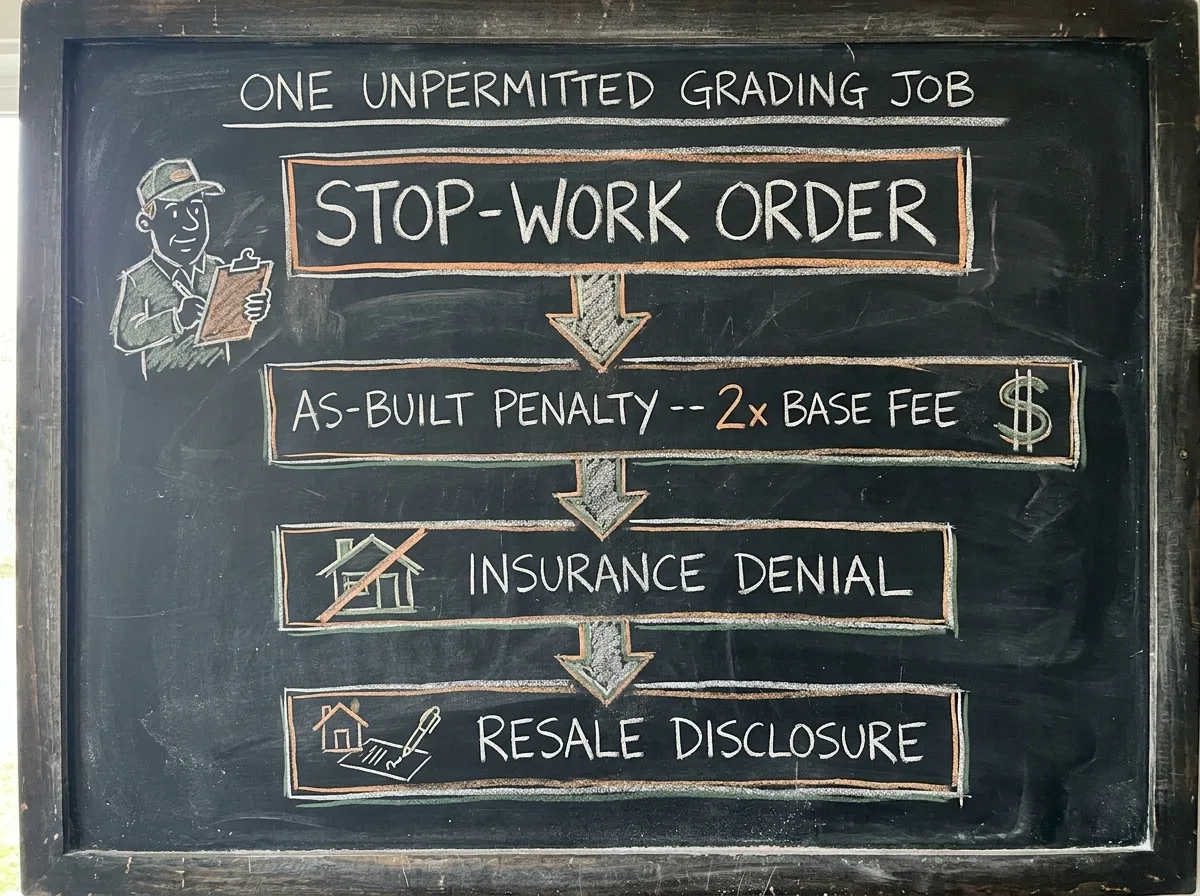
Stop-work order within hours. As-built fee typically 2x the base. Plus insurance and resale-disclosure exposure.
No horror stories required — the operational math is enough.
| Consequence | When it hits | Typical impact |
|---|---|---|
| Stop-work order | Within hours of inspector visit | Project halts; contractor mobilization costs continue to accrue while permit gets filed |
| As-built permit | After unpermitted work discovered | ~2x base fee penalty; some counties require partial demolition + re-inspection before issuing |
| Homeowner insurance | After drainage-related claim | Carrier may deny coverage on grounds that unpermitted work altered drainage patterns — documented risk, verify your policy |
| Resale disclosure | At sale (NC G.S. Chapter 47E) | Required disclosure of known unpermitted work; buyer’s inspector finding it becomes negotiating wedge at closing |
The permit line item on a contractor’s itemized quote — typically a few hundred dollars scaled to acreage — is worth every cent for exactly these reasons.
Five Mistakes That Trigger Permit Disputes in NC
These are the operator-grade failures that cost projects time and money — every one observed across Wake, Mecklenburg, Durham, and Guilford in the past five years.
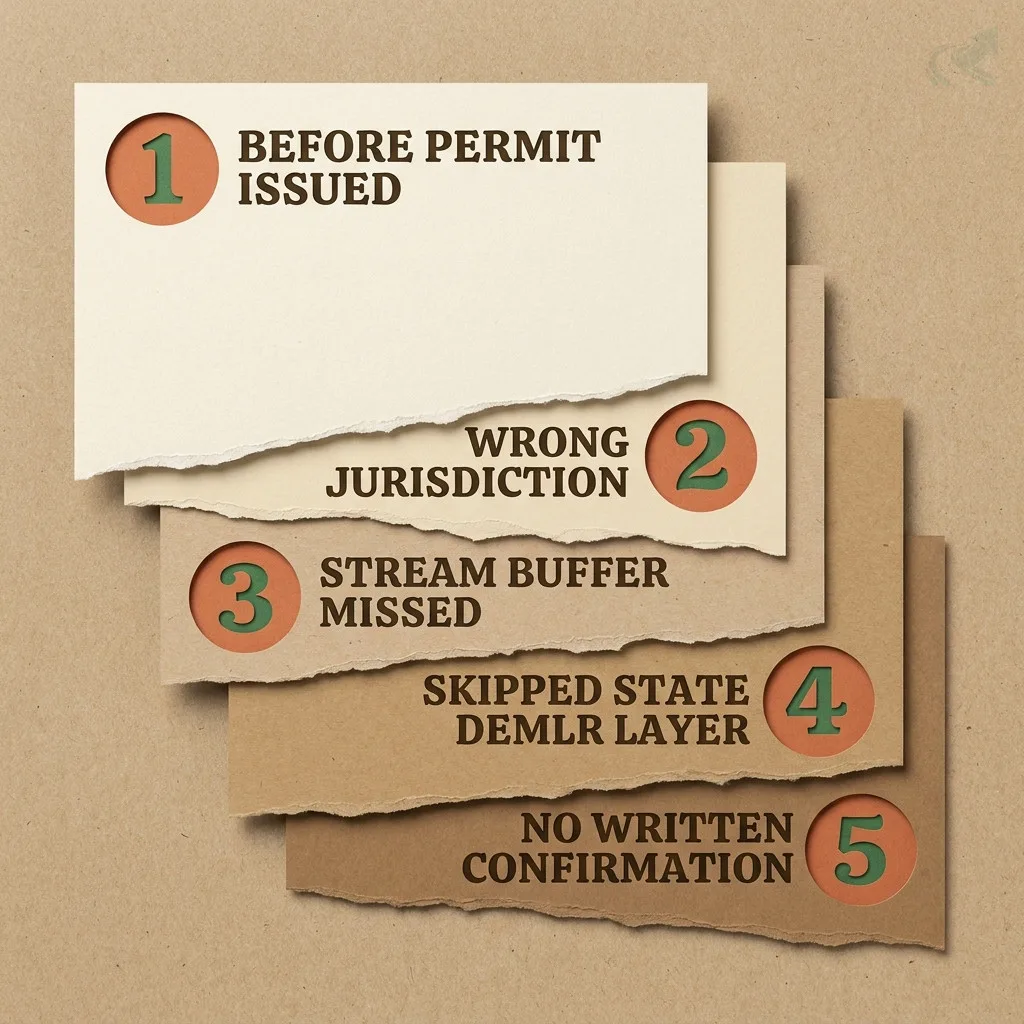
- Starting work before the permit is in hand. Not before submission — before issuance. A submitted plan under review is not a permit. Any disturbance counts as unpermitted work and triggers stop-work authority.
- Filing in the wrong jurisdiction. A Greensboro address routed to Guilford County, or a Charlotte project sent to Mecklenburg . Confirm the project’s incorporated/unincorporated status BEFORE the application package goes out.
- Underestimating stream-buffer triggers. Wake’s #1 permit-catcher: a backyard regrade well under the disturbance threshold still requires the permit if any disturbance falls within the stream buffer. The Neuse River Riparian Area Rule protects a 50-ft zone from streams where forested vegetation exists in the first 30 feet — the buffer narrows where tree cover is absent, but 50 ft is the working figure. Verify the buffer map, not just the acreage math.
- Skipping the state layer on 1+ acre projects. The county Land-Disturbance Permit does NOT cover . They run parallel — both required, separate filings. Contractors who tell you “the county permit handles state too” are wrong.
- Relying on verbal confirmation from a county clerk. If the call doesn’t end with an emailed confirmation that names your project address and the determination, it didn’t happen. Get jurisdictional and threshold determinations in writing before you bid the job.