
The contractor emailed a PDF at 9pm. It’s dense — policy numbers, coverage boxes, expiration dates, an issuing agent address. You open it on your phone. Your husband says it looks fine. Neither of you knows what to actually check.
Most homeowners confirm a certificate exists and stop there. The certificate existing is not the same as the certificate protecting you. Four specific things determine whether that document does anything useful for your project — and most people check none of them.
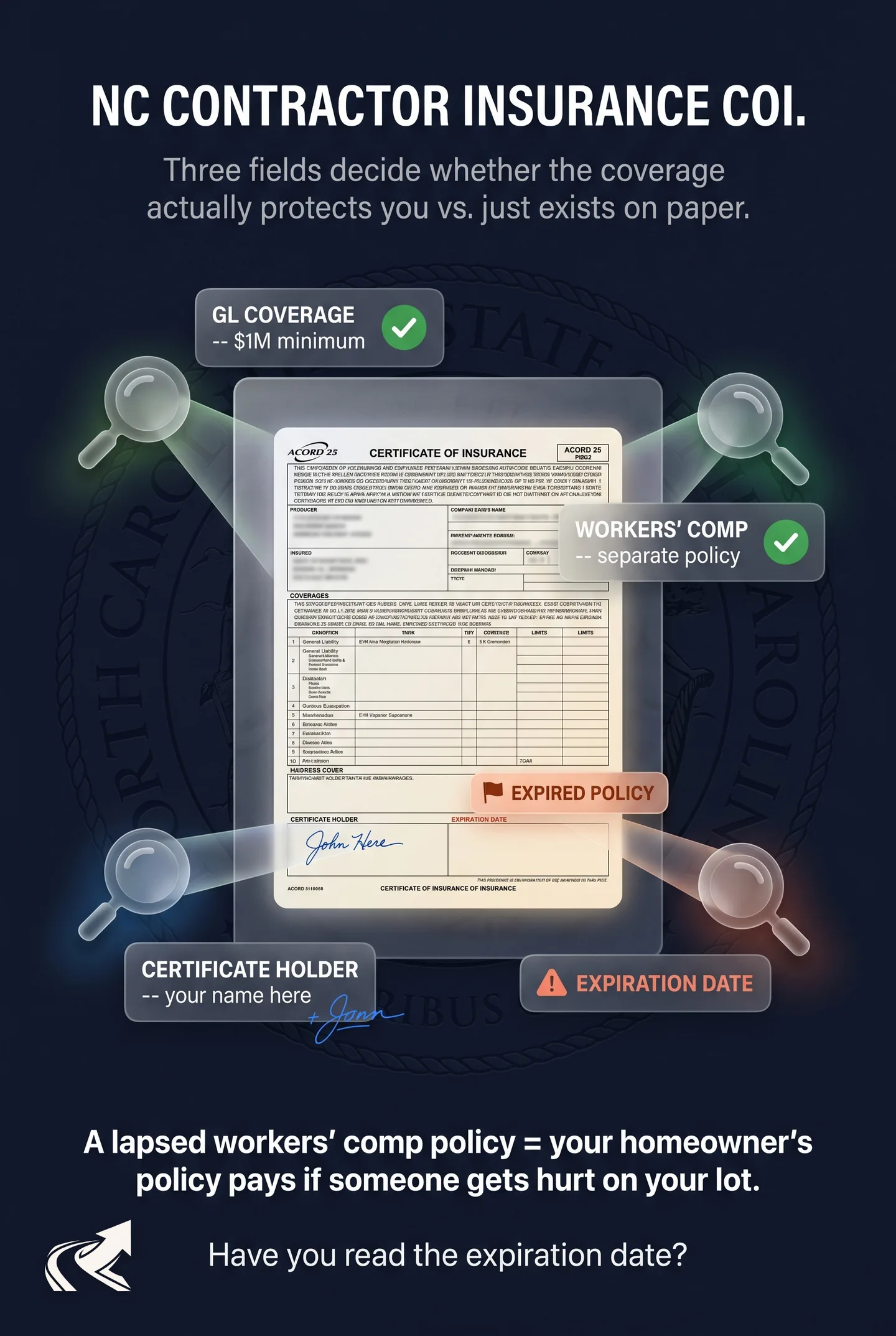
What the ACORD 25 Is and Why It’s the Standard Document
The 25 is the industry-standard — every legitimate contractor should be able to produce one immediately on request.
The ACORD 25 is issued by the contractor’s insurance agent, not the contractor. It lists the insured (the contractor), the insurer (the insurance company), policy numbers, coverage types, effective and expiration dates, and — critically — the certificate holder field.
One important clarification: the COI does not create new coverage. It documents existing coverage. If the underlying policy has problems, the certificate doesn’t fix them.
What to do if a contractor can’t produce one: ask them to call their agent. Any contractor with active insurance can have a certificate emailed within 2 hours. If they say they need days, or give you a reason to wait, the insurance may not exist.
The Certificate Holder Field — The Most Misunderstood Box
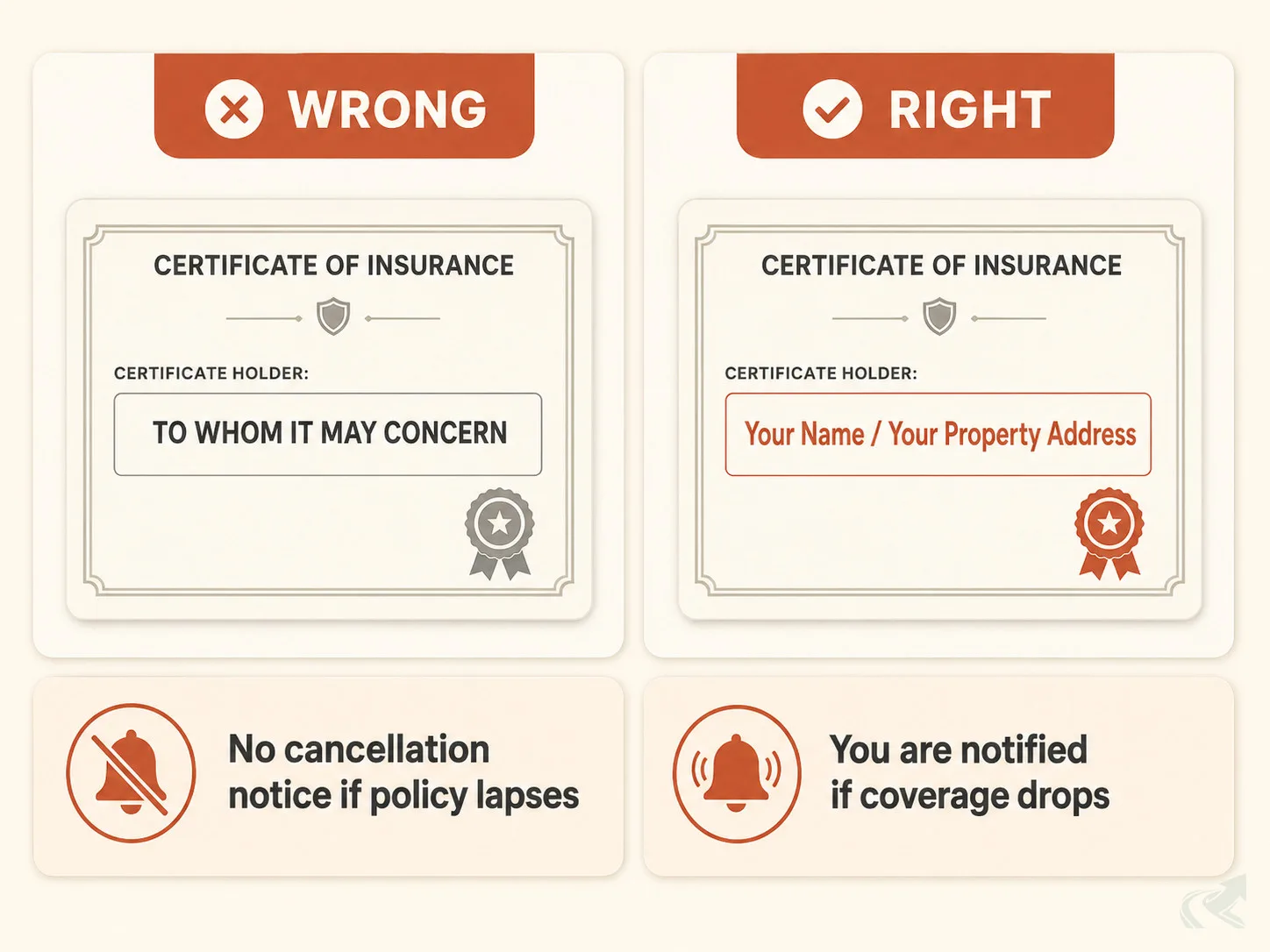
The certificate holder field is where YOUR name and property address belong. A certificate naming the contractor’s office address does nothing for you on your specific project.
Here’s why the field matters. The certificate holder is who gets notified if the policy changes or lapses after the certificate is issued. If the holder field says “TO WHOM IT MAY CONCERN” — a generic placeholder — you receive no notification if coverage drops while your job is in progress.
If your name and address aren’t in that field, the certificate is documentation of the contractor’s coverage relationship with their insurer. It is not tied to your project.
What to do: before work begins, ask the contractor to have their agent reissue the certificate with your name and property address in the certificate holder field. Reputable contractors handle this request without hesitation — it’s standard practice. Resistance is a flag worth noting.
A certificate holder field with your address is the difference between proof of insurance and a piece of paper.
GL vs. Workers’ Comp — Two Separate Policies That Both Matter
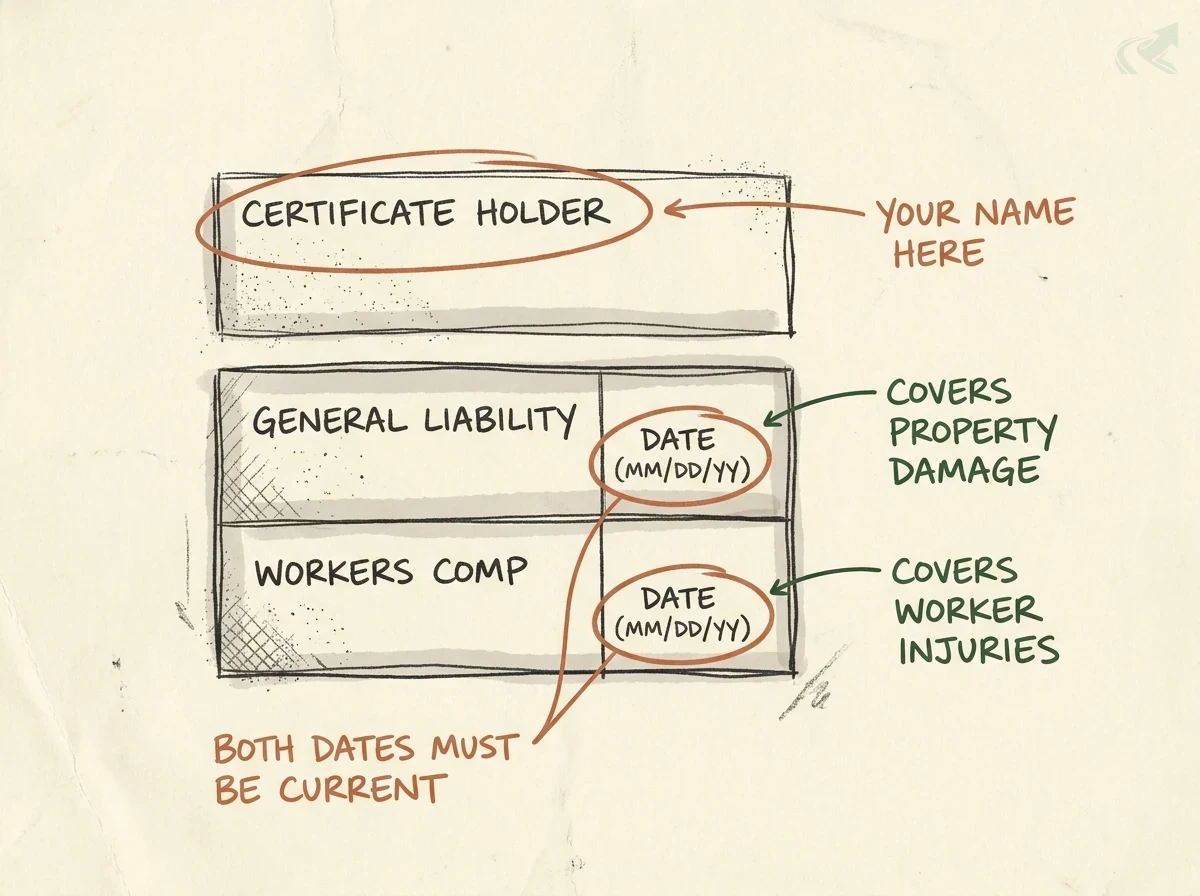
and workers’ compensation are two separate coverages protecting against two separate scenarios. Both must appear on the certificate.
| General Liability (GL) | Workers’ Compensation | |
|---|---|---|
| What it covers | Damage to your property caused by the contractor’s work — a trench collapse that damages your foundation wall, a gravel delivery that knocks over your fence | Injuries to the contractor’s employees or subcontractors who are hurt on your property |
| What it does NOT cover | Injuries to workers | Damage to your property |
| Minimum to look for | $1,000,000 per occurrence (standard industry minimum for North Carolina residential grading) | Statutory limits per North Carolina law |
| Where it appears on ACORD 25 | Box labeled “COMMERCIAL GENERAL LIABILITY” | Box labeled “WORKERS COMPENSATION AND EMPLOYERS’ LIABILITY” |
| What happens if it’s lapsed | Property damage claims go uncovered — may fall to your homeowner’s policy | Injured workers may have claims against your property; consult your homeowner’s insurer |
On the ACORD 25, find both boxes. Both must show effective and expiration dates that are current. If either box is blank or shows a past expiration date, ask the contractor to provide a certificate showing active coverage before work starts.
What a Lapsed Policy Means for You — and How to Catch It
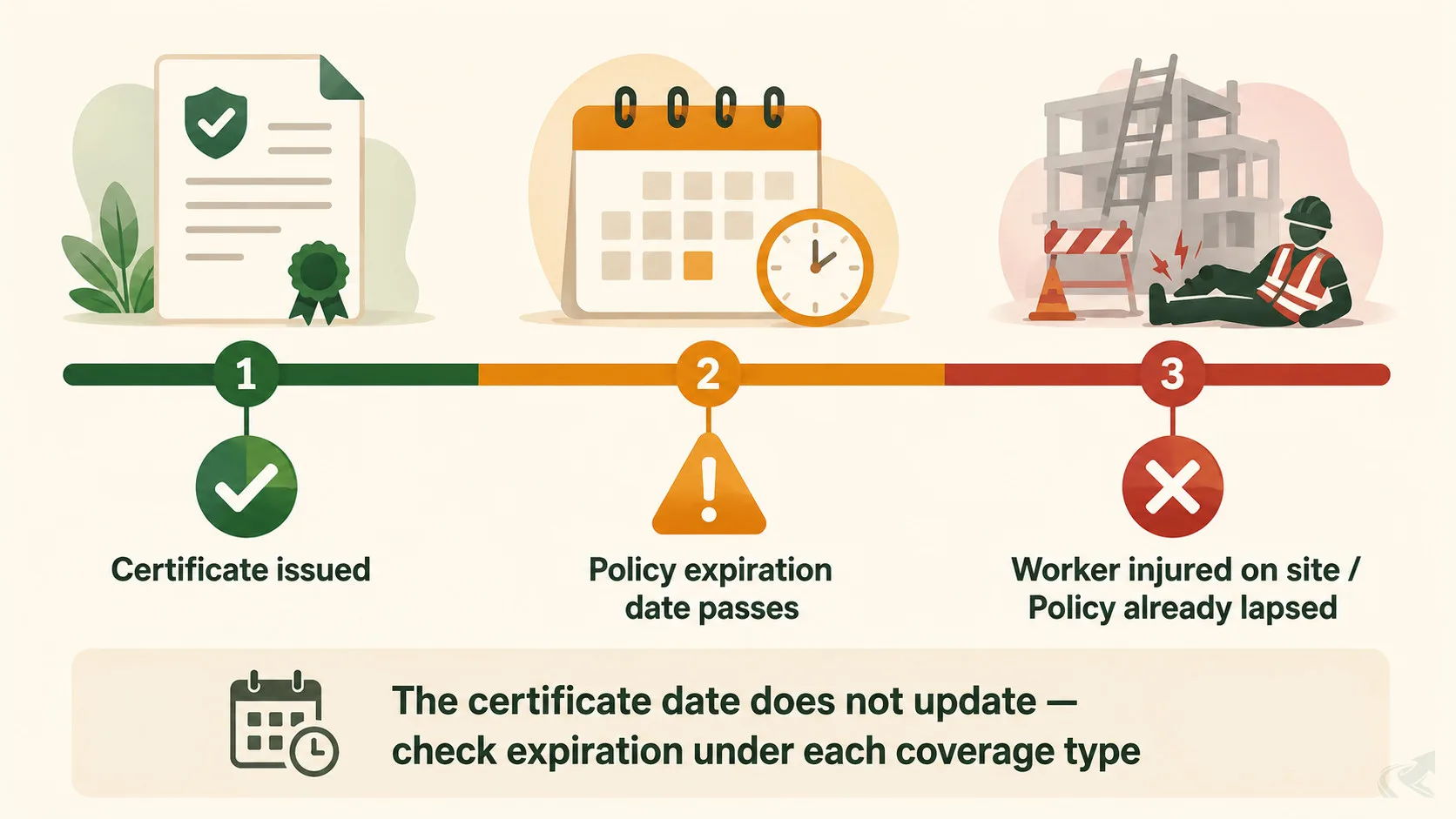
A lapsed policy means the contractor had insurance when the certificate was issued and may have none now. The certificate date does not tell you whether coverage is still active.
Certificates are issued at a point in time. If the contractor’s policy lapses after the certificate date, the document doesn’t update. The expiration date on each coverage type is the number you need to check — not the certificate issue date.
How to catch it before the job starts: check the expiration date under each coverage type. If any policy expires during your project window, ask the contractor to provide a renewal certificate before that date.
What lapse means for your liability: if a worker is injured on your property while the contractor’s workers’ comp is lapsed, your homeowner’s insurance may be the first line of coverage. The specifics depend on your policy. Check with your own insurer — that conversation is worth having before you sign a contract, not after someone gets hurt.
One additional option if you have any doubt about current coverage: call the insurance company directly. The certificate lists the insurer’s name. Active policy status is something an agent can confirm. You don’t have to take the contractor’s word for it.
The Bonding Question — What It Is and When It Matters
A bond is different from insurance — it guarantees the contractor will complete the work. Most North Carolina residential grading contractors are not bonded, and bonding is not required for most residential projects.
Insurance covers accidental damage and worker injuries. A bond covers non-performance — if the contractor walks off the job or fails to complete the work as contracted, a surety bond provides a recovery path.
For most North Carolina residential grading work, bonding is not standard and not required. For commercial projects or public works, bonding requirements are more common. If a contractor advertises “fully bonded and insured,” that phrase doesn’t substitute for verifying the insurance. Check the COI regardless of what the marketing language says.
For a full picture of what North Carolina requires contractors to carry before they work on your property, see NC contractor licensing requirements and who needs a grading license in NC.
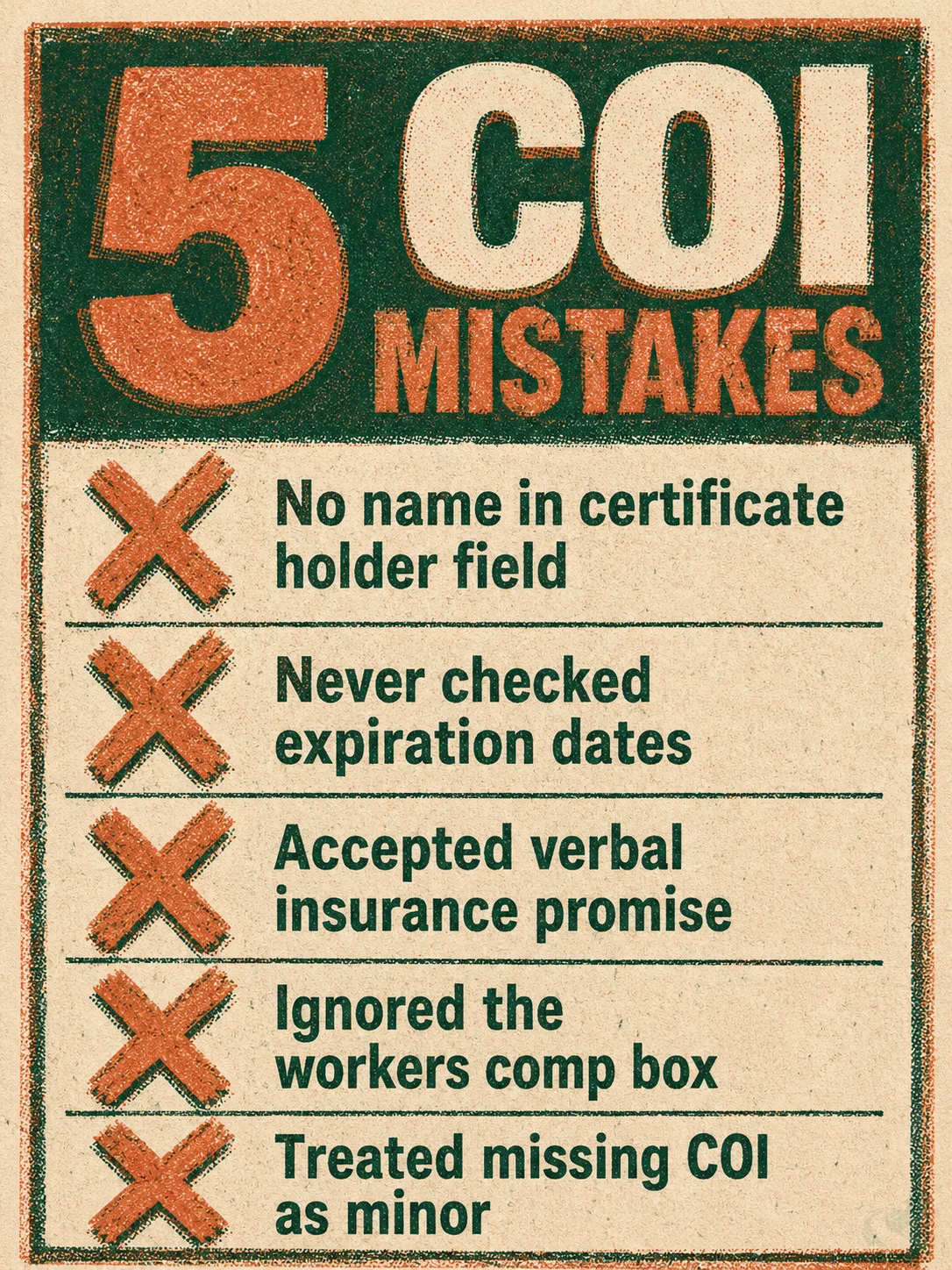
Common Mistakes When Reviewing a COI
Most homeowners make at least one of these errors before a job starts.
- Not naming yourself as certificate holder. A generic certificate is not protection tied to your specific project. The holder field must have your name and address.
- Not checking the expiration date on each coverage type. The certificate shows when the policy was issued. That’s not the same as whether coverage is currently active.
- Accepting “fully licensed and insured” verbally. The phrase is marketing language. Always get the document, then verify the four things that matter.
- Ignoring the workers’ comp box. General liability and workers’ comp are not interchangeable. Both must be current. A contractor with GL but lapsed workers’ comp is only half-covered for what can actually go wrong on a North Carolina job site.
- Treating a missing COI as a minor issue. If a contractor can’t produce an ACORD 25, they may be operating without insurance. No legitimate contractor with active coverage struggles to produce the document.
The absence of a COI belongs in the same category as a cash-only bid when you’re evaluating what cash-only bids signal — it’s a flag that tells you something about how the contractor operates. See the full list of no-insurance as a contractor red flag and other warning signs before you sign anything.
Request the Certificate Correctly — A Ready-to-Send Message
Before signing a contract, send this message to the contractor:
“Can you have your agent send me a Certificate of Insurance listing [Your Name] and [Property Address] in the certificate holder field? I need general liability and workers’ compensation listed separately, with current effective and expiration dates on both.”
Copy that text, fill in your name and address, and send it before work is scheduled. A contractor who responds with a certificate the same day — with your information in the certificate holder field — has demonstrated exactly what you’re looking for. A contractor who pushes back, delays, or sends a generic certificate with the wrong holder field has given you information worth acting on.
An itemized quote for any grading project should also show proof of insurance before you sign — not something you chase down after. When you hire a verified North Carolina grading contractor through NC Grade and Haul, license and insurance status are verified before the listing appears in the directory. That’s the starting point; you still confirm the certificate before any job begins.
For more on builder accountability for NC drainage failures and the documentation chain that protects you when work goes wrong, the builder accountability page covers what happens when a contractor damages existing drainage during a job.
Use the full NC contractor vetting guide to run the complete pre-hire checklist alongside insurance verification.