
Two questions people ask before signing a grading contract
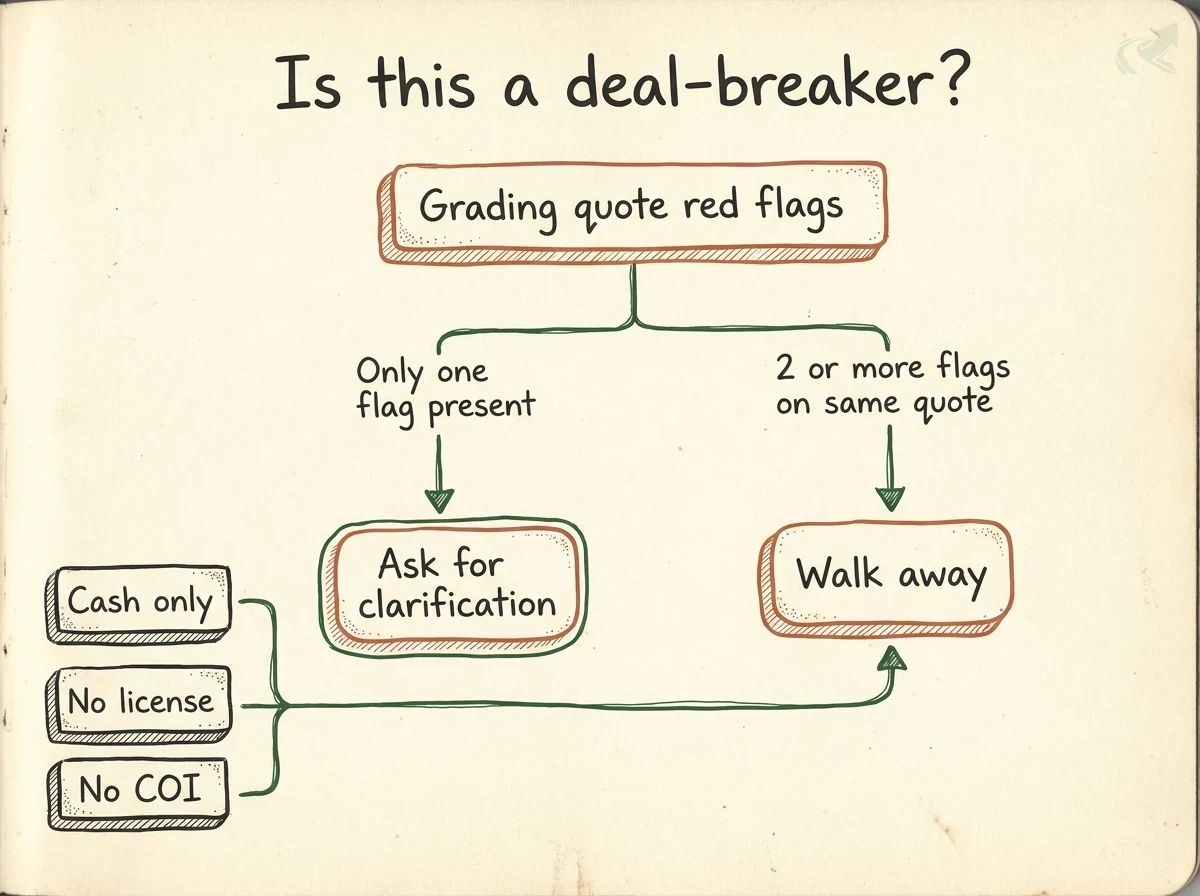
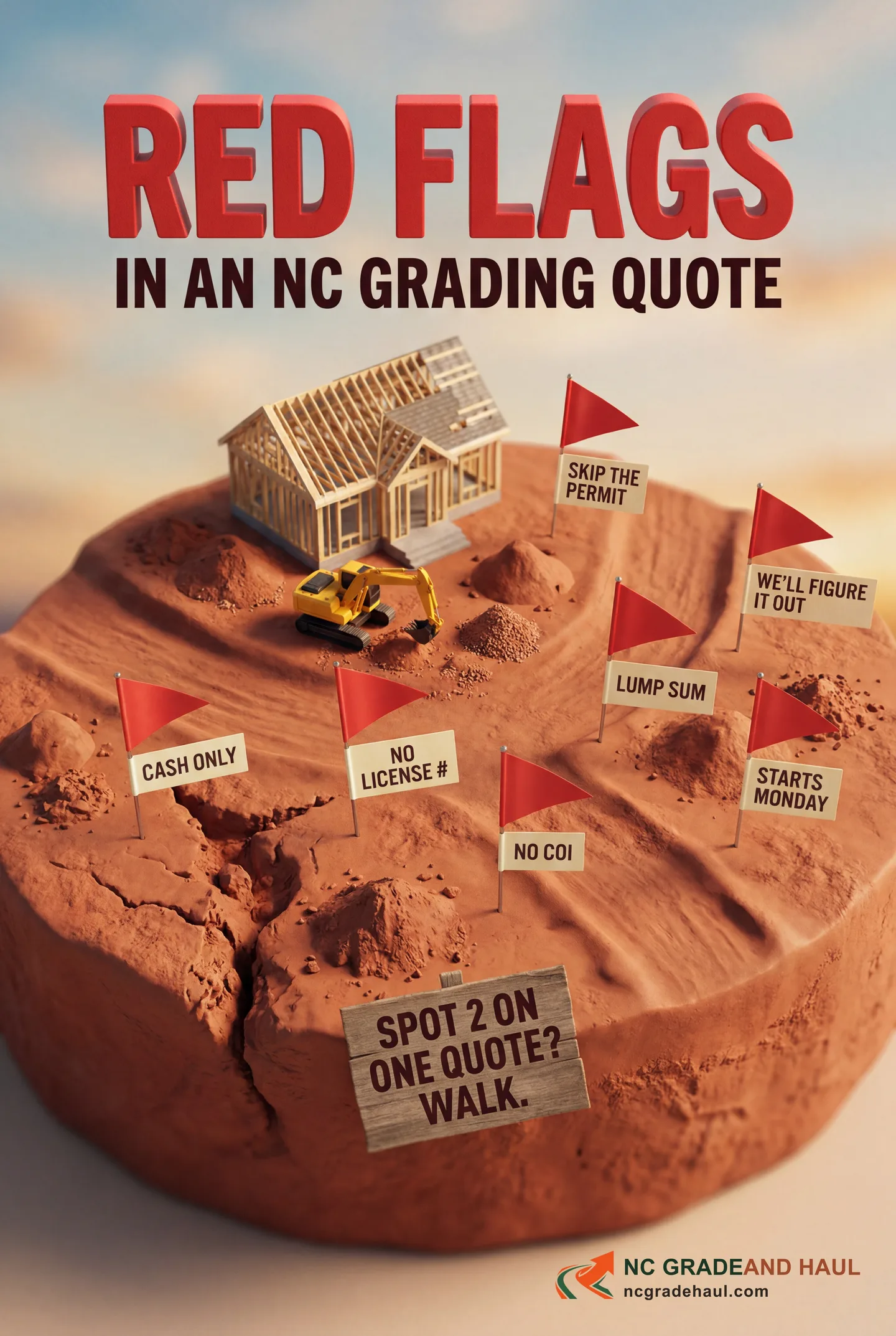
How many red flags does it take to walk away from a grading quote?
Two or more on the same quote means walk. One flag on its own is not always a deal-breaker -- some contractors are sloppy with paperwork but good with a blade. Two flags means the pattern is intentional.
What is the single fastest red flag to check before anyone shows up?
Call up portal.nclbgc.org and look up the license number they gave you. Free, no account needed. If the name does not match, the license is lapsed, or they cannot give you a number -- that is your answer.
You come inside after the contractor walk-through. The quote is one number on a sticky note. He said “we can usually start Monday.” He seemed confident. You felt something was off.
You opened your phone and searched “red flags grading contractor NC.” Nothing specific came up.
This is what should have come up.
NC Grade and Haul reads contractor records alongside homeowners. We are not a contractor — we are a verified directory. Every flag below is sourced from homeowner accounts on Reddit, NC licensing data, and enforcement actions. Not our opinion.
The 12 flags below are organized by severity. The first three end the conversation. The rest tell you which category you are in before equipment mobilizes.
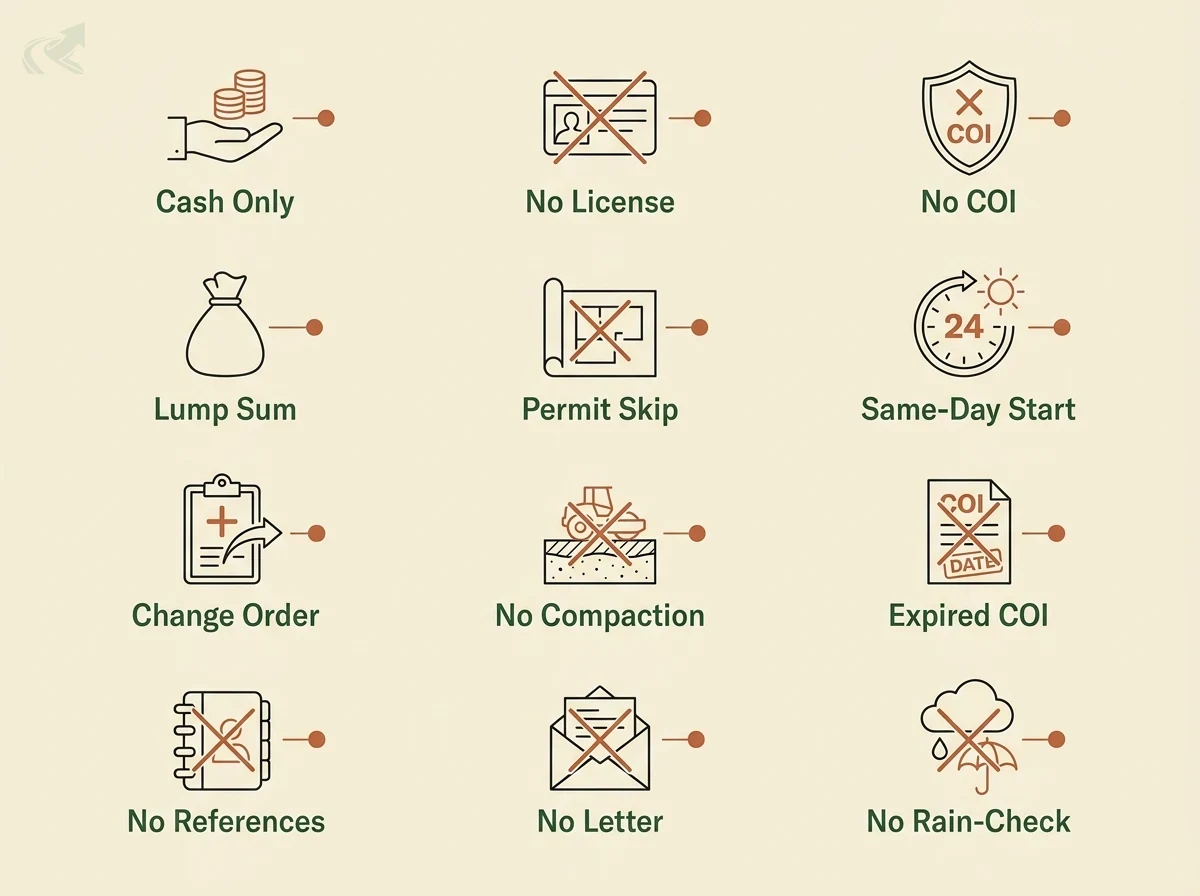
The Three Flags That End the Conversation
If cash-only, no license number, and no are all present on the same quote, do not book the site walk.
These are not paperwork inconveniences. Each one is an observable signal of a specific underlying problem.
Cash-only or no written estimate. When a contractor quotes verbally and asks for cash, there is no paper trail. No paper trail means no documentation if the work fails, no bonding backstop if the contractor disappears after the deposit, and no mechanic’s lien protection for you. One Reddit homeowner put it directly: “I have no idea how to evaluate which one is legitimate and which ones are padding.” That is exactly what cash-only is designed to produce.
No NC license number, or the number does not check out. North Carolina requires a GC license for any project above $40,000 (N.C.G.S. §87-1 — raised from $30,000 in 2023). Below that threshold, state licensing is not required, but county permits still are. Verify at portal.nclbgc.org before the site walk, not after. The search is free and takes 90 seconds. If the contractor stalls, says “we’re licensed” without producing a number, or gives you a number that pulls up a lapsed or suspended record — that is your answer.
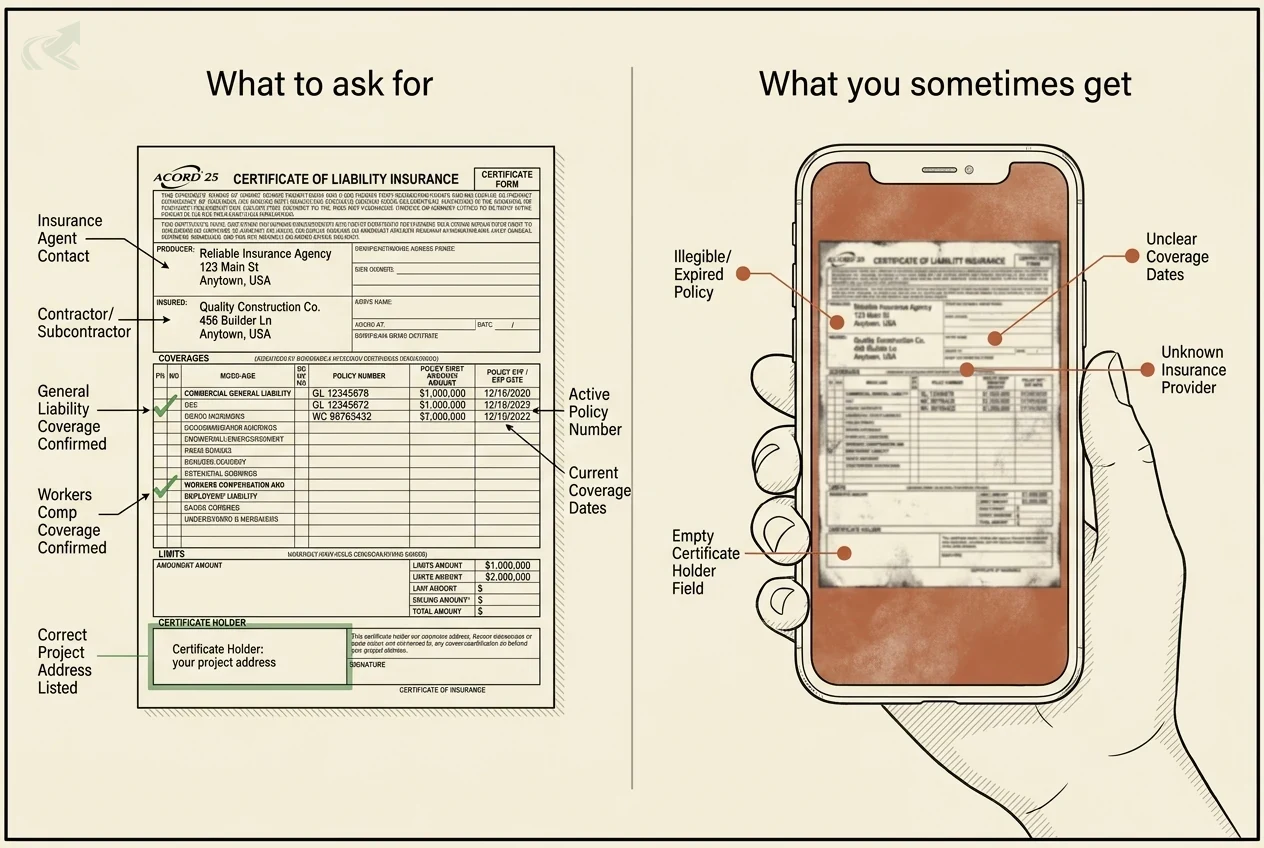
No COI with your project address listed. A certificate of insurance with no address, or addressed to the contractor’s last client, does not protect you. The address matters because it is how the policy actually responds if equipment damages your neighbor’s fence or a crew member is hurt on your property. A contractor with active coverage reissues the certificate with a phone call to their carrier — usually same day. Anyone who stalls has either let the policy lapse or does not carry one.
Permit Resistance — What It Actually Signals
When a contractor says “we do not need a permit for this,” ask which county and which threshold. They should know both without looking it up.
County land-disturbance thresholds vary across North Carolina. What does not vary: the permit system has real teeth, and a contractor who steers around it knows this.
From a Reddit homeowner thread on a Piedmont grading job gone sideways: “Stop work yesterday. Get a licensed professional in there that has good referrals. Maybe even ask your county inspectors for a recommendation.” The county inspector recommendation is a trust signal — the contractor who avoids permits is also avoiding that kind of scrutiny.
The consequences are not hypothetical. In another North Carolina thread: “The county came out today and saw the mess and agreed. They said by Monday they’d yank their ability to obtain permits until it was fixed.” Permit violations follow a contractor’s record. A contractor avoiding permits has often been burned before.
“We do not pull permits in unincorporated counties” is a variation of this flag that sounds plausible but usually is not. Unincorporated areas in North Carolina still fall under county jurisdiction for land disturbance above threshold. State rules under 15A NCAC 04 apply regardless of incorporation status. County thresholds, not city limits, govern whether a permit is required.
For the full breakdown by county, see county land-disturbance thresholds.
Quote Red Flags — Lump Sum, Vague Line Items, Same-Day Urgency
A real grading quote names equipment hours, material spec, permit line item, and contingency — all separate. If you cannot tell what you are paying for, you cannot dispute it later.
Three flags, one section, because they cluster on the same quotes.
Lump-sum with no itemization. A lump sum is a number you cannot compare. One homeowner described it clearly: “I have no idea how to evaluate which one is legitimate and which ones are padding.” That is precisely what a lump sum produces. A legitimate grading quote separates equipment by hour or day, materials with spec, labor by role, permit fee, and disposal. Full treatment at what a legitimate grading quote looks like.
Vague line items. “Site work — $X” is not a line item. Real itemization names equipment (track loader, excavator), materials with spec (ABC gravel by tonnage, #67 stone by ton), labor by role, permit fee as a standalone line, and disposal or hauling separately. In NC Piedmont clay, gravel spec is not a detail — substituting unwashed crusher run for #67 washed stone saves the contractor money and costs you a clogged drainage system in two seasons.
Same-day start urgency. “I can have a crew there Monday” on a permitted job is a flag, not a selling point. Wake, Mecklenburg, Durham, and Guilford counties all require permit submission before land disturbance begins. A contractor who can mobilize that fast either pulled a permit for your specific site before your first conversation (extremely unlikely) or is planning to skip it. The urgency is a closing tactic. A permitted job takes the time it takes.
The Change-Order Trap — What “We Will Figure It Out” Actually Costs
Every unexpected site condition should trigger a written change order you sign before extra work begins — not a verbal “we found rock” phone call.
The low-ball lump sum and the open-ended change-order process are often the same contractor’s playbook. The initial number gets you to sign. After mobilization, discovery becomes expensive.
“The price will go up if we find rock” with no threshold and no written process is improper change-order setup. The correct framing from a contractor who has done this before: “If we encounter unsuitable material during excavation, we stop, show you what we found, give you a written change-order estimate, and you approve before we continue.” That is the language of accountability. Verbal “we found rock” with a new number is not.
The second version of this flag: “we will regrade if you are not happy” without specifying compaction. Regrading without is moving dirt. A contractor who cannot name their compaction verification method — loaded vehicle proof-roll, nuclear density gauge, or similar — cannot guarantee the work will not settle. “We will fix it” is a promise with no measurable standard attached.
From one homeowner thread: “The most expensive one seems like they’re betting I won’t ask questions.” The change-order trap is where a low-ball quote becomes expensive after mobilization.

Insurance and Reference Red Flags
“We will send the COI later” is not a COI. Get the current certificate before anyone sets foot on your property.
An ACORD 25 is the standard certificate of insurance form used across the industry. When you receive one, check four things: the effective date, the expiration date, that both general liability AND workers’ comp are listed, and that your project address or property appears as the certificate holder or additional insured. A photo of last year’s certificate, or a COI with a blank certificate-holder field, protects no one.
No references with local specificity is a different kind of flag. A real operator names the county, the service type, and the approximate year. “I can give you names” without follow-through is a reference dodge. One thread from a Piedmont homeowner experiencing a failed job: “Get a licensed professional in there that has good referrals. Maybe even ask your county inspectors for a recommendation.” County inspectors see contractor work constantly. When they can name operators they’d recommend, that is a meaningful signal.
“We do not write certification letters” is the third flag in this section. A certification letter is a signed, dated document on company letterhead stating observed site conditions and required remediation. Builders take it seriously because it is discoverable in dispute proceedings. A contractor who is uncomfortable putting their site assessment in writing is not equipped to back you up in a builder accountability situation. For how that letter works, see the certification letter for drainage disputes.
No rain-check offer after project acceptance is the last flag here. NC clay drainage must be evaluated in real water conditions, not at dry-day job sign-off. A contractor who will not return after a significant rain to verify drainage behavior has no accountability mechanism. The job is done when water goes where it is supposed to go.
The 3-Flag Gaslighting Pattern (For Builder-Dispute Situations)
If your builder is already disputing a drainage problem, the red flags in the fix contractor’s behavior are the same — plus one more: unwillingness to document.
This section is for a specific situation: you already have a drainage problem from a new build, and you are hiring a second-opinion grader to assess it. The flags above still apply. Add these three.
The source here is real homeowner accounts from NC builder-dispute threads:
“The builder blamed the sprinkler system being on, my dogs making holes in the ground… all which are false.”
“Builder keeps blaming rain or won’t answer emails.”
“As the professional in this situation are you willing to certify in writing that you have seen these site conditions…” — the script homeowners in these situations have used to shift the accountability dynamic.
A contractor who will not assess in writing. They saw the problem. They told you verbally what was wrong. They will not put it on letterhead. That certification letter is what the builder responds to. Without it, the conversation stays verbal indefinitely.
A contractor who says “it’ll just settle.” Ask them to be specific: how many hours of standing water after a 2-inch rain is acceptable in North Carolina Piedmont clay? The answer should be measurable. An open-ended “it’ll settle” is not an assessment.
A contractor who wants to start work before the builder dispute is documented. Starting new grading before you have a written record of what was wrong means you have buried the evidence. Get the assessment letter first. Then authorize the remediation.
Hiring a second-opinion grader who shows these same flags creates a compounding problem — you came to resolve a builder dispute and now have two accountability gaps instead of one.
For escalation paths when a contractor is already on site showing these flags, see NC stop-work order escalation and the builder accountability playbook.
The 12-Flag Checklist
Quick-reference summary. Each flag is an observable behavior — the table maps what you see to what it actually signals.
| Red Flag | What you see | What is actually happening |
|---|---|---|
| Cash-only, no written estimate | Verbal price, no written quote | No paper trail if work fails or contractor disappears |
| Cannot produce NC GC license number | Stall or “we are licensed” with no number | May not hold an active license — verify at portal.nclbgc.org |
| No COI with your project address | Generic certificate or “we will send it later” | Policy may be lapsed or may not respond to a claim at your site |
| Permit resistance | ”We do not need a permit for this job” | Avoiding county oversight; permit system has enforcement teeth |
| ”We do not pull permits in unincorporated counties” | Sounds plausible | Usually false — county E&S jurisdiction applies regardless of incorporation |
| Lump-sum with no itemization | One number, no line items | No way to compare quotes or dispute post-job invoicing |
| Vague line items | ”Site work — $X” | Cannot confirm material spec; substitution risk on gravel and fill |
| Same-day start urgency | ”I can have a crew there Monday” | Skipping the permit — permitted jobs take the time they take |
| ”We will figure it out” change orders | No written threshold, verbal discovery calls | Low-ball opens door to open-ended cost escalation after mobilization |
| ”We will regrade” with no compaction standard | Verbal guarantee, no proof-roll mention | No measurable accountability for settling or drainage failure |
| References with no specificity | ”I can give you names” with no follow-through | Reference dodge — a real operator names county, service, and year |
| Will not write a certification letter | Verbal assessment only | Cannot support you in a builder dispute proceeding |
The directory is free. Every contractor in the verified cohort has passed license, COI, and permit-pull checks against public records. If something still feels off about a quote, that instinct is usually right. Hire a verified NC grading contractor and get an itemized quote from an operator whose records we have already reviewed.