
Water up against the foundation — knuckle-high, sitting there for days. Builder’s warranty team came out twice and said “normal settling.” That’s the situation. This page hands you the tools to change the conversation.
North Carolina Residential Code sets specific, measurable standards for final grade slope. Four independent enforcement levers exist outside the builder’s warranty process — and most homeowners only know about one of them.
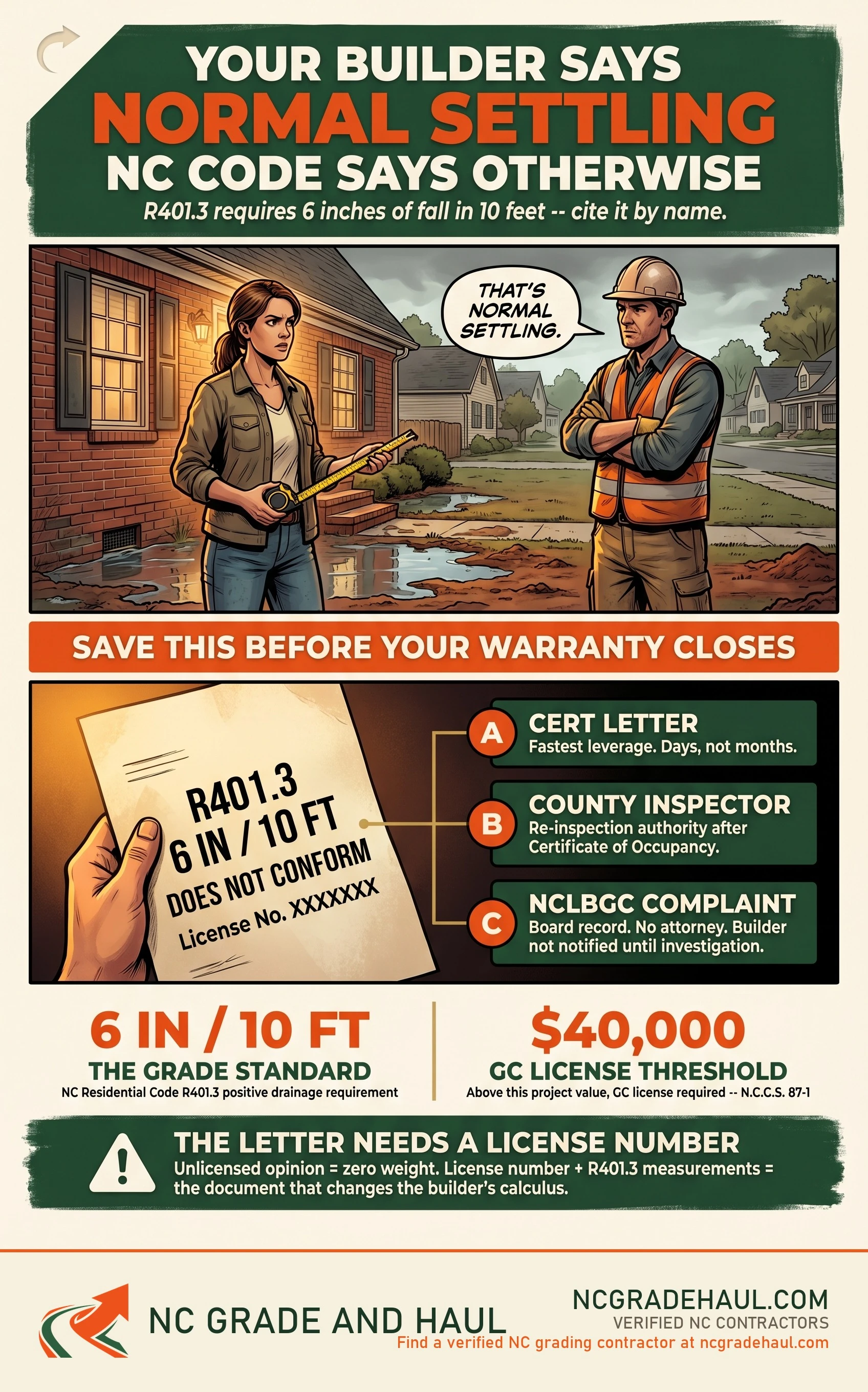
What NC Code Actually Requires — The Numbers Your Builder Won’t Volunteer
NC Residential Code R401.3 + R405. Final grade must fall away from the foundation. The field standard is 6 inches in 10 feet. That is measurable and it is citable.
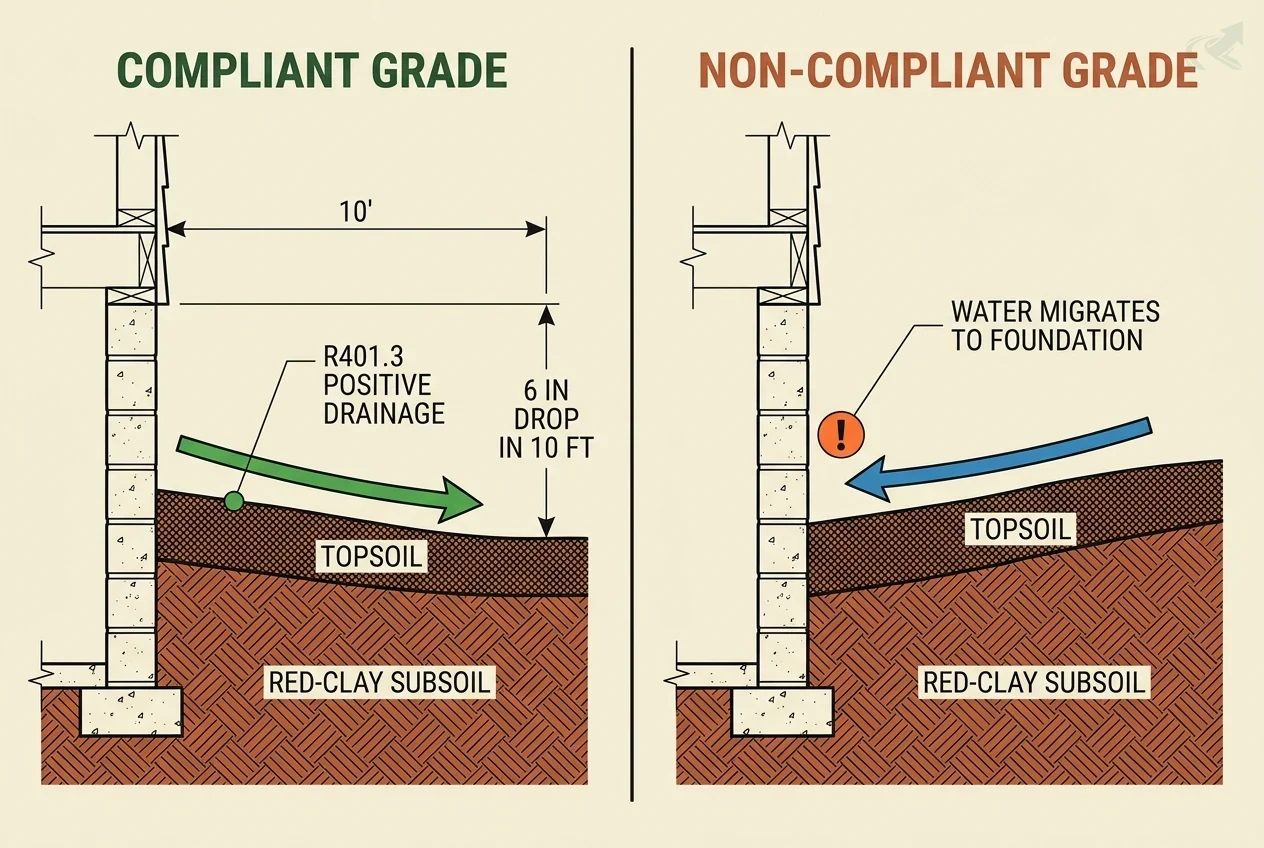
Section R401.3 of the North Carolina Residential Code covers lot grading as a pre-construction requirement. The code requires that the final grade around a new home slopes away from the foundation — positive drainage is the technical term for this. It is not a suggestion, and it is not subjective.
R405 governs foundation drainage systems — perimeter drain requirements, moisture management at the foundation wall, and what drainage infrastructure a crawl space or slab foundation must have in place before the slab is poured.
The commonly cited field standard is 6 inches of drop in the first 10 horizontal feet. That figure is a measurable threshold, not a general guideline. You can verify it yourself: stretch a 10-foot level along the soil surface near your foundation. Positive drainage shows the far end elevated; negative drainage — the kind that causes foundation problems — shows the near end elevated and the ground sloping back toward the house.
In Piedmont red clay — which covers the Triangle, Triad, and Charlotte metros — the urgency is compounded. Sandy soil drains between rain events. Red clay holds water for days. Water that would pass harmlessly in a sandier region sits against a foundation wall in Guilford or Wake County, where it creates hydrostatic pressure against the sill plate and drives moisture into the crawl space.
The combination of R401.3 + R405 is your citation. See the NC foundation drainage guide for how both sections interact at the foundation wall specifically.
The Four Levers — And Why Most Homeowners Only Use One
Warranty is lever one. Three more run in parallel and the builder does not control any of them.
Most homeowners submit a warranty claim and wait. That’s the builder’s timeline, the builder’s decision, and the builder’s paperwork. The other three levers move on a different clock — and using all four simultaneously changes what the builder is looking at.
-
Warranty. Express warranty on new construction typically runs 1 year for workmanship defects, with longer windows for structural issues. Under North Carolina law (N.C.G.S. Chapter 87 and related consumer protection provisions), builders are required to repair certain defects within the warranty period. Warranty is a path — but the timeline and interpretation are controlled by the builder. Document every warranty contact in writing. Read new home warranty vs county inspector NC for a side-by-side breakdown of what each lever actually controls.
-
Certification letter. An independent licensed grading contractor puts in writing what they observed, what code requires, and whether the current grading meets it. This document is discoverable in arbitration. Builders take it seriously because it is the evidence record — not a homeowner opinion. A strong letter names the specific measurements, the code sections, and the contractor’s license number. See H2 4 below for what makes a letter weak vs. strong.
-
County permit office. The office that issued the builder’s Certificate of Occupancy has authority to require re-inspection on code compliance items. That includes final grade slope under R401.3. File your request in writing, cite R401.3 and R405 by section number, and include a description of the observed site conditions. Do you need a permit for grading in your NC county? See your county building department — the same office that issued the can accept a written re-inspection request. For NCLBGC license verification details on the grading sub, see the next lever.
-
complaint. In North Carolina, a contractor must hold a general contractor license for projects above $40,000 (N.C.G.S. 87-1). If the builder’s grading subcontractor exceeded that threshold, they were required to hold a license. An NCLBGC complaint creates a formal record and can trigger a board investigation. No attorney required. The builder is not notified until the board decides to investigate.
The Four Enforcement Levers
1. 1. Warranty claim -- Builder controls the timeline and interpretation. Start here -- but don't stop here. Document every contact in writing. Slow by design. 2. 2. Certification letter -- An independent licensed grading contractor documents non-compliance in writing with measurements and specific code citations. Discoverable in arbitration. Fastest leverage -- takes days, not months. 3. 3. County permit office -- The office that issued the Certificate of Occupancy can accept a re-inspection request on R401.3 grade slope. File in writing, cite both code sections by number. 4. 4. NCLBGC complaint -- Creates a formal board record. Builder is not notified until the board investigates. No attorney required. Applies to the grading subcontractor if they exceeded the $40,000 license threshold.
-
1. Warranty claim
Builder controls the timeline and interpretation. Start here -- but don't stop here. Document every contact in writing. Slow by design.
-
2. Certification letter
An independent licensed grading contractor documents non-compliance in writing with measurements and specific code citations. Discoverable in arbitration. Fastest leverage -- takes days, not months.
-
3. County permit office
The office that issued the Certificate of Occupancy can accept a re-inspection request on R401.3 grade slope. File in writing, cite both code sections by number.
-
4. NCLBGC complaint
Creates a formal board record. Builder is not notified until the board investigates. No attorney required. Applies to the grading subcontractor if they exceeded the $40,000 license threshold.
Using all four levers simultaneously changes what the builder is looking at -- warranty alone leaves the timeline in their hands.

What to Say When They Try to Gaslight You
The script is specific. “As the licensed professional in this situation, are you willing to certify in writing that you have seen these site conditions and that they conform to applicable code?”
That question — adapted from a widely-shared r/landscaping thread where an NC homeowner posted verbatim what worked with their builder’s warranty team — is the hinge of the conversation. Two things can happen when you ask it. They say yes: you have a certification, get it in writing. They say no or hedge: you have documented their refusal, and now you need your own independent certification.
Builder responses to expect, and how to handle each:
-
“Normal settling.” Response: R401.3 is a final grade requirement, not a settling allowance. The code applies to the finished grade at the time of Certificate of Occupancy. Normal settling does not create an exemption from the slope requirement.
-
“Wait until spring.” Response: water against a foundation in NC clay is not a seasonal condition. It is a drainage failure that continues every time it rains. Delay is not a remedy.
-
“Your landscaping is the problem.” Response (verbatim from r/HomeImprovement, where a Raleigh homeowner described an identical conversation): “The builder blamed the sprinkler system being on, my dogs making holes in the ground — all of which are false.” If the final grade at the time of CO was non-compliant, downstream landscaping does not shift that liability.
-
“The city inspector signed off.” Response: a Certificate of Occupancy inspection checks for gross code compliance at a single point in time. It is not a final-grade certification and does not preclude a re-inspection request.
-
“Standing water for up to 48 hours is within code.” There is no NC Residential Code provision that permits standing water against a foundation for any window of time. R401.3 requires positive drainage — water moving away from the foundation. If a builder’s warranty team makes this claim, ask them to cite the code section by number. You will not receive one.
Common Mistakes
-
Waiting. Every month of delay is a month of hydrostatic pressure against your foundation in NC clay. The urgency is real.
-
Emailing only. Written communication is essential — but phone calls to warranty teams disappear. Follow every call with an email summary sent the same day.
-
Using the wrong vocabulary. “The drainage is bad” is dismissible. “R401.3 final grade does not conform to the 6-inch-in-10-foot requirement” is a code citation. Specificity matters.
-
Assuming the CO means you’re out of options. It does not. The re-inspection path and the NCLBGC complaint path both remain open after a CO is issued.
The 8-point builder dispute checklist at the foundation drainage guide walks through documentation steps in the order a re-inspector will look for them.
The Certification Letter — Your Fastest Leverage Tool
A certification letter from an independent licensed grading contractor is the single document that changes the builder’s calculus most quickly.
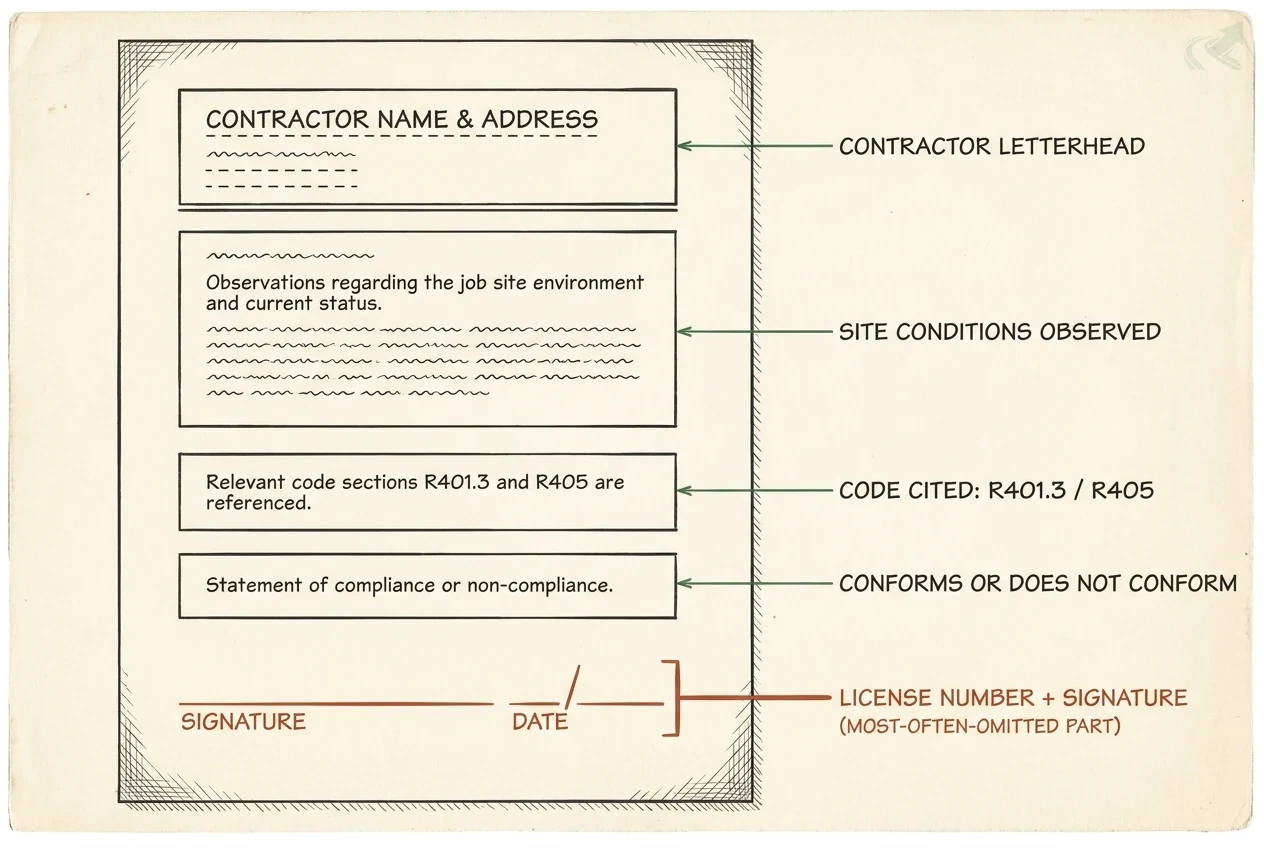
A strong certification letter contains four elements: the site conditions the contractor observed (with measurements), the code requirements those conditions must meet (R401.3 + R405 cited by section), a clear statement of whether the current grading conforms or does not conform, and the contractor’s NC license number and signature.
What makes a letter weak: “drainage looks bad” or “in my professional opinion this is inadequate.” That’s an opinion. What makes a letter strong: “I measured 2 inches of negative slope in 10 horizontal feet toward the foundation at the northeast corner of the structure, versus the R401.3 requirement of positive drainage away from the foundation. This grading does not conform.”
The difference between those two letters in arbitration is significant. The weak version is rebutted by the builder’s own contractor opinion. The strong version is rebutted by measurement.
This is also why the letter needs a license number. An opinion from an unlicensed person holds no weight. An opinion from a licensed North Carolina grading contractor with NCLBGC-verifiable credentials — and a signature they’ll stand behind — is a different document.
When you contact an independent grading operator to request a certification letter, send them the following:
Script to send to the independent contractor you hire
Script 1 — What to ask the builder’s warranty team
As a licensed professional who has visited this site, are you willing to certify in writing that you have seen these conditions, that you believe they do or do not conform to NC Residential Code R401.3 and R405, and that you stand behind that assessment?
Script 2 — Code citation for written requests
NC Residential Code R401.3 requires positive drainage away from the foundation. R405 governs foundation drainage systems. I am requesting re-inspection to confirm my home’s final grading conforms to both.
Script 3 — NCLBGC complaint opener
I am filing a complaint regarding NC Residential Code R401.3 non-conformance at [address] by [contractor license number]. Documentation attached.
The dedicated child page — the certification letter for drainage disputes — has the full template with field-by-field instructions for what the letter must contain to hold up in arbitration.
When to Escalate — The Yank-Permits Path
When the county inspector finds code violations during re-inspection, they can restrict a builder’s ability to pull new permits until the violation is resolved. Homeowners who have documented their complaint in writing are the ones who trigger this.
The county building inspection office — the same office that issued the CO — has enforcement authority over code compliance on permitted work. If you file a written re-inspection request citing R401.3 and R405, and the re-inspection confirms non-conforming final grade, the inspector has authority to issue a notice of violation.
What “yank-permits” actually means: the county can place a hold on the builder’s ability to pull new building permits until the cited violation is resolved. This is not a criminal action. It is an administrative enforcement mechanism. It affects the builder’s active projects in that county — which is why it moves fast when it moves at all.
The practical evidence of this path working: in one documented Triangle case, within three hours of a homeowner contacting the county inspector, the builder had crews on-site addressing the complaint. That outcome is not guaranteed — the re-inspection must find an actual code violation, and the inspector’s enforcement decision is discretionary. But homeowners who have documented their request in writing, with specific code citations, are the ones who trigger re-inspections.
When to use this path vs. warranty + certification letter: if the builder is still active on your street or in your subdivision, the permit-hold mechanism has direct financial leverage. If the builder has completed the subdivision and moved on, the certification letter + NCLBGC complaint path is more direct.
See how to get a builder’s permits yanked in NC for the full procedure, including what documentation the inspector needs and what the enforcement timeline looks like.
Comparison: Warranty Types and Enforcement Venues
The right path depends on which combination of levers applies to your situation — and who controls the timeline.
| Factor | Express Warranty | Certification Letter | County Inspector | NCLBGC Complaint |
|---|---|---|---|---|
| Who controls timeline | Builder | You + contractor | County office | NCLBGC board |
| Fastest to initiate | No | Yes | Moderate | Yes (no attorney) |
| Evidence required | Written claim | Measurements + code section | Written request + code cite | Written complaint + docs |
| Requires attorney | Sometimes | No | No | No |
| Builder controls outcome | Yes | No | No | No |
Highlighted row: fastest to initiate. Certification letter and NCLBGC complaint both move without builder consent.
Which Tool Fits Your Situation — Decision Guide
The right path depends on how much time you have, whether the builder is still active on your street, and whether you are inside or outside the warranty window.
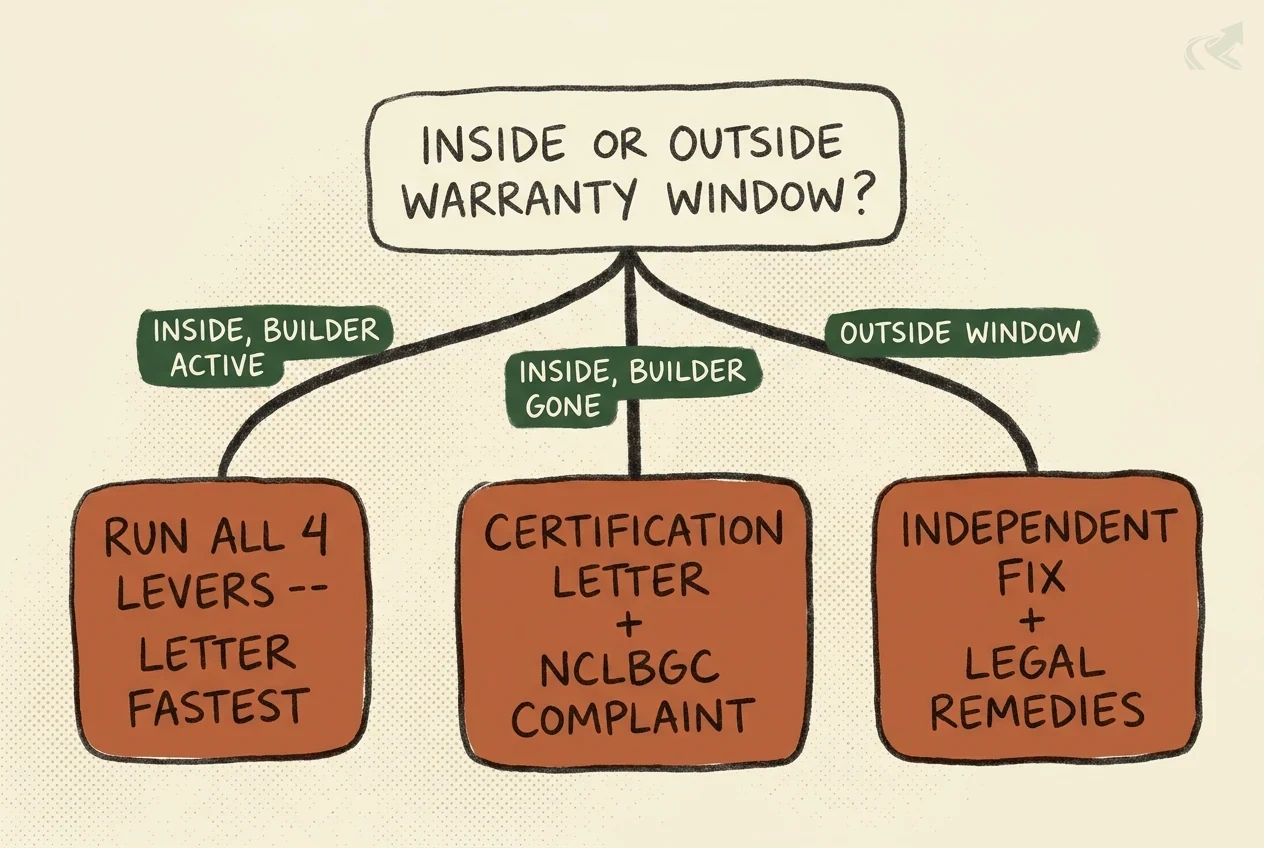
Three scenarios, three paths:
-
Inside warranty window, builder still active nearby. Run all four levers simultaneously. The certification letter + county inspector path moves fastest. Warranty is for the record. If you’re in a large production-builder community, see the Triangle production-builder drainage pattern for the specific pattern and what has worked.
-
Inside warranty window, builder gone. The certification letter plus NCLBGC complaint are your primary levers. County inspector re-inspection is still available even if the builder is no longer active in your county.
-
Outside warranty window. An independent contractor can both assess and fix the grading failure. At this stage the conversation is about repair, not warranty enforcement. NCGH connects North Carolina homeowners to verified operators who do exactly this work. Get an itemized quote — not a verbal estimate, an itemized one in writing.
Next Steps — Finding an Independent Grading Contractor
An independent licensed grading contractor can assess, document, and fix builder grading failures. NCGH connects NC homeowners to verified operators who do this work.
Before any contractor starts, ask three questions:
-
License number. They should be able to give it on the spot. You can verify it at the NCLBGC portal. If they hesitate, that’s information.
-
. Ask for a current certificate naming you as the additional insured for the duration of the project. A grading contractor working on a property dispute without insurance creates liability you don’t want.
-
Willingness to write a certification letter. Not every operator does this — some prefer to assess and quote repair without generating a written record for a dispute. Find one who will.
The quote should be itemized: what was observed, what work is required, what materials will be used, what the grade will measure when done. A single round number with no breakdown is not an itemized quote.
NCGH verifies operators against the NCLBGC active-license database before listing them. When you hire a grading operator in North Carolina through the directory, you’re starting with operators who have an active license on record — not self-reported credentials.