
Two questions WNC homeowners ask most
Is it too late to get Helene repair work done?
No -- the backlog is real but it is moving. The contractors doing this work in WNC are verified and licensed. Getting in queue now is better than waiting another season. Each rain event without a working culvert makes the underlying problem worse.
How do I tell a real contractor from a storm chaser?
Two checks take two minutes: (1) pull their license number at NCLBGC.gov -- North Carolina Licensing Board for General Contractors -- and (2) ask for a certificate of insurance naming your project. A real operator has both ready. No itemized quote? Walk away.
The gravel on your driveway is gone. The culvert is either missing or buried under debris. Six months later, you’ve had two contractor callbacks and one quote that had no line items — just a number that didn’t make sense.
That’s where post-Helene driveway repair in WNC actually stands right now. This page maps the damage categories, shows you what to document before calling anyone, and explains how to tell who’s actually equipped to do this work in WNC mountain terrain.
Helene-damaged WNC driveway: solid roadbed vs undercut shell
Comparison. Still load-bearing: Compacted roadbed intact below the surface; Culvert seated in a sound headwall; Outlet drains clear without scour; Feels firm underfoot from edge to edge. Hollow and failing: Flood water scoured a void beneath the surface; Headwall collapsed, culvert displaced; Outlet scoured out below the pipe; Looks intact from above -- springs or feels hollow when walked.
- Compacted roadbed intact below the surface
- Culvert seated in a sound headwall
- Outlet drains clear without scour
- Feels firm underfoot from edge to edge
- Flood water scoured a void beneath the surface
- Headwall collapsed, culvert displaced
- Outlet scoured out below the pipe
- Looks intact from above -- springs or feels hollow when walked
The dangerous Helene damage is the kind you cannot see -- probe the edge before trusting a roadbed with vehicle weight.
What Helene Actually Did to WNC Driveways and Grading
Helene didn’t just wash out gravel — it scoured culverts, undercut roadbeds, and relocated creek channels, sometimes permanently.
Four damage categories come up on nearly every WNC Helene job. They have different repair costs, different urgency, and different consequences if deferred.
-
Gravel surface scour — flood velocity stripped the top layer. Cheapest repair, most common. Misleading because it’s visible and fixable, which makes some homeowners think the job is done when it’s only the surface.
-
Culvert failure or washout — the pipe collapsed, silted solid, or the headwall eroded away. The culvert controls whether the driveway holds through the next storm. This is the expensive fix most homeowners defer, and the one that costs the most when deferred.
-
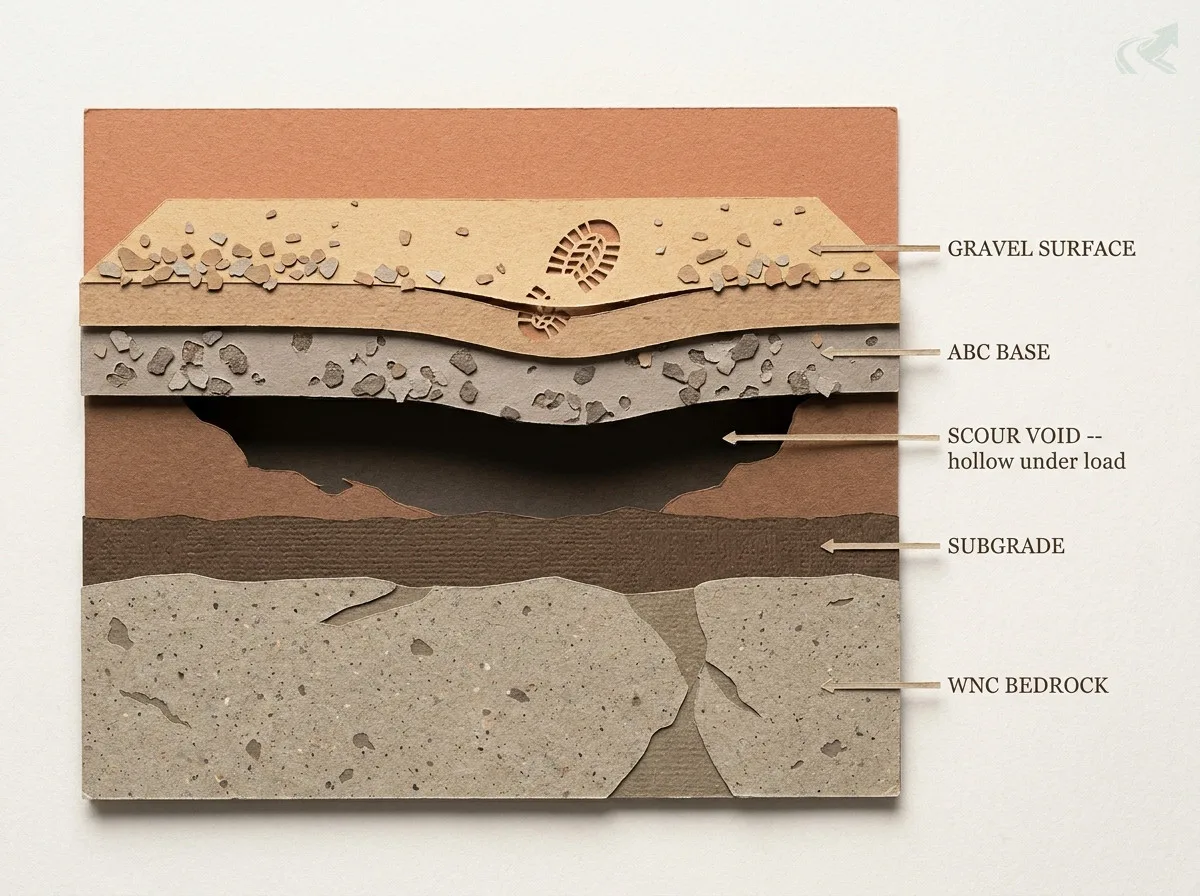
Roadbed undercut — flood water moved under the road base, leaving a shell that looks intact from above. Probe the edge with a rod, or walk slowly — if it feels hollow or springs underfoot, the subgrade is gone. It will collapse under vehicle load.
-
Stream channel relocation — the creek moved. It now runs where the driveway used to be, or close to it. This is a different engineering problem from a washed-out culvert: the drainage pattern itself has changed and the repair spec changes with it.
North Carolina mountain terrain in Rutherford, Buncombe, Henderson, Haywood, and McDowell counties adds complexity that Piedmont jobs don’t have. Shallow rock, steep grades, and saturated WNC soils change what the repair actually requires. WNC mountain soils and shallow rock is the deeper reference.
How to Assess Damage Before Calling a Contractor
Do a walk-down and document these specific things before you call anyone — it changes how the contractor treats the site visit.
Walk from the road end to the house end. Photograph everything. What to look for:
- Culvert inlets and outlets — are they still there? Is the headwall intact or eroded flat? Is the pipe silted, crushed, or shifted off its seat?
- Roadbed surface condition — walk the edge slowly. Probe soft spots with a rod or a piece of rebar. A hollow sound or spring underfoot = undercut subgrade.
- Scour marks and debris lines — these show you where the water came from and at what velocity. A contractor needs to understand the drainage path, not just the damage at the surface.
- Any channel migration — look at the creek bank nearest the driveway. Has it moved toward you? Is there active bank erosion between the creek and the driveway?
Document each item with photos. GPS pin the culvert location if you can. This isn’t busywork — an operator who sees organized documentation before the site visit allocates more time and arrives prepared for a real scoping conversation.
That vocabulary — headwall displacement, subgrade evaluation — signals you’re not calling for a gravel delivery. An operator who hears those terms treats the call differently.
Contractor Vetting in a Surge Market
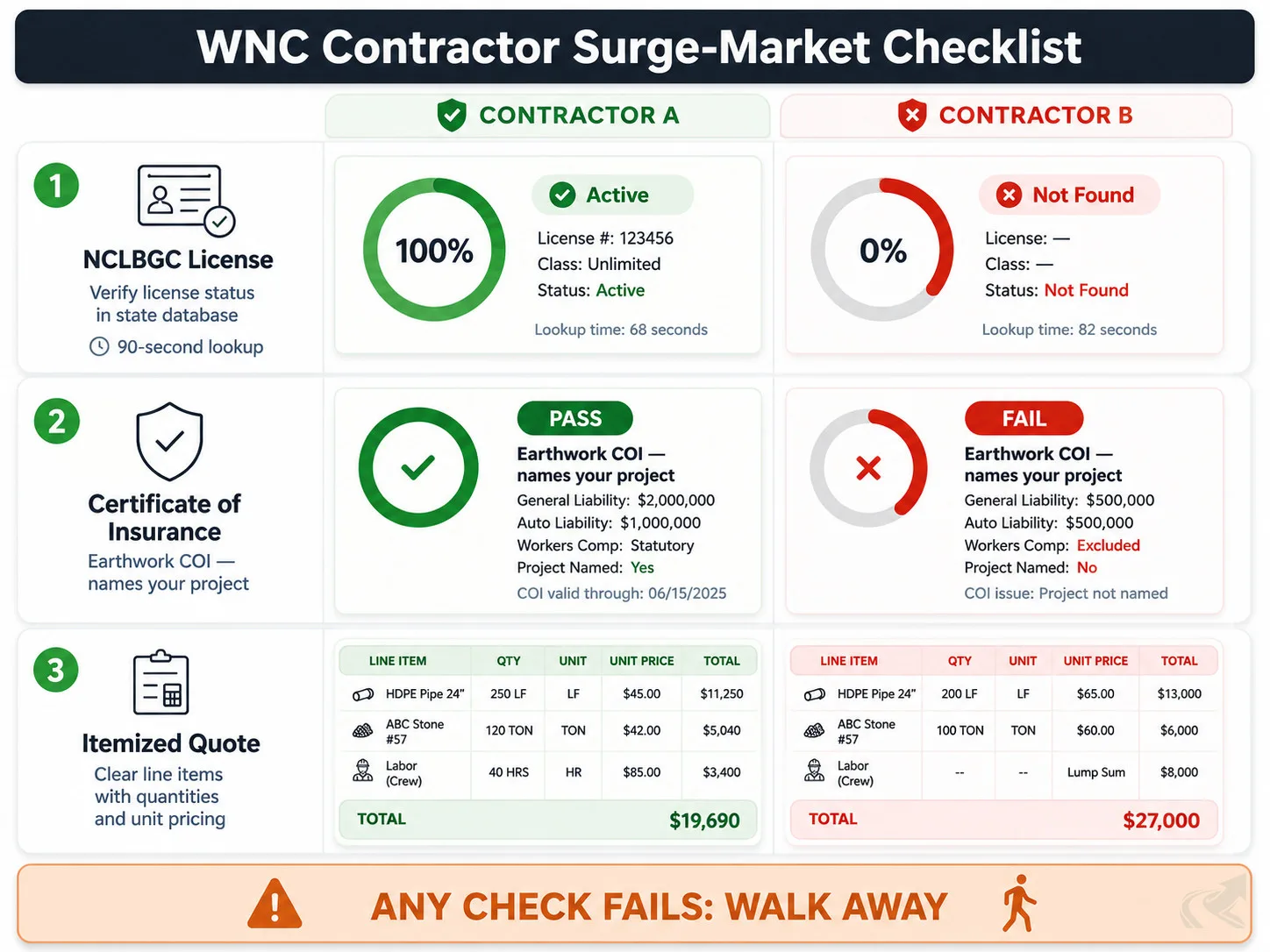
Post-disaster markets attract unlicensed operators. Two checks take two minutes and filter out most of them.
Western North Carolina has a limited pool of contractors who know WNC mountain terrain. Helene brought in operators from outside the region who quoted fast, often without seeing the site. The two-minute filter:
-
license verification — search at nclbgc.org. Takes 90 seconds. If the contractor’s name or company isn’t in the database, stop there. License status must show active, not expired or suspended.
-
specific to earthwork — ask for the certificate naming your project. A real operator has this document and can email it same day. Verbal assurances don’t protect you.
Three red flags specific to the Helene surge market:
-
No itemized quote — a lump-sum number with no material breakdown means the operator is pricing to your urgency, not to the actual work. You can’t tell whether the culvert is included, what grade of pipe, or how many tons of are in the bid.
-
“Cash only, start tomorrow” — real contractors in western NC have a backlog. Anyone who can start tomorrow six months into recovery has a reason.
-
No mention of permits — driveway repairs that require culvert replacement or roadbed reconstruction often trigger permit requirements in Buncombe, Henderson, and Rutherford counties, and sometimes right-of-way permits for work near a state-maintained road. If the contractor doesn’t bring it up, ask specifically: “Do any parts of this work require a county permit or NCDOT permit?”
The Repair Sequence — What Gets Fixed First
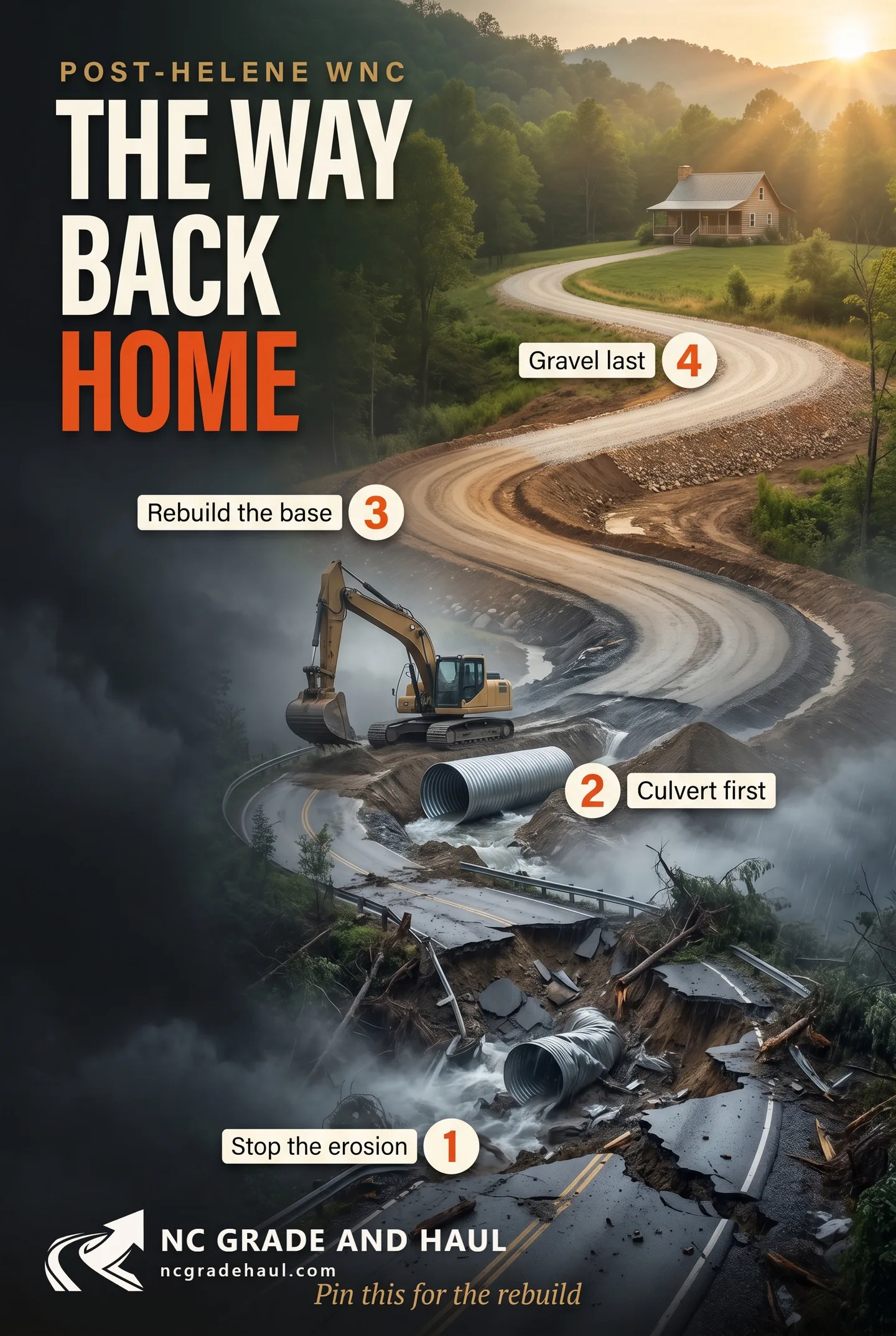
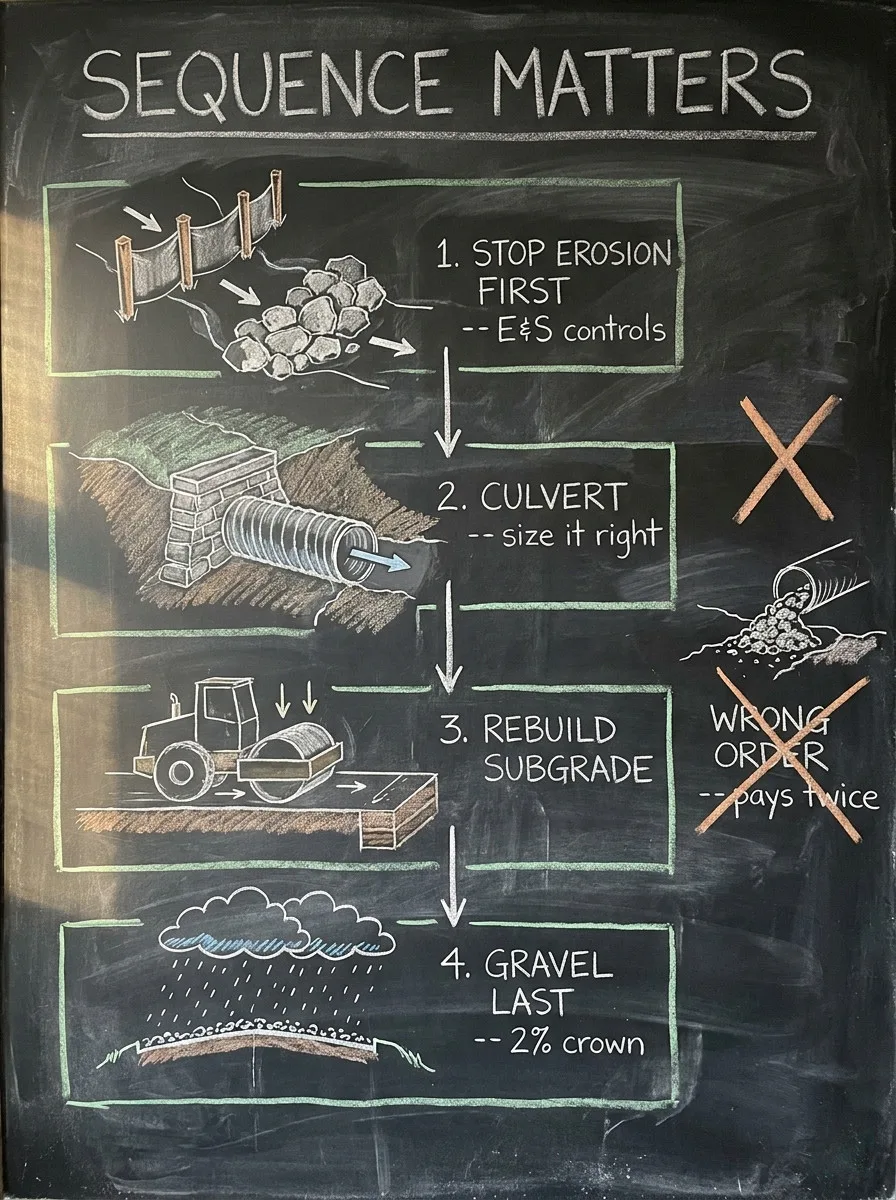
Culvert before gravel. Subgrade before surface. The sequence matters because the wrong order means paying for the same work twice.
The instinct is to get gravel on the driveway first — it’s visible, it’s daily-life functional, and it feels like progress. That’s usually the wrong call. Correct order:
-
Stabilize active erosion first — silt fence at stream entry points, rock check dams if water is still moving across the disturbed area. controls go in before anything else.
-
Replace or clear culverts — no point graveling a driveway if the culvert fails the first rain event. Size matters: undersized culvert pipe is one of the most common reasons a driveway fails again within a year. Ask the contractor what pipe diameter they’re specifying and why.
-
Rebuild subgrade where undercut — compact the roadbed, proof-roll to confirm load capacity, and verify the base material before any surface goes on. Skipping this step is how a driveway that looks repaired collapses under a loaded truck.
-
Surface gravel last — ABC base layer, #57 stone cap, proper crown for positive drainage. Crown is a 2% slope toward the ditch line — without it, water sheets across the surface rather than shedding off it.
WNC mountain terrain adds one element most Piedmont contractors haven’t worked with: rock outcrops and shallow soil that limit culvert depth and headwall options. Some WNC culvert replacements require rip-rap at the outlet to dissipate velocity without scouring the outlet end. Ask specifically whether the contractor has done culvert work in WNC mountain terrain — not just Piedmont grading.
Getting in Queue — How Scheduling Actually Works Right Now
WNC contractors are running 4—6 month wait times for new driveway and culvert projects [verify current timeline each quarter]. Getting in queue is not the same as having a confirmed start date.
The WNC contractor pool for earthwork was limited before Helene. It is still limited. Practical steps for actually getting on a schedule:
-
Call at least three verified contractors — first-call response rate in surge markets is lower than normal. Some operators are scheduling site visits six weeks out before they’ll quote. That’s normal right now.
-
Ask for a site visit, not a quote — the site visit establishes scope; the quote follows. Trying to get a real number over the phone for WNC mountain terrain is how you end up with a guess that doesn’t survive the first site walk.
-
Get a specific timeline — ask: “What is your current booking lead time for a project of this scope?” A month, not “we’ll fit you in.” If they can’t give a month, keep calling.
-
Confirm WNC experience — not just grading experience. WNC culvert and roadbed work in mountain terrain is different from Piedmont subdivision grading. Ask if they’ve done culvert replacement work in Buncombe, Henderson, or Rutherford county specifically.
Read booking a contractor in a post-Helene WNC market for the full booking strategy. Then hire a verified NC grading contractor — filter for WNC coverage and active NCLBGC license. Asheville driveway washout repair after Helene covers Buncombe County-specific considerations.
Common Mistakes in a Post-Disaster Market
Graveling before culvert repair. The gravel washes out in the first rain. You just paid for it twice.
Taking the first quote. Post-disaster first quotes are priced to urgency. Three quotes minimum, even if it takes three weeks to collect them.
Skipping the license check. Takes 90 seconds at nclbgc.org. Not optional in a surge market.
Deferring the culvert. A failed culvert doesn’t stabilize on its own. It gets worse and takes the roadbed with it the next time it rains hard in the mountains.
Get an itemized quote — not a phone estimate, not a ballpark. WNC Helene repair quotes should break out pipe size, ABC tonnage, and labor separately so you can tell what you’re actually buying. Hire a grading operator in North Carolina to start comparing real numbers.
For the broader NC disaster recovery contractor backlog situation, that page covers patterns across all post-Helene counties.