
Questions Buncombe County homeowners are asking right now
Can I get a driveway contractor in Asheville now?
The Buncombe County contractor market surged after Helene and remains backlogged. NC Grade and Haul lists verified contractors who operate in WNC -- lead times for mountain driveway work vary by contractor and recovery phase; expect multi-week waits and confirm availability directly when you call. Here's what the repair scope looks like and what to ask.
Is my washed-out WNC driveway the same job as a regular driveway repair?
No. Shallow soil over bedrock, failed culverts, and stripped embankments make mountain washout repair a different category from Piedmont driveway work. Equipment selection, compaction approach, and sequencing all differ. Most surge contractors who showed up after Helene were geared for the latter.
Your gravel is gone. The culvert at the road connection is crushed or washed out entirely. The embankment on one side has caved toward the creek. You’ve called three contractors — two never called back, one quoted you an 8-week wait.
That’s the standard post-Helene driveway situation in Buncombe County. This page is about what the repair job actually is, why WNC mountain driveways are a different repair category, and how to hire in a market where everyone is busy and not everyone knows mountain-soil conditions.
What Helene Did to Mountain Driveways in Buncombe County
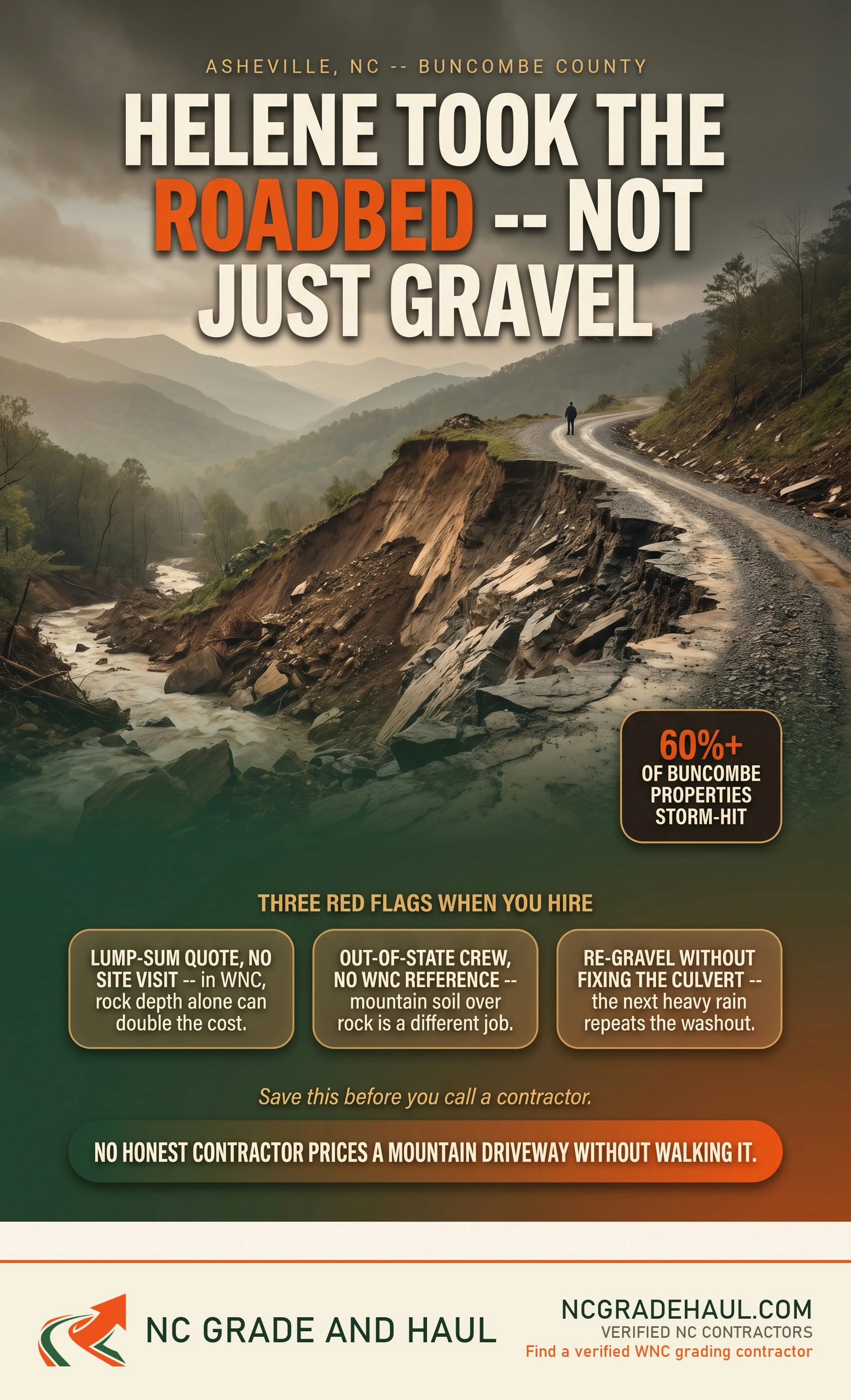
Helene didn’t just wash gravel off WNC driveways — it undercut culverts, stripped embankments down to bedrock, and destroyed the substrate that gravel ever sat on.
WNC mountain soil is thin. Most Buncombe County driveways sit on a shallow soil profile above decomposed granite and hard rock — NRCS soil series established in the Southern Blue Ridge (Craggey series: bedrock at 14 inches; Tsali series: bedrock at 18 inches) confirm that many upland and ridge-side driveways have fewer than 20 inches of workable soil before hitting bedrock. That’s the entire profile.
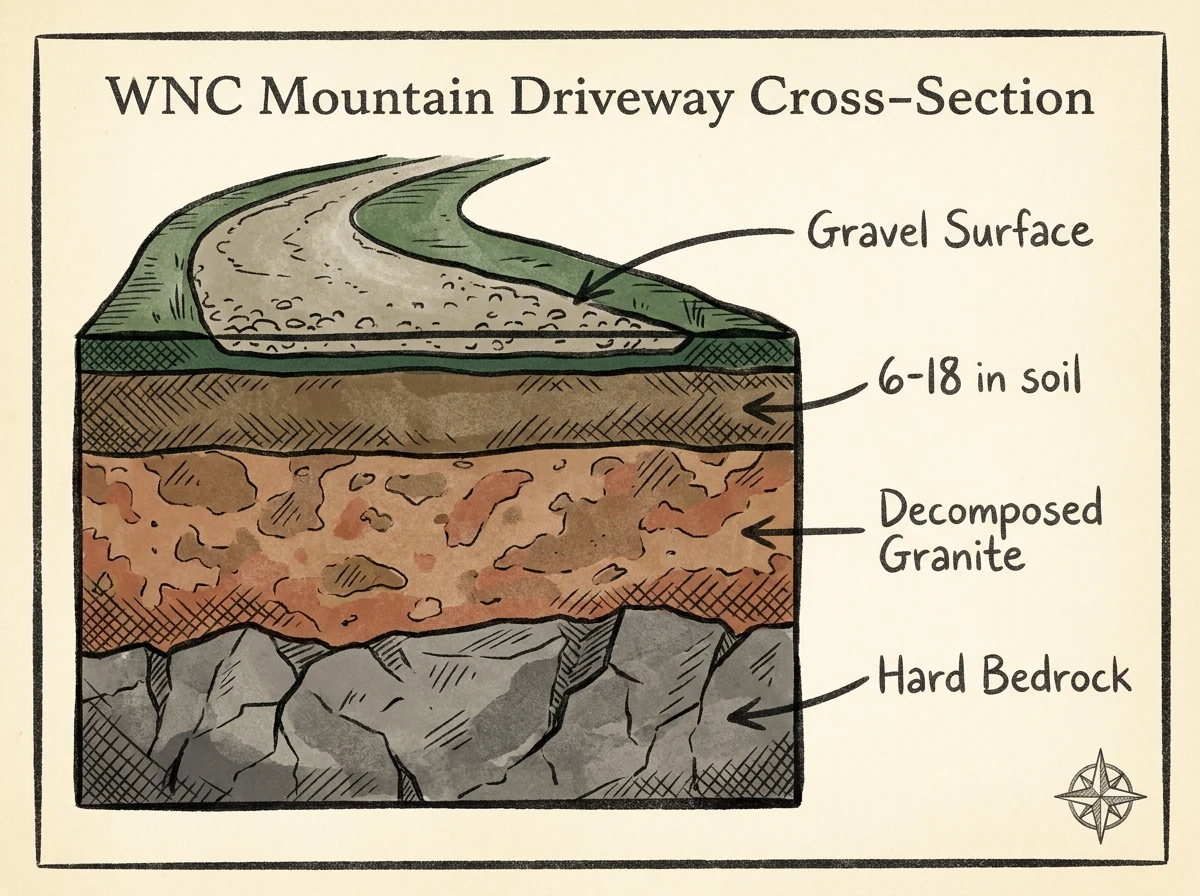
When that shallow layer saturates, it sheds water like a paved surface. Every low point, culvert inlet, and driveway entrance becomes a channel. Helene dropped sustained rainfall across WNC that overwhelmed every one of those channels simultaneously.
The result in Buncombe County was extensive driveway and road damage across the county. NCDOT identified more than 8,100 damage sites to roads, bridges, and culverts across the WNC recovery zone — one of the largest infrastructure damage events in state history. The driveway damage was concentrated at culverts, embankment transitions, and road-connection points — exactly the spots where water had somewhere to go fast.
What Helene did to a Buncombe County mountain driveway
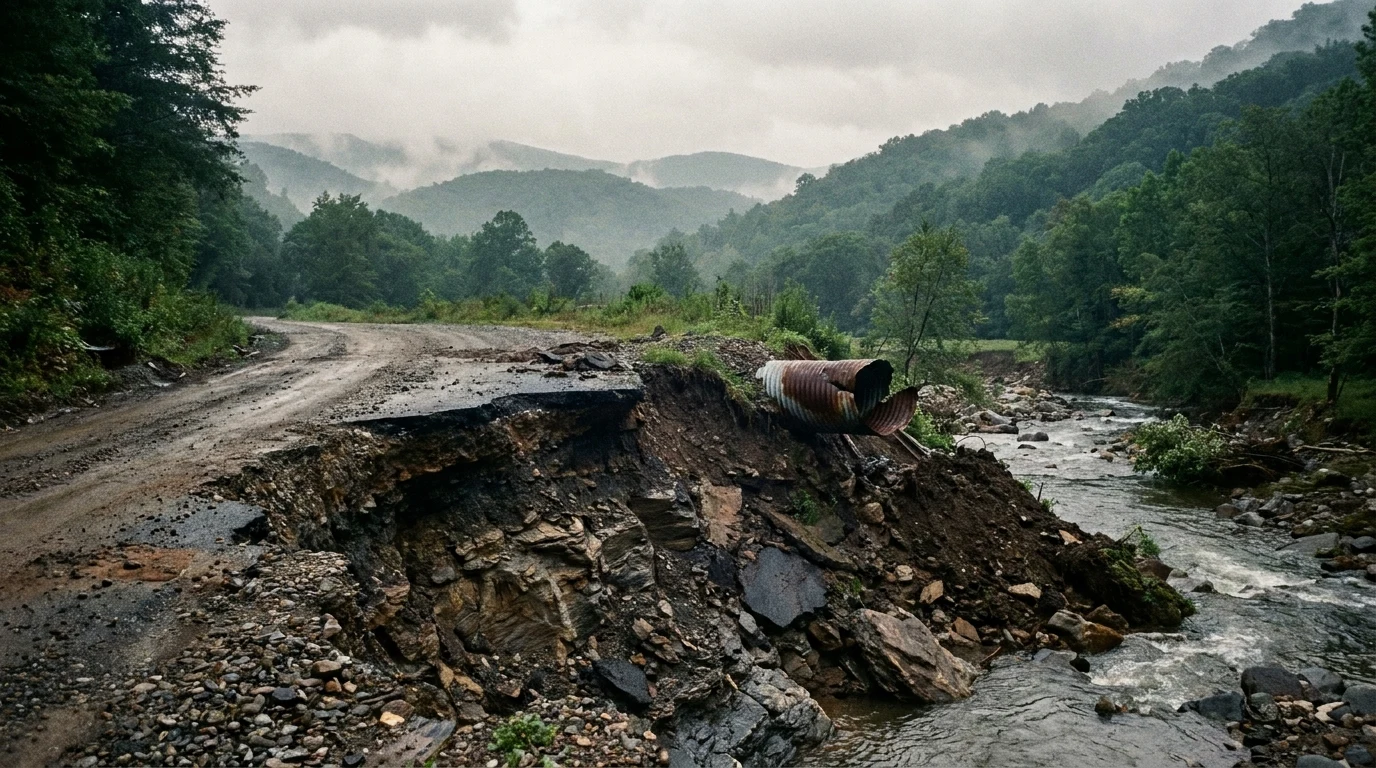
Comparison. Intact mountain driveway: Compacted CABC base over a cut-and-graded subgrade; Culvert sized for mountain flow and set at the correct grade; Embankment retained, with erosion control at the inlet and outlet; Surface aggregate sheds water instead of channeling it. Post-Helene washout: Culvert crushed, undersized, or scoured out entirely; Embankment caved toward the creek, subgrade gone; Decomposed granite and hard rock exposed at the surface; Gravel and the substrate it sat on both washed away.
- Compacted CABC base over a cut-and-graded subgrade
- Culvert sized for mountain flow and set at the correct grade
- Embankment retained, with erosion control at the inlet and outlet
- Surface aggregate sheds water instead of channeling it
- Culvert crushed, undersized, or scoured out entirely
- Embankment caved toward the creek, subgrade gone
- Decomposed granite and hard rock exposed at the surface
- Gravel and the substrate it sat on both washed away
On WNC's 6-to-18-inch soil profile, the repair is re-setting the culvert and rebuilding the roadbed -- not re-graveling.
The repair job is not re-graveling. It’s re-setting culverts, re-establishing embankments with compacted fill, and in some cases cutting into rock to re-establish drainage channels before any aggregate goes back down. See the full NC driveway washout repair guide for the technical sequence.
The Surge Contractor Market in WNC — What You’re Actually Navigating
After Helene, WNC’s contractor market saw an immediate surge of out-of-state operators who had the equipment but not the mountain-specific experience.
Here’s what a surge market looks like from the inside. Legitimate local operators who know Buncombe County rock conditions carry significant backlogs — lead times vary by contractor and change as recovery progresses, so call ahead and confirm directly. Out-of-state operators show up with skid steers and compact excavators — useful equipment, wrong experience base.
A contractor experienced with Piedmont red-clay drainage does not automatically know how to work in shallow-soil-over-rock conditions. Equipment selection is different. Blasting vs. chiseling decisions are different. Culvert sizing for mountain flow rates is different from sizing for flat-lot drainage.
Red flags in a surge market:
- Lump-sum quote with no site visit — in WNC, rock depth alone can double repair cost. No legitimate contractor can price this job without walking it.
- No license — verify the number at the NCLBGC portal before signing anything.
- No local reference from within Buncombe or Henderson County — out-of-state operators should be able to name a completed WNC job.
Ask specifically: “Have you done post-storm driveway repair in WNC? What was the rock depth?” If the answer is vague, keep looking.
For a post-Helene driveway repair in WNC overview covering the broader mountain-county surge context, that page covers what the Helene recovery window looks like across the region.
What Buncombe County Requires for Driveway Repair
Most residential driveway repair in Buncombe County doesn’t require a county grading permit — but culvert permits apply if you’re touching the road connection.
Buncombe County requires an erosion control permit for land disturbance of one acre or more — mirroring the state Sedimentation Pollution Control Act 1-acre trigger. The exception: properties in a designated Hillside Subdivision drop to a 1/4-acre threshold. Most residential driveways fall under the 1-acre threshold, but if your parcel is in a hillside subdivision, confirm the lower trigger. Note that inside the City of Asheville limits, the city — not the county — administers erosion control.
The culvert at the road connection is a different situation. Any time the driveway connection to a state-maintained road is constructed or modified, NCDOT requires a Street and Driveway Access Permit (an encroachment agreement) before work begins on state right-of-way. NCDOT also sets minimum pipe sizes — 15 inches for driveway pipes, 18 inches for cross pipes. Your contractor needs to know this — and needs to know whether your road is state-maintained or privately maintained, because the rules differ.
This matters in practice. A contractor who pulls the culvert and swaps it without the NCDOT permit is leaving you exposed. Ask before work starts: “Is this road state-maintained? What permit do you pull for the culvert work?”
What the Repair Scope Looks Like (and What It Costs to Scope)
A WNC mountain driveway repair after Helene is a site-specific job — there is no per-foot price that means anything before a contractor walks the driveway.
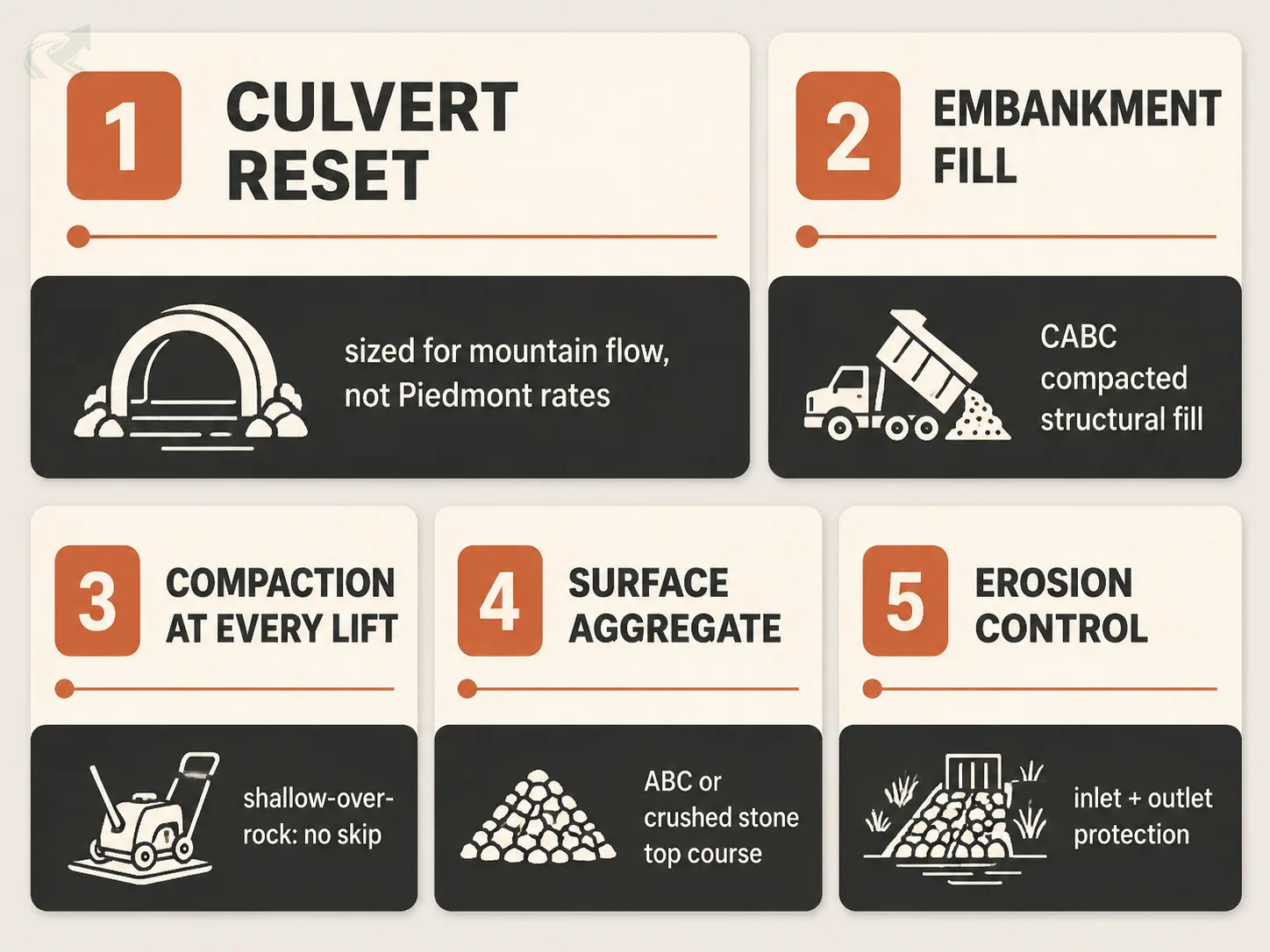
Typical scope elements for a post-Helene Buncombe County driveway:
- Culvert replacement or reset — if the existing culvert is crushed, undersized, or offset, it goes out first. New culvert sized for mountain flow rates, not Piedmont rates.
- Embankment re-establishment — compacted structural fill to rebuild what washed away. or ABC gravel as the base layer, not loose fill.
- Compaction at each lift — shallow-over-rock conditions mean there’s no deep soil column to absorb vibration. Compaction at every lift is non-negotiable on WNC driveways.
- Surface aggregate — ABC or crushed stone top course after base is confirmed stable.
- Erosion control at inlets and outlets — culvert inlets and outlets are the next failure points if they’re not protected.
What a proper site assessment includes: the contractor walks from the road connection to the top of the driveway, identifies every failure point, notes rock depth at each one, and assesses culvert condition before writing a line item. An itemized quote that comes back without that site visit isn’t worth the paper.
Hire an NC grading operator in Asheville — NC Grade and Haul lists contractors with active NCLBGC licenses who operate in Buncombe and adjacent WNC counties.
Three Mistakes WNC Homeowners Make After a Surge Event
All three are avoidable. All three are common right now in Buncombe County.
-
Hiring without a local reference. Out-of-state surge contractors may have equipment but not mountain-soil experience. Ask for a Buncombe or Henderson County reference specifically. If they can’t name one, that’s your answer.
-
Accepting a lump-sum quote without a site visit. In WNC, rock depth alone can double repair cost. There is no ballpark number for a WNC mountain driveway repair — the site walk IS the scope. No legitimate contractor skips it.
-
Re-graveling without fixing the culvert. If the culvert failed, re-graveling is wasted money. The next heavy rain repeats the damage. Fix the drainage failure first, then put gravel down — not the other way around.
What This Page Does NOT Cover
Use these links if your situation falls outside Asheville/Buncombe County driveway washout repair.
- FEMA and state disaster aid for private driveway repair — see Hurricane Helene WNC earthwork recovery context for current program status. Some programs have closed; confirm at fema.gov and the NC recovery portal directly.
- Henderson County and Bat Cave driveway context — see Bat Cave NC driveway repair near Asheville after Helene for the adjacent-county micro-context. Rock profiles and contractor market differ slightly.
- When to hire in a post-hurricane backlog market — see booking a contractor for Asheville driveway repair after Helene.
Before You Call: Copy This Question
The question below covers what a legitimate WNC contractor will answer in the first five minutes of a call. If the contractor can’t answer it, that’s diagnostic information.
Question to ask before hiring a post-Helene driveway contractor
“Have you done mountain driveway repair in Buncombe or Henderson County? Walk me from the road connection to the top — where are the failure points?”
From our directory
Verified contractors near you
Every listing is cross-checked against the NC Licensing Board public record before it appears. Pick your city:
Or browse the full NC contractor directory.