
Two questions WNC homeowners are asking
My driveway was destroyed by Helene. What do I do first?
Determine whether the damage is cosmetic (gravel stripped from an intact base) or structural (culvert failure, base scour down to rock, creek channel migration). Cosmetic can be temporarily stabilized. Structural needs a licensed contractor and an itemized quote before anyone touches it. Verify any NC contractor at NCLBGC.org before signing.
Will NCDOT fix my driveway?
No. NCDOT repairs state-maintained roads, including SR-numbered secondary roads. Your private driveway -- even if it's your only access -- is your financial responsibility. One exception: if Helene destroyed the culvert under the state road right-of-way where your driveway meets the road, that specific portion may be NCDOT's. Ask your NCDOT Division Engineer directly.
The creek that always ran 40 feet from Dave’s driveway in Bat Cave is now 10 feet away. Three sections of driveway are gone — not washed, gone. The base, the gravel, the culvert at the bottom. NCDOT fixed the state road 200 yards down the hill in November. Dave’s private driveway is not on anyone’s list.
He’s gotten two calls from contractors he’s never heard of. One from Georgia. One from Tennessee. Both quoting $28,000. A neighbor went with a low bidder from the valley and is paying for it twice.
This page is for Dave. And for everyone in Buncombe, Henderson, Rutherford, McDowell, and the other WNC counties living with the same situation seven months after Helene made landfall.
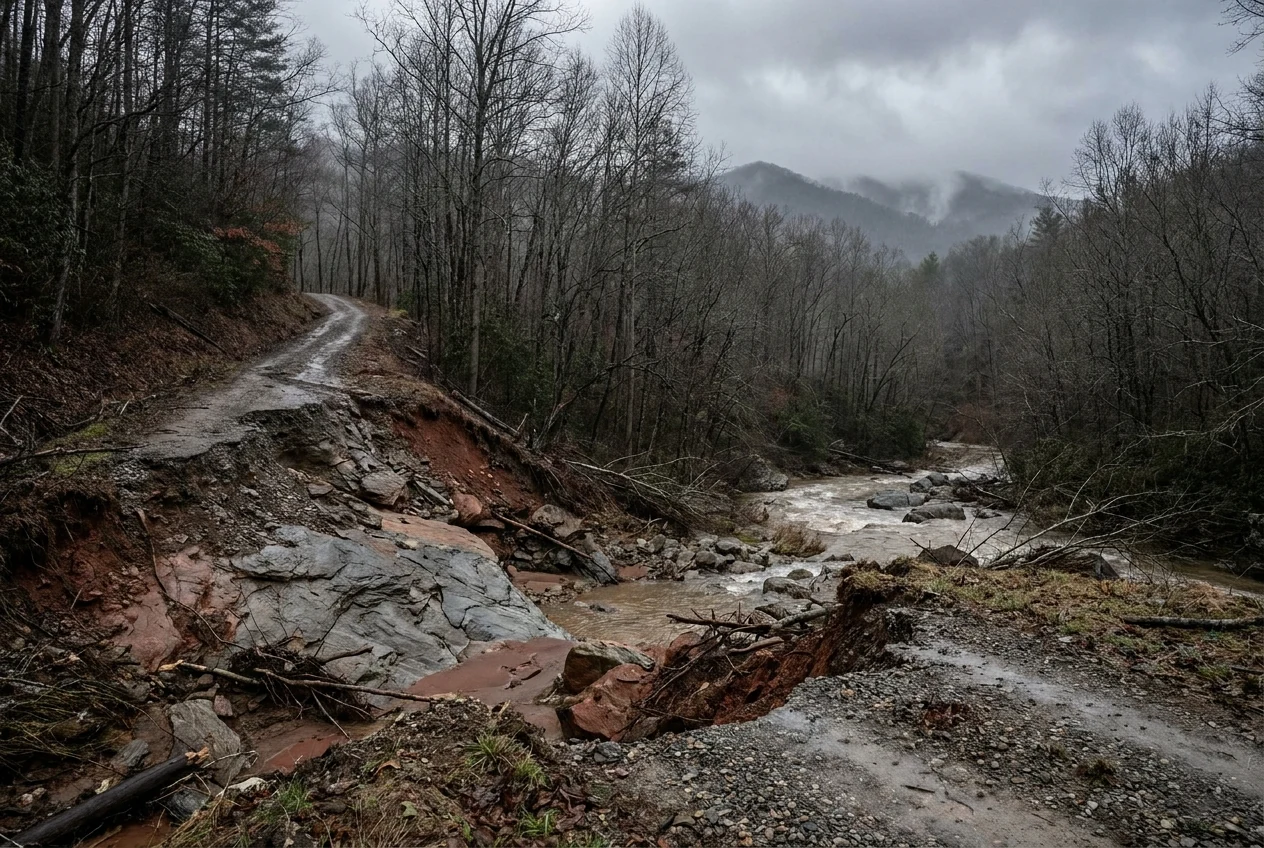
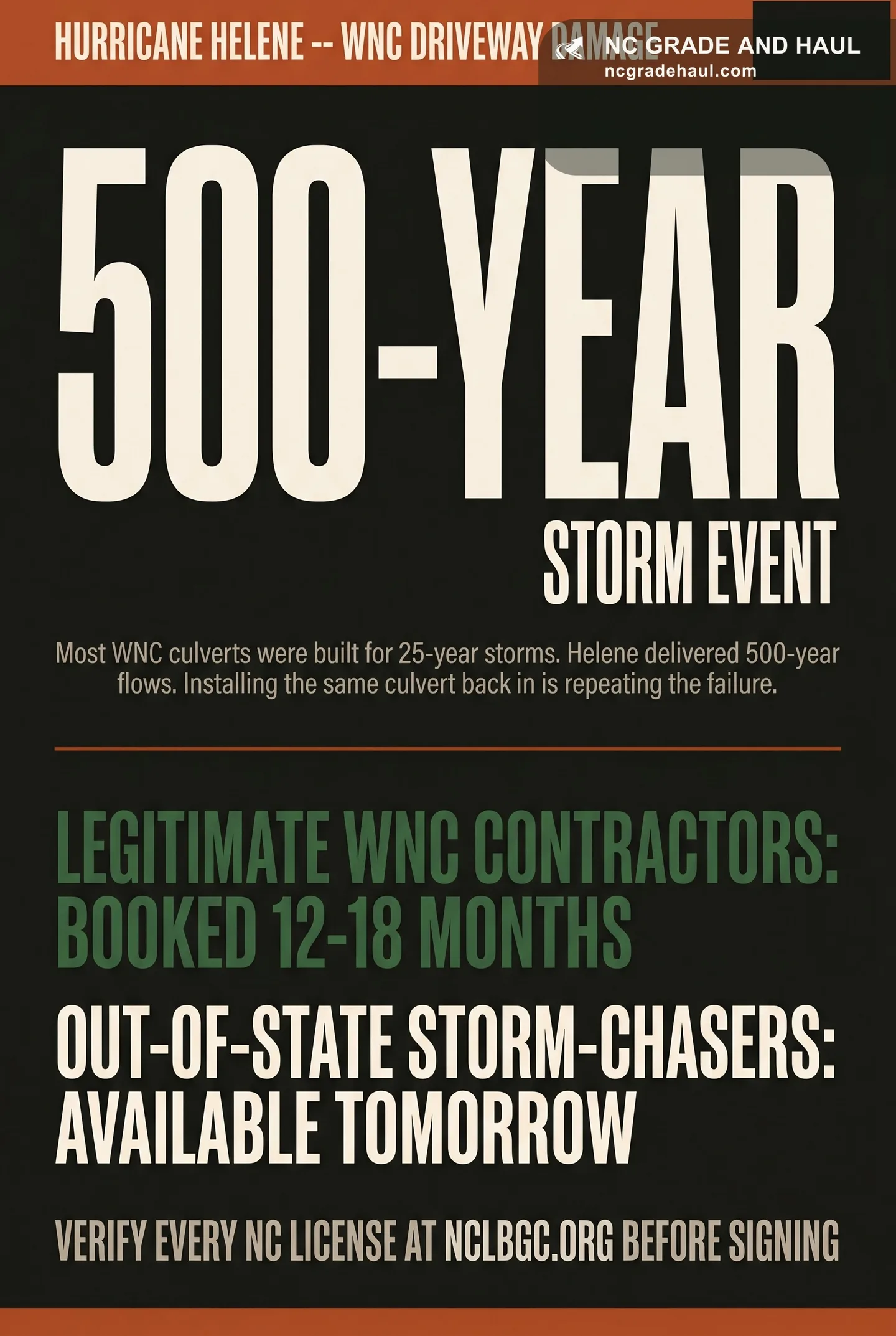
What Helene Actually Did to WNC Driveways
Helene wasn’t a typical spring washout — it moved creek channels, destroyed culverts, and undercut road bases that were stable for 40 years. That’s a different repair problem than a heavy-rain event.
Most WNC mountain driveway culverts were sized for 25-year storm events. Helene delivered flows in some watersheds that exceeded 500-year event levels. Those culverts didn’t fail because they were neglected — they failed because the event was outside their design envelope.
Four damage types show up across Buncombe, Henderson, and Rutherford counties:
- Culvert destruction. Replacement culverts should be upsized from what was there. Installing the same diameter back in is repeating the failure.
- Creek channel migration. In many holler properties, Helene moved the creek channel itself. A driveway built 30 feet from a creek may now have 6 feet of buffer. That is a bank stabilization problem — potentially requiring permits from NC Division of Water Resources or US Army Corps (Section 404) — not a driveway-gravel problem.
- Base layer scour. WNC mountain soils are shallower than Piedmont soils. Helene scour didn’t just strip gravel — it removed the base layer down to solid rock in some locations. That changes the repair sequence entirely.
- County road access. Buncombe, Henderson, and Rutherford county roads that serve private properties are still partially unrepaired. The driveway repair problem is compounded by whether the county road it meets is accessible.
See Hurricane Helene WNC damage context for broader recovery data and timeline.
NCDOT vs Private — Who Repairs What
repairs state-maintained roads. Your private driveway — even if it’s the only access to your property — is not NCDOT’s responsibility, regardless of how Helene damaged it.
The boundary is typically the property line, at the start of your private driveway. The public road right-of-way (state or county) covers repairs on the public side. Your side is your financial responsibility.
One exception worth pursuing: if Helene destroyed the culvert that sits under the state road right-of-way where your driveway meets the road — not your private driveway culvert, but the access-connection culvert — that portion may be NCDOT’s. This is the specific question to bring to your NCDOT Division Engineer for Division 13 (Buncombe, Henderson, Rutherford area) or Division 14 (McDowell, Yancey area).
Secondary road note: roads with SR numbers are state-maintained and on NCDOT’s repair list. If your access road has an SR designation, it is not a private road. Check the road number before assuming your access is private.
On Individual Assistance: homeowners in federally declared disaster counties may qualify for IA funding toward driveway repair if the driveway is the primary access to the home. North Carolina’s post-Helene disaster declaration (DR-4827-NC) covers Buncombe, Henderson, Rutherford, McDowell, Haywood, Yancey, Burke, and Caldwell counties, among others. Check current eligibility at FEMA.gov or through NC Emergency Management (NCEM.org) — IA program details have evolved as the recovery period has extended.
For private road damage beyond the driveway itself, see private road repair when NCDOT has no Helene timeline.
Surge Market Navigation — Vetting Contractors After Helene
Post-disaster markets attract unlicensed and out-of-state contractors. Two questions and one website separate qualified operators from the storm-chasers.
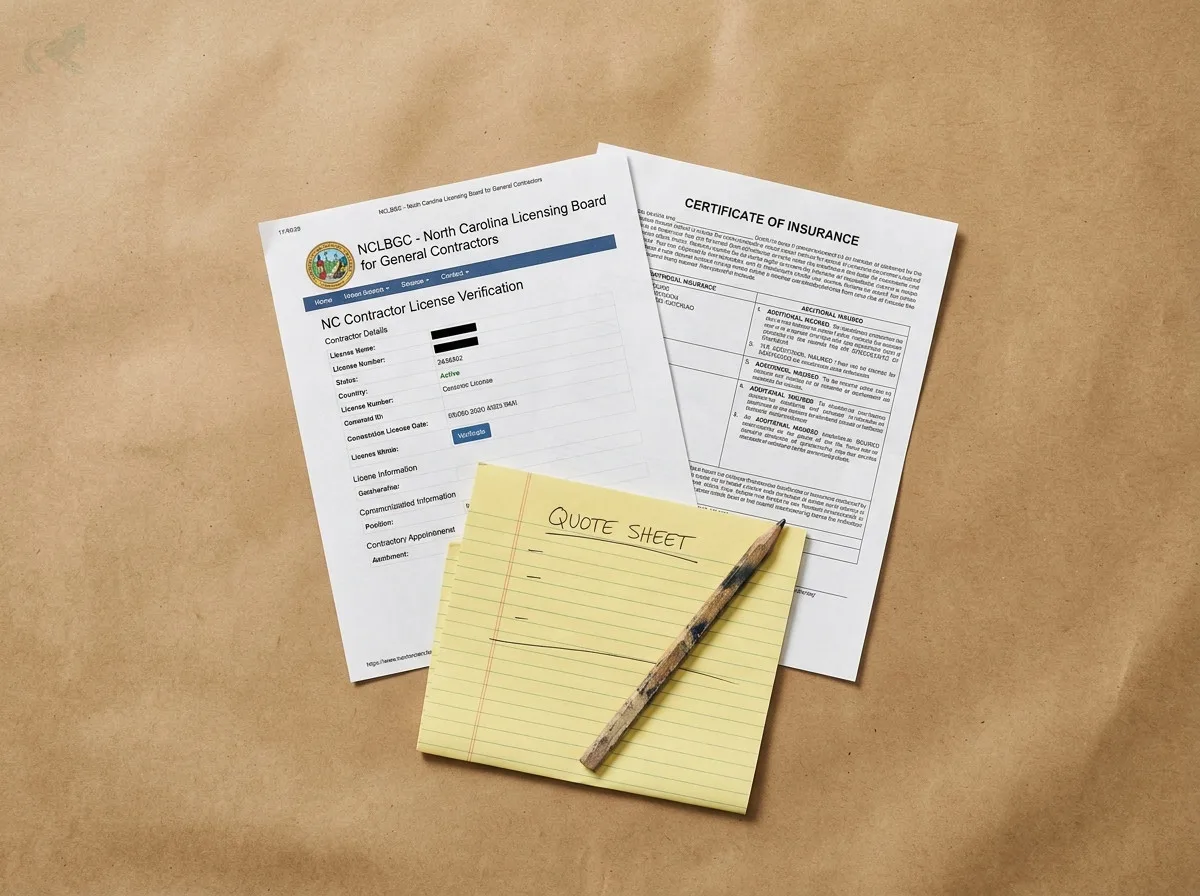
North Carolina requires contractors performing grading, excavation, or road construction above certain dollar thresholds to hold a license from the . Verify any contractor’s license at NCLBGC.org before anyone touches your property.
The three-question filter before signing anything:
- “What is your NC contractor license number?” — verify it live at NCLBGC.org while they’re standing there.
- “Do you have a that lists my name as additional insured?” — get the certificate in hand before any equipment rolls onto your property.
- “Can you give me three WNC references from post-Helene work?” — contractors who arrived from two states away after the storm don’t have WNC references.
Copy This Contractor Vetting Card
Post-Helene Contractor Check — 3 Questions Before Anyone Touches Your Driveway
- What is your NC contractor license number? (Verify at NCLBGC.org)
- Do you have a Certificate of Insurance (COI) listing my name as additional insured?
- Can you give me three WNC references from post-Helene driveway or road work?
Red flags: unsolicited door-knock, cash-only deposit, quote within 5 minutes of arriving, same-day availability. Legitimate WNC contractors are booked out.
Surge market red flags specific to post-disaster WNC:
- Unsolicited door-knock. Legitimate contractors in a post-Helene market are backlogged 12 to 18 months. They are not knocking on doors.
- Cash-only deposit. No license, no insurance, no liability. Walk away.
- Quote within 5 minutes of arriving. A legitimate WNC driveway repair quote requires walking the full damage, checking the culvert throat, assessing slope and drainage path — not a look from the truck.
- “We can start tomorrow.” Post-Helene, the contractors who know WNC subgrade and mountain culvert sizing are booked. Same-day availability is a red flag, not a convenience.
The WNC contractor backlog after Helene page has current wait-time data as contractors cycle through the recovery queue.
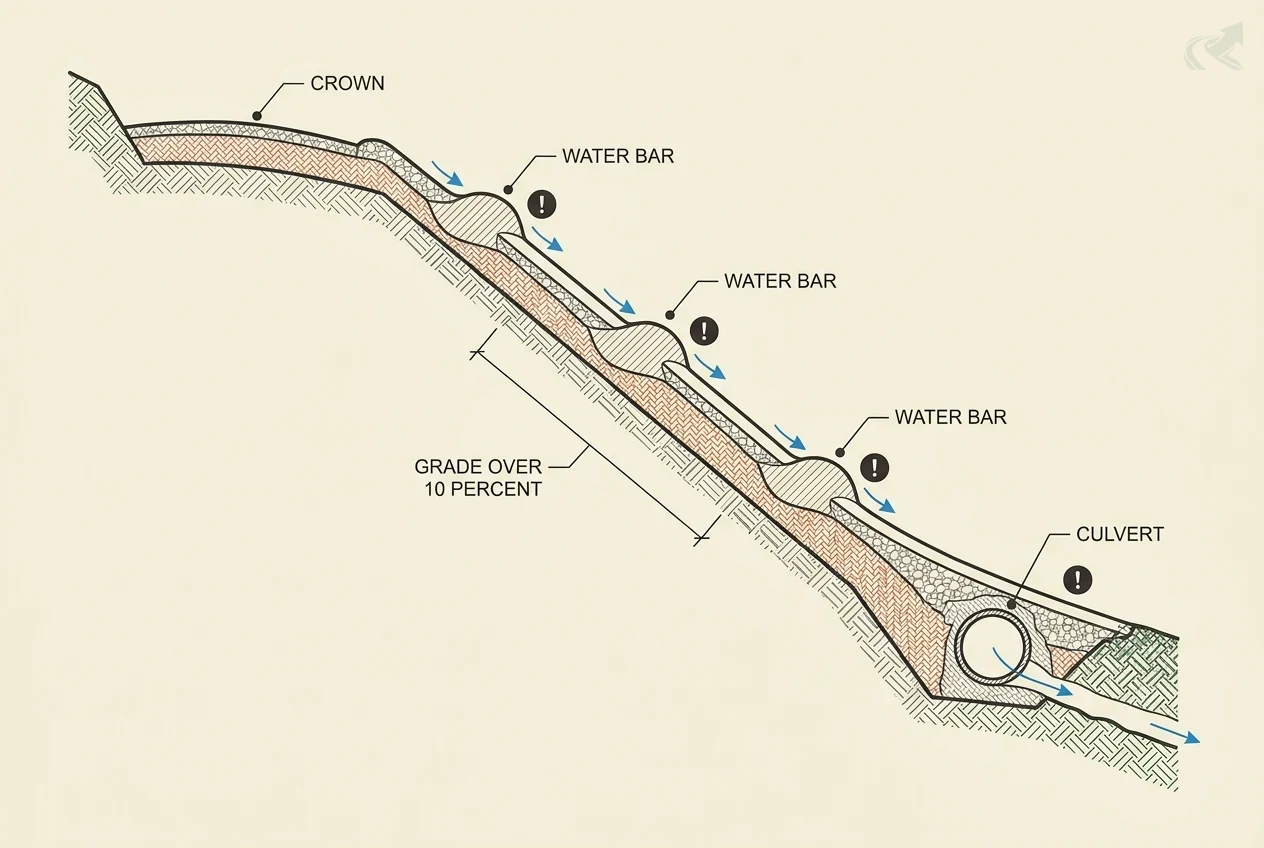
The Repair Sequence for Mountain Driveways
Mountain driveway repair follows the same sequence as Piedmont repair — source, base, fill, compact, crown — but WNC adds steps for slope management and culvert upsize.
The standard sequence for washout repair is covered in the NC driveway washout repair guide. WNC-specific additions:
- Culvert upsize. Don’t reinstall what was there. If the existing culvert was 12-inch and Helene destroyed it, the replacement should be sized for a larger design storm. Ask your contractor what sizing methodology they’re using and whether it accounts for Helene-level flows in WNC watersheds.
- Water bar installation. On steep grades above 10%, water bars — compacted berms placed perpendicular to the driveway every 50 to 100 feet — break up sheet flow before it gains enough velocity to scour. Standard crown isn’t sufficient on WNC grades. Ask for water bars to be specified in the quote.
- Rock subgrade confirmation. WNC base layers are shallower. Repairs may hit solid rock 18 inches down. That’s a foundation, not an obstacle. Confirm your contractor knows how to use a rock base rather than treating it as a problem to bury.
- Compaction verification. On mountain grades, compaction matters more than on flat Piedmont work. The contractor should be able to tell you the lift thickness and compaction method — not just “we packed it in good.”
For the deep divot driveway repair from Helene damage scenario — where scour created 2-foot drops in the surface — see the specific spoke on that failure type.
For driveway culvert installation specifics, see driveway culvert installation NC.
What to Do While Waiting for a Contractor
If your driveway is impassable and you’re waiting on a booked contractor, there are temporary steps that reduce further damage without committing to a full repair.
Temporary measures within DIY scope:
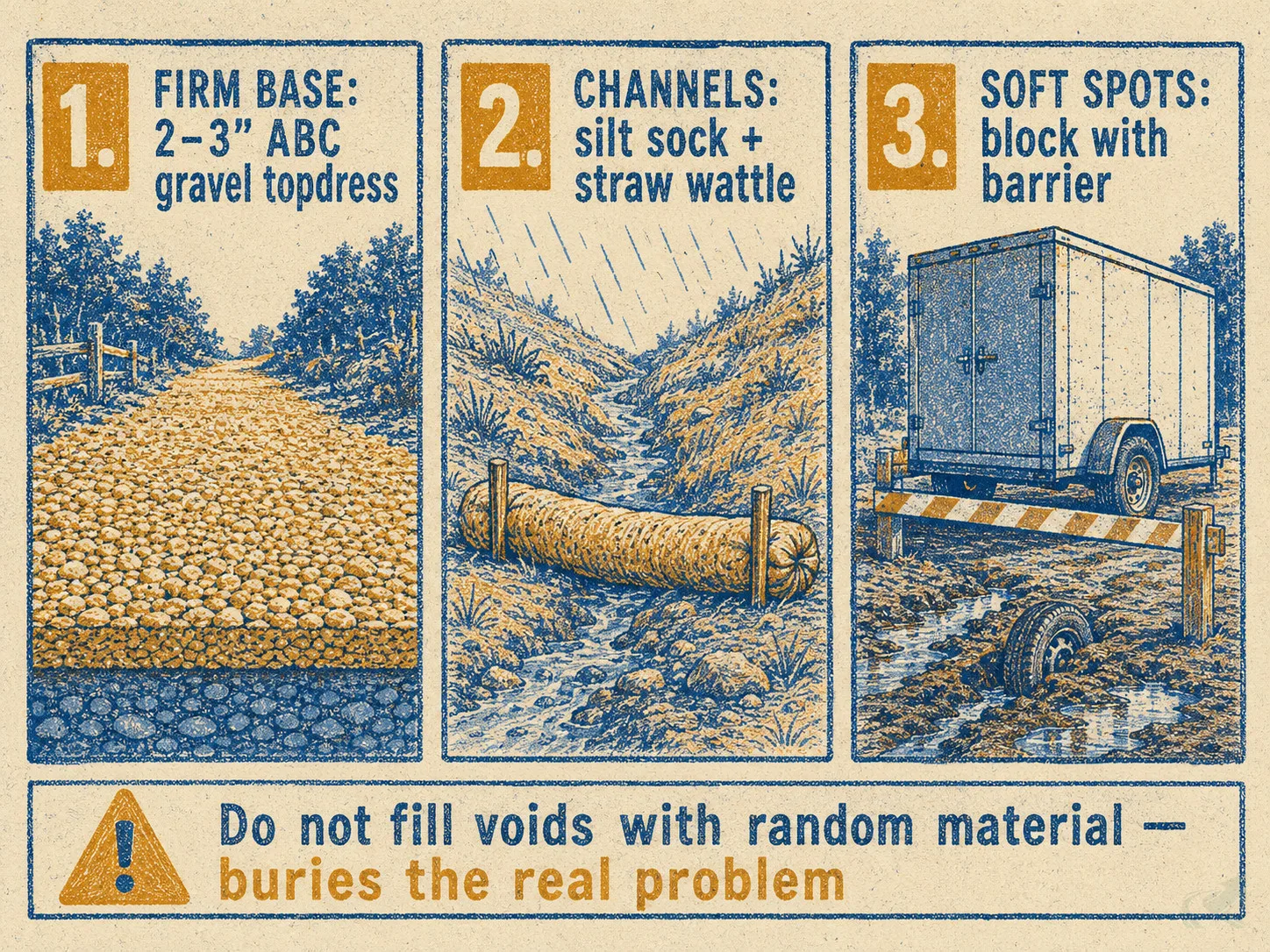
- Gravel topdress on firm surfaces. If the base is intact but gravel is stripped, 2 to 3 inches of fresh on firm ground restores passability temporarily. This is cosmetic maintenance, not repair. The base assessment still needs to happen.
- Silt sock and straw wattle. Install erosion barriers to prevent NC driveway washout at channels to slow further cutting while the base is exposed. These delay deterioration; they are not repairs.
- Block soft sections. Park a trailer or barrier at sections where the base is soft. Driving over unrepaired soft base with a loaded vehicle deepens the damage and increases the eventual repair cost.
What not to do while waiting: fill the void with anything — old concrete, rip-rap dumped loose, random fill — without a base assessment first. Burying the problem without knowing what’s underneath is the most expensive temporary fix there is. A contractor who arrives to a void full of random material has to remove it before starting the actual repair.
Getting a Quote That Means Something
WNC is not Triangle. The contractors who work mountain driveways understand WNC shallow rock subgrade, culvert sizing for mountain watershed flows, and slope management on grades that would never appear in Piedmont residential work.
Get an itemized quote from a licensed North Carolina operator who will walk the damage with you, name the water source, specify the culvert size, and call out the water bar locations before quoting material.
If they quote by the load without seeing the subgrade, they are not bidding the repair. They are bidding the surface.
Find a grading contractor in North Carolina who operates in WNC.