
The two questions WNC homeowners ask first
How is WNC mountain drainage different from Piedmont or Coastal Plain NC?
Mountain soils in western NC are typically 6 to 24 inches deep over hard bedrock. There is no soil depth for a French drain to work in. Drainage engineering here is surface routing -- swales, grade, diversion berms -- not pipe-in-trench systems. Helene made this visible when saturated shallow soil detached from rock and failed as debris flows.
My WNC driveway was destroyed by Helene. Why did it happen and what actually fixes it?
WNC driveways fail during extreme rainfall because shallow soil over impermeable bedrock has nowhere to send water underground. All runoff travels on the surface at high velocity. A driveway that failed once will fail again unless the uphill runoff path is redesigned -- not just the surface rebuilt. Surface diversion, proper crown, and correctly sized culverts are the fix.
A Buncombe County contractor showed up at a Bat Cave property after Helene and recommended a French drain to handle the washed-out driveway. The homeowner had seen French drain installations before. Something felt off.
The contractor dug six inches and hit solid rock. The homeowner sent him home.
That instinct was correct. A French drain needs 18 to 36 inches of soil to install and drain into. WNC mountain soil often does not have that depth — and even when it does, the bedrock below provides no percolation outlet. Installing a French drain into six inches of mountain soil creates a collection basin at the rock surface, not a drainage solution.
This page explains why WNC mountain soil behaves the way it does, what Helene’s rainfall made visible, and what drainage approaches actually work in western North Carolina.
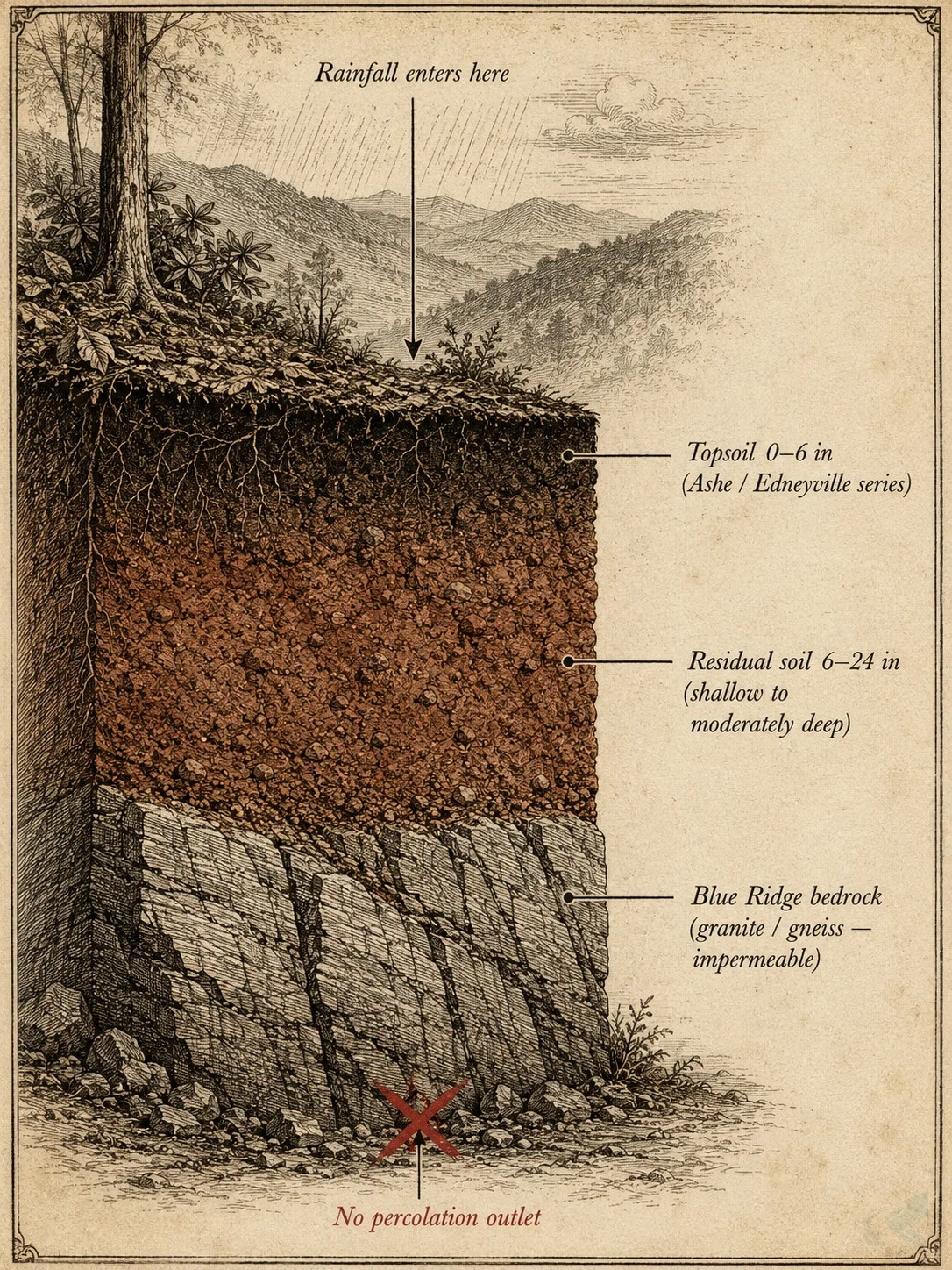
WNC Mountain Soils: Shallow Over Rock
Western NC mountains sit on granitic and metamorphic bedrock — Blue Ridge basement rock — with soil thickness typically ranging from 6 to 24 inches. That depth is too shallow for subsurface drainage systems and just deep enough to saturate catastrophically during intense rainfall.
The dominant soil series in Buncombe, Henderson, Rutherford, and McDowell counties include Ashe, Edneyville, and Porters series — all mapped by USDA Web Soil Survey as shallow-to-moderately-deep soils over hard crystalline bedrock. These are not soft Piedmont soils that formed in place from weathering clay. They are residual soils: thin accumulations that formed over millennia on steep slopes where gravity constantly works against depth.
Aspect matters. North-facing slopes in western NC tend to retain slightly more soil than south-facing slopes — less direct sun means slower evaporation and less dry-season root die-off that loosens soil. But the difference is measured in inches, not feet.
For a comparison of all three NC soil zones, see the NC soil guide including mountain zones.
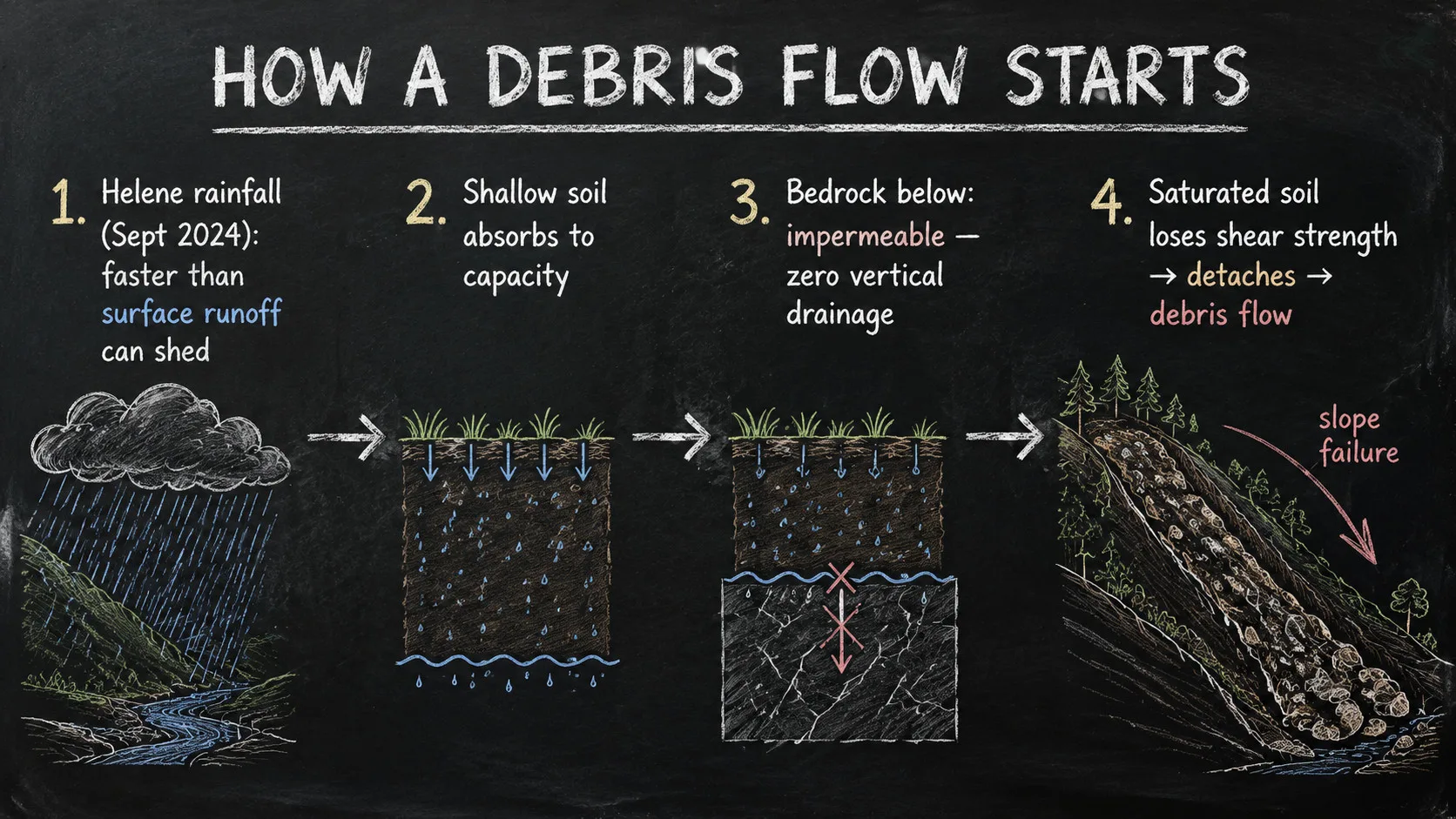
What Helene Exposed: Saturated Shallow Soil Over Rock
Hurricane Helene’s rainfall saturated WNC mountain soils to capacity within hours — and when shallow soil over impermeable bedrock reaches saturation, the entire soil layer can detach and move as a debris flow.
This is the mechanics of what happened across Buncombe, Henderson, Yancey, and Mitchell counties in September 2024. Water fell faster than surface runoff could shed it. The soil layer absorbed to capacity. With no drainage outlet below — bedrock is impermeable to vertical flow — the fully saturated soil lost shear strength and detached from the rock surface.
That is a debris flow. It is not the same as Piedmont flooding, where water moves laterally across flat terrain. It is not the same as Coastal Plain flooding, where a shallow water table backs up. It is a slope failure triggered by the soil’s inability to drain vertically.
The contractor who proposed a French drain in eight inches of soil over granite had the wrong solution. There is no trench depth to work with, and there is no percolation pathway below the trench even if the depth existed.
For the full North Carolina recovery guide, see how WNC mountain soils were affected by Hurricane Helene.
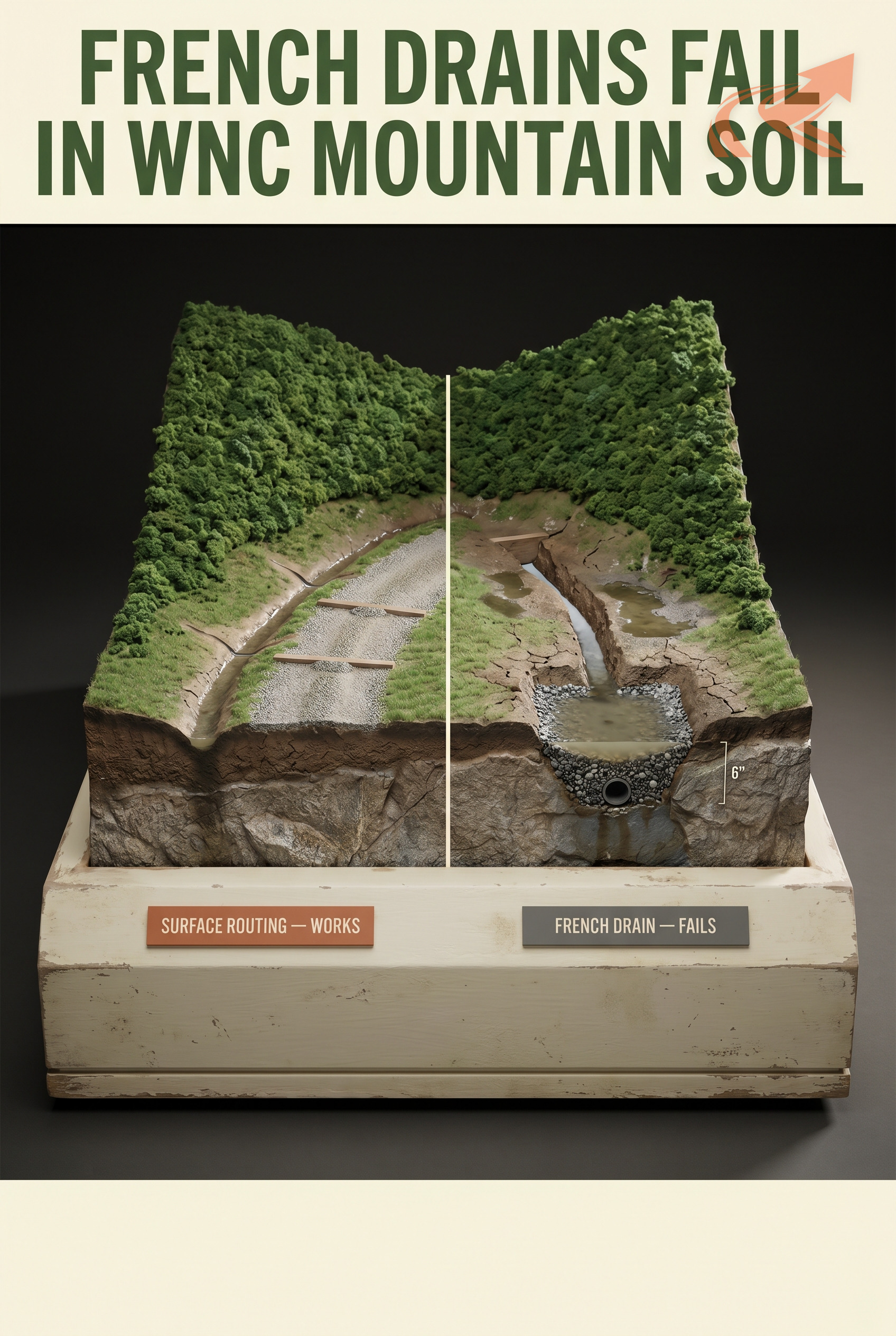
Why French Drains Don’t Work in Shallow Mountain Soil
A French drain needs 18 to 36 inches of soil to install properly. Most WNC mountain sites do not have that depth, and even where they do, the bedrock below provides no percolation outlet.
The minimum French drain installation requires enough depth to bury perforated pipe in a gravel bed with fabric wrap, then cover with soil. On a WNC mountain site with 8 to 12 inches of total soil depth, a trench hits bedrock before the pipe can be properly seated.
What happens then: water enters the perforated pipe, travels to the end of the trench, and pools at the rock face. There is no outlet — water cannot percolate through granite. The result is a gravel-lined basin that collects water adjacent to whatever structure the drain was meant to protect. The drainage situation is worse after installation than before.
WNC mountain drainage: surface routing vs a French drain
Comparison. Surface routing -- works: Diversion swale intercepts runoff uphill of the driveway; Crowned driveway with water bars shedding flow to the side; Culverted crossing carries the stream under the drive; Water routed to a stable outlet without crossing the surface. French drain -- fails: Trench hits bedrock at 8 inches, too shallow to seat pipe; Water cannot percolate through granite; Drain becomes a gravel-lined basin holding water; Drainage is worse after installation than before.
- Diversion swale intercepts runoff uphill of the driveway
- Crowned driveway with water bars shedding flow to the side
- Culverted crossing carries the stream under the drive
- Water routed to a stable outlet without crossing the surface
- Trench hits bedrock at 8 inches, too shallow to seat pipe
- Water cannot percolate through granite
- Drain becomes a gravel-lined basin holding water
- Drainage is worse after installation than before
Most WNC sites have 6-24 inches of soil over rock -- mountain drainage is surface routing, not pipe-in-trench.
The correct diagnosis on a WNC mountain site is not “which French drain design.” It is “where does surface runoff go, and how do I route it to a safe outlet without letting it accelerate across the driveway surface.”
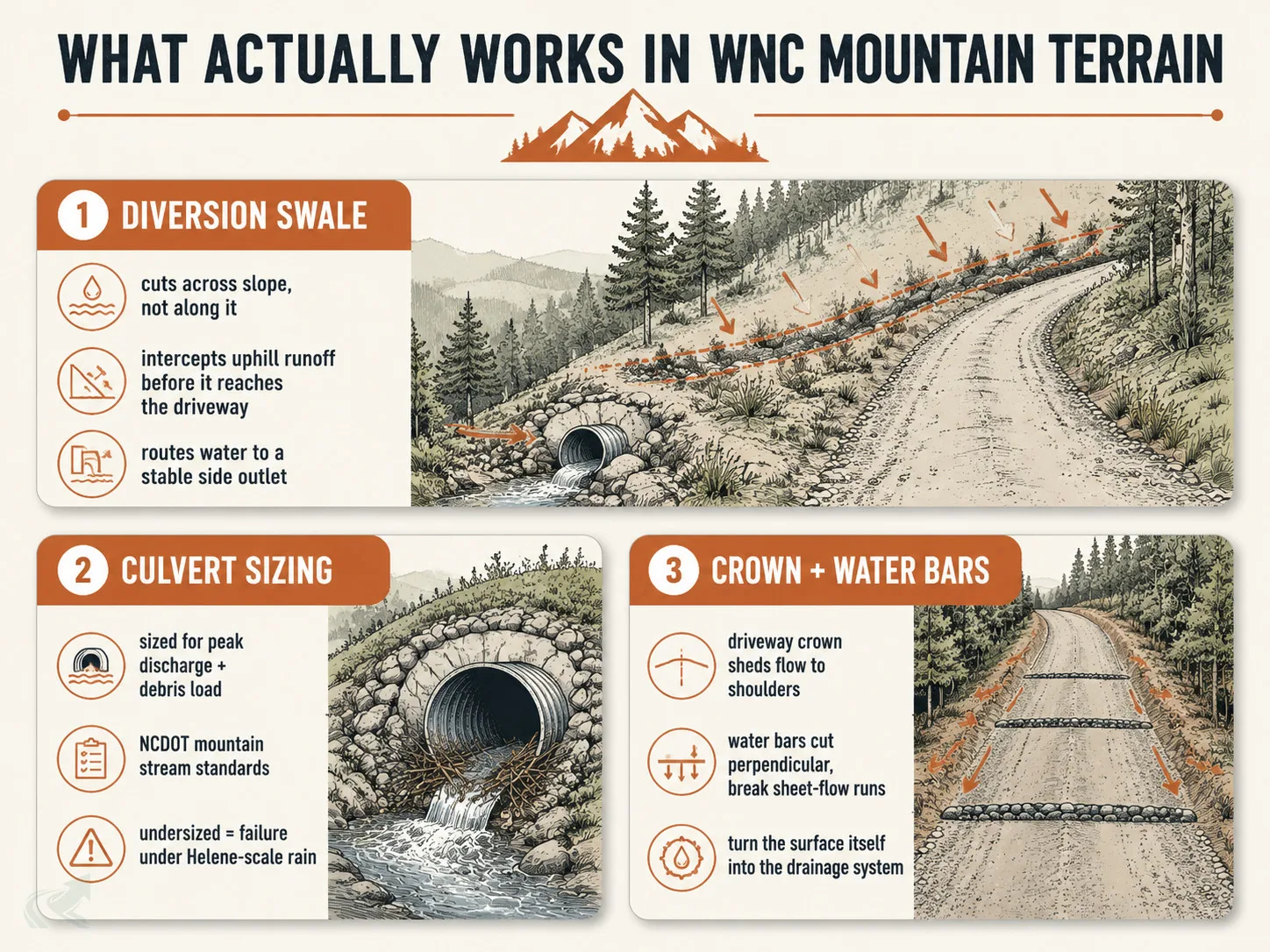
What Actually Works: Surface Routing and Diversion
WNC mountain drainage engineering is surface-focused: grade the terrain to route runoff to a safe outlet, install diversion swales to redirect flow away from structures, and reinforce driveway surfaces to resist velocity erosion.
Three primary tools work in WNC mountain terrain:
Diversion swales intercept uphill surface runoff before it reaches the driveway or structure. A diversion swale cuts across the slope — not along it — and routes collected water to a stable outlet at the side. Properly placed, it prevents the volume buildup that causes erosion. This is the WNC analog to the French drain: it intercepts water, just at the surface instead of below it.
Culvert sizing at stream and hollow crossings is critical. WNC driveways that cross drainage channels need culverts sized for extreme rainfall, not average flow. NCDOT mountain stream culvert standards account for the velocity and debris load that WNC streams carry during storm events. A culvert that handles normal flow may fail under Helene-scale rainfall if it was not sized for peak discharge and debris.
Driveway crown and water bars shed velocity before it erodes. A properly crowned driveway — slightly higher at center — moves water to the shoulders before it accelerates. Water bars cut perpendicular to the travel direction at intervals, breaking long sheet-flow runs into short sections that can daylight at the edge without building erosive velocity. Together, crown and water bars turn the driveway surface itself into part of the drainage system.
The vocabulary here — water bars, crown, swale, culvert, positive drainage, daylight — is the vocabulary a WNC-competent grading contractor will use without prompting. If a contractor does not use these terms when scoping a WNC mountain driveway, that is a signal.
| Factor | WNC Mountains | NC Piedmont | NC Coastal Plain |
|---|---|---|---|
| Soil depth | Shallow (6 to 24 in) | Deep (36+ in) | Deep (36+ in) |
| Bedrock | At or near surface (granite/gneiss) | Deep | Deep or absent |
| Primary water movement | Surface runoff | Lateral flow | Percolation + surface |
| French drain applicability | Usually not applicable | Adapted system | Standard application |
| Key design tool | Swale + diversion | Interceptor trench | Grade creation + outlet |
| Helene relevance | Debris flow context | N/A | N/A |
For a comparison against NC Piedmont red clay for comparison, that guide covers the Piedmont’s specific drainage constraints in detail.
Driveway Repair After Helene: What the Soil Science Means
Post-Helene driveway repair in WNC needs to address the runoff volume that caused the failure — not just rebuild the surface. A driveway that failed once will fail again if the uphill runoff path is not redesigned.
The diagnostic question before any repair is: where did the water come from? The answer determines the fix.
Uphill surface runoff — the most common source in WNC — requires a diversion swale uphill of the driveway to intercept and route water before it crosses the driving surface. Rebuilding the driveway without addressing uphill flow is a two-season repair.
Stream or hollow overflow requires culvert evaluation. If the crossing culvert was undersized for Helene-scale flow, it will fail again under similar rainfall. This is a culvert replacement or supplemental culvert task, not a fill-and-grade task.
Road ditch overflow sometimes redirects NCDOT ditch flow across private driveways during extreme events. The fix here involves working with NCDOT on ditch maintenance and sometimes adding a curb or berm at the ditch edge.
Subsurface seep at bedrock is rare in WNC but does occur where the rock surface is not flat — water traveling along the bedrock surface can emerge at a break in slope. This is typically addressed with a shallow interceptor swale at the seep location rather than any subsurface installation.
For the specific repair workflow, see post-Helene driveway repair in WNC mountain terrain.
What to Ask a Contractor for WNC Mountain Work
Two vetting questions for any WNC contractor: “How deep is the bedrock on my site, and does your solution work at that depth?” and “Where will the surface runoff go once you reroute it?”
A contractor who does not ask about bedrock depth before proposing a drainage solution does not understand WNC mountain soil. The bedrock question comes first — before pipe selection, before trench depth, before any methodology decision.
The second question — where does the runoff go after rerouting — is equally important. Surface diversion only works if the rerouted water has a stable outlet. A swale that routes water to an unprotected slope edge creates erosion at the outlet. The contractor should specify outlet location and protection as part of the scope.
For WNC mountain work, ask: “How deep is the bedrock on my site, and is your solution designed for that depth? Where does the surface runoff go after your rerouting?”
If the contractor hesitates on either question or defaults to a French drain proposal without a bedrock assessment, that is the signal to ask for an alternative proposal or a different contractor.
Find a grading operator in North Carolina who has experience with WNC mountain soil and post-Helene driveway repair. For Asheville-area work, the Asheville driveway washout repair page covers contractors operating in the metro.
Common Mistakes in WNC Mountain Drainage
- Proposing a French drain without checking bedrock depth first. In western NC, this is the first question. A contractor who does not ask about bedrock depth before designing a drainage solution does not understand mountain soil.
- Rebuilding a washed-out driveway in the same spot with the same profile. If it failed once under a large storm, it will fail again unless the runoff source is addressed. Same grade, same surface, same outcome.
- Undersizing culverts for mountain stream crossings. WNC streams carry extreme velocity during rain events. A culvert adequate under normal conditions may fail under Helene-scale rainfall if it was not sized for peak discharge and debris load.