The two questions people land on this page for
Do I need a grading permit in Wake County?
It depends on whether your lot is in an active subdivision. Outside a subdivision, the trigger is one acre of disturbance — the statewide rule. But inside an active subdivision (a common plan of development), a land-disturbance permit is required regardless of size, even for a fraction of an acre. Note that the City of Raleigh and several towns run their own permitting with their own thresholds.
Is there a limit on how much of my lot I can cover with driveway and patio?
Yes — and most people never hear about it until they hit it. Wake County caps impervious surface at 30% of a residential lot, and in some subdivisions and protected watersheds the limit is far lower, recorded against your deed. Adding driveway, patio, or a slab can require a stormwater review.
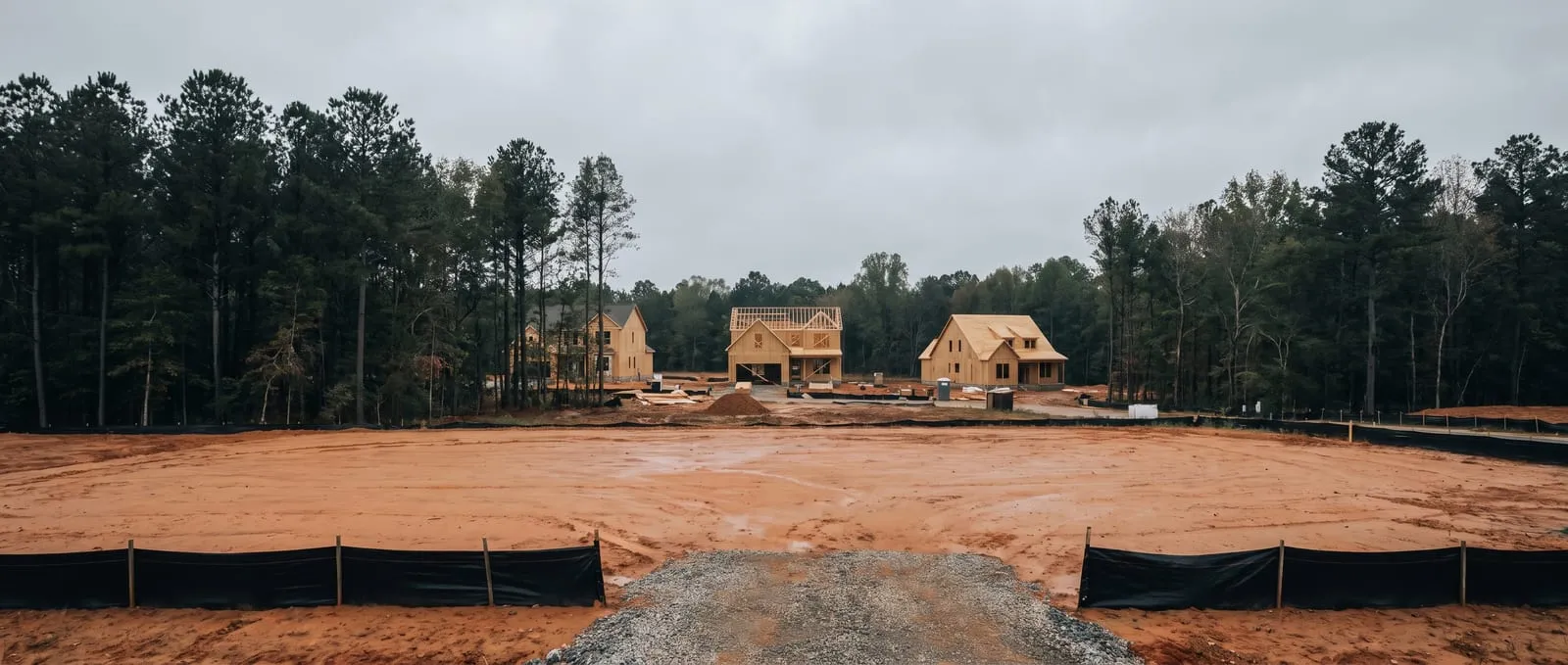
A family buys a new build in a Wake County subdivision and, a season later, decides to fix the water pooling in the back yard by regrading and adding a patio. They check the state rule first — an erosion plan is required at one acre, and their lot is a fraction of that — and hire someone to start.
Two Wake County rules they’d never heard of were already in play. Because the lot sits in an active subdivision, a land-disturbance permit was required regardless of size. And the new patio pushed them toward the county’s impervious-surface cap — the limit on how much of the lot can be covered by hard surface — which is recorded against the deed and enforced.
Neither rule is on the state’s one-acre radar, and neither is obvious from the lot. This page translates both — the permit maze and the impervious cap — plus the process, the fees, and which office actually has jurisdiction over your address.
Do you need a permit? The subdivision rule
Outside a subdivision, Wake County follows the statewide one-acre trigger. Inside an active subdivision, a land-disturbance permit is required at any size.
That distinction is the one that catches people. “Land-disturbing activity” — clearing, grading, filling, excavating — is what counts, not the cost of the job. Which threshold applies to you turns on where your lot sits:
| Where your lot is | Land-disturbance permit triggers at | Also note |
|---|---|---|
| In an active Wake County subdivision | Any size — even a small fraction of an acre | Common plan of development; in effect since April 1, 2019 |
| Outside a subdivision (unincorporated) | 1 acre of disturbance | The statewide Sedimentation Pollution Control Act rule |
| Inside the City of Raleigh | 12,000 sq ft (Raleigh runs its own program) | Erosion measures still mandatory on every lot |
In an active Wake County subdivision
- Land-disturbance permit triggers at
- Any size — even a small fraction of an acre
- Also note
- Common plan of development; in effect since April 1, 2019
Outside a subdivision (unincorporated)
- Land-disturbance permit triggers at
- 1 acre of disturbance
- Also note
- The statewide Sedimentation Pollution Control Act rule
Inside the City of Raleigh
- Land-disturbance permit triggers at
- 12,000 sq ft (Raleigh runs its own program)
- Also note
- Erosion measures still mandatory on every lot
The Wake County subdivision rule exists because builders across a whole development add up to far more than an acre of disturbance, even when each individual lot is small — so the county requires permit coverage on every lot in an active common plan of development. If you bought a recently built home, your lot almost certainly falls under it.
Two things are true regardless of whether you need the permit:
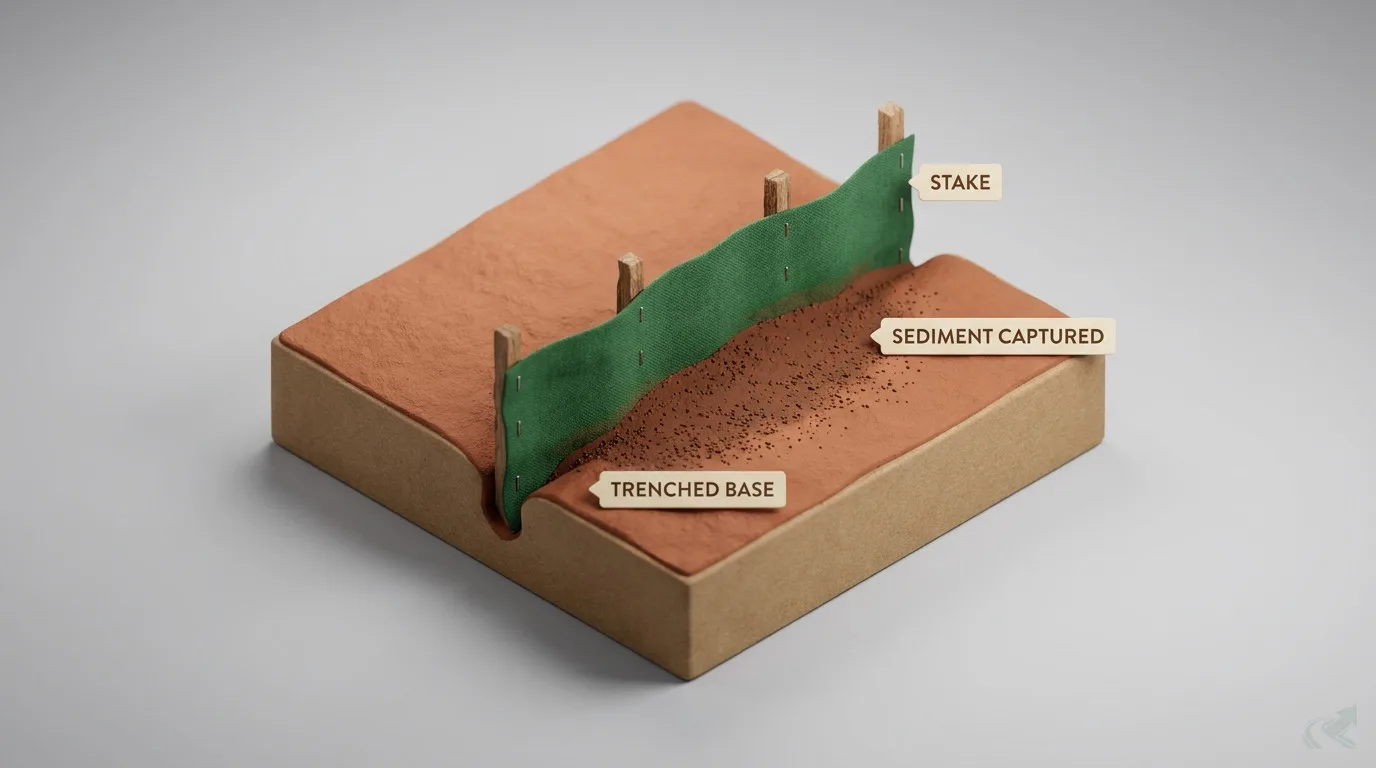
- Erosion-control measures are mandatory on every lot — at minimum a stone construction entrance and silt fence on the low side, to keep sediment on your property.
- If your project disturbs an acre or more, you also need coverage from , with proof provided to the county before your permit issues.
When you can’t tell whether your project crosses a line — or which office has jurisdiction over your address — treat that as a question for the county, not a judgment call. Wake County Watershed Management (919-856-7436) is the place to confirm.
What the permit process looks like
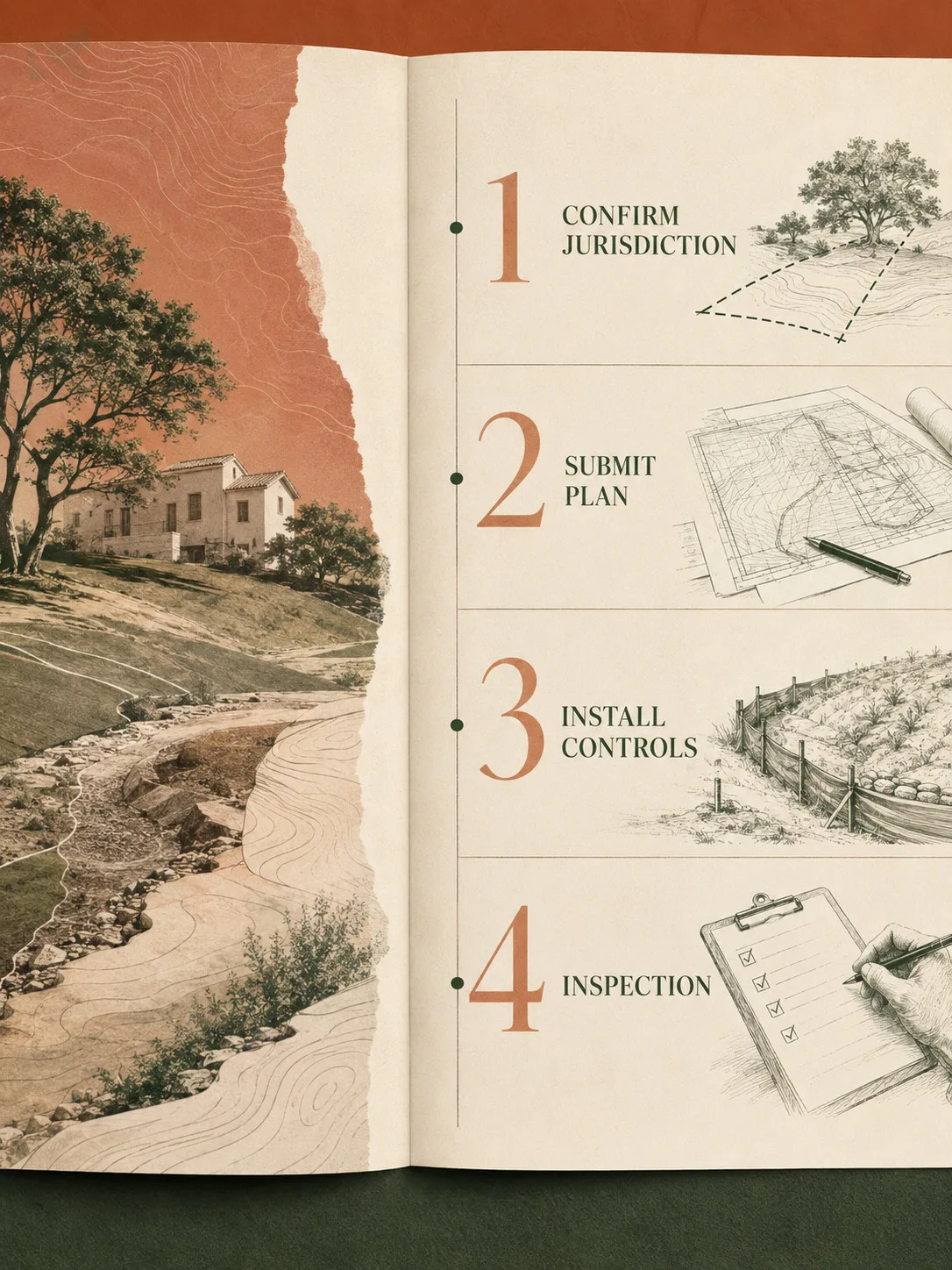
The land-disturbance permit runs through the Wake County Permit Portal, and the review clock is measured in working days, not days. The sequence:
- Confirm your trigger — subdivision or not, and your disturbance area. This decides whether you need a permit at all.
- Create a Permit Portal account and prepare your documents.
- Assemble the submittal — a site plan; an erosion and sediment control plan (a standard plan may suffice under an acre, a custom plan above); a form; and the NCG01 e-NOI coordination where an acre or more is disturbed.
- Submit through the portal. Initial land-disturbance review runs about 30 working days; resubmittals are generally reviewed within 15.
- Provide NCG01 proof (for one-acre-plus projects) before the permit issues.
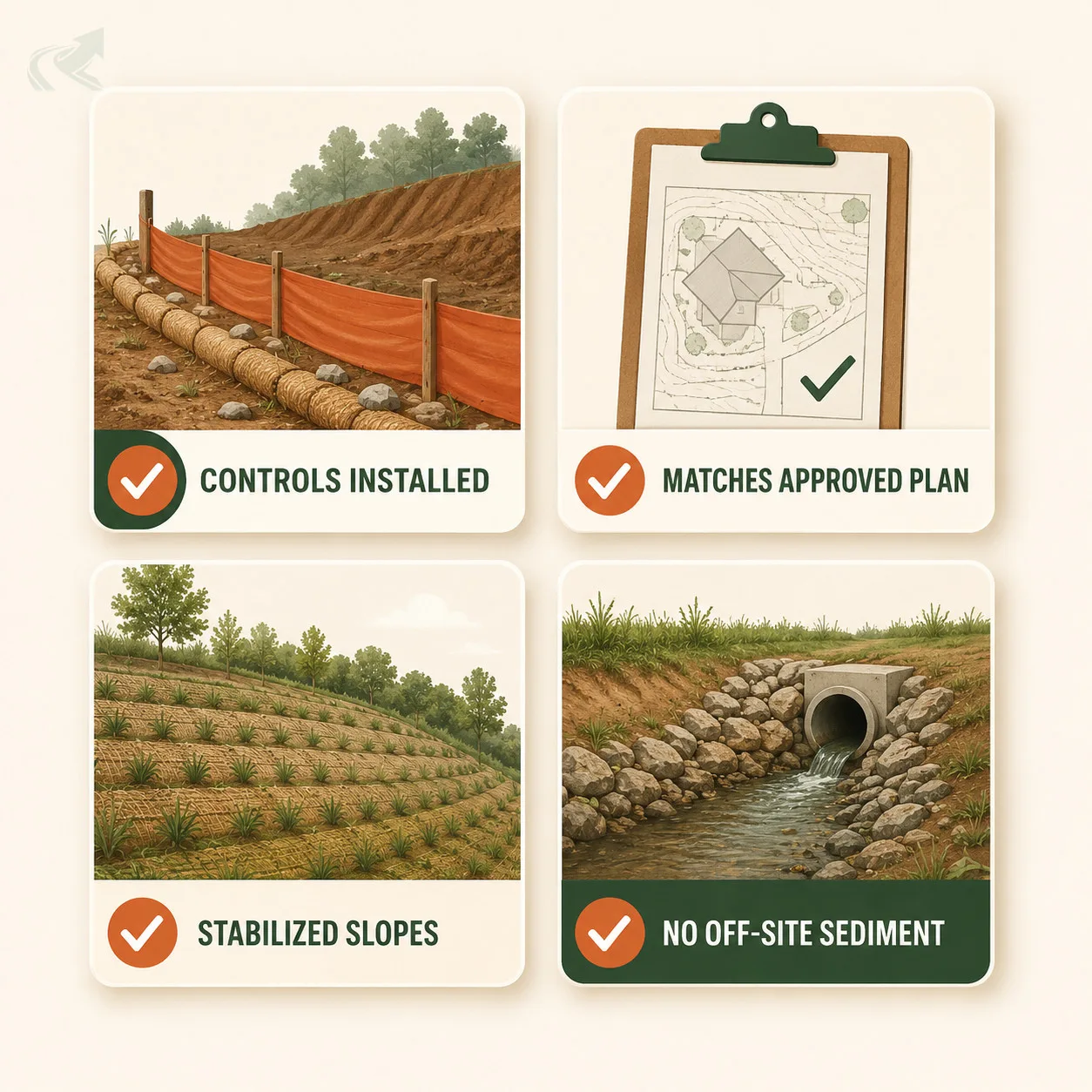
- Pass inspections through construction.
- Establish ground cover within 14 calendar days of finishing a phase — a real deadline, and the one most likely to be forgotten once the equipment leaves.
Fees are calculated on the disturbed acreage in your plan; the current schedule is on the county’s permitting pages, and it’s worth confirming the number when you apply rather than budgeting from an old figure.
The impervious cap nobody mentions
Wake County limits how much of your lot can be covered by hard surface — roof, driveway, patio, slab — and in many subdivisions and protected watersheds the limit is well below the headline number.
The general ceiling is 30% impervious on a residential lot. But subdivisions can range from 6% to 30% depending on how much stormwater treatment was built in when the development was approved — and in protected watersheds like Swift Creek, the critical-area limit drops to a small single-digit percentage. Crucially, the limit for your specific lot — the — is often recorded on your plat and enforced against the deed in perpetuity.
The practical consequence: you cannot always pave your way out of a drainage problem, or add the patio you planned, without checking your cap first. Adding impervious surface can require a stormwater review, and exceeding the cap without one is an enforcement problem. Find your limit on your plat or the county’s iMaps viewer, or confirm with the Wake County Planning Department (919-856-6310) before you design hardscape.
Every Wake County resource you’ll need
Grouped by what you’re trying to do — every entry says what it’s for and when you’d reach for it.
Before you dig
- NC 811 — call before you dig. Free, and legally required: notify utility owners at least two business days before you break ground. Call 811 or 1-800-632-4949. Applies to any grading, trenching, or post-hole digging.
Before you hire
- NCLBGC license lookup. Any contractor on a project of $40,000 or more must hold an active license. Search by license number, business name, or individual at the license portal — status, classification, dollar limit, and disciplinary history, no account needed.
- Our verified Triangle directory. Every contractor in our Raleigh-area directory is cross-checked against that same NCLBGC record before listing.
Applying and tracking
- Wake County Permit Portal. Search permits by address, apply, track status, and pay through the county permit search.
- Watershed Management (erosion, stormwater, land-disturbance): 919-856-7436. Planning Department (impervious limits, MISA): 919-856-6310.
Site conditions
- Impervious limit / MISA lookup. Check your lot’s cap on your recorded plat or the county’s iMaps viewer before designing driveway, patio, or slab.
- USDA Web Soil Survey. Pull soil and drainage ratings for your parcel at Web Soil Survey — useful in the Triangle, where red clay drains slowly and changes what a drainage plan needs to do.
- Red clay, explained. Our Piedmont red clay guide covers why the soil behaves the way it does — the root of most Wake County drainage work.
State overlay
- NCDEQ NCG01 coverage. Required from the state for any project disturbing one acre or more, in addition to the county permit. Note the Falls Lake Watershed stormwater rule (effective September 24, 2025) can pull in new homes disturbing a cumulative acre.
Which office covers you
Calling the wrong office costs you a week, so start with jurisdiction — and in Wake County there are many. The county’s own erosion and land-disturbance program covers:
- Unincorporated Wake County — the default outside any town’s limits
- Several towns by agreement — including Garner, Knightdale, Morrisville, Wendell, Rolesville, and Zebulon, whose erosion programs the county administers
But the largest jurisdictions run their own programs, with their own thresholds and offices:
- City of Raleigh — its own land-disturbance permitting (12,000 sq ft trigger)
- Cary, Apex, Wake Forest, Holly Springs, Fuquay-Varina — each with its own rules
So a project inside Raleigh city limits goes to the City, not the county, even though both sit in Wake. If you’re unsure which side of a line your parcel falls on, confirm your specific address with the county before you spend a phone call finding out the hard way.
What this means for your project
Wake County rewards one habit: confirming, not assuming. The subdivision rule and the impervious cap are both invisible from the lot and both enforced — and the office you call depends on your address.
For the wider picture of Triangle earthwork — why red clay drains the way it does, and how the whole region’s permit maze fits together — start at the Triangle earthwork hub. For the neighboring county, see Durham County. And if you’re vetting a contractor for a Wake County job, the Raleigh directory lists only operators whose licenses we’ve checked against the public record.
We’re a directory, not a permit office — we can’t file, expedite, or influence anything at the county. What this page can do is get you to the right counter with the right questions already answered.
Verified contractors in Wake County
Every licence number below links to that contractor’s own record on the NC Licensing Board — we don’t ask you to take our word for it.
From our directory
Verified contractors across Wake County
Every listing is cross-checked against the NC Licensing Board public record before it appears. Pick your city:
Or browse the full NC contractor directory.