
A geotechnical engineer holds a soil core from a Cary homeowner’s lot. The top few inches are dark topsoil. Below that, the core is dense, bright red clay — tight, plastic, barely permeable. The engineer explains why the French drain installed two seasons ago is sitting in standing water: the clay between the drain pipe and the surrounding soil is too impermeable to let water through in any meaningful quantity.
The drain was installed correctly per the manual. The manual was written for a different soil.
NC Piedmont clay follows different physics than Florida sand or Michigan loam. Understanding those physics — kaolinite structure, iron oxide behavior, B-horizon depth, seasonal movement — is the starting point for any drainage or grading decision in North Carolina’s Piedmont zone. This page is that starting point.
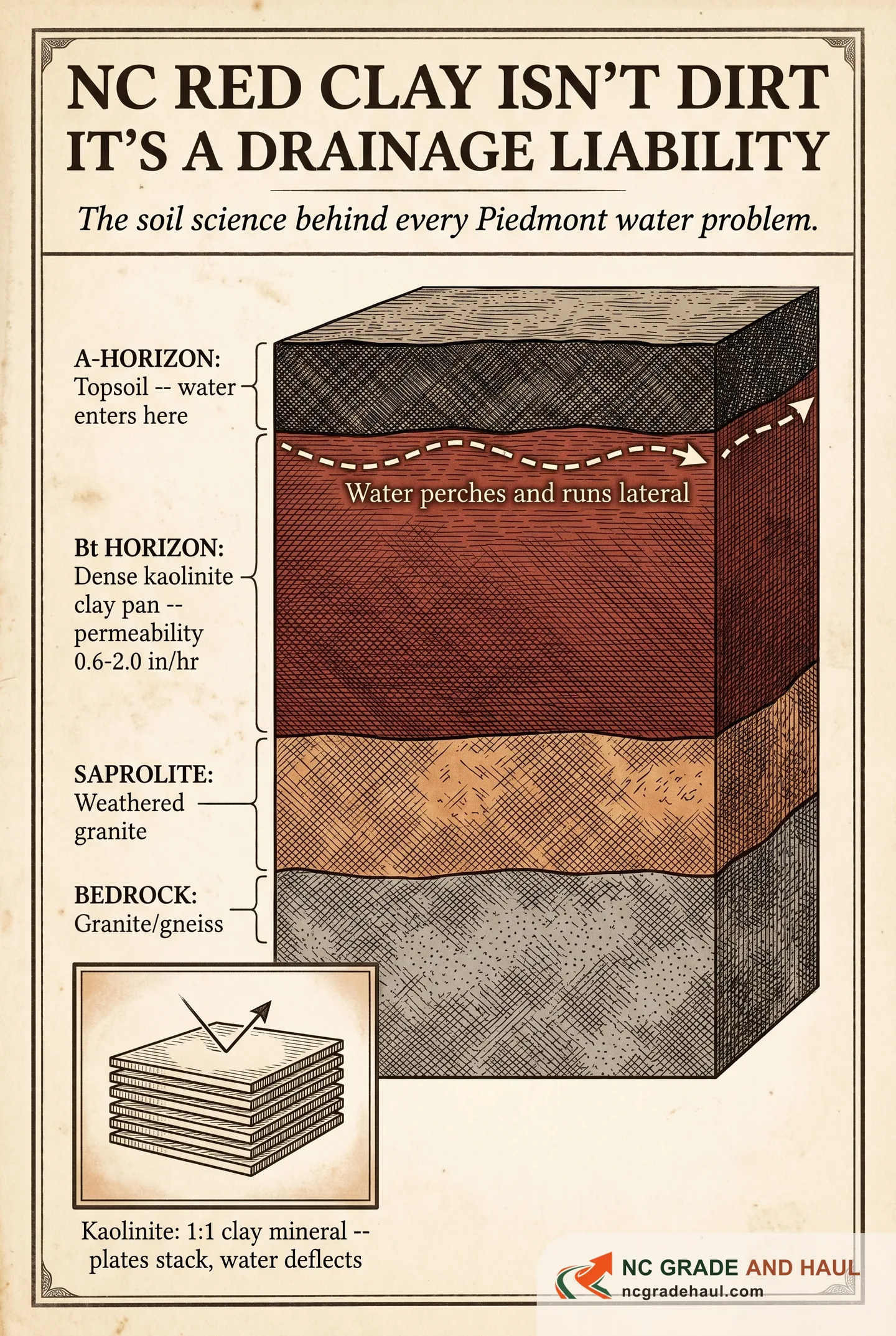
The Cecil Series: NC’s Most Common Piedmont Soil
Cecil series soils cover most of NC’s Piedmont urban areas — including Wake, Guilford, Mecklenburg, and Durham counties — and their properties drive nearly every drainage and grading decision in the region.
The Cecil series is a deep, kaolinitic red clay classified by the as a fine, kaolinitic, thermic Typic Kanhapludult. It formed over millions of years from the weathering of granite and gneiss bedrock under humid subtropical conditions — the same parent material and climate that produced the rolling red hills characteristic of the NC Piedmont.
Cecil is not alone in the Piedmont. The Appling series shares the same kaolinite-dominant structure and similar hydraulic conductivity — the USDA NRCS Official Series Descriptions for both Cecil and Appling classify them identically as fine, kaolinitic, thermic Typic Kanhapludults, and Appling is distinguished mainly by its yellower subsoil. The Pacolet series appears on steeper Piedmont slopes (commonly 15 to 25 percent) and was formerly mapped as a thin-solum phase of the Cecil series; its argillic horizon is thinner than Cecil’s. Cecil is NC’s official state soil and covers more than 1.6 million acres statewide — it is the dominant mapped series across the urban Piedmont corridor where Wake, Guilford, Mecklenburg, and Durham counties lie. Appling and Pacolet occur within those counties on specific landforms (yellower lower slopes and steeper ridge flanks respectively); the dominant soil on most residential and commercial lots is Cecil. Use the USDA NRCS Web Soil Survey to confirm the exact series for any specific parcel.
The key soil fact: all three series are kaolinite-dominant, iron-oxide-stained, and produce the same drainage behavior. When a North Carolina contractor says “NC clay is different,” they are describing Cecil-series soil physics.
For an overview of how Cecil fits into NC’s three soil zones, see the NC soil guide covering all zones.
Kaolinite: Why NC Clay Has Such Low Permeability
Clay mineral structure: kaolinite (NC Piedmont) vs montmorillonite (expansive soils)
Comparison. Kaolinite -- NC Piedmont clay: 1:1 crystal: one silica sheet bonded to one aluminum sheet; Flat rigid plates stack tightly -- almost no interlayer space; Water cannot expand the stack -- very low shrink-swell; Hydraulic conductivity controlled by tight plate stacking, not interlayer hydration; Drainage problem: dense Bt pan perches water, not near-zero Ksat. Montmorillonite -- expansive soils (e.g. Texas): 2:1 crystal: one aluminum sheet between two silica sheets; Water molecules intercalate between layers -- stack expands; High shrink-swell: volume changes dramatically wet-to-dry; Very low permeability when wet -- swells shut; Rare in NC Piedmont -- Cecil clay drainage is governed by Bt pan, not interlayer swelling.
- 1:1 crystal: one silica sheet bonded to one aluminum sheet
- Flat rigid plates stack tightly -- almost no interlayer space
- Water cannot expand the stack -- very low shrink-swell
- Hydraulic conductivity controlled by tight plate stacking, not interlayer hydration
- Drainage problem: dense Bt pan perches water, not near-zero Ksat
- 2:1 crystal: one aluminum sheet between two silica sheets
- Water molecules intercalate between layers -- stack expands
- High shrink-swell: volume changes dramatically wet-to-dry
- Very low permeability when wet -- swells shut
- Rare in NC Piedmont -- Cecil clay drainage is governed by Bt pan, not interlayer swelling
NC Piedmont clay is kaolinite-dominant -- it does not swell shut like smectite clay. The drainage constraint is the dense Bt clay pan, not interlayer hydration.
Cecil series clay is kaolinite-dominant — a flat-plate clay mineral that stacks tightly and dramatically reduces water movement through the soil matrix.
Kaolinite is a 1:1 clay mineral. That ratio refers to its crystal structure: one silica tetrahedral sheet bonded to one aluminum octahedral sheet, forming a flat, rigid plate. Those plates stack on each other with almost no interlayer space. Water molecules cannot expand the stack — kaolinite has very low shrink-swell potential and essentially no interlayer hydration capacity.
The practical consequence is restricted hydraulic conductivity ( ) relative to sandy and loamy soils. The USDA NRCS Official Series Description for the Cecil series lists permeability in the Bt (argillic) horizons as “moderately high” — roughly 0.6 to 2.0 inches per hour. That is well below the rapid percolation of sandy soils, but it is not the near-zero figure sometimes assumed for “clay.” The drainage problem on Piedmont clay is less about an absolute Ksat floor and more about structure: the dense Bt clay pan conducts water far more slowly than the looser A-horizon above it, so water perches and deflects at that boundary rather than continuing straight down.
Compare that to other mineral structures. Kaolinite is a 1:1, non-expanding clay — substitutions in its lattice leave it electrically neutral, so there are no swelling clays in the kaolin family. Illite is a 2:1 but non-expanding clay. Montmorillonite (a smectite, and the clay in expansive soils like those in Texas) is a 2:1 expanding clay: water intercalates between its sheets, producing large volume change and very low permeability when wet. Montmorillonite is rare in the NC Piedmont. The practical point for drainage is that kaolinite-dominant Cecil clay does not swell shut the way smectite clay does — its drainage behavior is governed by tight plate stacking and a dense Bt pan, not by interlayer hydration.
The Cecil series B-horizon is the design constraint that shapes every drainage decision on Piedmont clay: the dense Bt accepts inflow far more slowly than the looser soil above it, so a gravel trench cut into it does not drain on the timescale of a storm. The trench fills, the pipe fills, and water finds the path of least resistance — which is almost always lateral along the A-to-Bt horizon boundary.
Iron Oxide: Why NC Clay Is Red — and What It Does to Soil Behavior
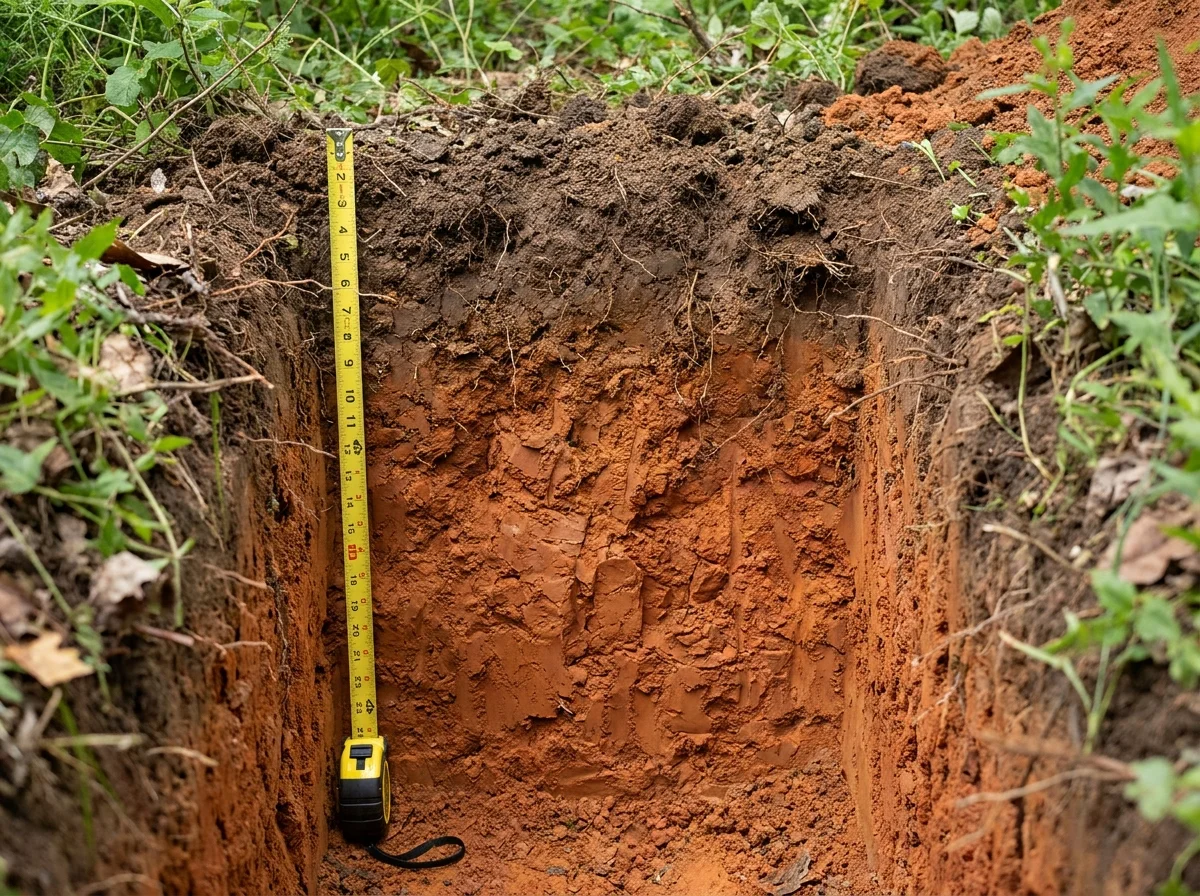
The red color of NC Piedmont clay comes from iron oxide (hematite and goethite) coatings on clay particles — which also partially cement the clay matrix and contribute to the dense B-horizon that characterizes deep Piedmont cuts.
Iron oxide forms through weathering: iron-bearing minerals in the parent felsic igneous and high-grade metamorphic rock release iron as they break down. In NC’s humid subtropical climate, that iron oxidizes and precipitates as iron oxide minerals — principally hematite (the bright red pigment) and goethite (the yellow-brown oxidized form). The result is a coating on kaolinite clay particles that acts as a partial cement.
That cementation has direct consequences for drainage and compaction:
For drainage: The cemented clay matrix has even lower effective permeability than uncemented kaolinite. The particles are bonded — there is less tendency for the structure to shift and create preferential flow paths through the clay.
For compaction: The iron-oxide-cemented structure makes Cecil series clay a high-performing structural material when properly compacted. It holds loads well. That is an asset for road sub-bases and building pads — and a liability when the same soil sits under a drainage system, because the same tight structure that supports a load does not let water through.
When a cut bank exposes the B-horizon, the transition from dark A-horizon topsoil to dense red clay is visible within inches. That red color is not just a visual marker — it is a density and permeability marker. The redder the clay, the more cemented, the lower the Ksat.
The B-Horizon: The Layer That Changes Everything
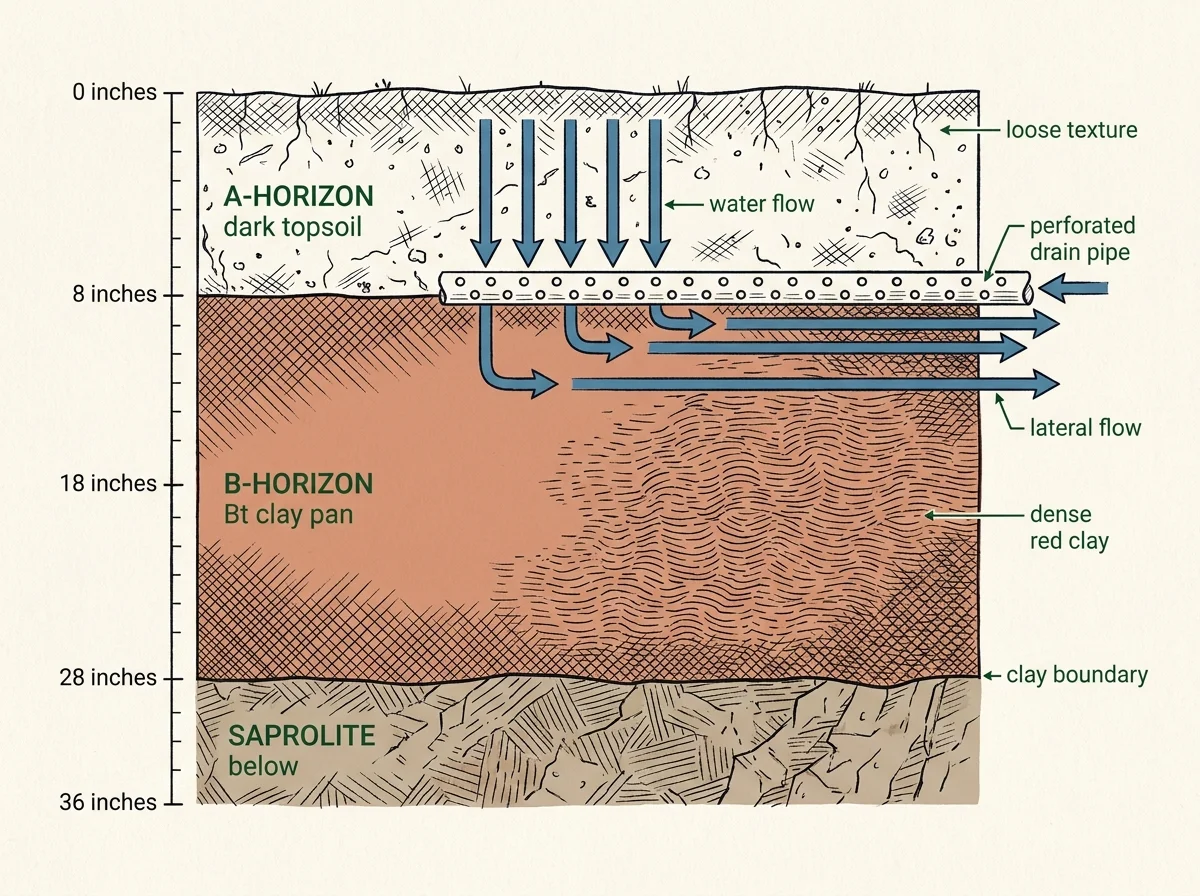
The B-horizon in NC Piedmont profiles is a dense, low-permeability clay layer typically at 6 to 24 inches depth — which acts as the lateral flow boundary that forces water to move along its surface rather than through it.
Soil profiles form in layers called horizons. The A-horizon at the surface is the organic-rich topsoil — darker, looser, more permeable. Below it, the B-horizon is where clay accumulates through a process called illuviation: clay particles that weathered out of the A-horizon and upper profile washed downward and accumulated in the B-horizon over thousands of years. The result is a denser, more clay-rich, lower-permeability layer below the surface.
In Cecil series soils, the B-horizon begins within roughly the first foot of depth — the USDA NRCS Official Series Description places the top of the argillic (Bt) horizon at about 8 inches (20 cm) in the typical pedon — and the clay-rich argillic horizon itself is 24 to 50 inches thick, extending several feet downward. On urban lots that have been graded, cut, or filled, the A-horizon may be thinner or absent, placing the Bt clay pan closer to — or at — the finished surface; always verify the specific parcel using the USDA NRCS Web Soil Survey before finalizing a drainage design. The Bt subhorizon (B with accumulated clay) has the lowest Ksat in the profile — it is the permeability wall that water encounters when it tries to move downward.
When a rain event saturates the A-horizon and the surface soil, the water hits the B-horizon and cannot penetrate it at meaningful rates. It deflects. It moves laterally — along the top of the B-horizon, following slope and topography. This is lateral flow, and it is the dominant drainage mechanism in NC Piedmont soil.
The design implication is direct: a drain pipe placed deep in the B-horizon is surrounded by the lowest-permeability material in the profile. Water cannot enter the pipe efficiently because the surrounding clay will not conduct it to the perforations. The correct placement is at or just above the top of the B-horizon — where the interceptor captures lateral flow at the point it deflects, before it overruns the protected area.
Drain pipe in an NC Piedmont profile: at the B-horizon vs too deep
Comparison. At the top of the B-horizon: Pipe sits where lateral flow deflects off the clay; Captures water at the point it starts moving sideways; Daylighted outlet keeps the line draining; Interception happens before water overruns the area. Buried deep in the B-horizon: Pipe surrounded by the lowest-permeability clay in the profile; Clay won't conduct water to the perforations; Lateral flow runs right over the top of the drain; Trench fills slowly and the protected area still floods.
- Pipe sits where lateral flow deflects off the clay
- Captures water at the point it starts moving sideways
- Daylighted outlet keeps the line draining
- Interception happens before water overruns the area
- Pipe surrounded by the lowest-permeability clay in the profile
- Clay won't conduct water to the perforations
- Lateral flow runs right over the top of the drain
- Trench fills slowly and the protected area still floods
In NC Piedmont clay, depth is the whole game -- the drain belongs at the top of the B-horizon where lateral flow deflects, not deep inside it.
Seasonal Behavior: Swelling Wet, Shrinking Dry
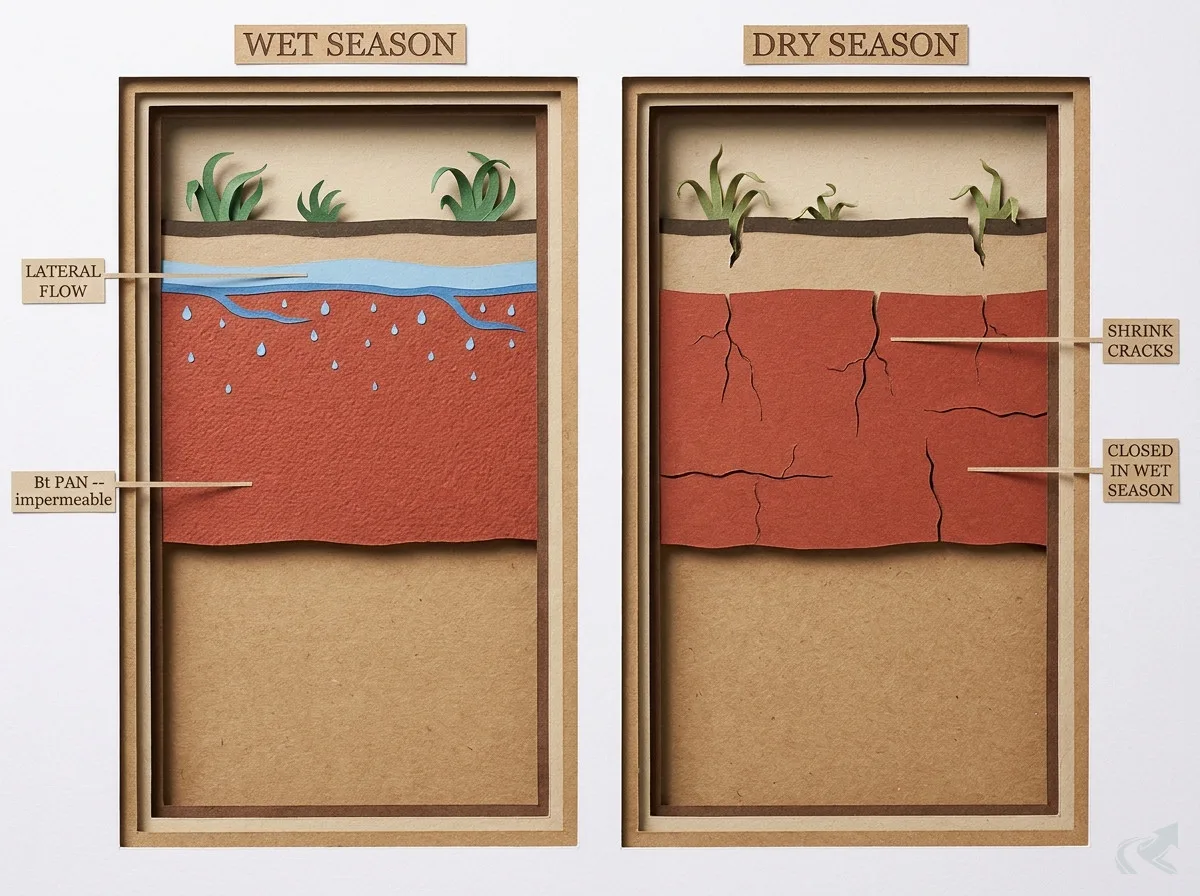
NC Piedmont clay swells when wet and shrinks when dry — creating seasonal volume changes that affect drain pipe slope, joint integrity, and driveway stability over multiple seasons.
Kaolinite has far lower shrink-swell potential than the montmorillonite (smectite) clays that produce the dramatic soil movement in Texas and parts of the Southeast. Kaolinite is a 1:1, non-expanding clay — it does not take water between its mineral layers the way smectite does, and the USDA classifies Cecil-series soils as having low shrink-swell potential. The seasonal movement that matters on Cecil clay is therefore modest, and it comes mostly from moisture-driven volume change in the soil mass as a whole and from wetting and drying at the surface — not from interlayer swelling of the clay mineral itself. Over many wet-dry cycles even that modest movement can accumulate.
For drainage systems, seasonal movement creates three failure modes:
Joint shift. PVC drainage pipe sections that were properly aligned at installation can separate or angle as the surrounding clay swells and shrinks seasonally. A joint that opens even a quarter inch allows fine kaolinite particles to infiltrate, accelerating clogging.
Slope loss. A drain pipe installed with a 1% slope — 1.2 inches of fall per 10 feet — can lose measurable fall after two or three wet-dry cycles if the pipe is running across a zone of uneven clay density. A system that drains correctly in the first wet season may be nearly flat two years later.
Driveway heave. Concrete and asphalt surfaces over Cecil series clay are vulnerable to heave at frost-thaw transitions and at the edge of wet-dry cycles. This is why NC Piedmont driveways crack along the edges and at control joints at higher rates than driveways in sandy-soil regions.
A perc test (percolation test) run during the dry season will produce a higher permeability reading than the same test run in the wet season — the clay has shrunk slightly, creating minor cracks and fissures that close when moisture returns. Design-critical perc testing should be done during or immediately after a wet period. For the full seasonal behavior analysis, see NC red clay dual nature — slippery wet, concrete dry.
Compaction Behavior: Strength and Drainage Liability Together
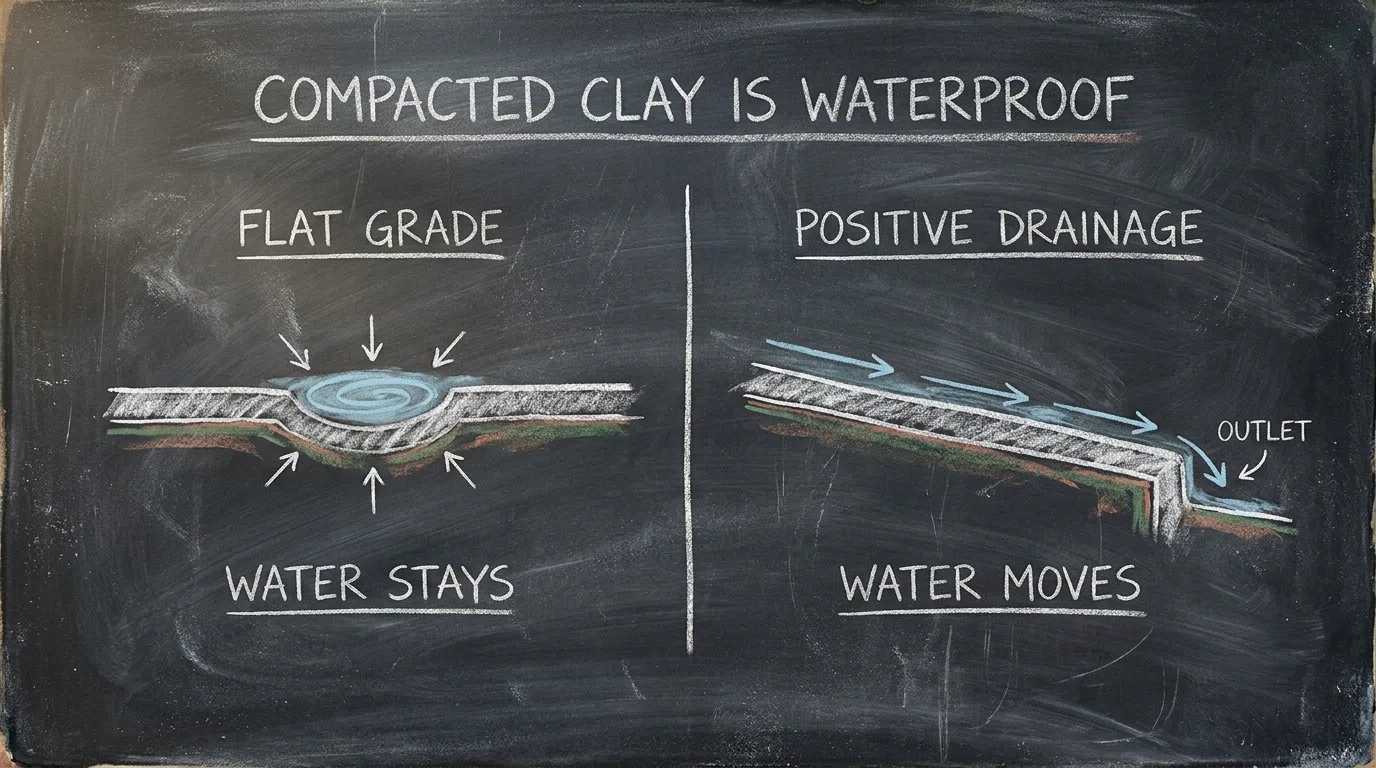
Properly compacted NC Piedmont clay is an excellent structural base — it holds loads well. But that same tight structure makes it impermeable to water, so any grade that is not positive drainage holds water instead of shedding it.
Cecil series clay compacts to high bearing capacity. A well-proof-rolled clay pad in NC can carry construction equipment loads and building foundations that would require engineered fill in lower-bearing-capacity soil. That is why Cecil series clay is a valued subgrade material throughout the Piedmont — it is strong, stable, and relatively cheap to prepare.
The same density that produces bearing capacity eliminates permeability. A proof-rolled pad is a water barrier. Any low point on a proof-rolled clay surface accumulates water. Any grade that is even slightly negative (sloping toward the structure rather than away from it) becomes a chronic pond after rain events.
This is why positive drainage — grades that actively shed water away from all structures at a consistent slope — is non-negotiable on NC Piedmont clay. A flat grade on compacted NC clay always produces standing water. The permeability is too low to absorb it and the grade is too low to move it. There is no compensation from absorption. Positive drainage is the only exit.
The vocabulary a grading operator uses: “positive drainage means the water has somewhere to go and it knows to go there.” If a proposed grade does not have consistent fall to a defined outlet, the grade is wrong for NC clay regardless of how it might perform in a different soil type.
Cecil Series vs. Other Soils: The Key Differences
The properties that make Cecil series NC Piedmont clay distinctive — kaolinite structure, iron oxide cementation, dense B-horizon, and seasonal movement — produce drainage physics that are measurably different from Florida sand or Michigan loam.
Cecil series NC Piedmont clay compared to representative soils from other regions. Cecil Ksat from the USDA NRCS Official Series Description (Cecil OSD). Michigan loam (Kalamazoo series) and Florida sand (Candler series) Ksat classes from their respective USDA NRCS OSDs; numerical ranges translated from NRCS Ksat class definitions.
| Property | NC Cecil Clay (Piedmont) | Michigan Loam | Florida Sand |
|---|---|---|---|
| Dominant mineral | Kaolinite (flat-plate, low swell) | Mixed (illite, quartz) | Quartz |
| Hydraulic conductivity (Ksat) | Moderately high in Bt: ~0.6--2.0 in/hr (USDA OSD, Cecil) | Moderately low to moderately high: ~0.06--2.0 in/hr (USDA OSD, Kalamazoo) | Rapid to very rapid: ~2--20+ in/hr (USDA OSD, Candler) |
| Color source | Iron oxide (hematite, goethite) | Organic matter + mixed minerals | Quartz (light / tan) |
| Seasonal volume change | Moderate -- swells wet, shrinks dry | Low | Minimal |
| B-horizon density | Dense, low-permeability clay pan at 6--24 in | Moderate -- glacial till parent material | Sandy throughout -- no dense clay pan |
| Key drainage consequence | Lateral flow dominant -- no vertical percolation | Mixed vertical + lateral | Vertical percolation dominant |
Dominant mineral
- NC Cecil Clay (Piedmont)
- Kaolinite (flat-plate, low swell)
- Michigan Loam
- Mixed (illite, quartz)
- Florida Sand
- Quartz
Hydraulic conductivity (Ksat)
- NC Cecil Clay (Piedmont)
- Moderately high in Bt: ~0.6--2.0 in/hr (USDA OSD, Cecil)
- Michigan Loam
- Moderately low to moderately high: ~0.06--2.0 in/hr (USDA OSD, Kalamazoo)
- Florida Sand
- Rapid to very rapid: ~2--20+ in/hr (USDA OSD, Candler)
Color source
- NC Cecil Clay (Piedmont)
- Iron oxide (hematite, goethite)
- Michigan Loam
- Organic matter + mixed minerals
- Florida Sand
- Quartz (light / tan)
Seasonal volume change
- NC Cecil Clay (Piedmont)
- Moderate -- swells wet, shrinks dry
- Michigan Loam
- Low
- Florida Sand
- Minimal
B-horizon density
- NC Cecil Clay (Piedmont)
- Dense, low-permeability clay pan at 6--24 in
- Michigan Loam
- Moderate -- glacial till parent material
- Florida Sand
- Sandy throughout -- no dense clay pan
Key drainage consequence
- NC Cecil Clay (Piedmont)
- Lateral flow dominant -- no vertical percolation
- Michigan Loam
- Mixed vertical + lateral
- Florida Sand
- Vertical percolation dominant
The structural gap drives the design difference. It is not that NC Cecil clay has a near-zero Ksat — the USDA OSD rates the Bt as moderately high. It is that the dense Bt clay pan conducts water much more slowly than the looser soil above it and far more slowly than sand percolates, so water perches at the top of the Bt and runs laterally instead of soaking straight down. A French drain system designed for the vertical-percolation behavior of Michigan loam or Florida sand will not perform the same way in NC clay, where the dominant mechanism is lateral flow along a perching layer.
For the full treatment of how North Carolina’s drainage physics differ from the national default, see why NC red clay demands different drainage methods.
What This Means for Your Drainage or Grading Project
Knowing you are on Cecil-series Piedmont clay means: plan for lateral flow interception (not percolation), plan for seasonal pipe movement, and expect that any flat grade will hold water.
These are not preferences or conservative estimates. They are direct consequences of the soil physics described above:
- The dense Bt clay pan perches water rather than passing it straight down, so percolation-based drain systems do not behave as designed. The drain must intercept lateral flow at the top of the B-horizon, not wait for vertical percolation.
- Seasonal movement means drain pipe needs to be inspected after 2 to 3 wet-dry cycles to confirm slope is maintained. Joint integrity should be checked before symptoms appear.
- Positive drainage on compacted clay means every grade must have consistent fall to a defined outlet — not a pop-up emitter that closes under back-pressure, and not a low area that accepts runoff from adjacent grades.
The question to ask any contractor who will touch a North Carolina property in the Piedmont: “How does your design account for lateral flow in NC clay rather than vertical percolation?” The answer should be immediate and specific: interceptor position relative to the B-horizon, outlet type and daylight elevation, and sock decision by soil zone.
Contractor vetting question — copy and use
”Ask your contractor: ‘Is this drain positioned at the top of the B-horizon clay layer to intercept lateral flow? What depth is the pipe, and how did you determine that depth?’”
For the methodology applications — how a contractor adapts pipe depth, outlet location, and aggregate selection for Cecil series soil — see why NC red clay demands different drainage methods and French drain methodology for NC Piedmont clay.
For foundation drainage specifically, where soil-zone mismatch has the highest structural stakes, see foundation drainage in NC soil zones.
Get an itemized quote from a verified NC grading contractor who specifies how they are adapting for your soil series — not a round-number bid with no methodology rationale.