
Most places, hiring a grading contractor starts with scope and price. In Randolph County there’s a wrinkle most contractors from outside the area get wrong, and it has nothing to do with how big your project is.
It’s who reviews the paperwork.
Randolph applies the same one-acre statewide trigger as the rest of North Carolina. But the Soil Erosion and Sedimentation Control Plan itself goes to the State, not a county office — Randolph’s own role is confirming that State approval exists before it will issue a building permit. And if your lot sits anywhere near the county’s nine mapped watersheds — Randleman Lake foremost among them — a minimum-lot-size rule may have already decided how much house you can build, long before anyone talks about grading.
This page covers what the work involves on Randolph’s rolling, red-clay Uwharrie-foothill terrain, what belongs in a complete quote, and how to check the person quoting it.
For the county’s full rules — the state-review structure, lot-size table, and flood setbacks — see the Randolph County page. For the Randleman Lake permit-trigger version of this same lake, told from Guilford County’s side, see the Guilford County page.
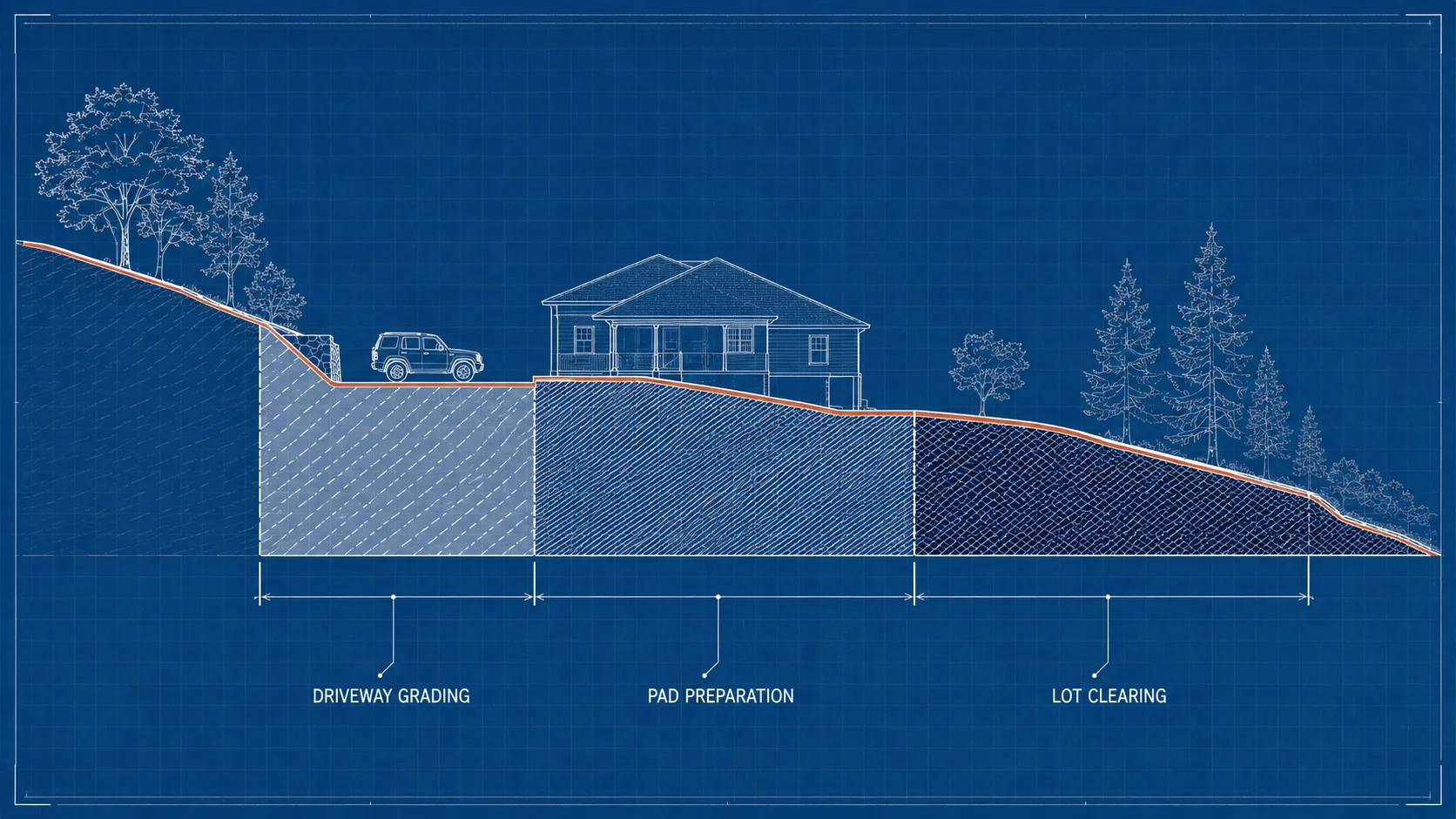
What an Asheboro grading contractor actually does
Four scopes, priced very differently on this terrain.
| Common Asheboro grading scopes | What it involves | What drives the cost |
|---|---|---|
| Driveway grading | Grade and crown, base stone, and shedding water off the surface | Length, base depth, and how much the Uwharrie foothill slope adds to the cut |
| New-home pad preparation | Cutting and compacting a level pad, then setting finish grade around it | Lot size, material moved, and whether fill has to be imported or hauled off |
| Drainage correction on clay | Reshaping the surface so water leaves, and carrying it to an outlet that works | Finding the outlet -- dense red clay won't absorb it, so the water has to go somewhere |
| Lot clearing and rough grading | Clearing vegetation and stumps, shaping ground to a workable contour | Disposal, slope, and whether the lot falls inside a watershed that limits how it can be subdivided |
Driveway grading
- What it involves
- Grade and crown, base stone, and shedding water off the surface
- What drives the cost
- Length, base depth, and how much the Uwharrie foothill slope adds to the cut
New-home pad preparation
- What it involves
- Cutting and compacting a level pad, then setting finish grade around it
- What drives the cost
- Lot size, material moved, and whether fill has to be imported or hauled off
Drainage correction on clay
- What it involves
- Reshaping the surface so water leaves, and carrying it to an outlet that works
- What drives the cost
- Finding the outlet -- dense red clay won't absorb it, so the water has to go somewhere
Lot clearing and rough grading
- What it involves
- Clearing vegetation and stumps, shaping ground to a workable contour
- What drives the cost
- Disposal, slope, and whether the lot falls inside a watershed that limits how it can be subdivided
The last row is the one that catches people. Randolph’s rolling terrain means more slope on an ordinary lot than the flat Piedmont clay you’ll find closer to Greensboro — and on a lot inside one of the county’s watersheds, clearing that would be routine elsewhere sits behind a minimum-lot-size rule that was decided when the property was platted, not when it’s graded.
The question that’s a hiring test
Ask a contractor where the erosion plan goes. The answer tells you how often they actually work here.
Randolph applies the statewide one-acre trigger like everywhere else in North Carolina. What’s local is the reviewer: the Soil Erosion and Sedimentation Control Plan is submitted to the NC Division of Land Resources, and it’s the State that approves it — not a county erosion office the way it works in Guilford or Johnston. Randolph’s own role, per NCGS 160A-417, is to hold the building permit until that State approval is confirmed.
Why this is the hiring test. Ask: “Where does the erosion plan get reviewed on a Randolph County job?”
A contractor who works this county regularly knows the answer is the State, not Randolph itself — and knows to build that review timeline into the schedule they give you. One who assumes a county office reviews it, the way it works in most of the Triad, is telling you they don’t work Randolph often.
The second question, if your lot is anywhere north of Asheboro near a reservoir: “Do you know whether this lot’s size even qualifies for what I want to build, given the watershed?” Full detail on the lot-size table is on the Randolph County page.

What a complete quote includes
- Who reviews the plan, and the timeline that implies. See above — this is the local one.
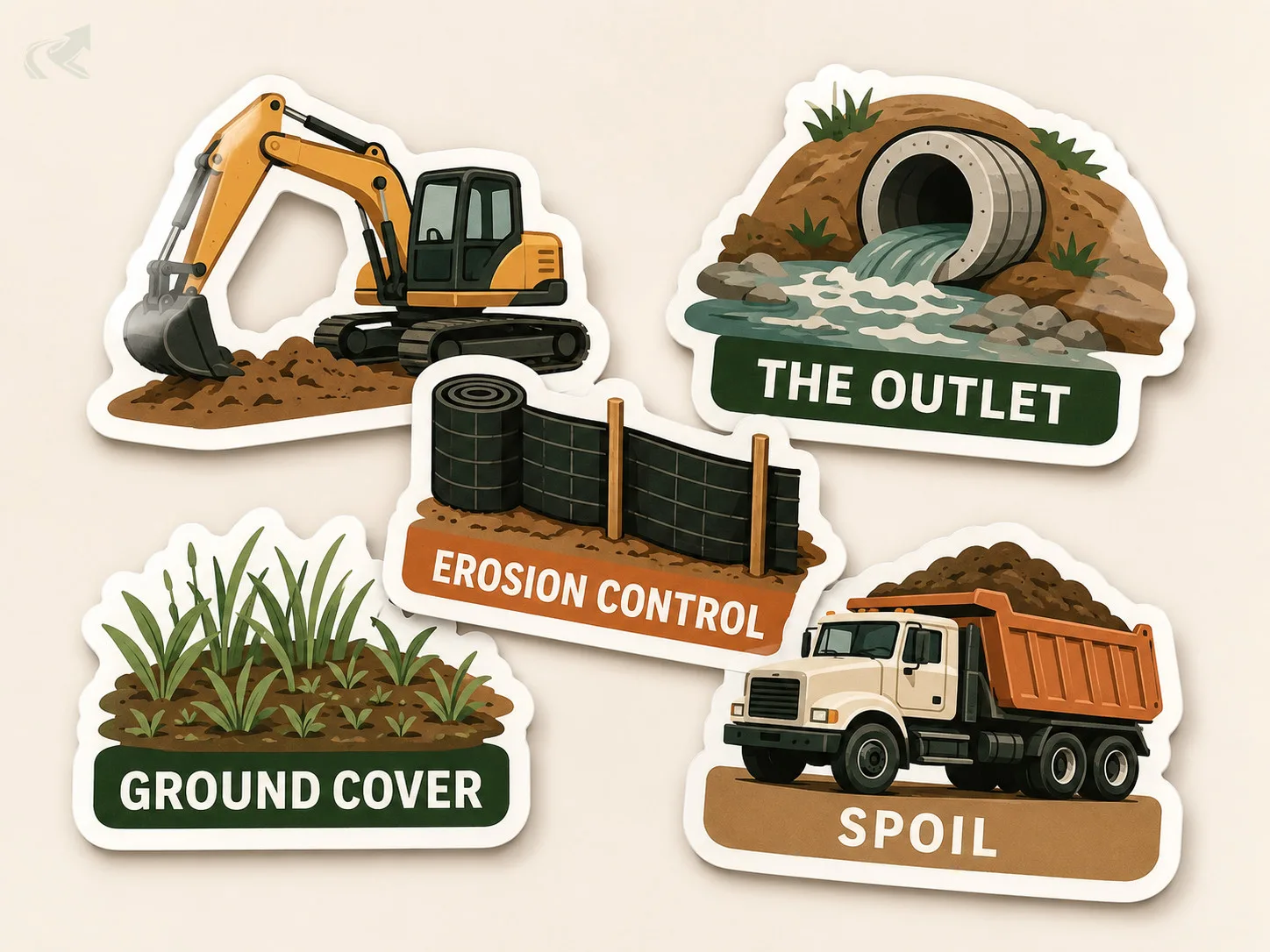
- The outlet. Where drainage water ends up, and whether that’s legal. On red clay, this is the project.
- Erosion control. Silt fence, inlet protection, and stabilisation aren’t optional above an acre, and they aren’t free.
- Ground cover restoration. Does the price end at bare clay or at established cover? The most common invisible gap between two quotes.
- Spoil. Excavated clay is heavy and has to go somewhere. Hauling is a line item; spreading it changes your grade.
Checking the contractor
Licence. Verify against the NC Licensing Board record itself — how to check an NC contractor licence takes about two minutes. The threshold is $40,000; above that a general contractor licence is required.
Insurance, from the agent. Sent by the insurer and naming you — not a PDF forwarded by the contractor.
Recent Randolph County work. Two jobs in the past year, nearby. An operator who works the county regularly will have them, and will already know the State-review structure and the watershed lot-size question.
Patterns worth walking away from are at contractor red flags.
What this page does not cover
The county’s full permit-review structure, lot-size table, and flood setbacks are on the Randolph County page. For the permit-trigger version of the Randleman Lake story from the county on the other side of the lake, see the Guilford County page. Regional context is at earthwork in the Triad. The statewide hiring guide is finding a grading contractor in NC.
From our directory
Verified grading contractors near Asheboro
Every listing is cross-checked against the NC Licensing Board public record before it appears. Pick your city:
Or browse the full NC contractor directory.