
A homeowner outside Fletcher watched his driveway wash out twice in two years. Before that, he had twenty-five years of no trouble at all.
Nothing about his property changed. The creek did. Helene straightened and scoured channels across Western North Carolina, and water that used to bend and slow now runs straight and fast. Local fire officials put it plainly in a May 2026 report: floodwaters move quicker than they used to, and what a stream did historically no longer predicts what it will do next.
That’s the thing to understand about earthwork up here. It isn’t Piedmont work with hills added. The ground is different, the water behaves differently, the permits trigger sooner, and the contractor market is still absorbing a once-in-a-generation storm. Advice that works in Raleigh clay can be actively wrong in Buncombe County rock.
This page is the map. Below: what’s actually different in the mountains, the slope threshold nobody warns you about, how Buncombe permitting works, where post-Helene recovery stands now — and every WNC guide we’ve published, sorted by the problem you’re trying to solve.
What’s actually different up here
Four things change when you cross into the mountains: the soil, the slope, the permit thresholds, and the market.
The ground is shallow over rock. Piedmont clay runs deep and holds water. Western North Carolina is often a thin soil mantle over bedrock, which means excavation hits rock early and water sheds across the surface rather than percolating down. One WNC operator’s summary of the job: you hit rock constantly. That reality drives the repair choice more than anything else — our WNC mountain drainage guide covers the soil science and why buried-trench solutions so often disappoint here.
The slopes exceed what the rules assume. More on this below — it’s the single most useful number on this page.
The permits start earlier. In a Buncombe County Hillside Subdivision, a quarter acre of disturbance triggers an erosion control permit — a quarter of the statewide threshold.
The market is still a recovery market. Helene reshaped both the damage and the contractor landscape. Availability, pricing spread, and vetting all behave differently than they did in 2023.
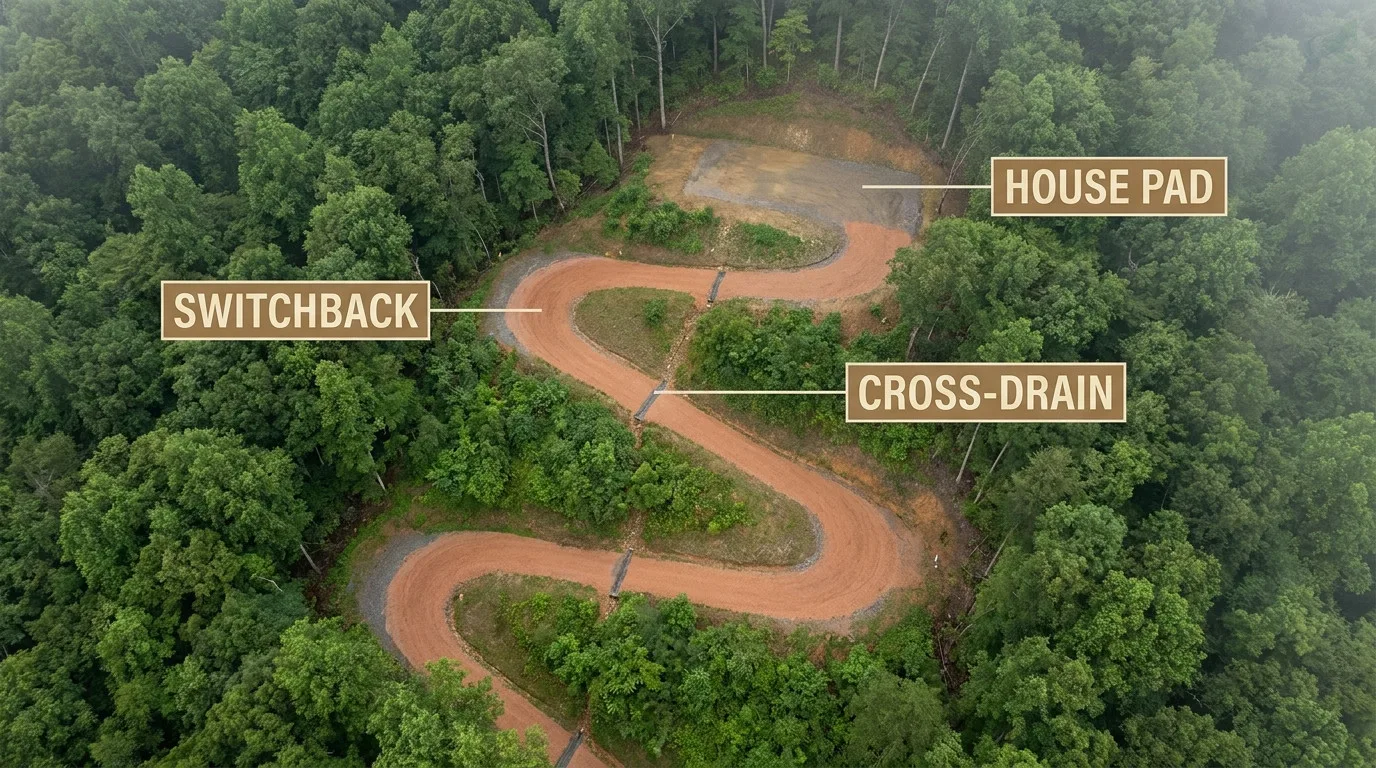
The slope problem nobody warns you about
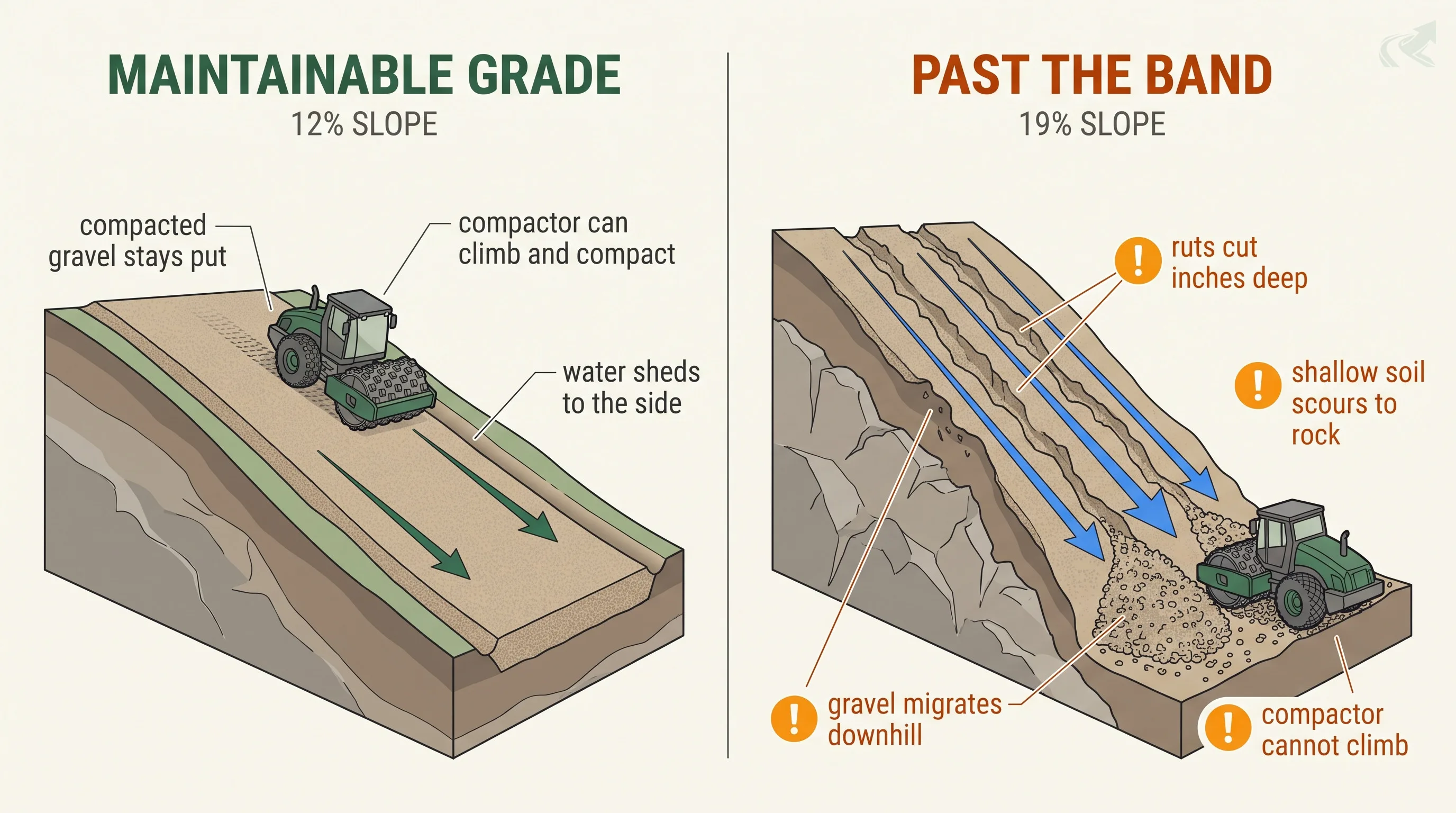
Builders in the region put the jurisdictional ceiling around 12–14%. Real mountain driveways routinely run 17–20%. Above that band, gravel stops being a maintenance choice and becomes a losing one.
This is the gap that catches people buying mountain property. Building codes and county standards are written around grades a loaded truck can climb and a compactor can work. WNC lots frequently exceed them — not because anyone designed it badly, but because that’s the terrain.
Here’s what changes past roughly 15%:
- Compactors struggle to climb. If the machine can’t get up the drive under its own power, the gravel underneath never gets properly compacted. It stays loose, and loose gravel migrates downhill with every rain.
- Vehicles lose traction on the surface. Homeowners describe spinning wheels on their own driveway — sometimes on the final walkthrough of a brand-new build.
- Water gains speed. A 19% grade turns a rain event into a scouring event. Ruts measured in feet, not inches, are common after a hard storm.
- Maintenance intervals collapse. A drive that needed regrading every few years starts needing it every season.
Cross that threshold and paving stops being an upgrade and becomes the practical option — not for appearance, but because gravel can no longer be held in place. That’s a genuinely different calculation than a Piedmont homeowner faces, and it’s worth knowing before you buy gravel for the third time.
Shared private drives carry their own limits in Buncombe County: no steeper than 10% for the first 30 feet, and no more than 20% after that.
Piedmont versus mountains, side by side
| Factor | NC Piedmont | Western NC mountains |
|---|---|---|
| Soil profile | Deep red clay, holds water, slow to drain | Shallow soil over bedrock, rock encountered early |
| What water does | Percolates slowly, saturates, pools | Sheds across the surface, gains speed on grade |
| Typical driveway grade | Gentle enough that gravel holds | Often 17-20%, past what a compactor can work |
| Land-disturbance trigger | Generally the statewide one-acre rule | Quarter acre in a Buncombe County Hillside Subdivision |
| Dominant failure mode | Standing water, saturated foundations, heave | Washout, scour, gravel migration, slope instability |
| The question a good contractor asks | Where does the water sit, and for how long? | Where does the water daylight, and what is under the soil? |
Soil profile
- NC Piedmont
- Deep red clay, holds water, slow to drain
- Western NC mountains
- Shallow soil over bedrock, rock encountered early
What water does
- NC Piedmont
- Percolates slowly, saturates, pools
- Western NC mountains
- Sheds across the surface, gains speed on grade
Typical driveway grade
- NC Piedmont
- Gentle enough that gravel holds
- Western NC mountains
- Often 17-20%, past what a compactor can work
Land-disturbance trigger
- NC Piedmont
- Generally the statewide one-acre rule
- Western NC mountains
- Quarter acre in a Buncombe County Hillside Subdivision
Dominant failure mode
- NC Piedmont
- Standing water, saturated foundations, heave
- Western NC mountains
- Washout, scour, gravel migration, slope instability
The question a good contractor asks
- NC Piedmont
- Where does the water sit, and for how long?
- Western NC mountains
- Where does the water daylight, and what is under the soil?
Permits: Buncombe triggers earlier than the rest of NC
North Carolina’s statewide rule requires an erosion and sedimentation control plan at one acre of disturbance. In a Buncombe County Hillside Subdivision, that drops to a quarter acre.
Two thresholds, and which one applies to you turns on how your lot is classified:
- One acre (43,560 sq ft) — the baseline everywhere, mirroring the state Sedimentation Pollution Control Act
- One-quarter acre (10,890 sq ft) — for property in a Hillside Subdivision, meaning a subdivision whose average natural slope is 25% or greater under the Buncombe County Land Development and Subdivision Ordinance
That distinction matters more than it looks. The 25% figure describes the subdivision’s average natural slope — computed by the formula in § 70-68(c)(2) — not your individual lot’s. So a punishingly steep lot outside a Hillside Subdivision is not automatically on the quarter-acre trigger, and a comparatively gentle lot inside one is. Ask the county how your specific parcel is classified rather than eyeballing your own grade.
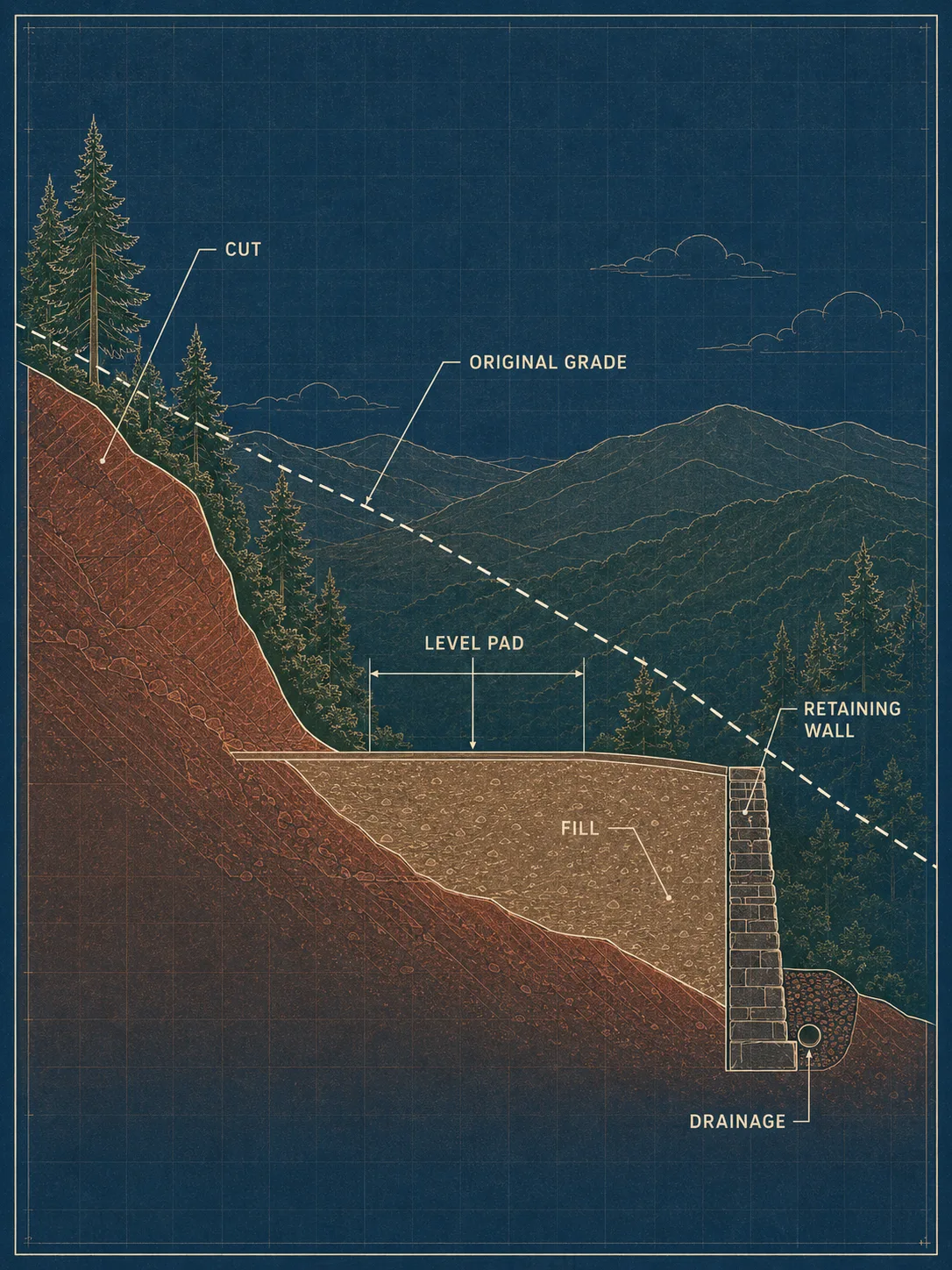
A retaining wall with more than four feet of unbalanced fill needs a permit of its own. A new driveway often needs a separate permit too — and if it meets a state-maintained road, an encroachment permit as well.
Two details worth knowing before you start. The plan has to be filed 30 or more days before work begins. And plan review fees double if land-disturbing work starts before the permit issues — the most expensive way to learn this rule is to learn it late.
Jurisdiction confuses people here, reasonably. Which office you call depends on where the lot sits:
- Inside Asheville city limits — the City of Asheville runs its own permitting
- Unincorporated Buncombe, plus Biltmore Forest, Weaverville, and Woodfin — Buncombe County (the three towns contract their service to the county)
- Anywhere else in WNC — your own county’s office; thresholds and contacts vary
Calling the wrong office costs you a week.
Homeowners are blunt about the experience. A recurring complaint is inconsistency between inspectors — “luck of the draw,” as one local builder put it. Going in with your thresholds, acreage, and slope estimate already worked out is the best defense against a round trip.
Full detail, direct portal links, phone numbers, and the erosion-control contacts are on the Buncombe County resource page. For any other NC county, use the permit lookup tool.
Post-Helene: what’s still true now
Helene made landfall in late September 2024. As of mid-2026, the acute emergency is long over — but three of its effects still shape earthwork decisions in WNC.
Waterways behave differently. Straightened, scoured channels move water faster than the historical record suggests. Property that flooded rarely may now flood repeatedly, and drainage sized against old assumptions may be undersized against current ones.
Private access took disproportionate damage. Driveways, private roads, and the culverts under them were hit hard — and they sit in an awkward gap where public repair programs and standard homeowner policies often both decline to cover them. Insurance framing matters here: several WNC homeowners found their claims contested as flood damage rather than storm damage, which is a very different coverage question.
Rebuilding is still in progress. Programs, waivers, and fee structures have shifted more than once since the storm. Anything you read about assistance — including here — deserves a check against the current county source before you rely on it.
For the full picture: our Helene damage assessment and recovery playbook covers what to document and in what order, and the contractor backlog guide covers realistic wait times and how to find operators actually taking work.
Hiring in a market that’s still catching up
The spread between quotes in WNC right now is wide enough that price alone tells you almost nothing.
One Asheville homeowner collected four quotes for the same washed-out gravel driveway. They came back at $2,600, $6,500, $8,900, and $15,000. The cheapest bid won the job and, by the homeowner’s account, did it well.
That’s not an argument for taking the low bid. It’s an argument that a 6x spread means the bidders are not pricing the same work — some are solving drainage, some are replacing gravel, and some are pricing a job they’d rather not take. Read the spread as a diagnostic, not a ranking.
Two conditions make WNC harder than a normal market. Demand is still elevated from storm recovery, so good operators are booked and scheduling slips. And post-disaster markets attract operators who follow the damage — a documented pattern that state agencies warned about specifically after Helene.
The defense is the same one that works everywhere, just more necessary here: verify the license against the public record before money moves, and confirm the insurance certificate is current and names you. Our guides on booking after a hurricane and what to do when a contractor turns out to be unlicensed cover both paths, and every contractor in our directory is cross-checked against the North Carolina Licensing Board before listing.
Every WNC guide, by problem
Start with the problem you actually have.
- My driveway washed out — Asheville driveway washout repair · Bat Cave driveway repair
- Water is in the wrong place and a French drain didn’t fix it — WNC mountain drainage
- I’m assessing storm damage — Hurricane Helene WNC recovery playbook
- Nobody will call me back — WNC contractor backlog and wait times
- I need to hire and I’m nervous about it — Booking after a hurricane · Unlicensed contractor: what to do
- I need a permit — Buncombe County permits and resources
- I need a contractor now — Verified WNC contractors
For the underlying methods — how grading, drainage, and hauling work statewide — start at drainage, driveways, or hauling and materials.
Counties and towns we cover
Buncombe County is where our WNC coverage is deepest, including Asheville, Black Mountain, Weaverville, Fairview, and Woodfin. Surrounding mountain counties — Henderson, Madison, Haywood, Rutherford, Transylvania, McDowell, Yancey, and the far-western counties — share the same shallow-soil-over-rock reality and the same storm history, though permit thresholds and contacts vary county by county.
If you’re outside Buncombe, the soil and slope guidance on this page still applies. Verify your permit thresholds with your own county before you break ground — the NC permit lookup covers all 100 counties.
From our directory
Verified WNC contractors by city
Every listing is cross-checked against the NC Licensing Board public record before it appears. Pick your city:
Or browse the full NC contractor directory.