
Dave Kowalski’s driveway in Bat Cave didn’t wash out gradually. One overnight storm in September 2024 took 40 feet of it. The gravel ended up in the creek. What was left was exposed red clay, some of it visibly soft, with two channels cut perpendicular to the driveway where a failed culvert had redirected the flow.
Standing at the edge of it the next morning, the question isn’t “how much will this cost.” The question is: where do I even start?
The answer matters more than most homeowners realize. Starting with a load of fill gravel without diagnosing the base is the most common mistake in driveway washout repair in NC. It defers the real problem by six months.
This page walks the diagnostic decision — cosmetic or structural — and then the repair sequence that applies either way. Only the scope changes, not the order.
Cosmetic Washout vs Structural Washout — How to Tell
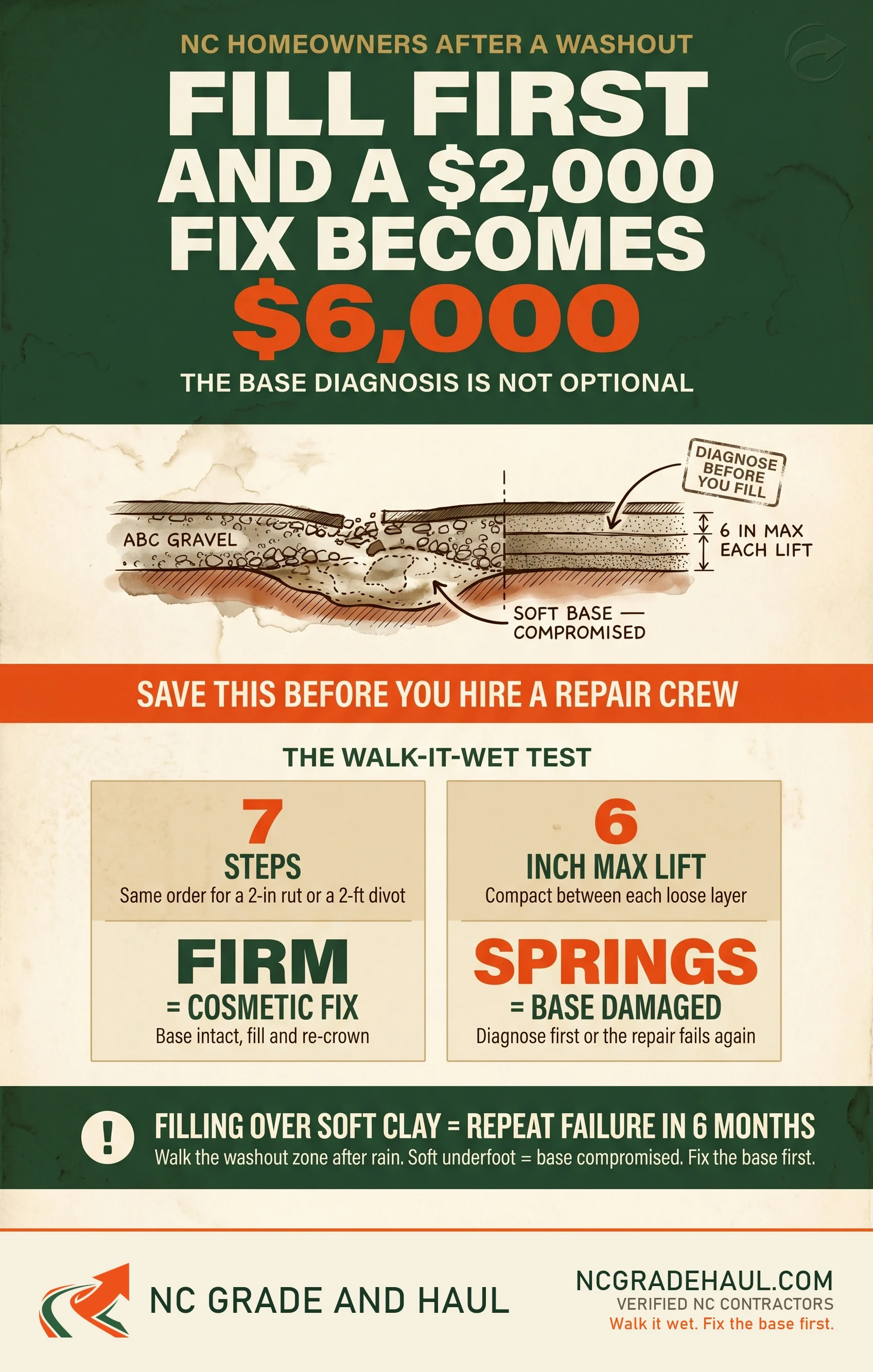
If the ground below the washout is firm when you walk it after rain, it’s cosmetic. If it springs, holds water, or channels cut across the driveway, it’s structural.
This distinction is the most important call you’ll make before any repair begins. Getting it wrong is expensive.
Cosmetic washout means water ran over the driveway, stripping surface gravel. The red clay base is visible but firm when walked. Fix: fill, re-crown, correct the drainage geometry to redirect water off both edges going forward.
Structural washout means water ran through or under the driveway. Signs: the ground below the washout zone is soft or spongy; ruts deepen with every storm instead of holding; channels are cut perpendicular to the driveway direction (not along it); or a culvert has collapsed, shifted, or undersized the drainage crossing. Fix: source diagnosis first, base correction second, fill third.
The common mistake — filling cosmetically over a structural problem — creates a soft spot beneath the new gravel. Under vehicle load and the next heavy rain, that soft spot fails. The driveway looks repaired for a season and then opens up worse than before.
The walk-it-wet test. After the next rain event, while it’s still safe to be on, traverse the entire washout zone slowly. Any spot that springs underfoot, leaves standing water in your footprints, or feels different from the firm surrounding ground is a soft spot. Mark it. That zone needs base correction before any fill goes in.
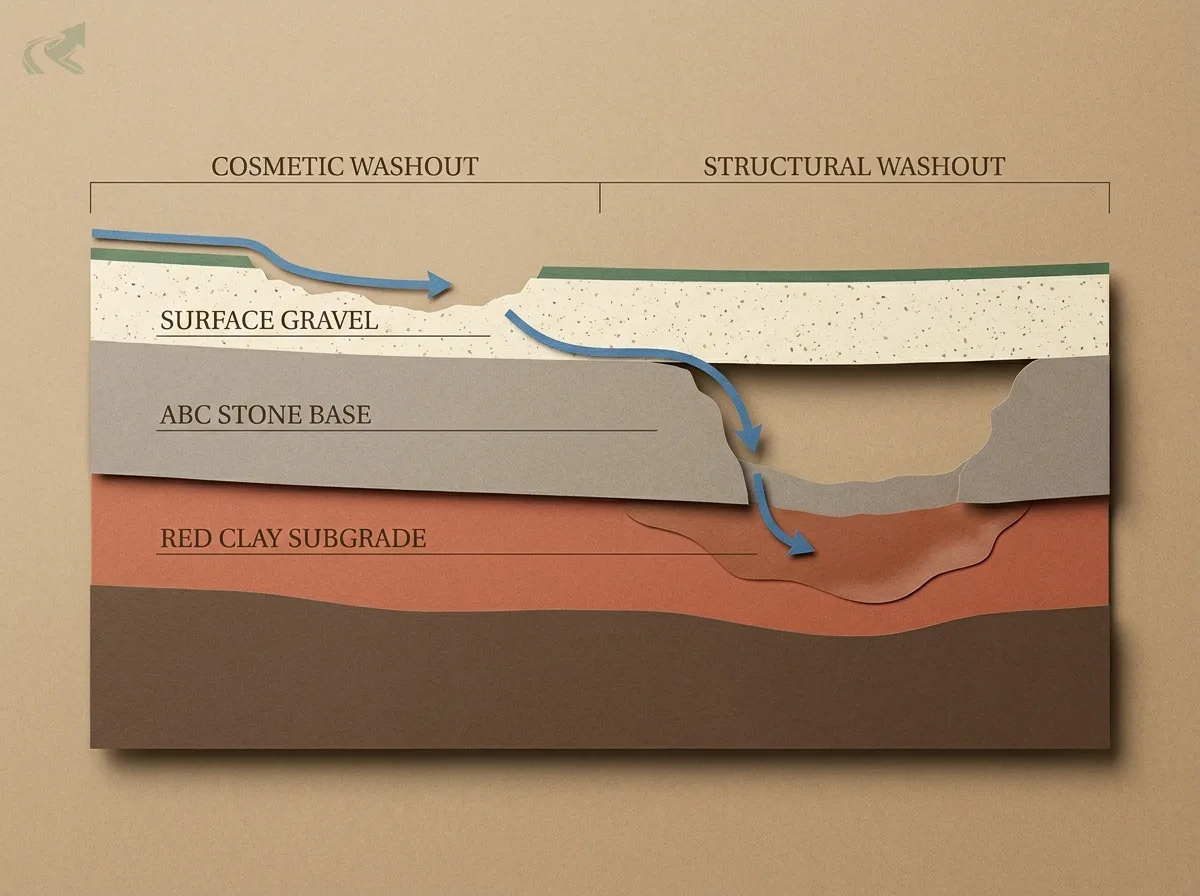
Cosmetic washout vs structural washout: how to read your driveway
Comparison. Cosmetic washout: Water ran over the surface, stripping gravel; Red clay base is exposed but firm when walked; No spongy spots, no standing water in footprints; Fix is fill, re-crown, and correct the drainage geometry. Structural washout: Water ran through or under the driveway; Ground below the washout springs or holds water; Channels cut across the driveway, not along it; Fix is source diagnosis and base correction before any fill.
- Water ran over the surface, stripping gravel
- Red clay base is exposed but firm when walked
- No spongy spots, no standing water in footprints
- Fix is fill, re-crown, and correct the drainage geometry
- Water ran through or under the driveway
- Ground below the washout springs or holds water
- Channels cut across the driveway, not along it
- Fix is source diagnosis and base correction before any fill
Filling cosmetically over a structural problem hides a soft spot that fails under load -- a $2,000 repair becomes a $6,000 one in six months.
The Repair Sequence — In Order
The repair sequence is non-negotiable: clear debris, identify the water source, fix the culvert if needed, re-compact the base, fill the void, re-crown, and verify drainage before spreading finish gravel.
The same seven steps apply whether the washout is a 2-inch rut or a 2-foot divot. Scope and material volume change; the order doesn’t.
-
Clear debris. Sediment, displaced gravel, and organic material from the washout zone come out before anything else. You cannot see what’s soft until the surface is clean.
-
Identify the water source. Where did the water originate? Upslope runoff? An NCDOT right-of-way ditch directing flow onto the driveway? A failed culvert that redirected a drainage channel? This step determines whether the fix is a gravel patch or a drainage project.
-
Address the culvert if applicable. An undersized or failed culvert must be repaired before any fill goes in. No exceptions. Filling over a failed culvert produces the same washout in the next storm.
-
Re-compact the base. Any soft subgrade must be proof-rolled and corrected. Adding fill over soft clay creates a sponge. That sponge fails under vehicle load — usually right at freeze-thaw or after the next heavy rain.
-
Fill the void with . Shallow ruts (2—3 inches) use a single fill pass. Voids 12 inches or deeper need layered lifts with compaction between each layer. Each lift: no more than 6 inches loose depth before compacting.
-
Re-crown. A repair that fills the void without re-establishing the crown is incomplete. The grading pass must create positive drainage — water shedding off both edges, not pooling at center or channeling to one side.
-
Verify drainage before finish gravel. Observe the graded surface in the next rain. Water should sheet off both edges of the crown. If it channels, the crown geometry needs adjustment before any finish gravel covers the problem.
The full repair sequence vs skipping straight to fill
Comparison. Full sequence: Debris cleared, water source identified, culvert fixed first; Soft subgrade proof-rolled and corrected; Void filled with ABC in compacted lifts; Crown re-established -- water sheds off both edges. Skip to fill: Gravel dumped before the base is diagnosed; Soft spot left buried under the new fill; Flat surface, no crown correction; Water returns to the same channel and the repair collapses.
- Debris cleared, water source identified, culvert fixed first
- Soft subgrade proof-rolled and corrected
- Void filled with ABC in compacted lifts
- Crown re-established -- water sheds off both edges
- Gravel dumped before the base is diagnosed
- Soft spot left buried under the new fill
- Flat surface, no crown correction
- Water returns to the same channel and the repair collapses
The seven steps run in order whether the washout is a 2-inch rut or a 2-foot divot -- scope changes, sequence does not.
When a Culvert Is the Real Problem
If water is cutting across your driveway rather than along it, a failed or undersized culvert is likely the cause — and no amount of gravel fixes a culvert problem.
The most reliable sign of culvert-related washout is the channel direction. When water runs along a driveway, it’s runoff issue. When channels cut across the driveway at the same location after every storm, something beneath or beside the crossing is failing.
Signs of culvert-related washout in North Carolina:
- Perpendicular channels cut across the driveway at the same spot after each rain
- Sinkhole or settlement visible directly above an existing culvert — the pipe has shifted or the bedding is washing out
- Water pooling at the driveway edge where a drainage ditch should pass underneath
- Visible pipe end displaced, collapsed, or blocked with sediment and debris
- Water running around the culvert, not through it — overflow pattern visible in the soil beside the pipe
note: if your driveway connects to a state-maintained road, culvert work likely requires an NCDOT driveway culvert permit. The permit specifies minimum culvert diameter — typically 12 inches for residential access, though site conditions can increase that requirement.
Many rural WNC properties have culverts installed before current NCDOT minimums were set. Hurricane Helene revealed this at scale across Buncombe, Henderson, and Rutherford counties. If your culvert is older than 15—20 years and hasn’t been inspected since installation, the culvert size may be the root cause of repeated washout — not the driveway surface.
For the full culvert diagnostic and replacement process, see culvert installation to stop driveway washout and road apron drainage to stop driveway apron washout.
WNC and Helene — What’s Different About Mountain Washout
Mountain washout in WNC after Helene is not the same as suburban Triangle washout — the slope, soil type, and water volume are different, and so is the repair scope.
Updated May 2026. WNC repair contractors are backlogged 6—18 months post-Helene. See post-Helene driveway washout repair in WNC for current WNC-specific market navigation and contractor availability.
Slope is the first difference. WNC driveways often run 15—20% grades — steeper than any NCDOT recommendation for residential access. At that grade, runoff concentrates far faster than on a Piedmont flat-grade driveway. Crown geometry alone doesn’t resolve steep-slope washout. Water bars — berms set at an angle across the driveway to intercept flow — are sometimes the structural fix, not just gravel and a crown pass.
Soil type matters differently in western North Carolina. Mountain soils are shallow rock-and-clay mix, not deep Piedmont red clay. The base layer behaves differently: compaction over rock is harder to achieve uniformly, and water moves faster through the upper soil horizon. What proof-rolls firm in the Piedmont can still hide instability in WNC rock-mixed subgrade.
Volume. Helene brought what meteorologists measured as 1,000-year rainfall in portions of WNC watersheds. Driveways engineered (or simply built) for 25-year storm events failed structurally. That’s not a maintenance failure — it’s a design threshold failure. Repair that restores the driveway to prior spec will fail again in the next equivalent event. The fix needs to upsize the drainage capacity, not just restore the surface.
If your property is in Buncombe, Henderson, or Rutherford County and Helene caused the damage, also see Asheville driveway washout repair services.
When to Hire vs Patch Yourself
Surface gravel replacement on a driveway with a confirmed firm base is DIY territory with rented equipment. Anything involving base correction, culvert work, or grades over 10% belongs with a contractor.
The DIY scope is narrower than most homeowners expect when they’re standing at the edge of the damage.
DIY is reasonable when: the base is confirmed firm by the walk-it-wet test, the crown geometry is intact or only slightly off, the washout is 3 inches or shallower, and the driveway doesn’t cross a state road.
Hire a contractor when: the base is soft in any zone; the repair involves culvert inspection, relocation, or replacement; the slope is steep enough that a grading pass requires equipment the average homeowner doesn’t operate; or the driveway connects to a state-maintained road (which triggers permit requirements). Also get a contractor when the total disturbed area is large enough to require E&S (erosion and sediment) controls — North Carolina’s land-disturbance threshold is 1 acre, but some counties set it lower.
The cost of getting this wrong is real. A DIY surface patch over a soft base fails in six months and costs more to fix properly than the original repair would have — including the second mobilization cost, which contractors charge at full rate.
When to patch it yourself vs when to hire
Comparison. DIY is reasonable when: Base confirmed firm by the walk-it-wet test; Crown geometry intact or only slightly off; Washout is 3 inches or shallower; Driveway does not cross a state-maintained road. Hire a contractor when: Base is soft in any zone; Culvert inspection, relocation, or replacement involved; Slope requires equipment you don't operate; Driveway connects to a state road -- NCDOT permit required; Disturbance area triggers E&S controls.
- Base confirmed firm by the walk-it-wet test
- Crown geometry intact or only slightly off
- Washout is 3 inches or shallower
- Driveway does not cross a state-maintained road
- Base is soft in any zone
- Culvert inspection, relocation, or replacement involved
- Slope requires equipment you don't operate
- Driveway connects to a state road -- NCDOT permit required
- Disturbance area triggers E&S controls
A DIY surface patch over a soft base fails in six months. The second mobilization costs the same as the first would have.
Getting an Itemized Quote
Before you book any contractor for driveway washout repair, ask one question: “Walk the driveway with me and tell me where the water came from before you give me a price.”
A contractor who can name the water source — upslope runoff, failed culvert, NCDOT right-of-way ditch — is diagnosing the actual problem. A contractor who looks at the surface, says “we’ll bring in some gravel and grade it,” and gives you a number is selling you a deferral.
Get an itemized quote that specifies whether the repair includes base investigation, compaction work, culvert assessment, and crown re-establishment. “Haul in some gravel and grade it” is not a driveway washout repair. It’s a cosmetic cover on a structural problem.
To hire a licensed NC grading contractor, look for license documentation and a covering the job site. Ask for both before signing anything.
Contractor evaluation question — copy and use
“Walk the driveway with me and tell me where the water came from before you give me a price.”
Also see how driveway crowning prevents future washout and erosion barriers to prevent NC driveway washout if the contractor hasn’t addressed drainage geometry as part of the repair scope.
For deep divot repairs — washouts 12 inches or deeper that need layered fill and compaction — see repairing deep driveway divots NC. For shared driveways and private roads, see private road and shared driveway washout repair NC.