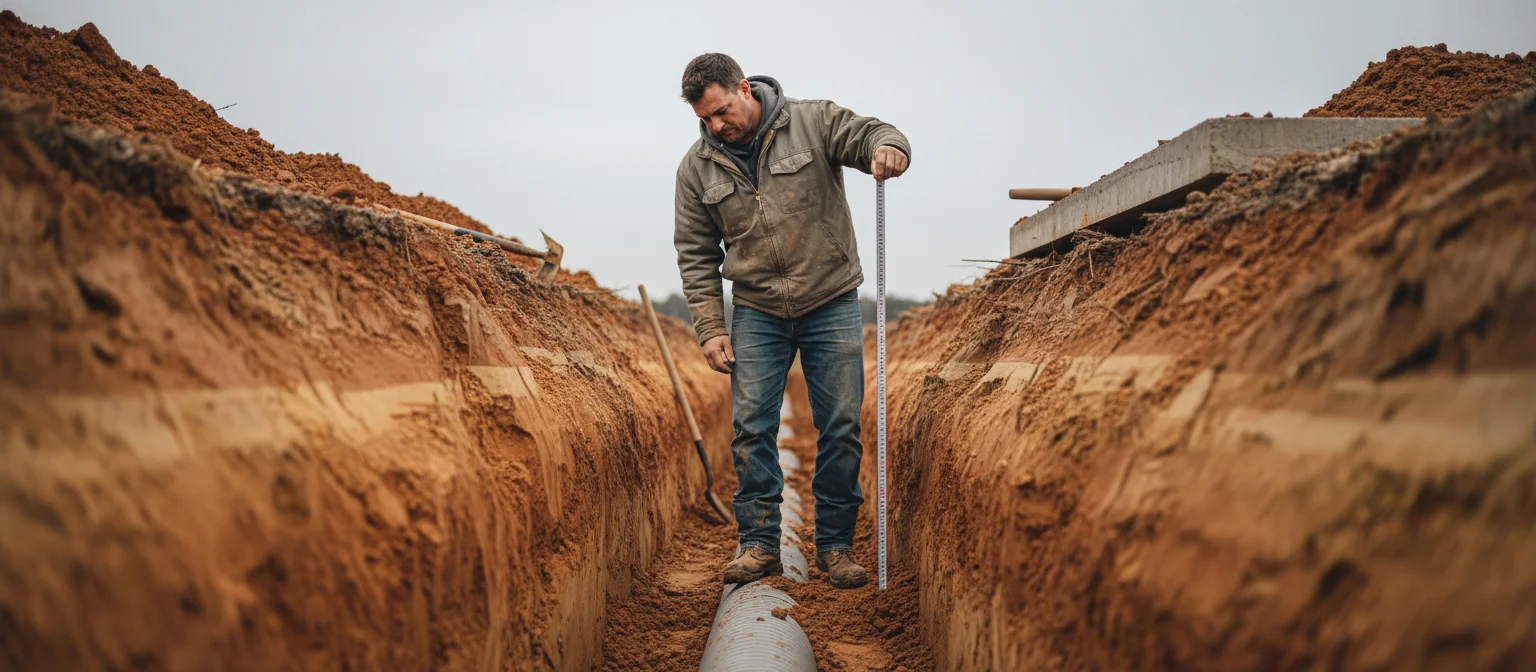
You got two quotes. One says 18-inch trench. One says 12-inch trench. Same yard, same problem, $600 difference. Which contractor is cutting corners — and how would you know?
That’s not a rhetorical question. Depth is where shallow quotes hide. And in North Carolina clay, underdepth isn’t just cheaper — it’s a different system with a different failure mode.
Depth by Application — The Reference Table
Depth is application-specific. The table below is the NC working guide.
| Application | Minimum depth | Common NC depth | Notes |
|---|---|---|---|
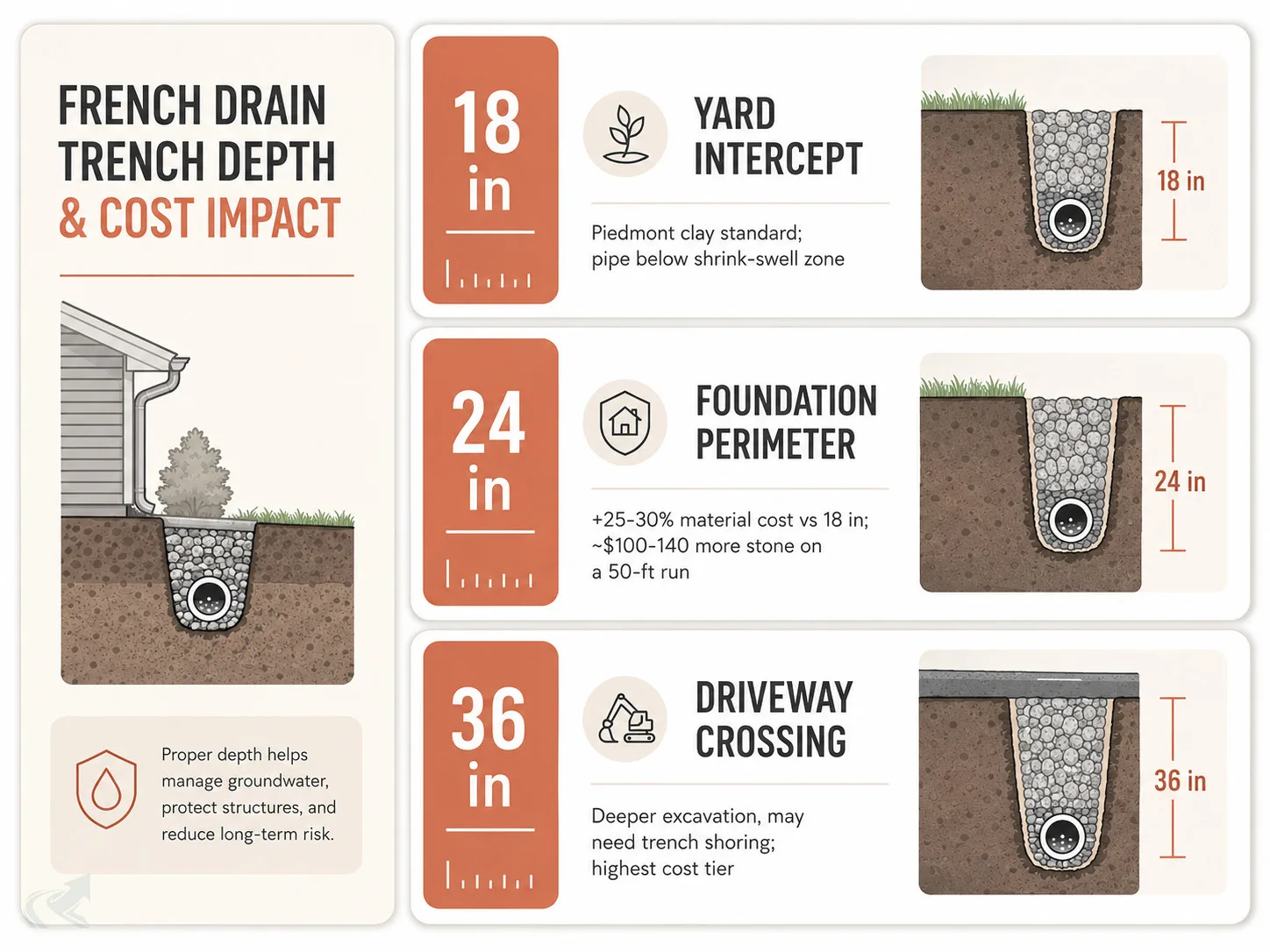
| Yard intercept (subsurface) | 18 in | 18—24 in | Gets pipe below the shrink-swell zone in Piedmont red clay |
| Foundation perimeter | 24 in | 24—36 in | Deeper required to intercept hydrostatic pressure at footing level |
| Driveway crossing | 36 in | 36—48 in | Accounts for frost depth, load bearing, and root zone clearance |
| Root zone avoidance | 24 in | 24—30 in | Mature tree roots in NC reach 18—24 in; go deeper to stay clear |
| Sandy transition areas | 12 in | 12—18 in | Sandy Coastal Plain soils drain faster; the shrink-swell concern is lower |
The frost depth argument (common in northern states) rarely drives NC depth decisions — the NC average frost depth is approximately 12 inches, well above the 18-inch yard-intercept minimum. In North Carolina, the driver is clay behavior, not freeze-thaw.
A 4-inch perforated drain pipe (the standard residential spec for a yard intercept) buried at 18 inches in Piedmont red clay sits comfortably below the zone of active moisture change. At 12 inches, it does not. Foundation drainage depth NC runs deeper still — 24 to 36 inches — because the target is hydrostatic pressure at footing level, not just the clay shrink-swell zone.
Why Fall Matters More Than Depth in NC Clay
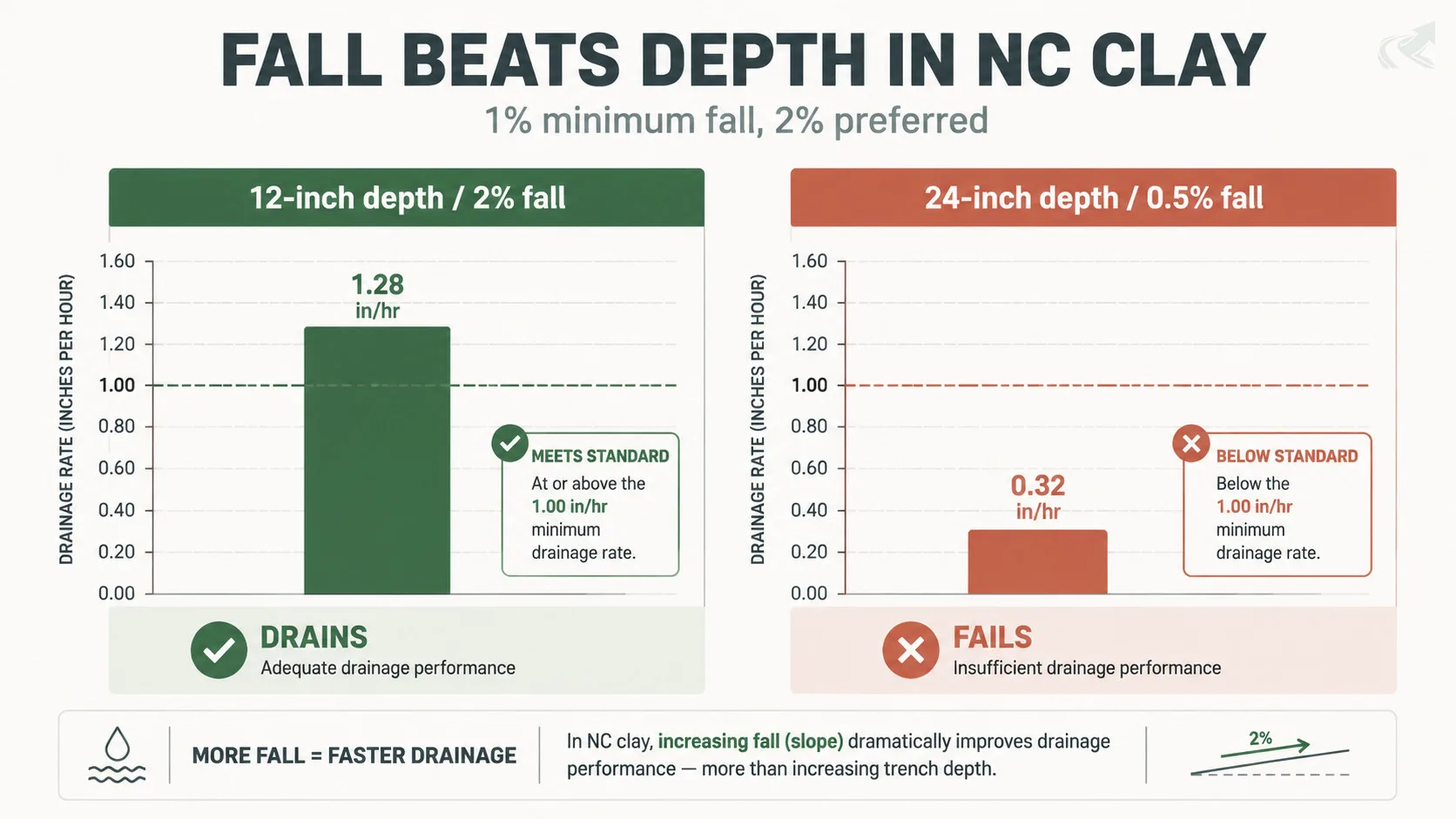
A 12-inch trench with 2% fall drains better than a 24-inch trench with 0.5% fall. In NC’s relatively flat Piedmont terrain, fall is often the binding constraint.
Fall is the vertical drop from the inlet of the system to the daylight point — where the water exits. It is not the same as surface slope. A yard can slope visually toward the street while the pipe runs nearly flat if the contractor didn’t read the grade carefully.
The recommended fall for a French drain in NC is 1% minimum, with 2% preferred. At less than 1%, water reaches the pipe and sits. At 0.5% or less on a clay subgrade, a French drain becomes a subsurface pond with a pipe in it.
You can use the yard drainage slope calculator to check the numbers for your specific grade before any contractor breaks ground.
This is why two bids can have the same advertised depth and produce completely different results. The 18-inch trench with flat fall will fail. The 16-inch trench with solid 2% fall will work. Always ask for both numbers — depth and fall — in writing. See French drain slope requirements for the full calculation.
Why 12-Inch Trenches Fail in NC Clay
A 12-inch trench in NC clay leaves the pipe in or near the zone of active clay moisture change — the pipe gets pinched during drought shrink cycles.
North Carolina Piedmont clay is not inert. When it’s wet, it expands. When it dries out, it contracts. That movement is concentrated in the top 18 to 24 inches of the soil column — exactly where a 12-inch trench puts the pipe. The engineering of French drains in NC red clay turns on this shrink-swell cycle in ways that national installation guides don’t account for.
The failure isn’t always visible from the surface. The pipe may look fine when inspected. But lateral pressure from expanding clay during wet seasons compresses the perforations. During dry seasons, the trench walls contract and shift. Over two to three years, inflow capacity drops. The yard floods again.
This is that’s not how it works in NC clay — a 12-inch spec is not “good enough.” It’s the wrong spec for the soil. The fact that it’s cheaper to dig makes it a common cut. And it’s one of the harder ones to spot if you don’t know to ask.
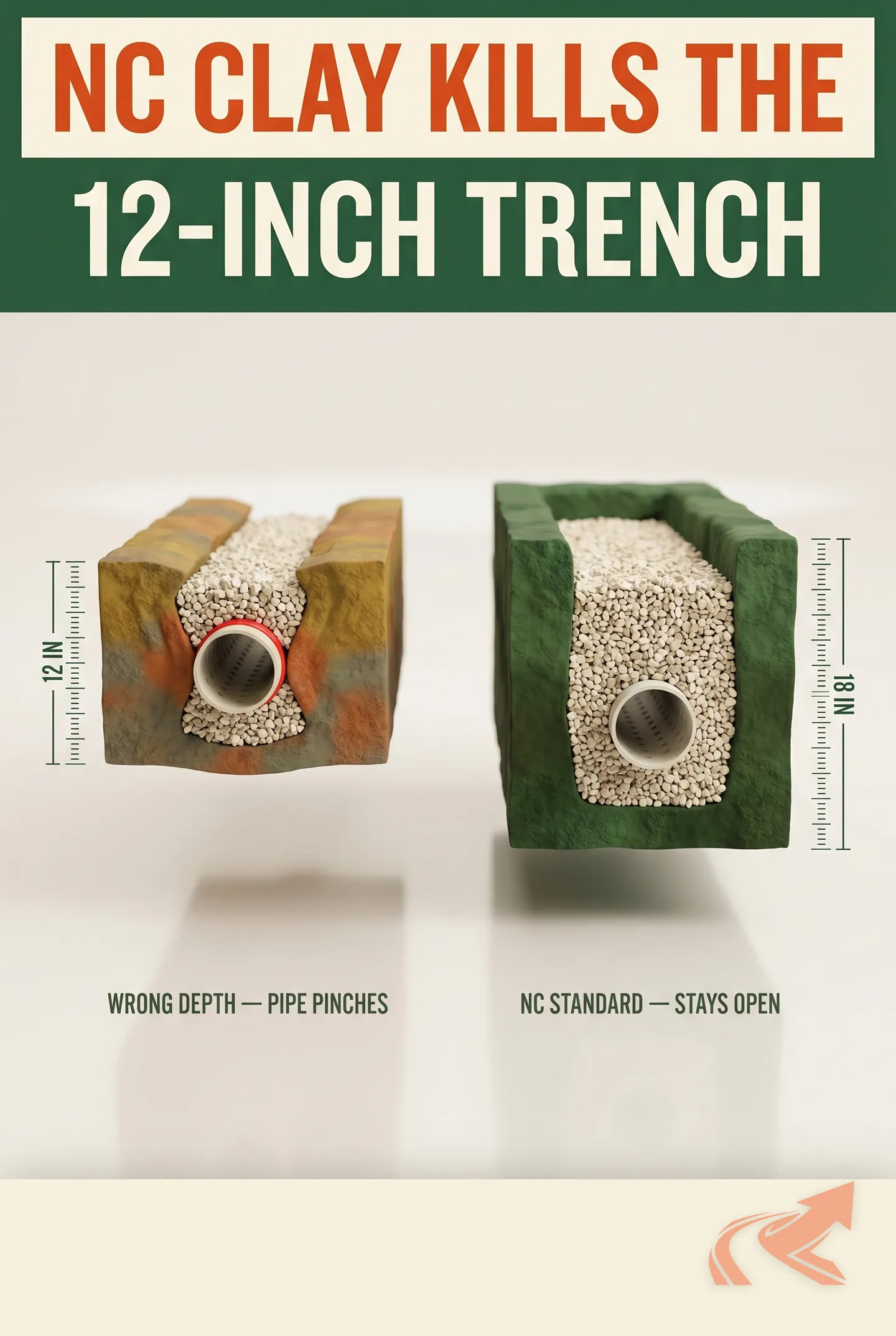
French drain depth in NC clay: 18-inch trench vs 12-inch trench
Comparison. 18-inch trench: Pipe sits below the active clay shrink-swell zone; Stable trench walls year-round, wet season or dry; Inflow capacity holds up over the long term; The NC Piedmont standard for a yard intercept. 12-inch trench: Pipe left in the top 18-24 in where clay moves most; Wet-season swell pinches the pipe perforations; Dry-season shrink shifts and distorts the trench; Inflow drops over 2-3 years -- the yard floods again.
- Pipe sits below the active clay shrink-swell zone
- Stable trench walls year-round, wet season or dry
- Inflow capacity holds up over the long term
- The NC Piedmont standard for a yard intercept
- Pipe left in the top 18-24 in where clay moves most
- Wet-season swell pinches the pipe perforations
- Dry-season shrink shifts and distorts the trench
- Inflow drops over 2-3 years -- the yard floods again
In Piedmont clay the 12-inch trench is not a cheaper version of the same drain -- it is the wrong spec for the soil, hidden behind a lower bid.
Depth and Cost — What Each Inch Adds
Every additional 6 inches of depth adds excavation time and stone volume. Going from 18 inches to 24 inches adds roughly 25—30% to material cost on a stone-column job.
The math is straightforward. A 6-inch increase in trench depth on a 50-foot run adds roughly 12.5 cubic feet of additional #67 stone per foot of width — approximately 0.5 cubic yards per linear foot of additional depth. On a standard 18-inch-wide trench that’s 50 feet long, moving from 18 to 24 inches means an additional 2.5 cubic yards of stone plus the excavation labor to go deeper.
At NC material prices (roughly $40—$55 per cubic yard for #67 washed stone delivered), that’s $100—$140 in material alone. Add excavation labor and that 6-inch difference lands in the $250—$400 range depending on equipment access and soil hardness.
Going from 24 to 36 inches for a driveway crossing or foundation perimeter adds more — partly material, partly because deeper trenches in hard Piedmont clay require more equipment time and may need trench shoring.
The cost-per-inch difference is real and it’s why the cheaper 12-inch quote exists. Understanding what each inch buys you is how you evaluate whether the premium is worth it — or whether you’ll be back researching standing water in yard NC solutions two seasons later.
What to Ask Your Contractor About Depth
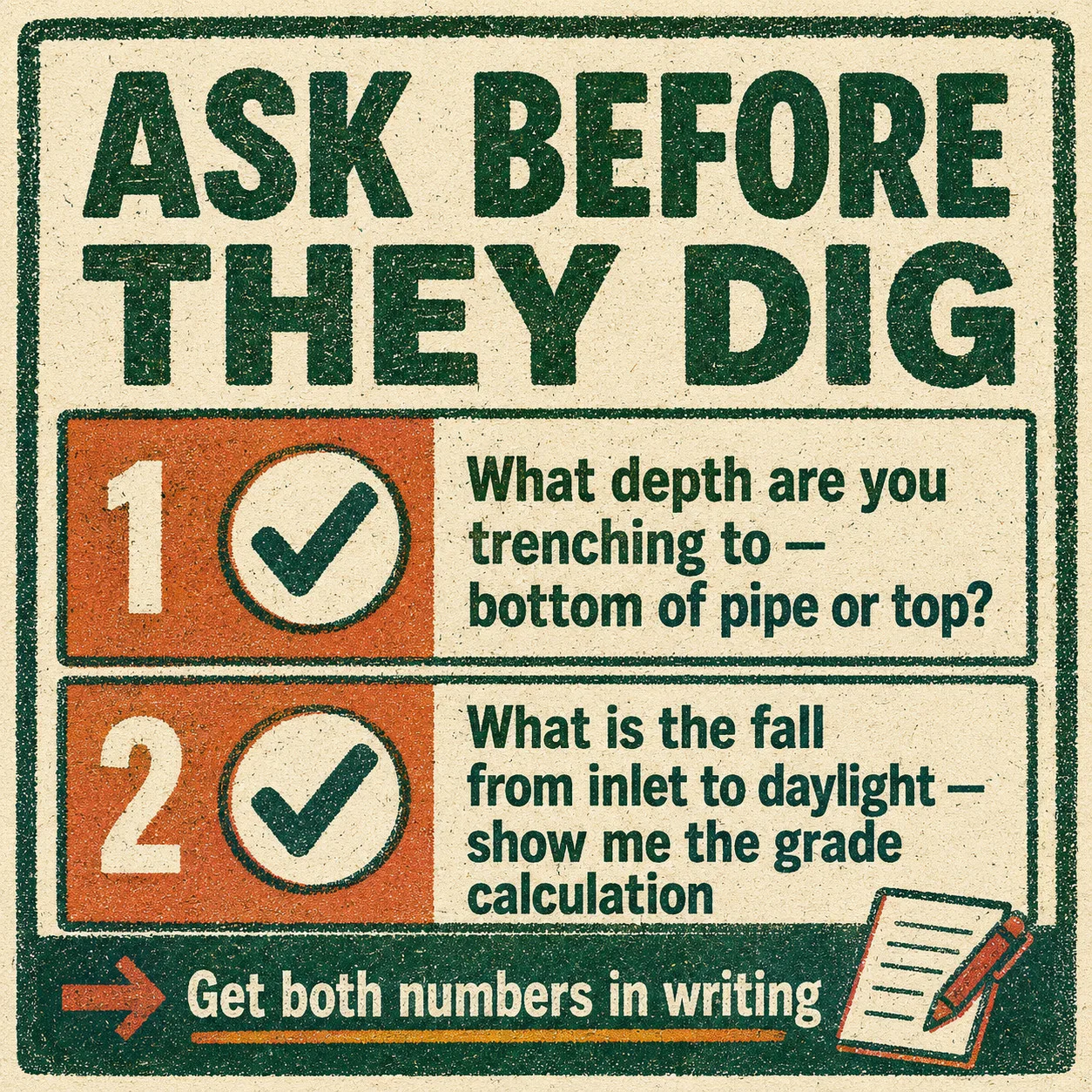
Ask specifically: what depth are you trenching to, and how did you determine that was right for my yard’s slope?
Two questions worth asking before any French drain gets dug in North Carolina:
- “What depth are you trenching to, and is that the bottom of the pipe or the top?”
- “What’s the fall from inlet to daylight, and how did you calculate that from my grade?”
If the answer to question two is “we’ll make it work” or a vague reference to eyeballing the slope, that’s the tell. A contractor who has done French drain work in NC clay knows the grade constraints. They should be able to name the fall percentage or at least describe how they’re reading the grade.
Get an itemized quote that specifies trench depth, pipe spec, and the calculated fall to daylight. If it’s not written down, it’s not accounted for.
Hire a grading operator in North Carolina who can put both numbers on paper before they start.
Ask this before they dig: “What depth are you trenching to, and how did you determine that’s right for my yard’s specific slope? Can you show me on a grade stake?”