
Two questions people often ask
Why is my yard still soaked 24 hours after the rain stopped?
Usually one of three things — a true drainage failure, a grading problem sending water the wrong way, or saturated Piedmont clay that can't absorb any more. The fix depends on which one, and a French drain is the right answer only for the first.
Do I just need a French drain?
Probably not first. About half the standing-water yards we look at in the Triangle have a grading issue, not a drainage issue. A drain installed on bad grade becomes a maintenance liability — it clogs, the water still pools, and now you have a pipe to maintain.
If you’re standing in your back yard after a thunderstorm watching water sit on top of the grass 12 hours later, you’ve probably Googled “bad drainage” and gotten a thousand results. Most of them are selling you a French drain.
Here’s the thing — what you’re looking at probably isn’t a drainage problem. Or rather, it’s a drainage symptom with one of three underlying causes. The fix depends on which cause is yours.
The three categories:
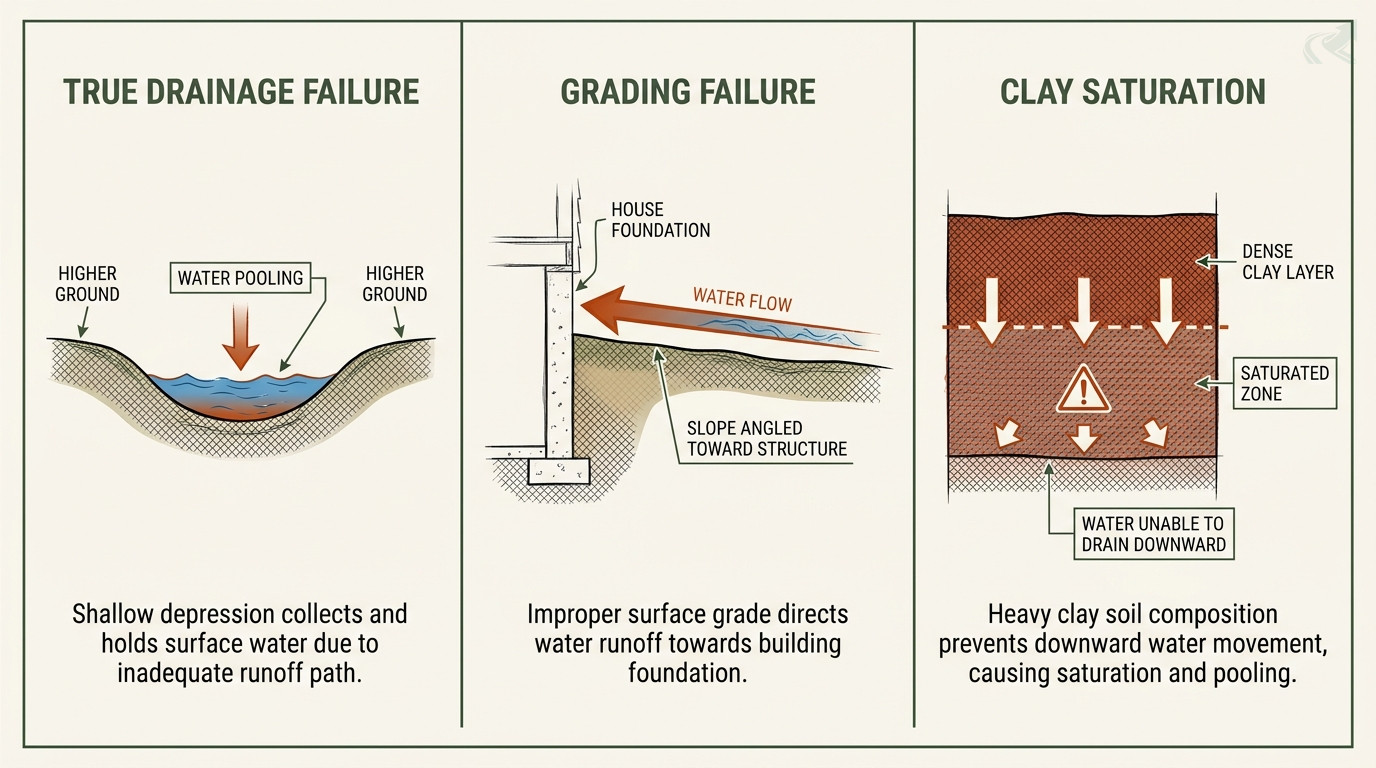
- True drainage failure — water has nowhere to go.
- Grading or siting problem — water is going exactly where the grade tells it to, which is toward your house.
- Soil or foundation condition — water isn’t moving because the soil won’t let it, or a foundation issue is the actual root cause.
Sort yours into one of those buckets before you spend a dollar on a fix.
The 3-Category Diagnostic
Every standing-water yard fits into one of three categories. The category decides the fix.
Category 1: True Drainage Failure
Water enters from a known source, travels somewhere, and sits because there’s no path out.
The clearest signal: you can point to where the water comes from (a downspout, a neighbor’s grade, a driveway shedding sheet flow) and where it ends up (a specific low spot that pools every storm). The grade is fine. The receiving area just has nowhere to send the water.
Signs you’re in this category:
- Water pools at a specific low point every time it rains — same spot, same shape, same depth.
- Downspouts discharge onto the ground or into mulch, not into a pipe that daylights.
- Low-lying area with no outlet — the water is trapped because there’s no graded path out.
Fix category: French drain with a real outlet, catch basin, drainage swale design and installation, or pipe-and-daylight. The job is to give the water a route. Details on the dedicated NC French drain installation for red clay and catch basin installation for downspout drainage.
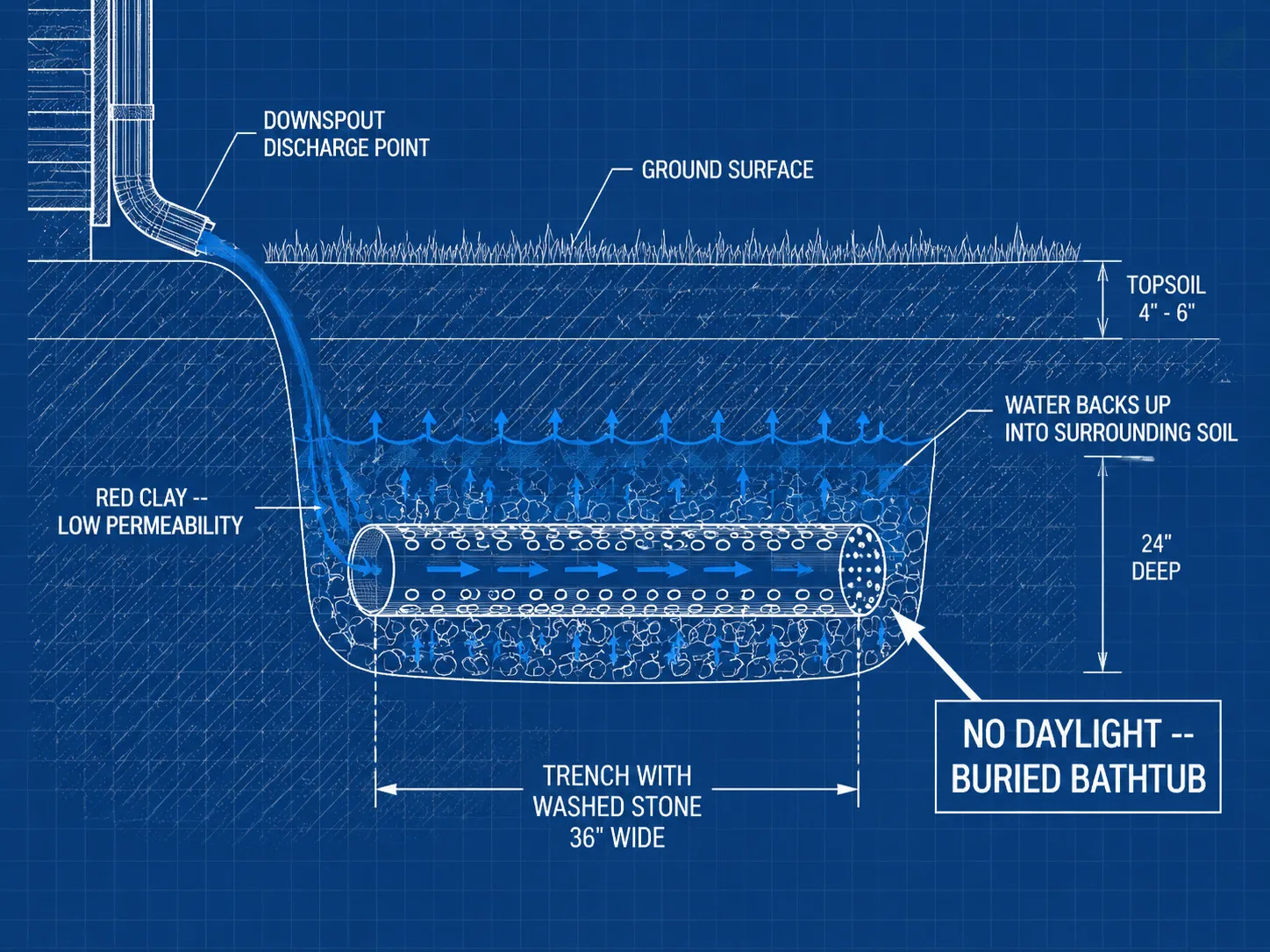
The trap: a French drain only works if you have somewhere to send the water. In NC subdivisions where the back lot line is the property edge and the neighbor sits at the same elevation, “daylight” can be hard to find. If the contractor can’t point at the exit, the drain is a buried bathtub waiting to fail.
Category 2: Grading or Siting Problem
Water follows the grade, and the grade is wrong.
This is the category most homeowners miss. Water is moving toward your foundation, or the back yard slopes lower than the front and flow gets trapped against the house. A French drain installed in a grading-failure yard becomes a clogged pipe in two seasons because the grade keeps feeding it sediment.
Signs you’re in this category:
- Water pools against the foundation wall, not out in the yard.
- Sod never takes root in stripes pointing toward the house — that’s subsurface water carving a path.
- Lot slope visibly falls from the street toward the house — common in 1980s and 1990s builds on cut-and-fill lots.
- Same water signature every storm at the same grade low point, regardless of how hard it rained.
Category 2: positive grade away from the house vs negative grade toward it
Comparison. Positive grade: Surface falls 2% or more for the first 10 feet from the wall; Water sheds away from the foundation to the property edge; No pooling against the foundation after a storm; A regrade alone usually stops the problem -- no pipe needed. Negative grade: Grade slopes back toward the foundation wall; Water converges and pools along the foundation line; Saturated clay sits against the wall, efflorescence appears; Subsurface water carves a path straight to the house.
- Surface falls 2% or more for the first 10 feet from the wall
- Water sheds away from the foundation to the property edge
- No pooling against the foundation after a storm
- A regrade alone usually stops the problem -- no pipe needed
- Grade slopes back toward the foundation wall
- Water converges and pools along the foundation line
- Saturated clay sits against the wall, efflorescence appears
- Subsurface water carves a path straight to the house
A French drain installed on negative grade just clogs -- the grade keeps feeding it sediment. Fix the slope first.
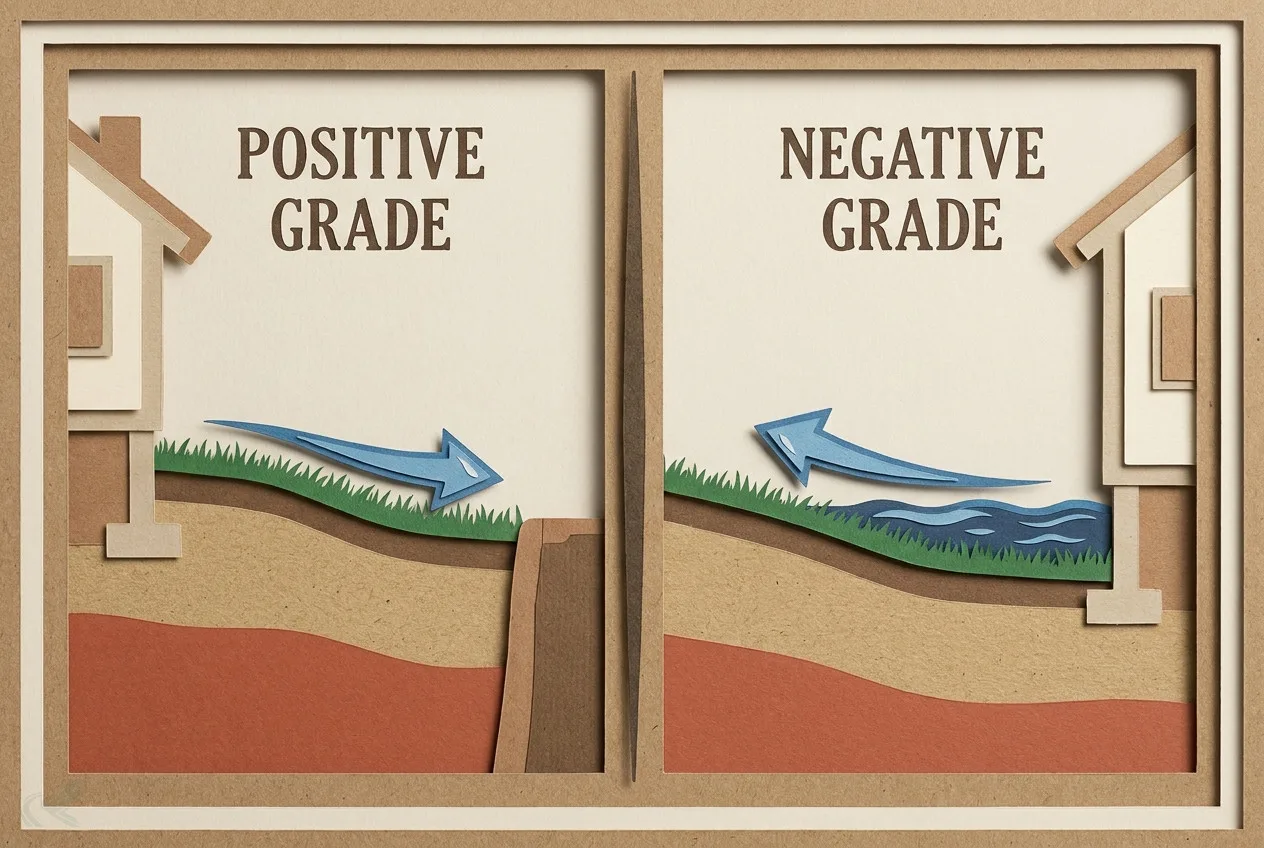
Fix category: regrading. Not a drain. Restore positive drainage away from the house — typically a 2% slope for the first 10 feet — and most of these yards stop pooling without a single foot of pipe. Full pattern at yard regrading to match addition pad levels.
Why this category gets missed: the visible symptom (puddle in the yard) looks identical to Category 1. The difference is where the puddle is in relation to the grade. Category 1 puddles sit at a real low point with high ground all around. Category 2 puddles sit where the grade is sending water — often a stripe along the foundation, or a corner where two negative slopes meet. Once you see it, you can’t unsee it.
Category 3: Soil or Foundation Condition
Water isn’t going anywhere because the clay is saturated, or the water you see is the symptom of an older foundation issue.
This is the hardest category to self-diagnose because the surface picture (standing water) looks identical to Category 1. The tell is timing — Piedmont clay saturated past its absorption point stays wet across the whole yard for 48+ hours, not just at a low spot.
Signs you’re in this category:
- Yard stays wet 48+ hours after rain across the whole yard — not just one low pocket.
- Wet crawl space, musty smell, efflorescence (the white mineral bloom) on the foundation wall.
- Nothing drains, ever — the whole property feels like a sponge two days after every rain.
Fix category: depends on the finding. Could be foundation drainage repair, could be soil amendment, could be a legitimate “this lot has problems” conversation. Start at foundation perimeter drain installation in NC and read is my lot unbuildable before you panic.
Is My Lot Actually Unbuildable?
Almost never. That’s the short answer, and we need to say it directly.
Some homeowners arrive at this diagnostic convinced their lot is permanently broken — that they bought a property no amount of work will fix. That outcome exists. It is rare.
The honest breakdown across the yards we walk in the Triangle and Piedmont:
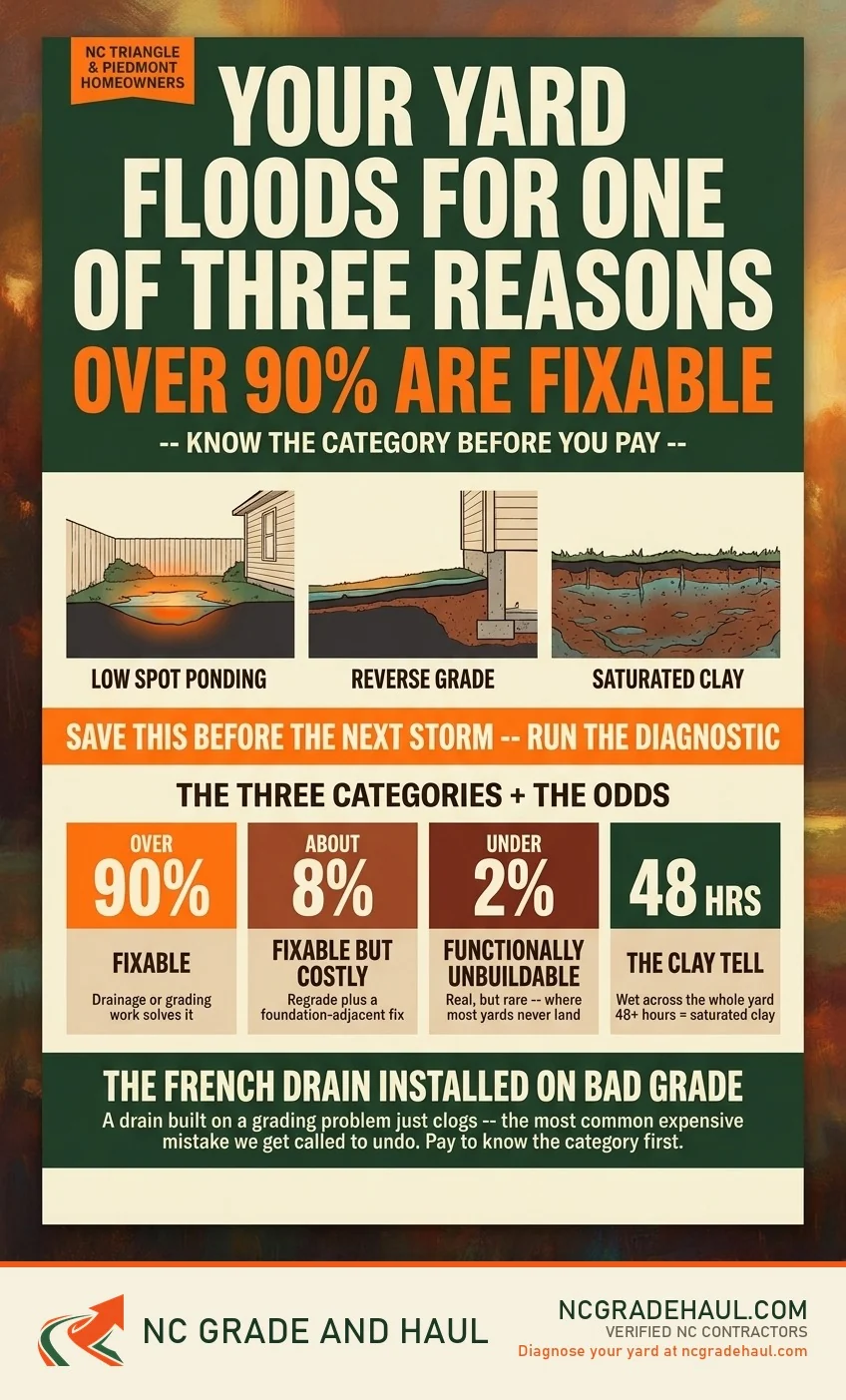
- Fixable (over 90% of cases) — drainage or grading work solves it. Cost band is usually $3k–$12k for residential lots.
- Fixable but expensive (around 8%) — real regrading plus a foundation-adjacent fix, $15k and up. Real money, but the problem goes away.
- Functionally unbuildable (under 2%) — flood zone, water table at the surface, or engineered-fill failure on a lot that never should have been graded the way it was. These are real. They are not where most yards land.
If you’re scared you fall into category 3, the tool for that fear is a site visit, not another Google search. We can usually tell within 20 minutes whether you’re in the 90%, the 8%, or the 2%. The signs are visible if you know what to look for.
Read is my lot unbuildable for the full sub-categorization and what each one costs to address.
NC homeowner takeaway on YouTube drainage advice. Most of the “fix your yard” channels you’ll find online (French Drain Man, Apple Drains, and the rest) film in soils that drain — sandy loam, glacial till, well-graded mix. Their methods work where they film.
Drop the same install into Piedmont red clay and the trench you cut yesterday is full of standing water today. The clay won’t let water move sideways into the gravel. The vocabulary still works (daylight, positive drainage, swale, catch basin), but the defaults don’t. NC clay needs more outlet, more slope, and more skepticism about subsurface fixes than the videos imply.
DIY Diagnostic Walk-Through
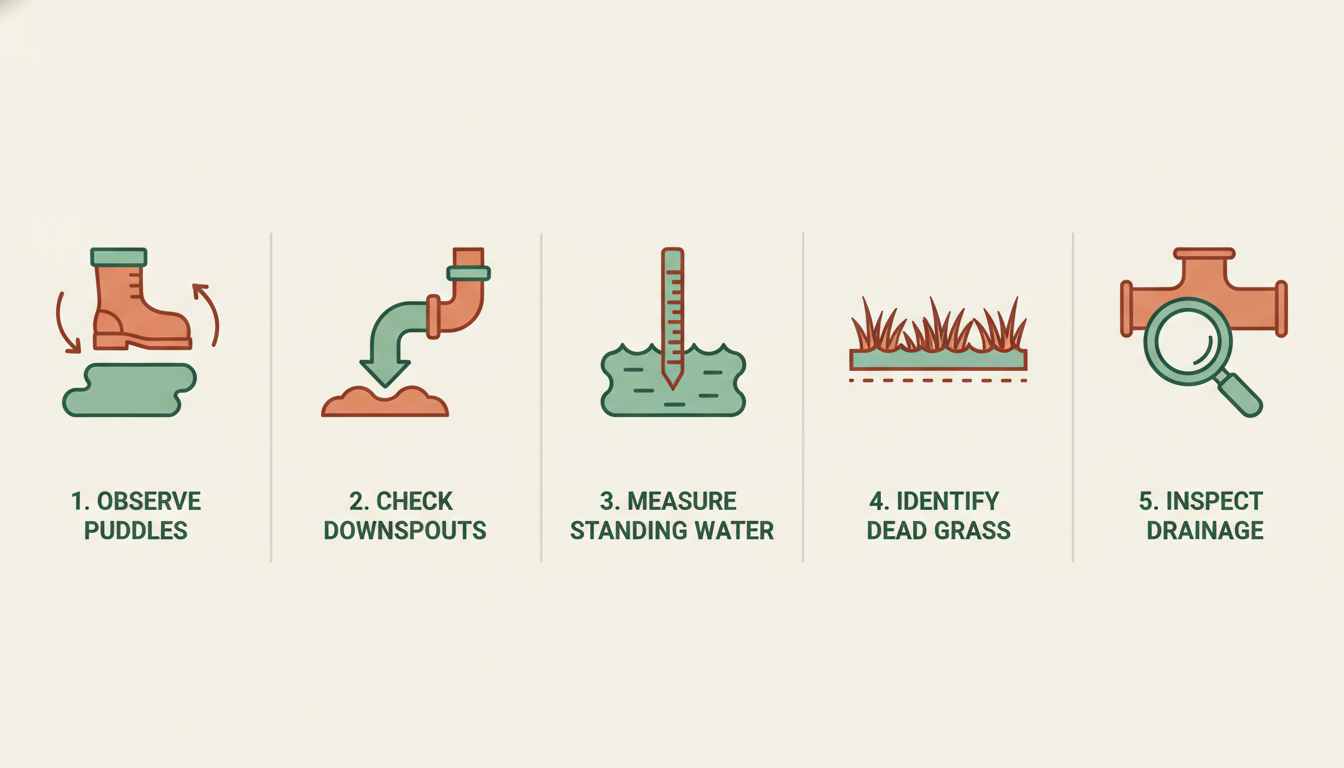
Any homeowner can do this in 30 minutes after the next rain. The output tells you which of the three categories you’re in.
- Photograph standing water at 1 hour, 6 hours, 24 hours, and 48 hours after the rain stops. Same spot, same angle, time-stamped. The timeline is the diagnostic — water gone by 6 hours is Category 1 or 2; water still sitting at 48 hours across the yard is Category 3.
- Walk the grade from street to back fence. Which way does water want to go? Drop a tennis ball at the high corner and watch where it rolls. If it rolls toward the house, you have a grading problem, full stop.
- Check every downspout. Is it connected to a solid pipe that daylights somewhere visible, or is it dumping into mulch four feet from the foundation? Disconnected downspouts cause more “drainage” complaints than any other single thing.
- Inspect the foundation wall. Look for water staining, efflorescence (white mineral bloom), or any crawl-space smell when you crack the access door. Any of those bump you toward Category 3.
- Note dying-grass stripes. Linear bands of yellow or dead turf often mark subsurface water movement — the grass is drowning along a hidden flow path. That tells you where the water is actually going underground.
Pair this with the slope calculator to put numbers on what you find. Deeper symptom-by-symptom mapping at the causes deep-dive.
Common NC-Specific Fixes
Four fixes cover most Triangle and Piedmont yards. Each one is right for a specific category — and wrong for the others.
Swale and regrade
A swale is a shallow vegetated channel that moves surface water along a designed grade. Combined with a regrade, it’s the most common true fix in Triangle new builds where the back-yard slope was lost during construction. Right fix when the lot has room for a channel and an outlet to daylight. Wrong fix when the problem is against the foundation — that’s a regrading job, not a swale job. Drainage swale design and installation details.
French drain with daylight exit
Subsurface perforated pipe in a gravel trench, wrapped in fabric, sloped to a daylight outlet or popup emitter. Right fix when there’s a real entry point (a saturated low spot, a downspout discharge) and a real outlet at a lower elevation. Wrong fix when you don’t have an outlet — a French drain that dead-ends in Piedmont clay is a buried bathtub. NC French drain installation for red clay guide.
Catch basin and pipe system
Surface inlet (the grate) feeding a solid pipe that carries water to daylight. Right fix on hardscape-heavy properties where a driveway, patio, or roof concentrates flow into a small footprint. Wrong fix when there’s no concentrated entry point — a catch basin in the middle of a soggy lawn collects almost nothing because surface water doesn’t actually flow toward it. Catch basin installation for downspout drainage guide.
Yard regrading with clean fill import
Reshape the surface so water moves where you want it. Often involves importing clean fill or screened topsoil to build up low areas, then re-establishing turf. Right fix when the grade is the problem — Category 2 yards. Wrong fix when the problem is saturated clay underneath (Category 3) — regrading the surface doesn’t help if water can’t move down into the soil at all. Yard regrading to match addition pad levels guide.
When to Call a Contractor vs DIY
Some of this is a Saturday job. Most of it isn’t.
The honest split for NC yards:
- DIY is reasonable when the job is under 20 linear feet of drain, there’s a clear outlet to daylight, and the issue is a single downspout discharging into mulch. Disconnect, extend with solid pipe, daylight at a lower point. Half a day with a shovel.
- Call a grading contractor in North Carolina for any regrading work — touching the grade has knock-on effects (runoff onto a neighbor, silt fence compliance during disturbance, possible permit thresholds depending on county and disturbed area). This is not a YouTube job.
- Call a contractor for anything against the foundation. Foundation-adjacent grading is structural-adjacent. Get someone who can spot a footing drain failure before they regrade over it.
- Call a contractor plus a foundation inspection for any crawl-space water or efflorescence on the foundation wall. The surface symptom is downstream of a bigger issue.
For yard-drainage-specific contractor hiring with the questions to ask, see how to hire a grading contractor for drainage work.
One question worth asking any contractor before they write a number: “Which of the three categories is my yard in, and what evidence on the lot tells you that?”
A contractor who can’t answer — who jumps straight to “you need a French drain” without walking the grade — is selling a product, not diagnosing a problem. The right answer references where the water enters, where it’s trying to go, and where it ends up, with specifics tied to your yard, not a generic playbook.
Diagnose Your Yard Before You Pay for a Fix
The category decides the fix. Pay to know the category, not to guess.
A French drain installed in a grading-failure yard is the most common expensive mistake we get called to undo in the Triangle. Avoid that one and most of this gets cheaper.
If you want us out during or right after the next storm — that’s when we can actually see which category your yard is in — ask for a rain-check visit when you call. We walk the lot, point at where the water comes from and where it’s going, and tell you which of the three buckets you’re in before we write a quote.
When you’re ready, hire an NC grading operator for drainage. It’ll name the category, the fix, the material spec, and the trip count — not a single round number.