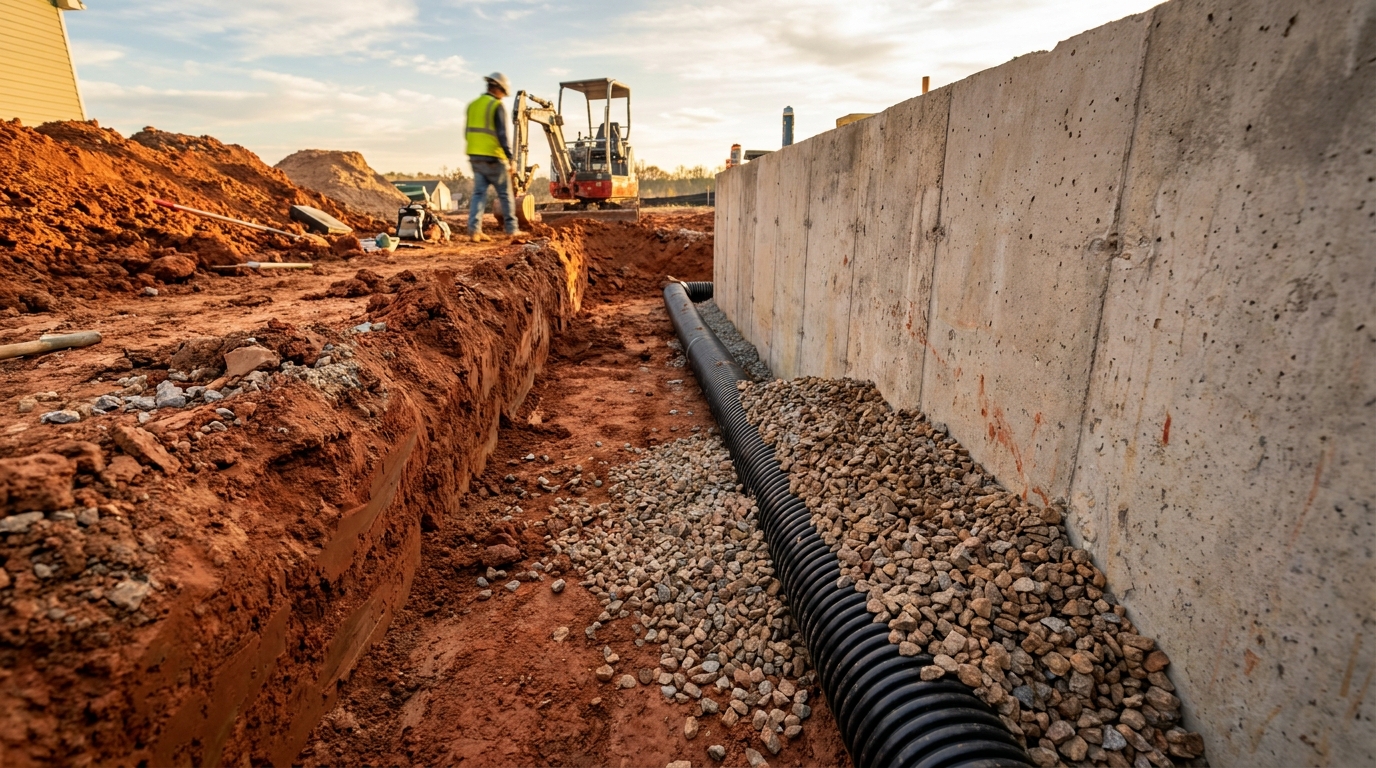
Three questions people often ask
My builder's warranty team keeps stalling. Do I have any other lever?
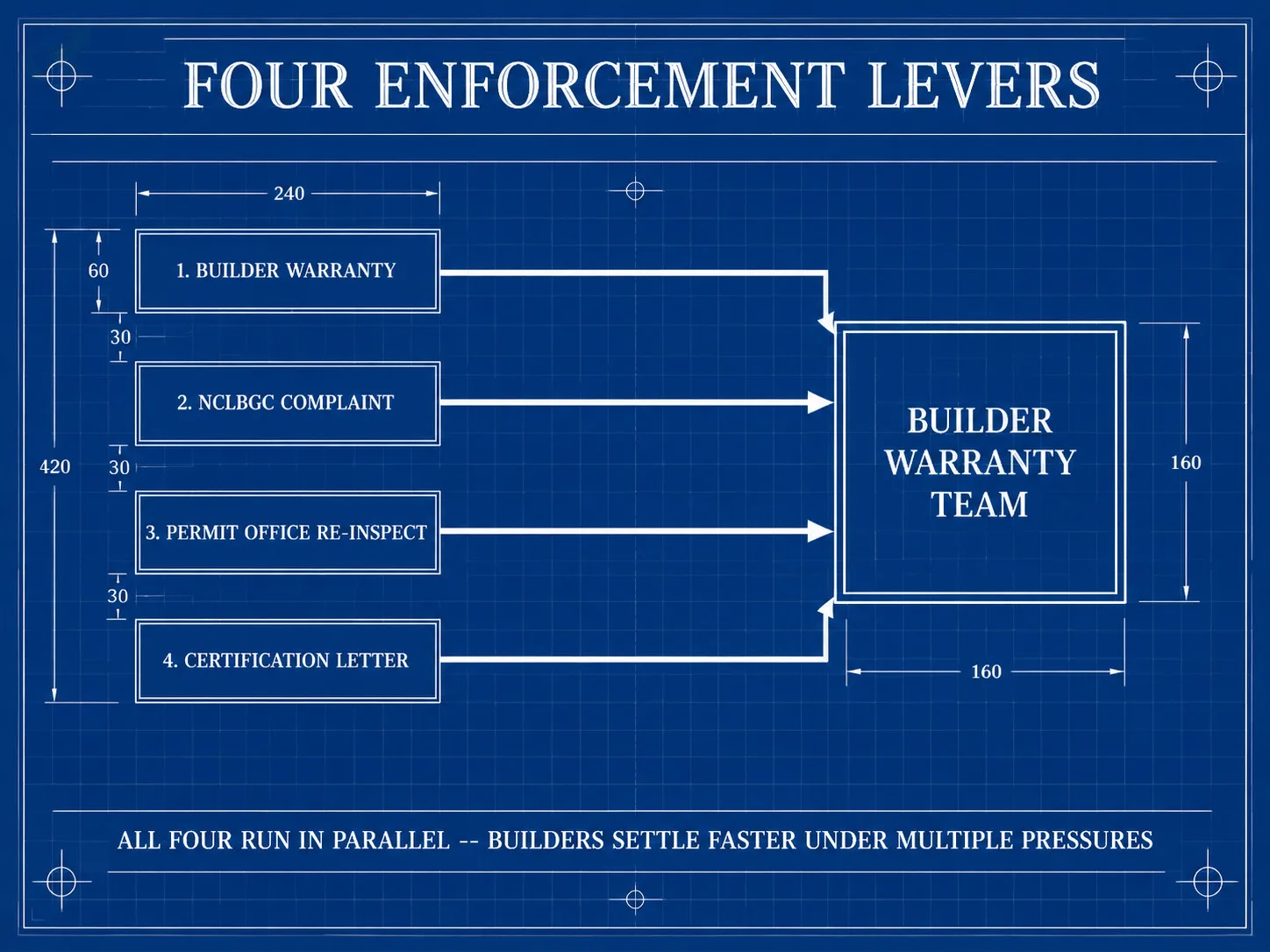
Yes — four of them, and they run in parallel. Warranty is one. The NC Licensing Board for General Contractors complaint is two. The county permit office's authority to require re-inspection is three. A licensed third-party certification letter is four. Most homeowners only know about #1 — and that's the slowest one.
Does NC code actually require something specific, or is "drainage" subjective?
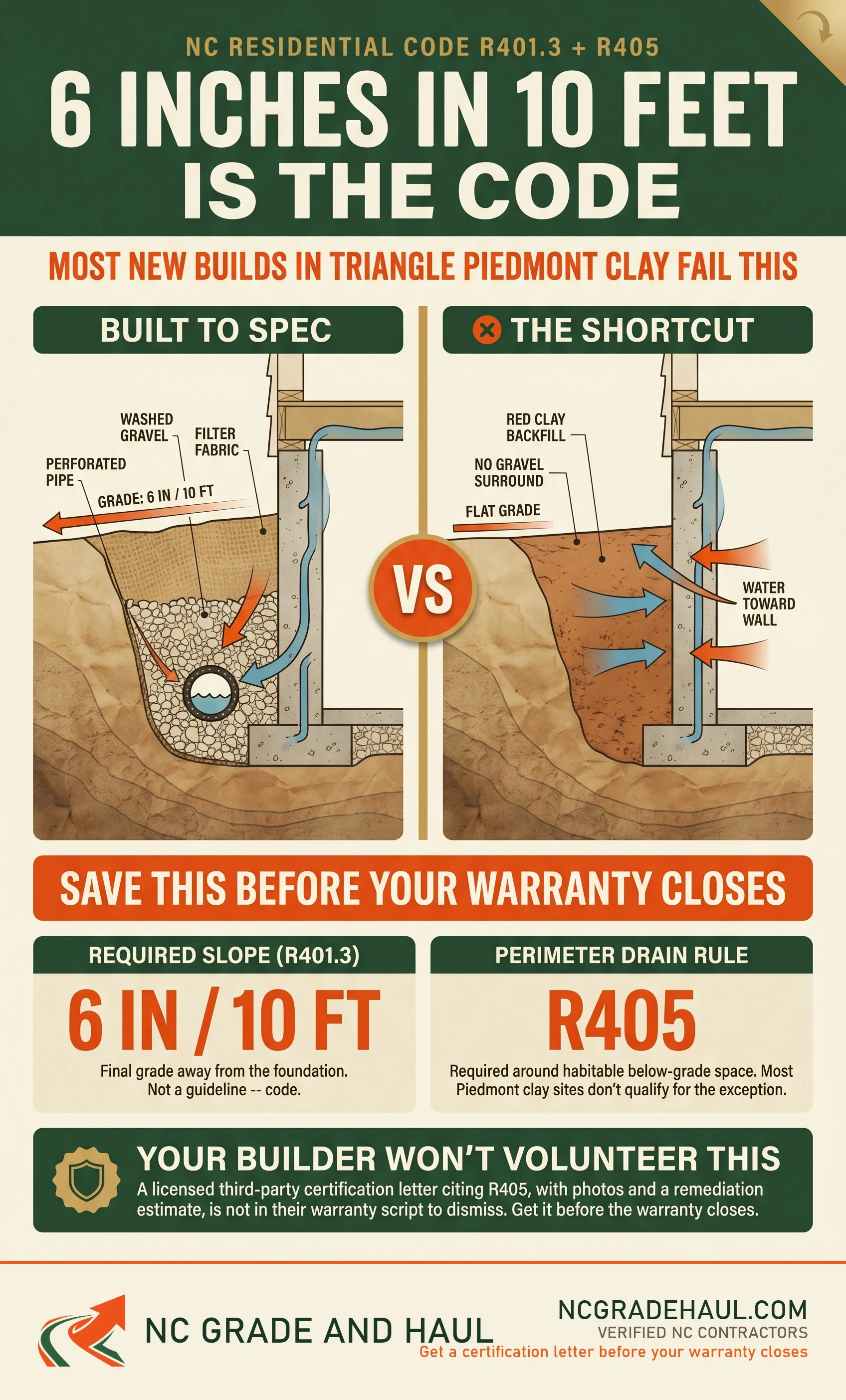
Code is specific. NC Residential Code R405 covers foundation drainage. The grade must fall 6 inches in the first 10 feet away from the foundation. Perimeter drains are required around habitable below-grade space. If your builder's work doesn't match, you have a code problem — not a workmanship opinion.
My warranty closes in months. Should I wait or call a third party now?
Now. Call before the warranty closes, not after. Levers 2–4 are stronger while you're still inside the warranty window.
You moved into a 2022 build in the Triangle. The drainage isn’t working. Your builder’s warranty contractor has been out twice, and nothing is different. You’ve been told this is “normal settling” or to “wait until spring.” It isn’t normal. And spring doesn’t fix a slope problem.
New-build drainage failure is a recognized pattern across Triangle production neighborhoods — Holly Springs, Fuquay-Varina, Apex, Wake Forest, Knightdale, Clayton. Same builders, same subcontractors, same red-clay backfill, same failure shape. Your house is not the exception. (For one of those markets specifically, see yard drainage on a Clayton subdivision lot — where the fix itself can need a town permit the problem never would.)
NC has specific code, specific permit tools, and a specific document — the certification letter — that the builder’s warranty team does not volunteer. This page maps both the engineering and the enforcement path. Most pages on the internet give you one or the other. You need both.
This page is long because the problem is layered. Jump to what you need.
What’s On This Page
- What NC code actually requires
- The new-build failure pattern
- Your four independent levers
- The certification letter — what it is and how to use it
- When to call a third-party contractor
- Triangle-specific: the production-builder pattern
What NC Code Actually Requires for Foundation Drainage
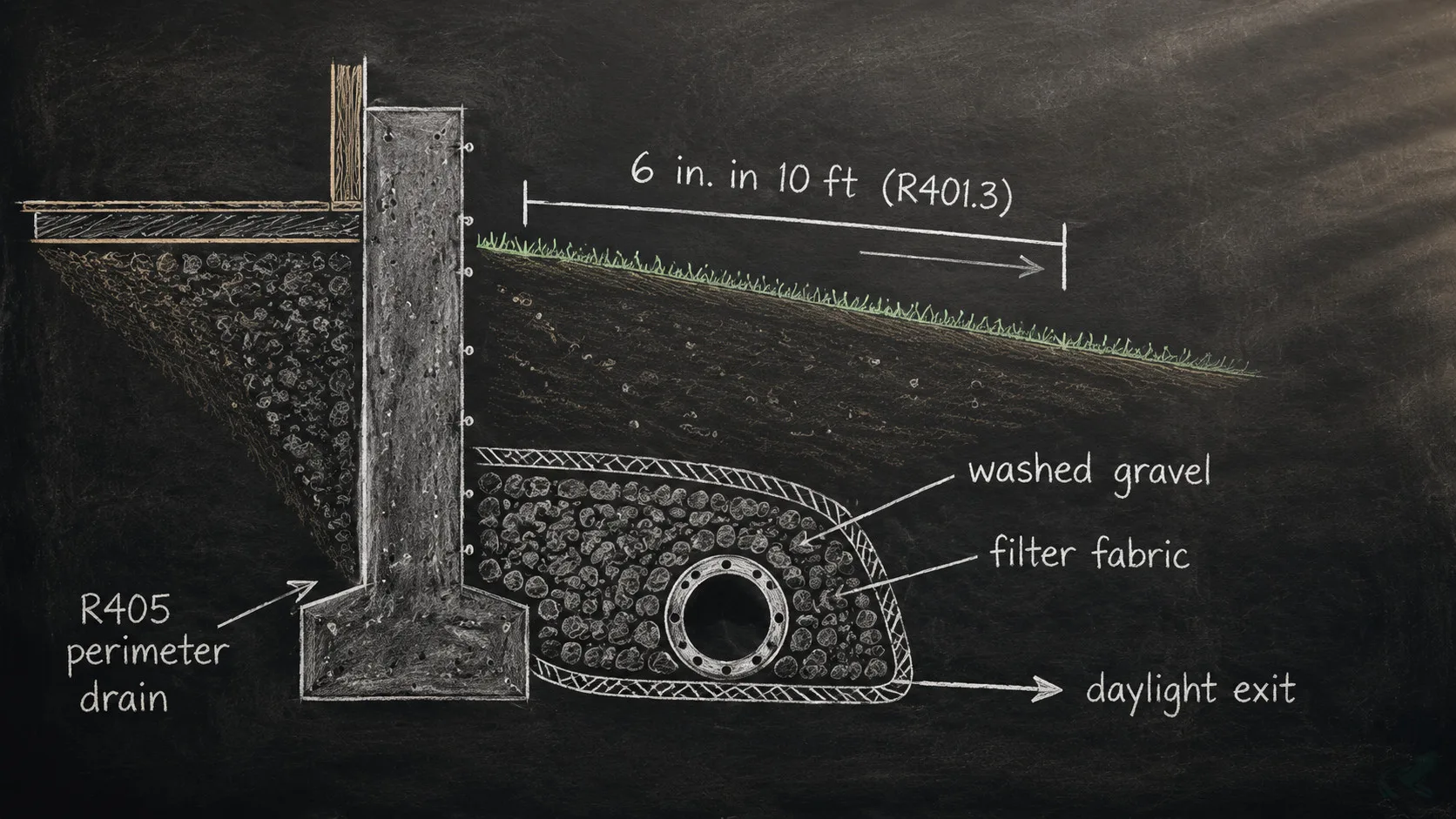
Two NC Residential Code sections govern foundation drainage: R401.3 sets the grade rule, and R405 covers perimeter drain requirements. Final grade must fall 6 inches in the first 10 feet away from the foundation. That’s not a guideline. That’s the code.
Both sections matter and they cover different failure modes. In plain English, here’s what they ask for in the typical Triangle production build:
- Positive drainage away from the foundation (R401.3). Final grade slopes a minimum of 6 inches over the first 10 feet measured outward from the wall. If your yard slopes toward the house — or sits flat — you have a code problem, not a landscaping preference.
- Perimeter drain at habitable below-grade space (R405). Crawl spaces and basements that sit below adjacent grade need a perimeter drain — perforated pipe in washed gravel, wrapped in filter fabric, daylighted to a lower point or terminated in a sump. Exception: R405 waives this requirement when the foundation sits on well-drained ground or sand-gravel mixture soils (Group I per the Unified Soil Classification System). Most Triangle Piedmont clay sites do not qualify for this exception.
- Daylight versus sump. The drain must terminate somewhere. Daylighting means the pipe exits at a lower elevation on the lot — gravity does the work. Sump means a pit with a pump. Daylight is preferred where the lot allows; sump is the fallback when grade doesn’t cooperate.
- Damp-proofing vs. waterproofing. Standard residential foundations get damp-proofed (asphalt-based coating). Walls that retain hydrostatic head — or sit in poorly drained soil like Piedmont red clay — may require full waterproofing membrane. NC code language is conditional; the soil determines the spec.
- Slab-on-grade changes the rules. A slab house has no perimeter drain because there’s no below-grade space to drain. The 6-inch-in-10-feet positive-drainage rule still applies. Crawl spaces and basements add the perimeter-drain requirement on top.
Cite sections R401.3 and R405 by name when you talk to your builder’s warranty team. Specificity matters. “I think the drainage is bad” is dismissible. “R401.3 requires positive drainage away from the foundation and the grade behind my chimney chase falls toward the wall” is not.
A deeper code walkthrough lives at the NC code detail page — translated, with the full section language linked.
If your builder’s work matches what’s above, you probably have a workmanship problem (compaction, drain installation, fabric). If it doesn’t match, you have a code problem. That’s a different kind of lever.
The New-Build Failure Pattern — What’s Really Happening in Your Yard
Production builders across the Triangle share a grading failure pattern: rushed backfill compaction, under-specced perimeter drain, final grade done after the sod truck arrives, and missing or wrong-direction swales between lots.
The pattern is consistent enough that an experienced grading contractor can predict the failure points before walking the lot. Here’s what’s almost certainly happening in your yard.
The lot was cut from red clay. Backfill against the foundation is the same red clay, dumped in from a trackhoe and barely compacted. When it rains, water hits the clay surface and can’t percolate. Your perimeter drain — if it exists — is silted up because no fabric was installed, or the wrong fabric was used, or the gravel surround is too thin. Water moves sideways along the foundation until it finds a low point: a crawl-space vent, the corner where the driveway meets the garage slab, the chimney chase. Then it sits.
You’re probably seeing some combination of:
- Standing water in specific corners or along one side of the house after every storm.
- Musty crawl-space smell that gets worse 24–48 hours after rain.
- Efflorescence — that white chalky deposit on foundation block or poured walls — telling you water is moving through the masonry.
- Sod that never takes over certain spots, or yellow grass in narrow strip patterns following a buried drain line that’s leaking.
- Mushrooms in the mulch beds against the house, especially on the north side where sun doesn’t dry the soil.
- Pooling at the garage corner where the driveway slab meets the foundation — a classic missed-grade location.
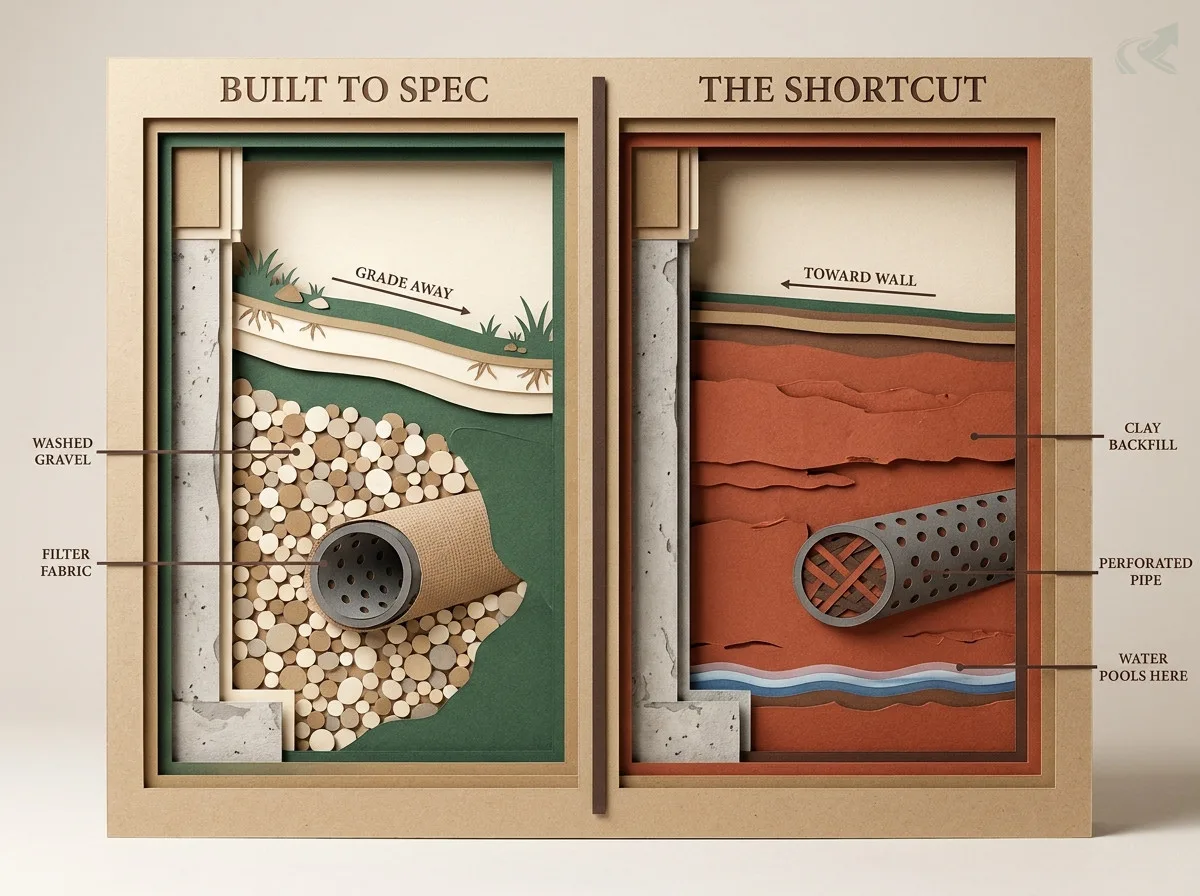
Foundation perimeter drain: built to spec vs the production-build shortcut
Comparison. Built to spec: Perforated pipe in washed gravel, wrapped in filter fabric; Backfill compacted, grade crowned away from the wall; Drain daylights to a lower point or a sump; Water is intercepted before it reaches the crawl space. The shortcut: Red clay backfill dumped against the wall, no gravel surround; Fabric missing or reversed -- silt clogs the pipe; No crown, so water ponds against the foundation; Loose backfill lets water migrate sideways into the crawl space.
- Perforated pipe in washed gravel, wrapped in filter fabric
- Backfill compacted, grade crowned away from the wall
- Drain daylights to a lower point or a sump
- Water is intercepted before it reaches the crawl space
- Red clay backfill dumped against the wall, no gravel surround
- Fabric missing or reversed -- silt clogs the pipe
- No crown, so water ponds against the foundation
- Loose backfill lets water migrate sideways into the crawl space
In Piedmont clay the drain has to be installed correctly the first time -- the failure mode is invisible until the first wet season.
This pattern is fixable. It is not the “is my lot unbuildable” question — that’s a different fear with a different page (see is my lot unbuildable). What you’re looking at is a workmanship-and-spec failure that a competent third-party grading contractor can document and remediate. The harder problem is getting your builder to pay for it. That’s the next section.
The deeper Triangle-specific writeup with photos lives at the new-build pattern detail page.
Your Four Independent Levers
Warranty is one lever. There are three others, and you can run all four in parallel. Builders settle faster when pressure comes from multiple directions.
Most homeowners only know about lever #1 — the warranty — and that’s the slowest one and the one the builder controls. The other three are levers the builder does not control, and that’s why they work.
-
The builder’s warranty. NC has no statutory warranty requirement — there is no law mandating specific coverage periods. What you almost certainly signed is an industry-standard express warranty: 1-year workmanship, 2-year systems (mechanical, electrical, plumbing), 10-year structural. This is common practice among NC production builders, not a legal floor. Foundation drainage usually falls under workmanship — meaning the 1-year clock matters most, but documented complaints filed inside the window keep it open. What the warranty does NOT cover, in most builder contracts: final grade, sod, plantings, and “homeowner-altered drainage.” Form-letter responses don’t close this lever; they stall it. Keep filing in writing. Email beats phone calls because email is the paper trail.
-
The NC Licensing Board for General Contractors. The licenses your builder. You can file a complaint at portal.nclbgc.org — free, no lawyer required. The board investigates code violations and unlicensed work. It does NOT mediate workmanship disputes or order refunds. Where it works best: when your evidence shows a specific code violation (R401.3 grade violation, missing perimeter drain per R405, etc.). Walkthrough at the NC licensing hub.
-
The permit-office “yank” lever. Most production builders get final occupancy sign-off before the grading is fully verified — the inspector looks at a snapshot, not a rain event. County permit offices retain authority to require re-inspection and, in narrow circumstances, can pull or condition the certificate of occupancy if final grading was misrepresented or non-compliant. This is the lever almost no homeowner knows exists. It is most useful when you can show the as-built grade does not match the approved site plan on file. Request the plan at the county permit portal. Compare to what’s actually there.
-
The certification letter. A formal document from a licensed third-party grading contractor stating that the current condition violates NC code or industry standard, with photo evidence and a remediation cost estimate attached. Hand it to the builder’s warranty team and the conversation changes — because warranty teams are trained to dismiss homeowner complaints, but they are not trained to dismiss a licensed third-party’s signed statement. Detailed walkthrough → the certification letter page.
You do not need to pick one of these. You can run them in parallel, and in most disputes that’s exactly what you should do. Each lever pressures a different party — the builder, the state, the county, the public record — and builders settle faster when they’re getting pressure from more than one direction at the same time.
For the full builder-dispute playbook with templated emails and timeline, see the builder dispute page and the builder accountability hub.
The Certification Letter — What It Is and How to Use It
A signed, licensed-contractor document stating which specific code or industry standard your builder’s drainage violates, with photo evidence and a remediation cost estimate.
The letter is one to three pages. It identifies the licensed contractor by name and license number, cites the specific NC code section in question (typically R405), describes the as-built condition, attaches dated photo evidence taken in or after a rain event, and includes an itemized remediation estimate. That’s it. No legal opinion. No accusations. Just a licensed professional documenting what they observed against what code requires.
It changes the conversation because the warranty team’s playbook assumes the homeowner is the only one objecting. Their internal scripts are built around dismissing emotional or non-technical complaints. They are not built around dismissing a licensed third-party’s formal technical statement attached to a remediation quote — because that document is now part of the file if the dispute escalates to the licensing board, to a permit office re-inspection, or to small-claims court. The letter raises the cost of dismissal.
If your parents or in-laws are telling you you’re overreacting, the letter is also for them. Family pressure is real. A spouse, a parent, a father-in-law who built houses in the 80s and tells you “every house has some water” — they are not malicious, but they are stalling your decision. The certification letter makes the problem visible as a technical failure rather than an emotional reaction. It moves the conversation from “do you really think it’s that bad” to “here’s what the code says and here’s what the licensed contractor measured.” That framing matters.
Full template, sample (redacted), and how-to walkthrough → the certification letter page.
When To Call a Third-Party Contractor
Before or during your warranty period — not after. The common mistake is waiting for the warranty to expire and then calling. By then, levers 2–4 are weaker or gone.
What an NCGH site visit on a foundation-drainage call includes:
- Site walk in rain or within 48 hours of rain. Dry-day walks miss the failure signal. We schedule around the radar.
- Photo documentation of water behavior. Where it pools, where it moves, where it enters. Time-stamped, geo-tagged, organized by failure point.
- Certification letter if the evidence warrants it. Not every site needs one. If the as-built clearly violates R405 or industry standard, we write it. If it’s borderline, we tell you that too.
- Itemized quote for remediation if the builder refuses. Not a “free quote.” An itemized line-by-line quote you can either send back to the builder as part of your dispute or use to schedule the work yourself.
Triangle-Specific — The Production-Builder Pattern
Triangle production neighborhoods — Holly Springs, Fuquay-Varina, Apex, Wake Forest, Knightdale, Clayton — show the same foundation-drainage failure pattern repeatedly. Recognizing it as a pattern, not a one-off, changes how you approach the builder.
When the same failure shape appears across hundreds of lots in the same metro, served by the same handful of grading subcontractors, the conversation with the warranty team is no longer “your house has a problem.” It’s “your build process has a known issue that you have not corrected.” That shift matters because builders’ internal escalation paths react differently to systemic complaints than to one-off complaints.
Read the full Triangle pattern writeup with the escalation tools and what to cite when you escalate → the production-builder Triangle pattern page.
For the soil-side context — why punishes rushed backfill — see the Piedmont red clay reference.
How NCGH Compares to the Other Calls You’re Considering
Three doors at the start of a builder dispute: a lawyer, a generic handyman, or a licensed third-party grading contractor. Each opens a different leverage stack.
| Factor | Real-estate / construction lawyer | General handyman or landscaper | NCGH (licensed third-party grading) |
|---|---|---|---|
| What you get | Legal opinion + demand letter + litigation path | Surface fix (regrade, French drain) without builder leverage | Site walk + certification letter + itemized remediation quote |
| What it costs to start | Retainer up front; hourly thereafter | Verify at quote — typically a flat site fee | Itemized quote, no retainer |
| Pressure on the builder | High, but slow — builder lawyers up in response | None — work is treated as homeowner alteration, may void warranty | Direct — letter goes into the warranty file and the licensing record |
| Best moment to call | After levers 1–4 stall and the warranty has closed | After the dispute is resolved, for cosmetic touch-up | While the warranty is still open — before levers 2–4 weaken |
| Risk to your warranty | Low — communication is formal | High — DIY-style repair language can void the workmanship clause | Low — letter documents condition without altering it |
What you get
- Real-estate / construction lawyer
- Legal opinion + demand letter + litigation path
- General handyman or landscaper
- Surface fix (regrade, French drain) without builder leverage
- NCGH (licensed third-party grading)
- Site walk + certification letter + itemized remediation quote
What it costs to start
- Real-estate / construction lawyer
- Retainer up front; hourly thereafter
- General handyman or landscaper
- Verify at quote — typically a flat site fee
- NCGH (licensed third-party grading)
- Itemized quote, no retainer
Pressure on the builder
- Real-estate / construction lawyer
- High, but slow — builder lawyers up in response
- General handyman or landscaper
- None — work is treated as homeowner alteration, may void warranty
- NCGH (licensed third-party grading)
- Direct — letter goes into the warranty file and the licensing record
Best moment to call
- Real-estate / construction lawyer
- After levers 1–4 stall and the warranty has closed
- General handyman or landscaper
- After the dispute is resolved, for cosmetic touch-up
- NCGH (licensed third-party grading)
- While the warranty is still open — before levers 2–4 weaken
Risk to your warranty
- Real-estate / construction lawyer
- Low — communication is formal
- General handyman or landscaper
- High — DIY-style repair language can void the workmanship clause
- NCGH (licensed third-party grading)
- Low — letter documents condition without altering it
The lawyer is the right call eventually. It is rarely the right first call. Levers 1–4 resolve most disputes without litigation — and even when they don’t, the certification letter and the documentation trail you build with a third-party contractor are exactly what your lawyer would ask you to gather first anyway.
The Playbook in One Page
Here’s the whole thing in three sentences. Document the failure with photos taken during or just after a rain event. Get a certification letter from a licensed third-party grading contractor citing R405 and quoting the remediation. File levers 1–4 in parallel — warranty in writing, NCLBGC complaint, county permit office re-inspection request, certification letter delivered to the builder’s warranty team.
For homeowners still worried the lot itself is the problem, not the builder’s work: is my lot unbuildable. For broader yard-flooding scenarios beyond the foundation: standing water in your yard.