Two questions people often ask
Do I need a French drain or something else?
Often something else. A French drain only works when there's somewhere to daylight (a lower outlet) AND a known water entry path. If your real problem is negative slope toward the house or saturated-clay yard with no obvious source, the fix is regrading — not a drain.
How much does a French drain actually cost in NC?
In the Triangle and Charlotte metros, a small 40-LF perimeter run with daylight exit and sod restore typically lands $3,200–$5,400. A 100-LF run with a catch basin runs $7,500–$11,000. Curtain drain plus regrade jobs reach $14,000–$22,000. Always itemized, never lump-sum.
If you’ve spent time on French Drain Man’s channel or Apple Drains videos, you’ve learned more about French drains than most contractors are willing to explain. Keep that knowledge — but understand this: those videos were filmed in Michigan and Florida. Both are the wrong soil for most of North Carolina.
NC Piedmont red clay is neither Michigan silty loam nor Florida sand. It swells when wet. It seals when cut. It sheds water sideways instead of absorbing it downward. A French drain installed to national spec will underperform here. Sometimes dramatically.
This page is the translation.
On This Page
- Why NC clay changes the rules
- When a French drain is the right fix (and when it isn’t)
- NC-specific installation methodology
- The fabric debate — why NC might be the exception
- Real NC cost ranges
- French drains in NC clay — what actually works
- How to hire a French drain contractor in NC
Why NC Clay Changes the Rules
Piedmont red clay does not drain like Michigan loam or Florida sand. The trench you dig in it acts more like a bathtub than a drainage channel until you give the water somewhere to go.
Most of the Triangle and Charlotte metros sit on Piedmont clay — high in kaolinite and iron oxide. That mineralogy does three things that matter for any drainage install:
- It swells when wet, shrinks when dry. A drain installed in August sits in a different soil structure than the same drain in February.
- It seals when cut with a bucket. Trench walls glaze over into a slick low-permeability skin within minutes of excavation.
- It sheds water laterally. Water doesn’t migrate down through clay at the rate it does through sand or loam. It pools on top, runs sideways, and finds the path of least resistance.
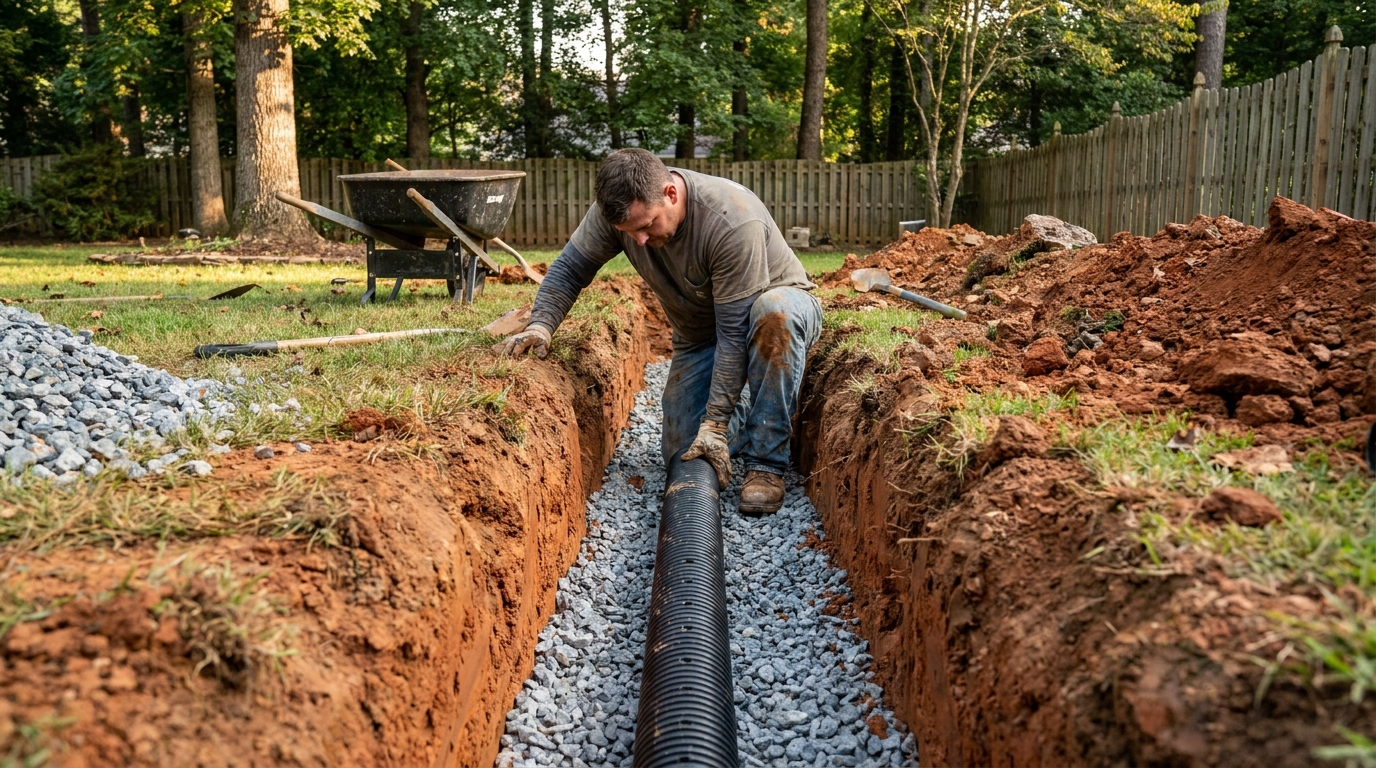
Trenching in Piedmont clay: raked walls vs a bucket-glazed tube
Comparison. Raked walls: Trench walls scratched open to break the bucket glaze; Washed stone at full depth, perforated pipe with sock; Water can move from the clay into the stone column; Drain intercepts and carries flow to a daylight outlet. Bucket-glazed tube: Smooth glazed clay walls seal the trench shut; Water pools in the trench instead of entering the drain; Clay fines migrate into the stone and silt it in; Pipe sits in stagnant water -- the drain is a holding tank.
- Trench walls scratched open to break the bucket glaze
- Washed stone at full depth, perforated pipe with sock
- Water can move from the clay into the stone column
- Drain intercepts and carries flow to a daylight outlet
- Smooth glazed clay walls seal the trench shut
- Water pools in the trench instead of entering the drain
- Clay fines migrate into the stone and silt it in
- Pipe sits in stagnant water -- the drain is a holding tank
A bucket cuts a slick skin into NC kaolinite clay within minutes -- raking the walls is the step the Michigan and Florida tutorials never need to cover.
The “gravel surround works because water percolates through the soil into it” model is a sand-soil model. In clay, the surrounding soil contributes very little inflow. The drain has to intercept water at a known entry point and carry it to a known outlet. If either end is missing, the drain is a holding tank.
Three NC soil zones, each a different problem:
- Piedmont (most of the Triangle and Charlotte metro). Red clay. The dominant case for everything below.
- Coastal Plain (east of I-95). Sandy, percolates well. National French-drain methods work closer to spec here — but most NCGH readers are not in this zone.
- WNC (mountain region). Shallow soil over rock. The problem is usually rock depth and surface runoff, not subsurface saturation. Different toolkit entirely.
For the soil-science deep-dive see Piedmont red clay and the broader why NC differs reference.
When a French Drain Is the Right Fix
A French drain works when you have an obvious water entry path AND somewhere to daylight the drain. Without both, you need a different system.
The contractors selling drains as a default solution are the ones who skip the diagnosis. The diagnosis is two questions: where is the water coming in, and where will the drain send it?
A French drain IS the right fix when:
- Obvious entry path. Wet foundation wall, saturated zone with a known upslope source, water sheeting against the structure during rain.
- Positive fall to an outlet. The drain can daylight to a swale, a street, a lower grade — somewhere with elevation drop from the trench bottom.
- Grading already ruled out. The lot’s positive drainage works; this is a localized intercept problem, not a sitewide regrade problem.
A French drain is NOT the right fix when:
- The real problem is negative slope. Yard pitches toward the house. Fix grading first. A drain downstream of bad slope is a band-aid that fails the next time the soil shifts.
- Nowhere to daylight. Flat lot, no lower grade, no street outlet. A “drain” terminating into a sealed sump is a stored-water tank — different system, different cost, different failure modes. Don’t let anyone call it a French drain.
- Saturated-clay yard with no entry point. The whole yard sits wet for days after rain with no obvious source. That’s a yard regrade and crown rebuild, not a drain job. See the standing water yard causes breakdown.
If a contractor quotes you a French drain without asking where it daylights, they haven’t finished the diagnosis. That’s the single most reliable red flag on the entire vetting checklist.
NC-Specific Installation Methodology
Seven steps where NC clay changes what the national methods teach. None of these are tricks — they’re adjustments that the Michigan and Florida tutorials don’t need to cover.
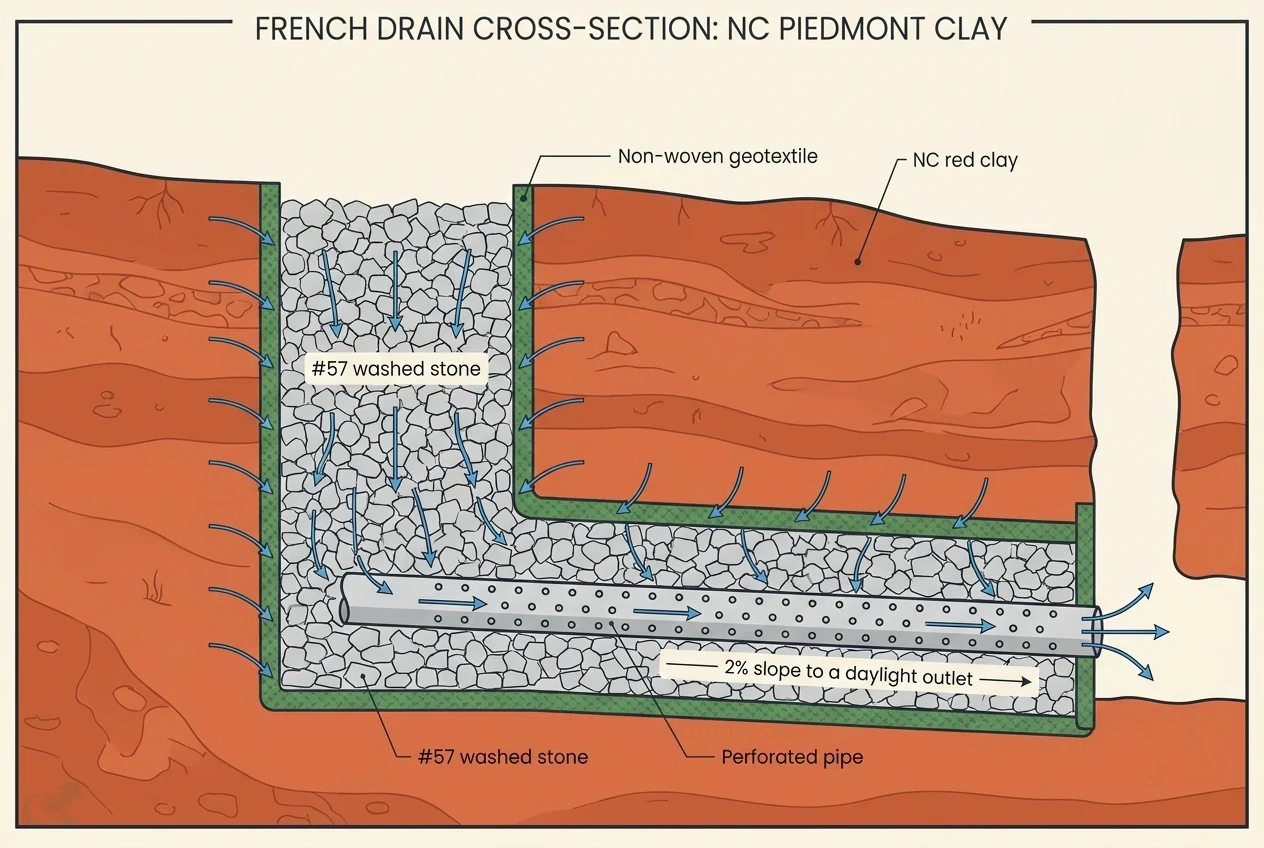
What the seven steps build: a French drain cross-section for NC Piedmont clay — washed #57 stone, a perforated pipe, a non-woven geotextile wrap, and a 2% fall to a daylight outlet.
1. Trench depth and fall. NC clay needs minimum 18” depth for perimeter work, 24”+ for deep drainage along foundations. Fall: 1% minimum, 2% preferred. In clay, fall matters more than in sand because water won’t migrate sideways through the surrounding soil to reach the drain — it has to fall by gravity inside the stone column.
2. Trench shape — rake the walls. Clay trench walls slick over when cut with a bucket. The result is a sealed tube of wet clay that even a perfect stone-and-pipe column can’t pull water through. Before backfilling, rake the walls (a hand mattock or the bucket’s teeth) to break the slick and expose unglazed clay. This is the step doesn’t cover because Michigan silty loam doesn’t glaze.
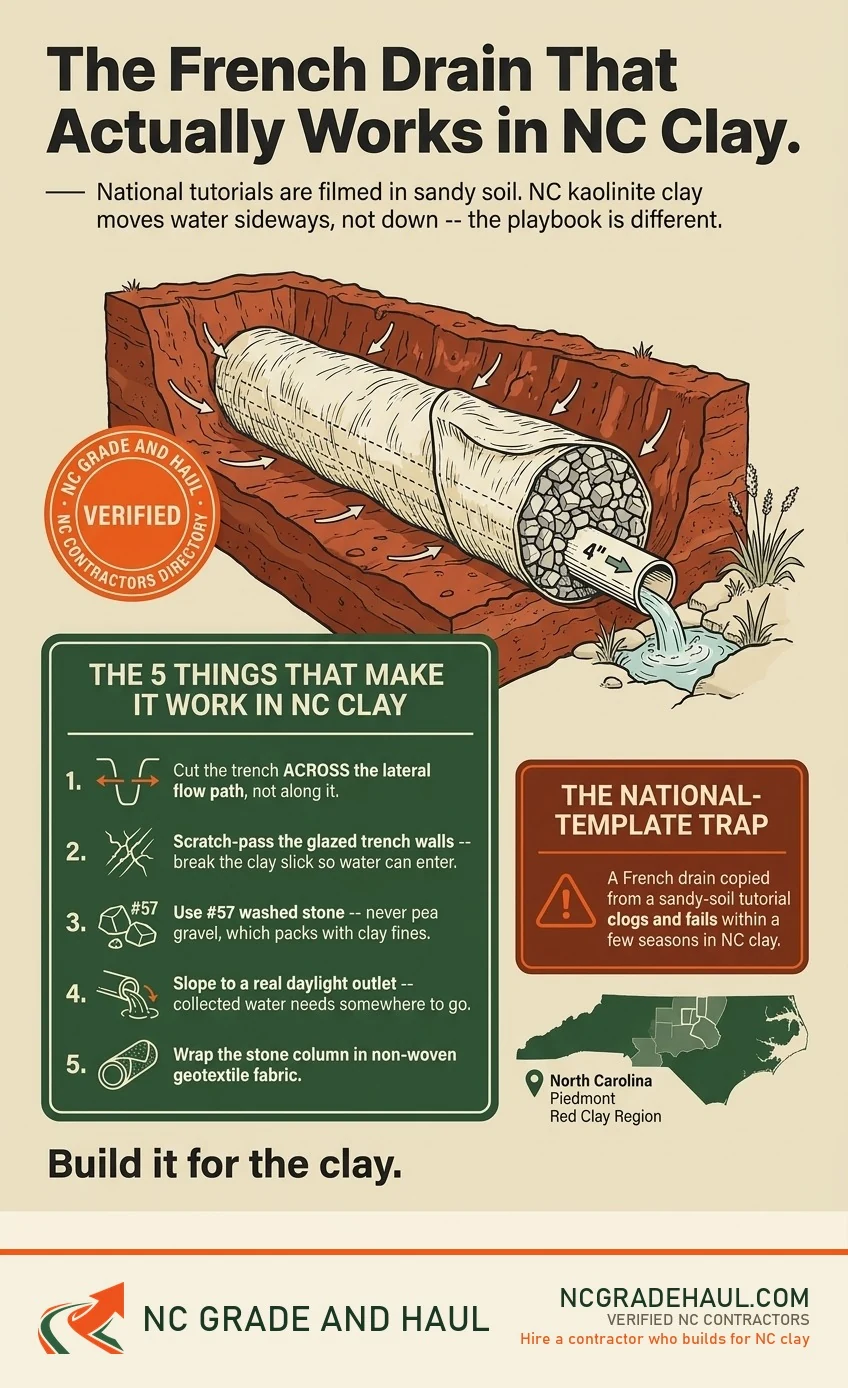
3. Fabric selection — debated. Non-woven 4oz+ around the trench is the textbook spec. Many NC operators skip trench-wall fabric entirely because clay fines clog the fabric instead of being filtered by it. See the fabric debate section below for the nuance.
4. Stone spec — washed only. #57 is the national default. CABC or #67 also work. The wash matters more than the size. Unwashed or stone with fines mixed in will silt the drain inside three years in clay. Washed #57 from a quarry that actually washes it (not “rinsed at the loader”) is the spec to insist on.
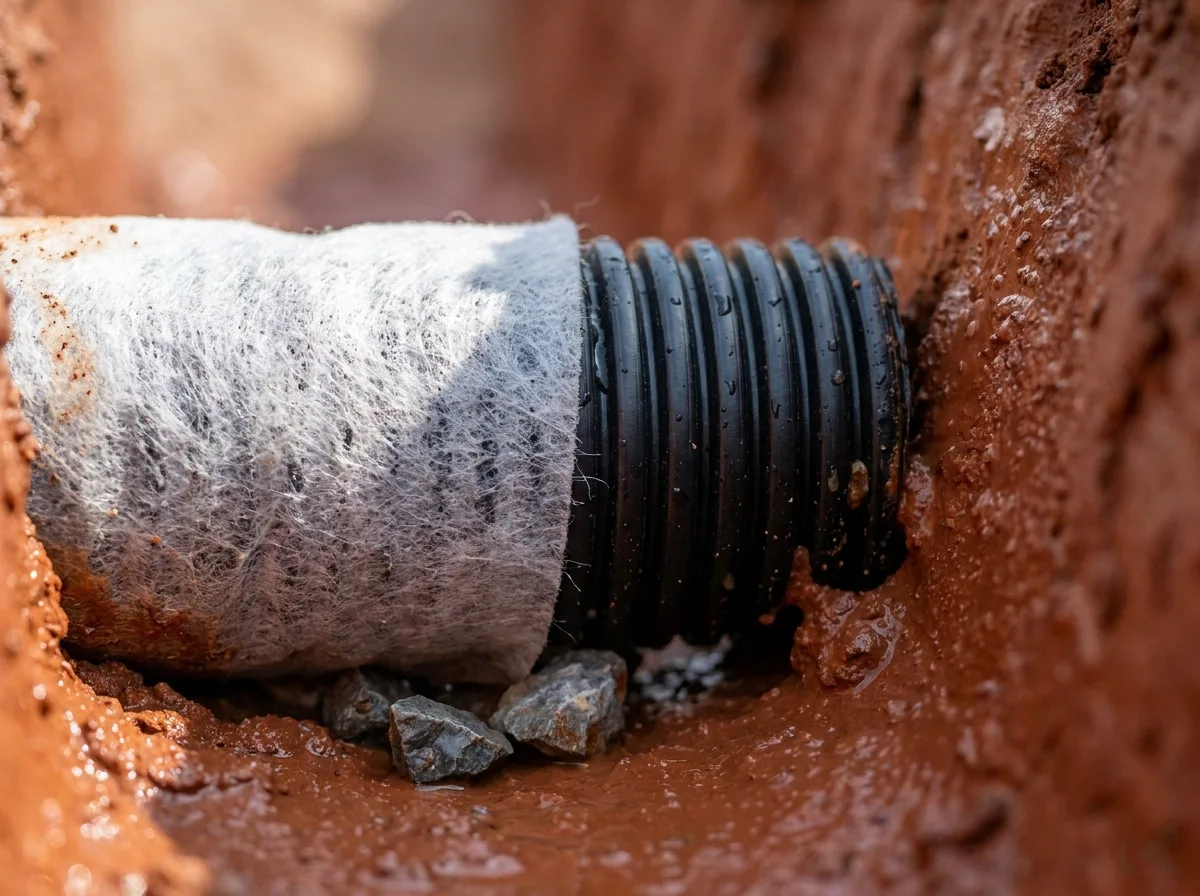
5. Pipe — sock orientation. 4” or corrugated with sock. The sock filters fines at the pipe wall — separate function from trench-wall fabric. Slot orientation: most NC operators run slots down in clay, not up. The reasoning: water in clay enters the drain from below (gravity) more reliably than from above (saturation).
6. Backfill — never clay. Stone to within 4” of surface, then a separator (landscape fabric or thin gravel layer), then topsoil or sod. Backfilling with native clay defeats the drain by sealing the top of the stone column. The backfill choice is where a lot of “the drain stopped working after a year” stories trace back to.
7. Daylight or designed termination. A French drain that ends in a sealed pit is a holding tank. State the termination explicitly on the quote: where does the pipe daylight, what’s the outlet structure, what’s the elevation drop from trench bottom to outlet? If the answer is vague, the install is vague.
The Fabric Debate — Why NC Might Be the Exception
FDM says no fabric, ever. Apple Drains says always fabric. NC operators split — and the right answer in clay is probably a hybrid neither extreme captures.
This is the single most-debated step in French-drain methodology, and reasonable contractors land in different places. The arguments:
- ‘s position: trench-wall fabric clogs over time, restricting flow. Use clean stone, no fabric, and let the stone-soil interface filter naturally.
- /Apple Drains’ position: without fabric, silt migrates into the stone column and clogs it from below. Fabric prevents migration; flow loss is acceptable.
- The NC Piedmont reality: clay fines are finer and more mobile than sandy loam fines. They pack against fabric and seal it faster. They also pack into unfabricked stone faster. Both extremes have real failure modes here.
NCGH’s working position: sock on the pipe, no trench-wall fabric, washed clean stone only, raked clay walls. This hybrid keeps the filtration where it matters most (at the pipe) without creating a fabric layer that clay fines can pack against.
Reasonable NC operators disagree. Some won’t touch a job without trench-wall fabric. Others won’t install with it.
NC homeowner takeaway: if your contractor commits to either extreme without asking about your specific site (slope, soil profile, upslope contributing area), that’s a signal to get a second opinion. The honest answer in NC is “it depends on what we find when we open the trench.”
Real NC Cost Ranges
Itemized quotes only. Anyone who gives you a single lump-sum number for a French drain in NC is either guessing or hiding the math.
These are typical Triangle and Charlotte metro ranges as of mid-2026. Costs vary with soil type, access, daylight distance, and disposal logistics. Use these as a sanity check, not a quote.
| Factor | Small (40 LF perimeter) | Medium (100 LF + catch basin) | Large (200 LF curtain + regrade) |
|---|---|---|---|
| Scope | Single-side perimeter drain, daylight exit, sod restore | 100 LF run, one catch basin, sod restore | Curtain drain, multiple basins, partial regrade |
| Mobilization | ~$400–$800 | ~$600–$1,000 | ~$800–$1,500 |
| Excavation | ~$800–$1,400 | ~$1,800–$3,200 | ~$4,000–$7,000 |
| Stone (#57 washed) | ~6–9 tons delivered | ~14–20 tons delivered | ~30–45 tons delivered |
| Pipe + sock | 40 LF SDR-35 or HDPE | 100 LF + basin tie-ins | 200+ LF + multiple tie-ins |
| Sod / seed restore | ~$400–$800 | ~$900–$1,800 | ~$1,800–$3,500 |
| Disposal (clay spoils) | ~$200–$500 | ~$500–$1,200 | ~$1,500–$3,000 |
| Typical total range | $3,200–$5,400 | $7,500–$11,000 | $14,000–$22,000 |
Scope
- Small (40 LF perimeter)
- Single-side perimeter drain, daylight exit, sod restore
- Medium (100 LF + catch basin)
- 100 LF run, one catch basin, sod restore
- Large (200 LF curtain + regrade)
- Curtain drain, multiple basins, partial regrade
Mobilization
- Small (40 LF perimeter)
- ~$400–$800
- Medium (100 LF + catch basin)
- ~$600–$1,000
- Large (200 LF curtain + regrade)
- ~$800–$1,500
Excavation
- Small (40 LF perimeter)
- ~$800–$1,400
- Medium (100 LF + catch basin)
- ~$1,800–$3,200
- Large (200 LF curtain + regrade)
- ~$4,000–$7,000
Stone (#57 washed)
- Small (40 LF perimeter)
- ~6–9 tons delivered
- Medium (100 LF + catch basin)
- ~14–20 tons delivered
- Large (200 LF curtain + regrade)
- ~30–45 tons delivered
Pipe + sock
- Small (40 LF perimeter)
- 40 LF SDR-35 or HDPE
- Medium (100 LF + catch basin)
- 100 LF + basin tie-ins
- Large (200 LF curtain + regrade)
- 200+ LF + multiple tie-ins
Sod / seed restore
- Small (40 LF perimeter)
- ~$400–$800
- Medium (100 LF + catch basin)
- ~$900–$1,800
- Large (200 LF curtain + regrade)
- ~$1,800–$3,500
Disposal (clay spoils)
- Small (40 LF perimeter)
- ~$200–$500
- Medium (100 LF + catch basin)
- ~$500–$1,200
- Large (200 LF curtain + regrade)
- ~$1,500–$3,000
Typical total range
- Small (40 LF perimeter)
- $3,200–$5,400
- Medium (100 LF + catch basin)
- $7,500–$11,000
- Large (200 LF curtain + regrade)
- $14,000–$22,000
What an itemized quote should show, line by line: mobilization, excavation hours or LF, stone tonnage with spec (#57 washed, source quarry if asked), pipe LF with spec (SDR-35 vs corrugated HDPE, sock or no sock), fabric if used, basin count and type, sod or seed restore square footage, disposal yards, permit fee if county requires one. If any of those line items is missing or rolled into “labor and materials,” ask for it broken out before signing.
For the full cost deep-dive plus a calculator, see the French drain cost page and the upcoming French drain cost calculator.
DIY French Drains in NC Clay
Short runs with easy daylight are doable. Anything crossing a foundation, deeper than 24”, or requiring a catch basin is not weekend territory in NC clay.
The honest DIY envelope:
- Doable: 15–20 LF surface trench, 12–18” deep, with a clear downhill daylight exit on the same property. A two-day project for a fit homeowner with a rented trencher.
- Not doable as DIY: anything along a foundation, anything deeper than 24”, anything requiring a catch basin or grate inlet, anything where the daylight runs to a neighbor’s property or a regulated stream buffer.
The trencher rental in particular is where NC clay surprises DIYers. A walk-behind trencher rated for “average soil” jams in wet Piedmont clay. Plan on chain failures and slow progress. Sandy-soil tutorials show the trencher cutting 50 LF an hour. In NC clay, expect a third of that on a good day.
If you’re considering DIY, the French drain DIY breakdown walks through what’s realistic and where the line is.
How to Hire a French Drain Contractor in NC
Three questions filter most of the field. Where does it daylight, what’s the stone spec, and is the quote itemized line by line?
A contractor who can answer all three on-site without hedging is in a different category than one who can’t.
- Daylight question. “Where does this drain terminate, and what’s the elevation drop from trench bottom to outlet?” The answer should be specific — a swale on the east side of the lot, a curb cut to the street, a lower grade behind the shed. “We’ll figure that out during install” is not an answer.
- Stone spec question. “Is the #57 stone washed at the quarry, and which quarry?” Anyone who installs French drains in NC clay regularly knows their stone source by name.
- Itemized quote question. “Can the quote break out mobilization, excavation, stone tonnage, pipe LF, restoration, and disposal as separate line items?” If the answer is “we work lump-sum,” that’s a red flag.
Three questions that filter most of the field
1. Where does it daylight? -- 'Where does this drain terminate, and what's the elevation drop from trench bottom to outlet?' The answer must be specific -- a swale, a curb cut, a lower grade. 'We'll figure that out during install' is not an answer. 2. What's the stone spec? -- 'Is the #57 stone washed at the quarry, and which quarry?' A contractor who installs French drains in NC clay regularly knows their stone source by name. Unwashed stone silts a drain inside three years. 3. Is the quote itemized? -- 'Can you break out mobilization, excavation, stone tonnage, pipe LF, restoration, and disposal as separate line items?' A contractor who answers 'we work lump-sum' is hiding the math you need to compare bids.
-
Where does it daylight?
'Where does this drain terminate, and what's the elevation drop from trench bottom to outlet?' The answer must be specific -- a swale, a curb cut, a lower grade. 'We'll figure that out during install' is not an answer.
-
What's the stone spec?
'Is the #57 stone washed at the quarry, and which quarry?' A contractor who installs French drains in NC clay regularly knows their stone source by name. Unwashed stone silts a drain inside three years.
-
Is the quote itemized?
'Can you break out mobilization, excavation, stone tonnage, pipe LF, restoration, and disposal as separate line items?' A contractor who answers 'we work lump-sum' is hiding the math you need to compare bids.
A contractor who answers all three on-site without hedging is in a different category from one who can't.
For the broader vetting framework, see how to hire a grading contractor and NC licensing thresholds — French-drain work above certain scopes triggers license requirements that a homeowner should verify before signing.
Ready for a Real Quote?
A French drain is the right fix for some NC drainage problems and the wrong fix for others. The contractor who tells you that — and shows you why — is the one to hire. The contractor who quotes a French drain before walking the lot is selling a default product, not a diagnosis.