You have a fill dirt quote in hand. The number means something different depending on what it includes — and in North Carolina’s Triangle and Triad markets, the gap between the cheapest and most expensive fill can be significant without anyone being dishonest about it.
This page breaks down the two-component cost structure, current price ranges by fill type, and the variables that move your quote up or down.
Material Cost vs Delivery Cost — How the Quote Breaks Down
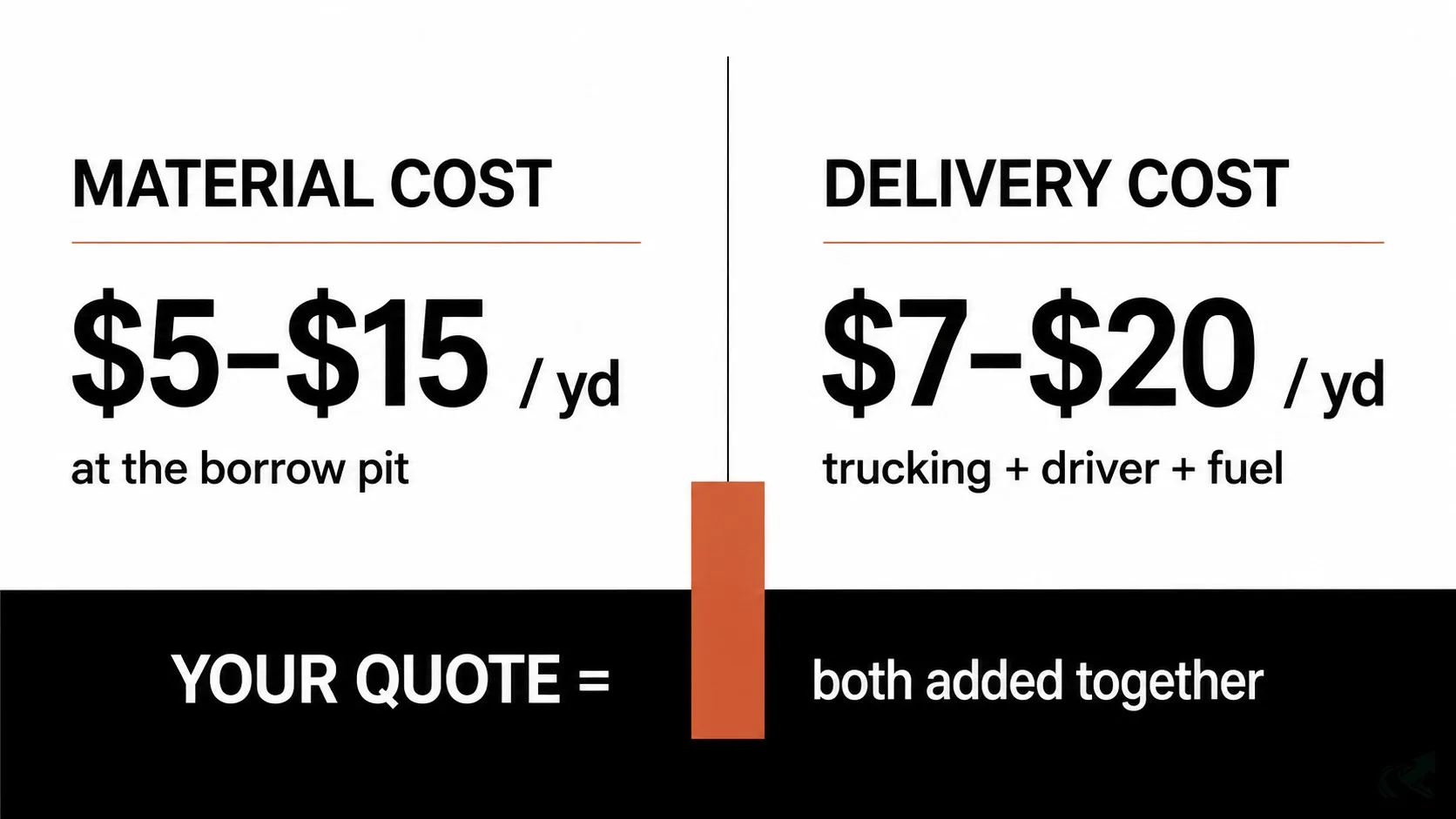
Every fill dirt price is two costs added together: what the material costs at the source and what it costs to truck it to your site.
Understanding this split is the most useful thing you can take from this page. A contractor sourcing unscreened fill from a local borrow pit in Guilford or Wake County may have near-zero material cost — the site owner is often glad to have the clay removed. What you’re paying for is the trucking: fuel, driver time, and the truck itself.
A contractor sourcing screened structural fill from a quarry has real material cost per yard. That cost is fixed regardless of distance. The delivery cost then adds on top.
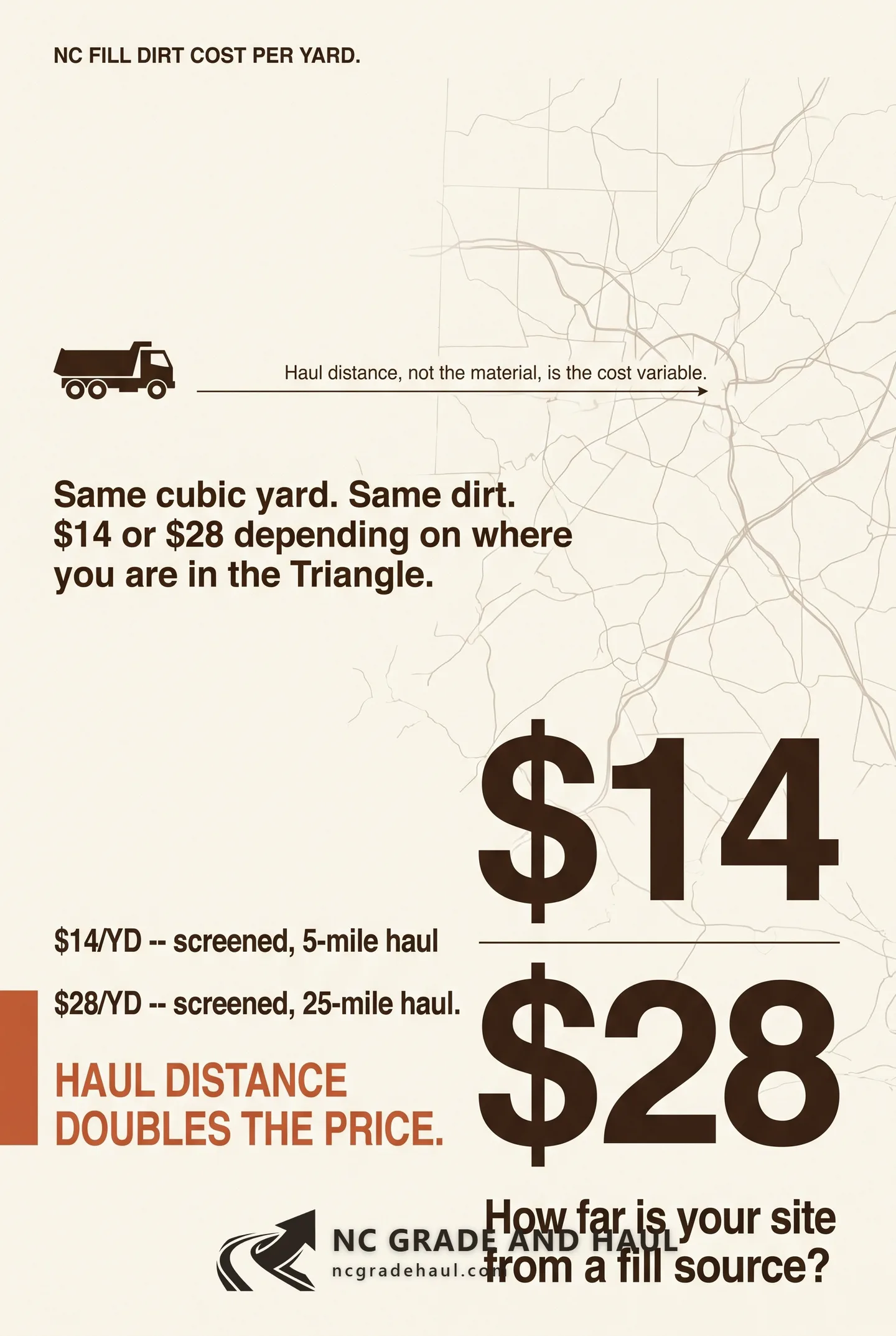
Haul distance is the primary driver of the delivery component. A 10-mile haul and a 40-mile haul for the same material at the same borrow pit can produce quotes that look wildly different — even though the material itself is identical. When comparing quotes, ask each contractor to separate the material cost from the delivery cost. That single question reveals whether you’re comparing the same thing.
The quote you received is a combined number. The contractor may or may not split it on paper. Most do not by default.
Price Ranges by Fill Type in North Carolina
Delivered fill dirt in North Carolina ranges from near-trucking-cost-only for unscreened clay to $60+ per yard for screened topsoil.
The table below uses Triangle (Wake, Durham, Orange counties) and Triad (Guilford, Forsyth counties) as the target markets. Price ranges are sourced from NC landscape supply yards and national contractor pricing data as of May 2026. Prices shift with fuel costs, seasonal demand, and borrow pit availability — verify current rates before ordering.
| Fill Type | Material Cost ($/yard) | Typical Delivered ($/yard) |
|---|---|---|
| Unscreened fill (borrow pit clay) | $5-$15/yard picked up | $12-$25/yard delivered |
| Screened fill | $15-$25/yard picked up | $22-$35/yard delivered |
| NC red clay (local borrow, nearby source) | Near zero | $8-$18/yard delivered (trucking only) |
| Screened topsoil | $18-$30/yard picked up | $25-$45/yard delivered |
| Imported structural fill (engineered) | $15-$30/yard picked up | $25-$45/yard delivered |
On unscreened fill: In the North Carolina Piedmont, unscreened fill is often red clay from a local cut site. Material cost may be zero or nominal if you can find a source within 15 miles. Delivered cost is primarily trucking.
On structural fill: Engineered structural fill — compaction-tested material meeting specific gradation specs — costs meaningfully more per yard than unscreened clay. If a spec sheet or engineer letter is attached to your project, you need this category, not basic fill.
For guidance on converting between yards and tons — which changes which row applies to your quote — see fill dirt quantity in yards vs tons NC.
What Makes Your Price Higher or Lower
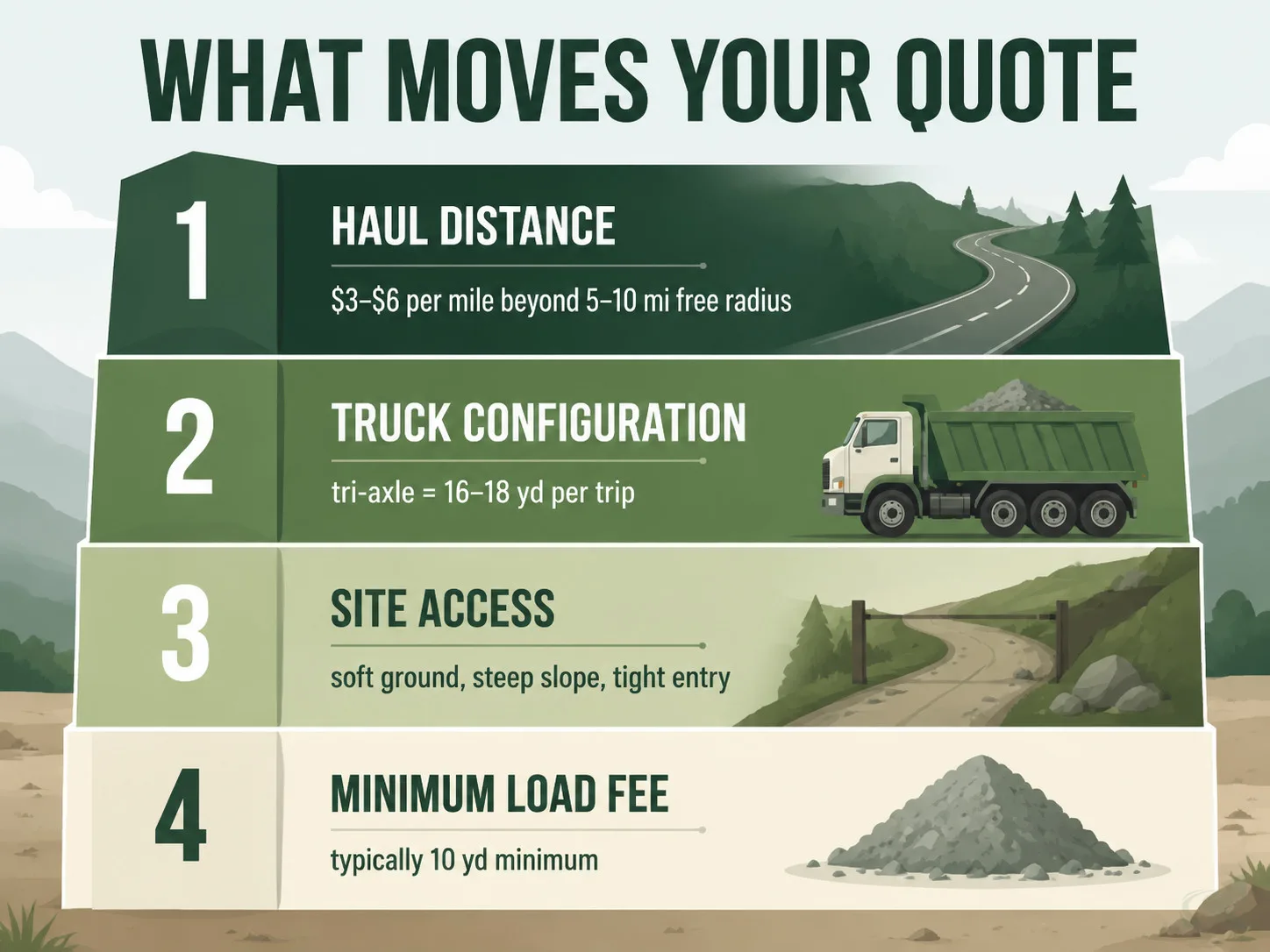
Haul distance is the largest single variable. After that: truck configuration, site access, and minimum load requirements.
Haul distance. Trucking cost scales with miles, not linearly but close. A contractor sourcing fill from a borrow pit 8 miles from your Triangle-area site is starting from a different cost floor than one sourcing 35 miles away. Some contractors build per-mile surcharges into their quote explicitly — typically $3-$6 per loaded mile beyond a 5-10 mile free-delivery radius. Others absorb distance into a total delivered rate.
Truck configuration. A tandem-axle dump truck carries roughly 14-16 cubic yards per load. A tri-axle carries 16-18. A quad-axle carries more. More axles per truck = more material per trip = fewer trips for the same total yardage. Fewer trips can reduce cost even if the per-trip rate is higher. This is why two quotes for the same job with different truck configurations don’t compare on a per-trip basis — compare on total delivered yards.
NCDOT weight limits directly affect how much any truck can carry per trip in North Carolina. See NCDOT weight limits that affect fill dirt delivery cost for how posted road limits interact with truck payload.
Site access. Soft ground, steep slopes, tight entry points, and active job sites with other trades present all add time per trip. Some contractors quote an access difficulty surcharge. Others do not quote it and absorb the extra time into their margin — until the job runs long.
Minimum load or trip fees. Most fill dirt deliveries in the North Carolina market carry a minimum load requirement — typically 10 yards for bulk delivery. Ordering 5 yards when the minimum is 10 means paying for 10. Small residential fills are particularly exposed to minimum load fees inflating the per-yard cost.
Delivery vs Haul-In Cost Comparison
Picking up fill dirt yourself saves the delivery markup but adds trailer rental, fuel, load fees, and trip time.
For small fills — under 10 yards — hauling your own material is sometimes worth evaluating. A 6x12 utility trailer carries roughly 1-1.5 cubic yards of fill. Getting 5 yards home requires 4-5 trips. Trailer rental, fuel, your time, and any load fee at the borrow pit are the real costs to compare against the contractor’s delivered price.
For fills of 15 yards or more, self-hauling typically does not pencil. A tri-axle contractor can deliver 15+ yards in one trip. You cannot match that tonnage or trip efficiency with a trailer rental.
Minimum delivery orders set the floor for contractor delivery. Ordering below the minimum means you pay for the minimum regardless. If your fill need is genuinely small, haul-in math may favor you — if you account for all the actual costs.
Imported vs On-Site Material
Using on-site clay as fill looks free. It is not free once you account for conditioning, compaction labor, and the risk of rejecting material mid-project.
In North Carolina, many residential and commercial lots contain usable fill material — typically red clay subsoil from grading cuts, utility trenches, or demolition. Reusing it avoids hauling cost entirely on paper.
But “free” material has real costs:
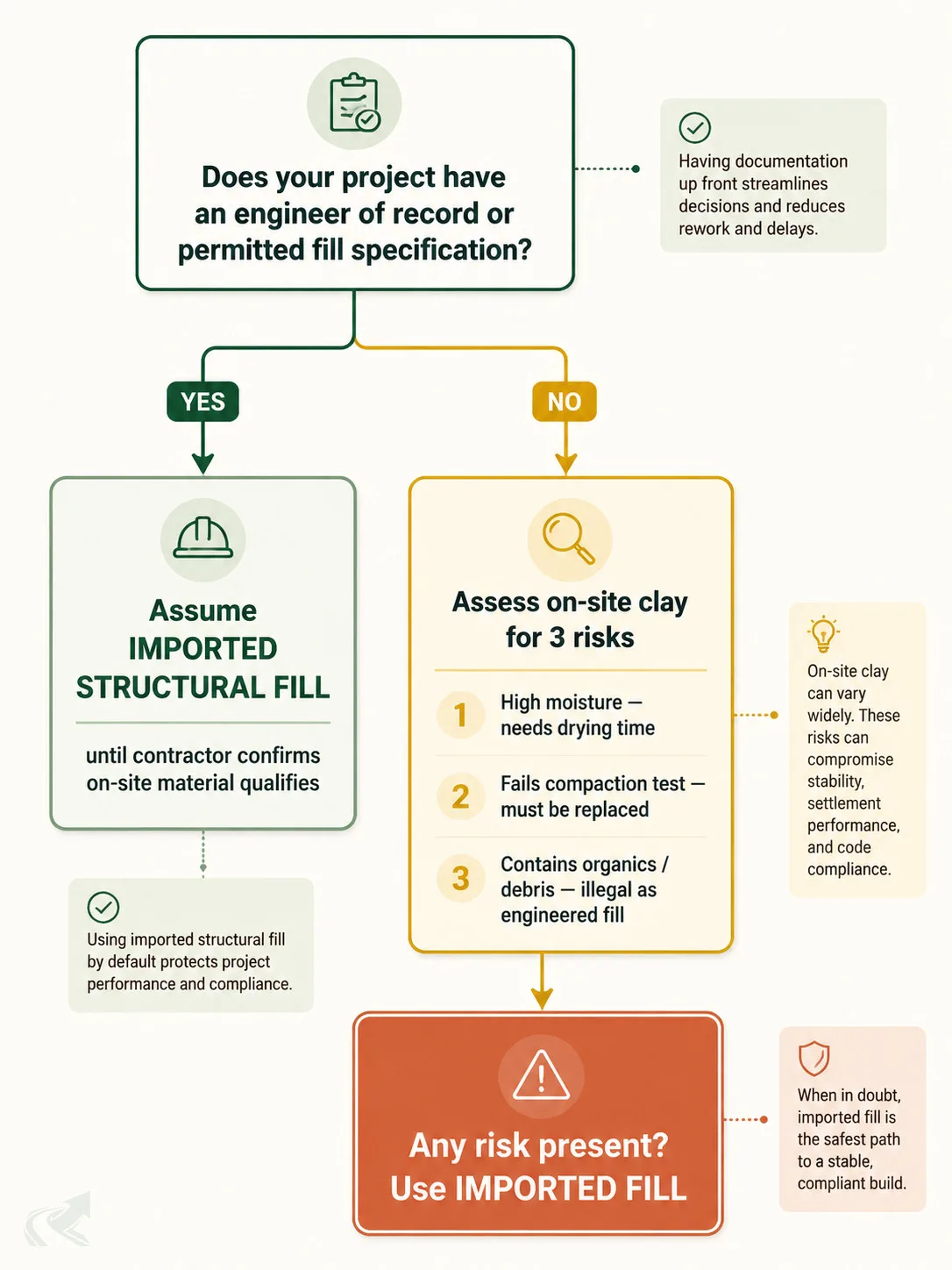
Conditioning. Clay with high moisture content does not compact properly. If your site clay was recently exposed or sits near a drainage path, it may need to dry before it can be placed and compacted. Drying takes time and cannot be rushed.
Compaction testing. On projects requiring compaction proof — foundation pads, permitted structures, any engineered fill section — your on-site clay must pass density testing regardless of origin. If it fails, it gets removed and replaced with imported material anyway, at full cost.
Rejection risk. On-site material containing organics, debris, or soft pockets cannot legally or structurally serve as engineered fill. A contractor who discovers bad material mid-project has to stop, haul out the bad fill, and bring in imported material. The net cost can exceed what imported fill would have cost at the start.
When your project has an engineer of record or a permit that references fill specifications, assume imported structural fill until your contractor confirms the on-site material qualifies. The “free” path has a failure mode that imported fill does not.
See NC fill dirt types and pricing for a full breakdown of fill categories and when each applies.
How to Evaluate a Fill Dirt Quote
A good fill dirt quote separates material cost from delivery cost and states truck configuration and cubic yard capacity per load.
Most quotes in the NC market do not volunteer this breakdown. You have to ask. Here is the list of questions to put to any contractor:
- What is the material cost separately from the delivery cost?
- What is the haul distance from the source to my site?
- What truck configuration will you use — and what is the cubic yard capacity per trip?
- Is there a minimum load or trip fee?
Getting clear answers to all four lets you compare quotes that look different on the surface but may be equivalent once the variables are aligned — or exposes a genuine cost difference you can negotiate.
For the step of finding and evaluating contractors in the North Carolina market, see hire an NC hauling operator. The directory lists contractors by county with verification source links so you can confirm license status before signing anything.
For how NC hauling regulations that affect fill dirt cost — including overweight permit requirements and county road restrictions — factor into delivery pricing, that page covers the regulatory side.