
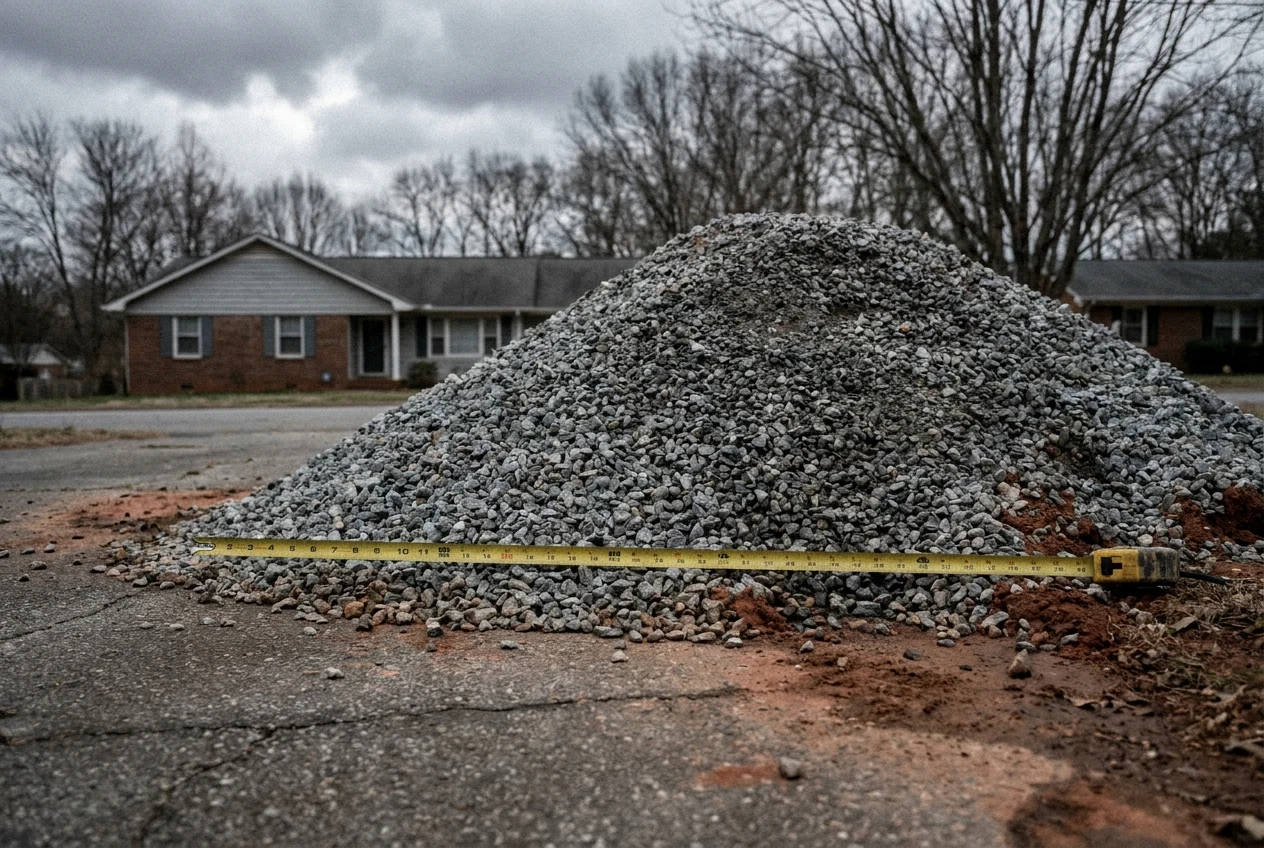
Someone posted a photo to a North Carolina homeowners subreddit last spring: a gravel pile that looked small for what they’d paid. The replies split immediately. Half said “that looks about right for 10 tons.” The other half said “no way, you got shorted.” Nobody had a method.
This page is the method.
If you received a gravel delivery in North Carolina and you’re not sure whether you got what you paid for, here’s how to check it — step by step, tape measure and phone calculator only.
Why Gravel Delivery Is Measured Two Ways
Quarries sell by weight because a certified truck scale is objective. Contractors quote in volume because that’s how homeowners visualize the job. The conversion between them is where disputes live.
The quarry loads the truck and reads the scale. That’s the authoritative number — a registered, calibrated scale with a paper trail. The contractor translates that weight into a volume estimate for your quote.
Those two numbers are not the same unit. And the conversion factor varies by material.
One cubic yard of gravel is not the same weight as one cubic yard of #57 washed stone. Density varies by material, by quarry, and by moisture. This is why the ticket matters more than the contractor’s word on volume.
How to Read Your Delivery Ticket
Your delivery ticket should show three numbers: gross weight, tare weight, and net weight. Net weight is what you paid for. If the ticket only shows an estimated quantity, you have no verified record.
A certified scale ticket looks like this:
- Gross weight: the truck fully loaded (example: 58,400 lb)
- Tare weight: the empty truck, truck-specific (example: 40,200 lb)
- Net weight: gross minus tare — the material (example: 18,200 lb = 9.1 tons)
That’s the number you compare to your invoice.
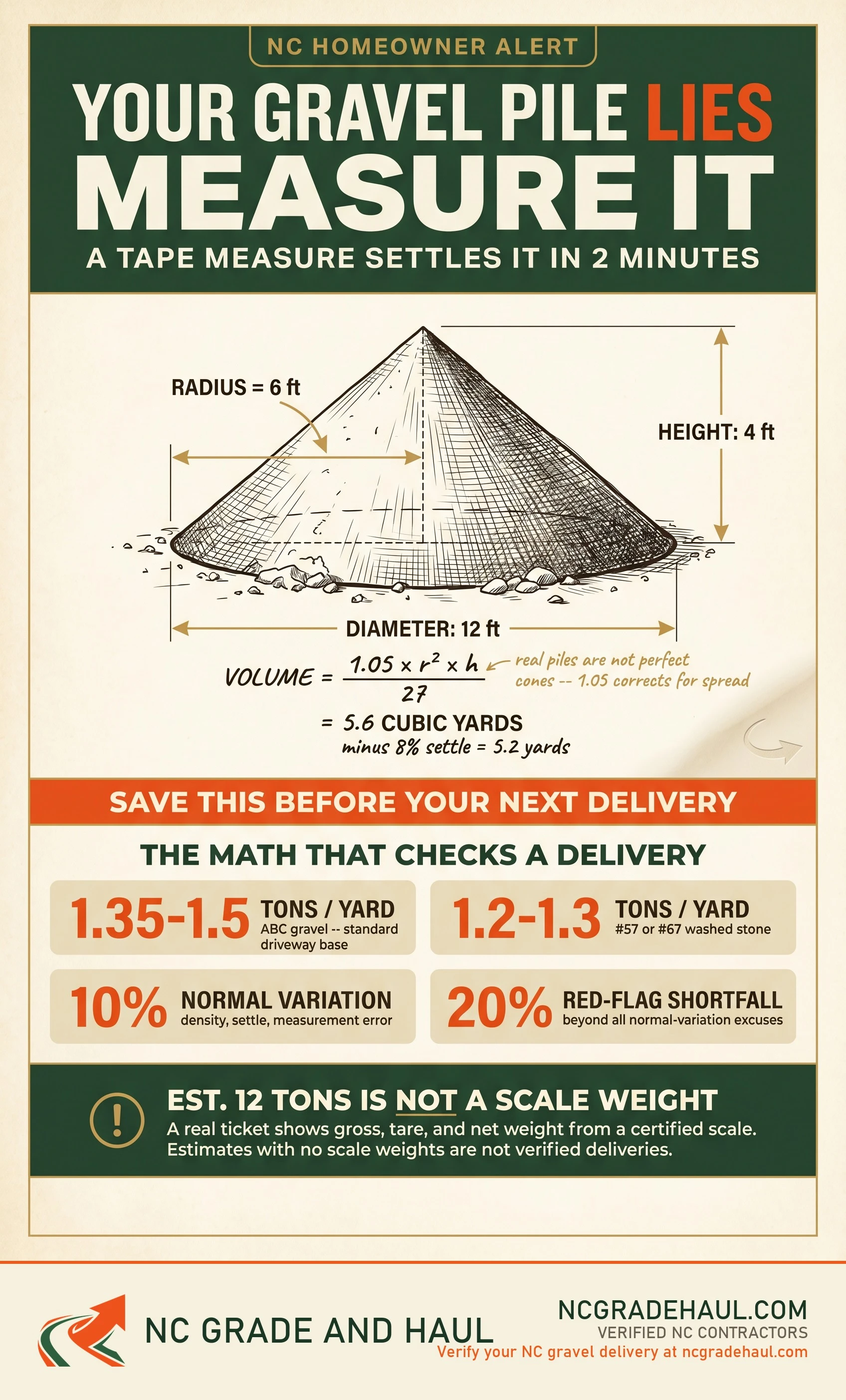
Red flag: the ticket reads “est. 12 tons” with no scale weights listed. That’s an estimated load, not a certified one. The driver’s gauge and the bed geometry produced that number, not a calibrated scale.
What a certified scale means: a registered public weighing station with a current calibration certificate, typically overseen by the NC Department of Agriculture and Consumer Services Weights and Measures division.
If the driver is still on-site and your ticket has no scale weights, ask for the scale receipt from the quarry before they leave. A legitimate operation can produce it.
For a full field-by-field walkthrough of what a real ticket looks like, see how to verify your gravel delivery ticket NC.
The Weight-per-Yard Math
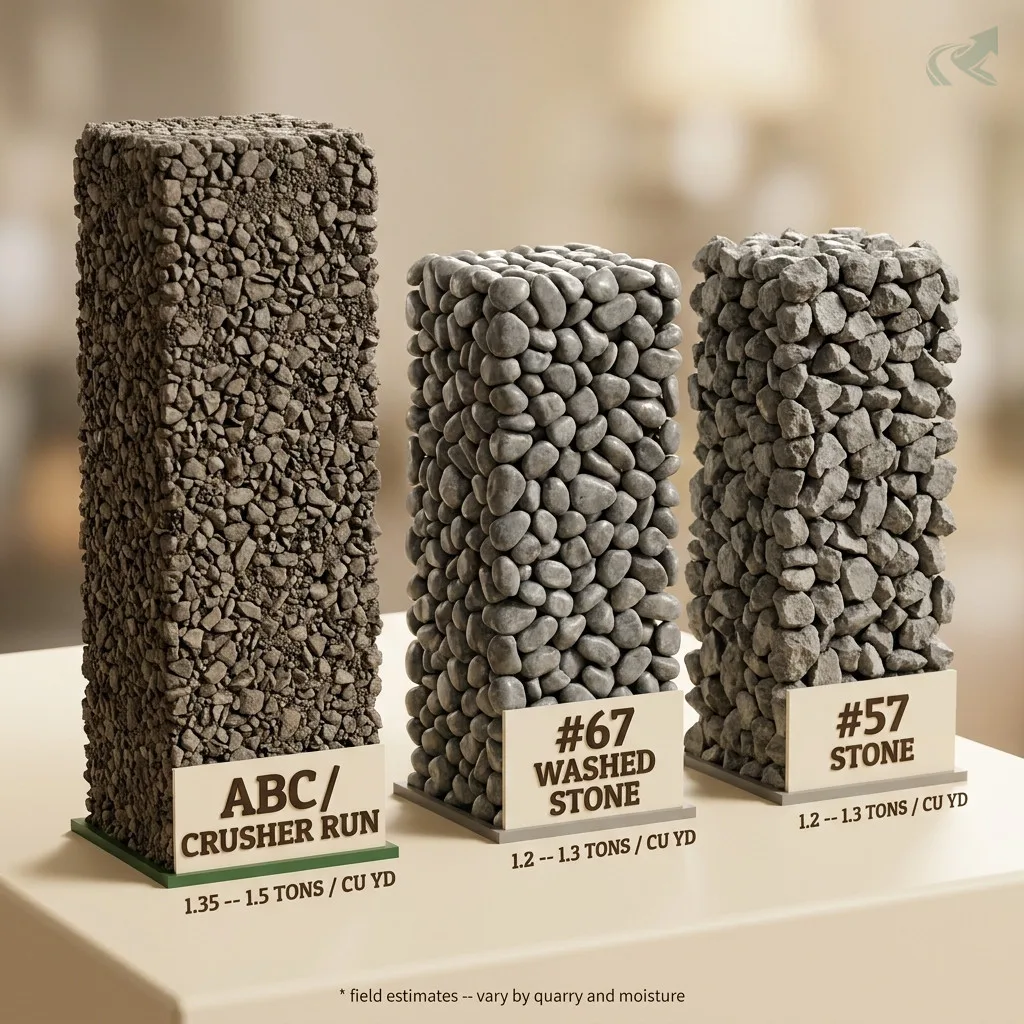
ABC gravel runs roughly 1.35 to 1.5 tons per cubic yard. #67 stone runs roughly 1.2 to 1.3 tons per cubic yard. If you ordered 10 cubic yards of ABC, your ticket should show approximately 13.5 to 14.5 tons.
Here’s the reference table for common North Carolina hauling materials. These are field estimates — actual figures vary by quarry, moisture content, and compaction. Use them to check the math, not to write a contract.
| Material | Approx. tons per cubic yard | Notes |
|---|---|---|
| ABC / | 1.35 — 1.5 | Varies with moisture; wet ABC runs heavier |
| #67 washed stone | 1.2 — 1.3 | ~2,410 lb/yd3 commonly cited |
| #57 stone | 1.2 — 1.3 | Similar density to #67, coarser aggregate |
| Crusher run | 1.35 — 1.5 | Similar to ABC; mix ratio varies by pit |
| Rip-rap | 1.3 — 1.5 | Heavier angular rock; density varies by size |
| Fill dirt (clay-heavy, Piedmont) | 1.4 — 1.6 | True red clay, fairly dry |
| Topsoil (screened, dry) | 0.7 — 1.0 | Lighter; planting layer |
Worked example: Ray orders 10 cubic yards of ABC gravel. At 1.4 tons/yard, his ticket should show approximately 14 tons. His ticket shows 11.2 tons. That’s 20% short — well outside normal tolerance. Time to ask questions.
Reverse example: Ray ordered 14 tons of ABC. At 1.4 tons/yard, he should have approximately 10 cubic yards. The pile math (next section) should confirm that.
For the full breakdown by stone type, see gravel weight per cubic yard by stone type.
Pile Math — Verify Volume Without Equipment
A cone-shaped gravel pile’s volume is roughly radius squared times height times 1.05, divided by 27. With a tape measure and your phone, you can estimate delivered volume within 10 to 15 percent of actual.
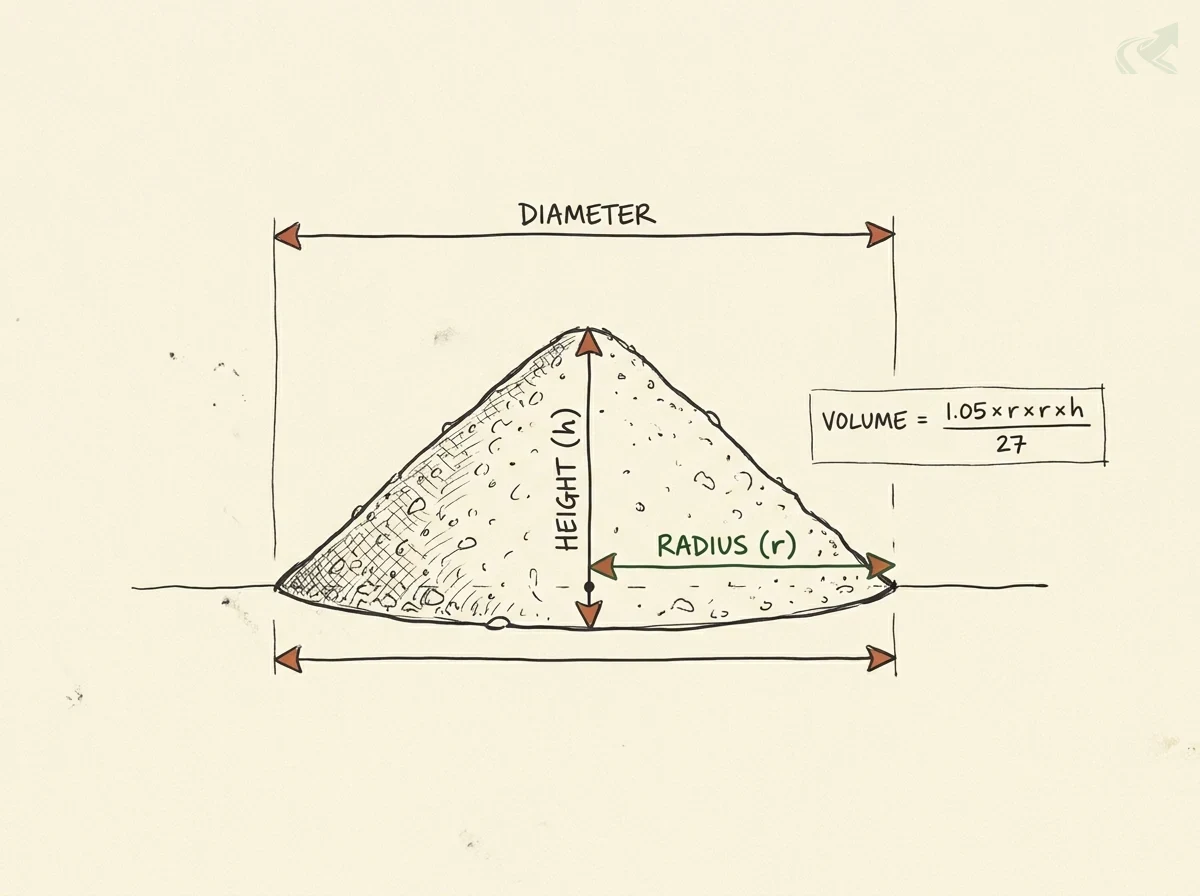
Step 1: Measure the base diameter at the widest point. Walk across the pile at ground level; measure the distance in feet. Divide by 2 to get the radius.
Step 2: Measure the height at the peak. Stand a tape measure vertically at the center — or prop a straight board from the peak to level ground and measure the drop.
Step 3: Run this formula on your phone:
Volume (cubic feet) = 1.05 x radius^2 x height
Volume (cubic yards) = cubic feet / 27
The 1.05 factor accounts for the fact that a real gravel pile is not a perfect geometric cone. It spreads at the base and rounds at the peak. The 1.05 multiplier adjusts for that imperfection and brings the estimate closer to actual.
Worked example: Ray measures a 12-foot-diameter pile, 4 feet tall.
- Radius = 6 feet
- Volume (cubic feet) = 1.05 x 36 x 4 = 151.2 cubic feet
- Volume (cubic yards) = 151.2 / 27 = 5.6 cubic yards
Settle factor: Freshly dumped gravel is loose — it sits higher than it will in a week. Expect 5 to 10 percent settling as it compresses. If you measure immediately after delivery, subtract 8 percent from your pile estimate before comparing to the ticket.
5.6 yards x 0.92 = 5.2 yards settled
Copy this formula:
Pile volume (cubic yards) = (diameter/2)^2 x height x 1.05 / 27 Example: 12-foot diameter, 4-foot height = (6^2) x 4 x 1.05 / 27 = ~5.6 cu yd. Subtract 8% settle = ~5.2 yards settled.
Full walkthrough with diagrams at measuring your gravel pile to verify delivery volume.
What to Do If the Math Is Off
If your pile math comes in 15 percent or more short of what you paid for, request the scale certificate from the quarry and compare gross and tare weights to the ticket. That’s the definitive check.
Step 1: Ask your contractor for the scale receipt from the quarry. They can get it from the weighmaster. A legitimate operation keeps these records. Resistance at this step is itself information.
Step 2: Verify the tare weight on the certificate matches the ticket. Tare weights are truck-specific — they’re registered for each individual truck, not the company fleet. If the tare on the ticket doesn’t match the registered tare for the truck that delivered, the net weight calculation is wrong.
Step 3: If the certificate and ticket match but the pile is still short, calculate the settle and swell factor for your material. Freshly dumped stone can sit 5 to 10 percent looser than the quoted “settled” volume.
When to escalate: If the delivery was an estimated load (no scale weights on the ticket) and your pile math shows a 20 percent or greater shortfall, you have a legitimate dispute. Start with a written request for documentation. If the contractor won’t produce it, see red flags when a NC gravel delivery seems short.
What a Short Load Looks Like vs Normal Variation
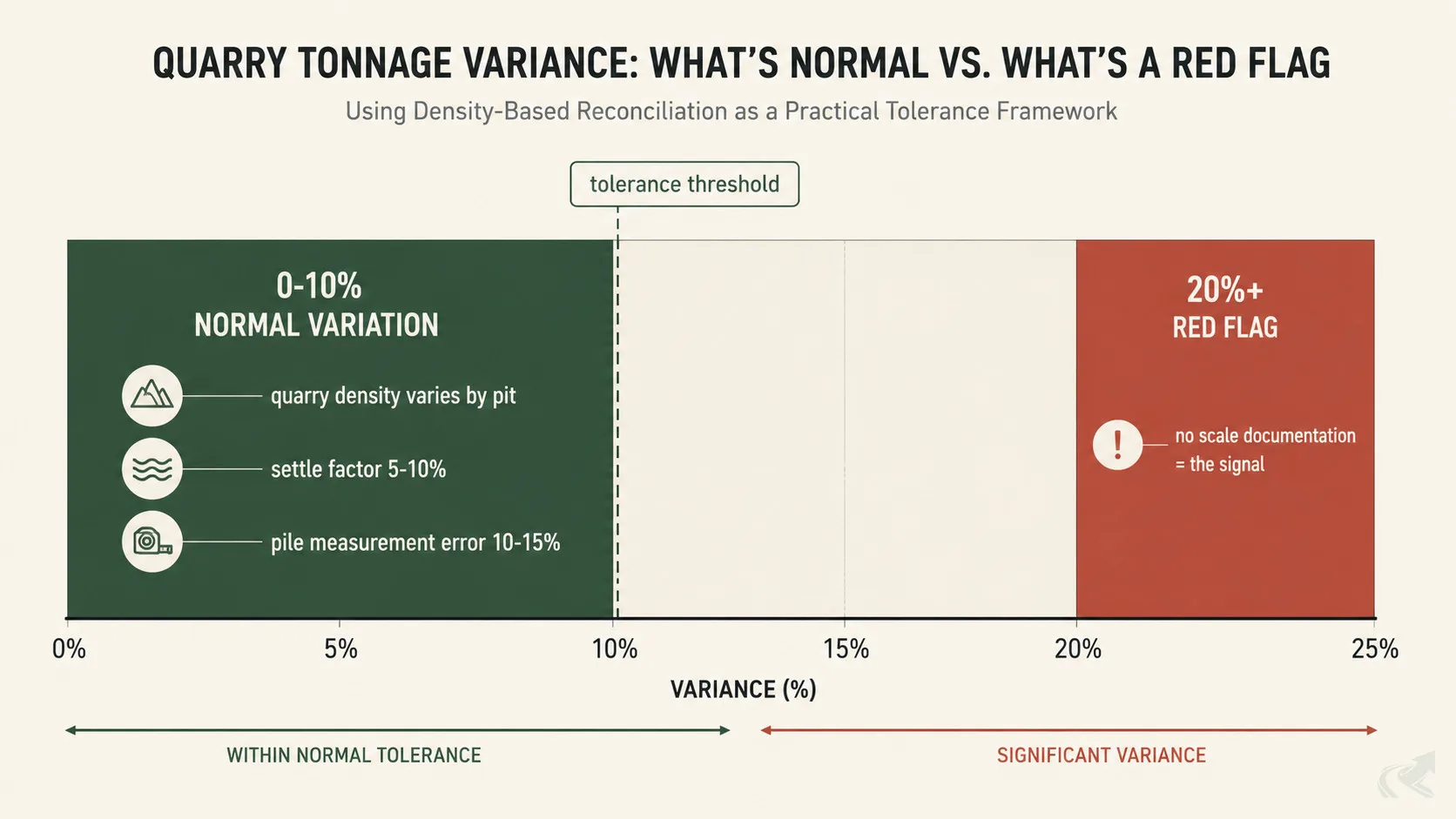
A 10 percent difference between estimated volume and delivered volume is within normal tolerance. A 20 percent difference is a red flag.
Normal variation comes from three sources — none of them fraud:
- Material density variation by quarry. ABC from one pit can run 1.35 tons/yard; from another it runs 1.5. Both meet spec.
- Settle factor. Freshly dumped, gravel sits higher. After a week of traffic, it compresses. The pile you measured day one was looser than the settled volume.
- Pile measurement error. A cone formula approximates. An irregular pile that spreads more than it piles can read 10 to 15 percent low even when the delivery was accurate.
What is actually a red flag: a contractor who can’t or won’t produce scale documentation. The ticket is a record-keeping requirement, not a favor. If the question makes them defensive, that’s the signal.
Also worth checking: what road did the truck take to get to you? How NCDOT weight limits relate to gravel load size affects how much a single truck can legally carry on weight-posted roads — which can explain a split delivery you weren’t expecting.
Common Mistakes
- Accepting an estimated-load ticket. “Approximately 12 tons” is not a scale weight. If you paid for 12 tons, the ticket should say 12.00 tons from a certified scale — not an estimate.
- Not accounting for settle factor in pile math. Fresh-dumped gravel measures high. Subtract 8 percent before you call anyone.
- Comparing volume quote to weight ticket without converting. If you ordered “10 yards” and the ticket says “13.5 tons,” those can be the same thing. Convert before calling it a short load.
- Assuming tare weight is a company-wide constant. Tare is registered per truck. A company with a fleet of three dump trucks has three different tare weights. Make sure the tare on the ticket matches the truck that arrived.
Get an Itemized Quote Before the Next Delivery
An itemized quote that specifies material type, quantity in tons, price per ton, haul cost per trip, and delivery with a certified scale ticket — that’s the baseline that makes all of this math unnecessary.
Everything in this page is what you do when you didn’t start there. The better path: before the truck rolls, ask for a quote that puts both units on paper. “10 cubic yards of #67 stone at 1.25 tons/yard = approximately 12.5 tons at $X/ton.”
That way you’re checking a specific number, not reverse-engineering from a pile and a vague invoice.
For NC hauling operators who will give you an itemized quote with scale documentation, see hire an NC hauling operator.
For NC gravel delivery and volume verification specifics by material and region, that page covers the delivery logistics in more detail.
You can also check fill dirt cost per yard and how to verify it if your delivery was soil rather than stone — the pile math is the same, but the settle factor and density figures differ.