Two questions about fill dirt
What kinds of fill dirt can I get delivered in NC?
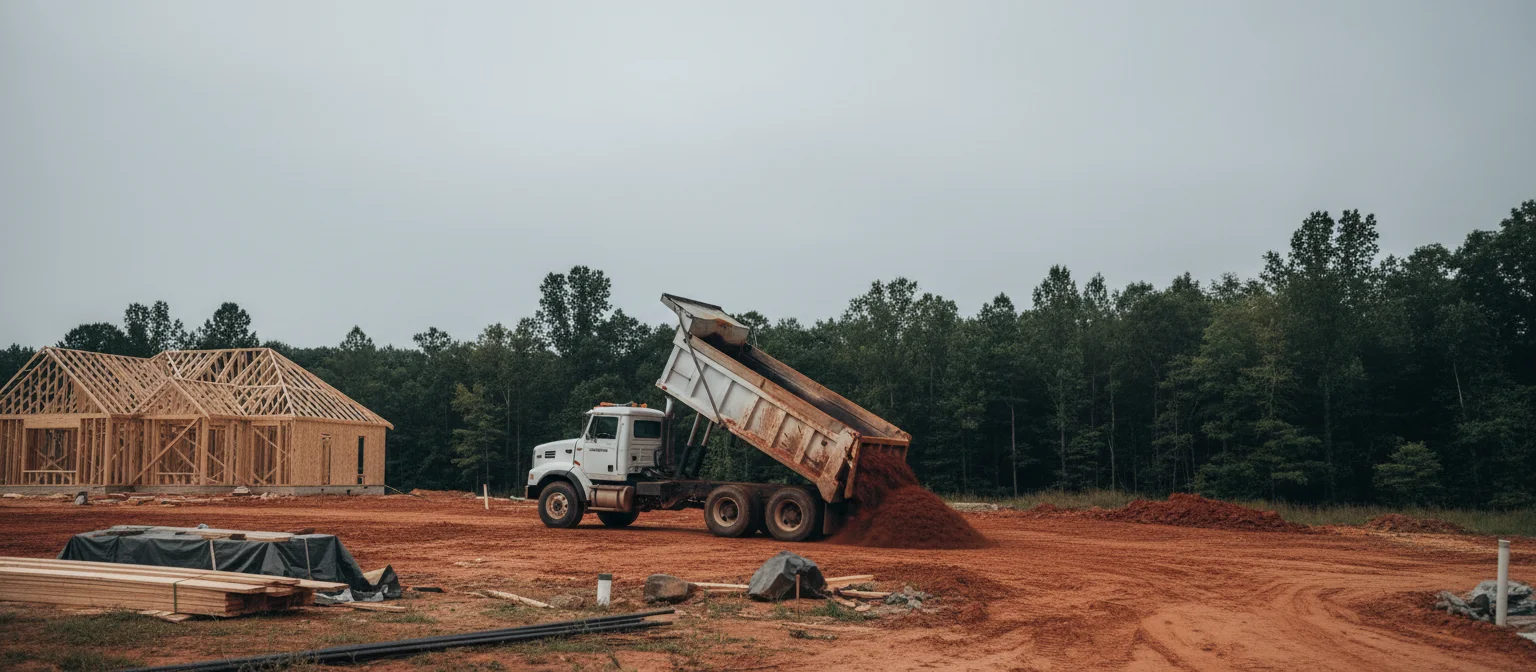
Three types: structural fill (compactable subbase for pads and foundations), general fill (grade changes and low-spot correction), and topsoil (not fill -- for growing things). NC red clay is often used as structural fill when dry enough to compact. Get clear on which one your job needs before ordering.
How do I know which fill dirt to order in NC?
Tell your contractor the application -- pad prep, grade correction, garden bed -- and let them specify the material. Then confirm the specification in the quote. A contractor who calls all three types 'fill dirt' without distinguishing them is a red flag.
Ray Pettiford got three quotes for filling a low spot near his barn in rural Guilford County. One contractor offered unscreened red clay from a local borrow pit at $18 per yard. Another quoted screened structural fill at $42 per yard. A third landed somewhere in the middle with no explanation of what they were actually delivering.
Without knowing the distinction between structural fill, general fill, and topsoil, there’s no way to evaluate any of those quotes. The cheapest option might be exactly right for the job — or it might fail under load in two years and cost twice as much to fix.
That distinction is what this page explains.
The Three Types of Fill Dirt in NC
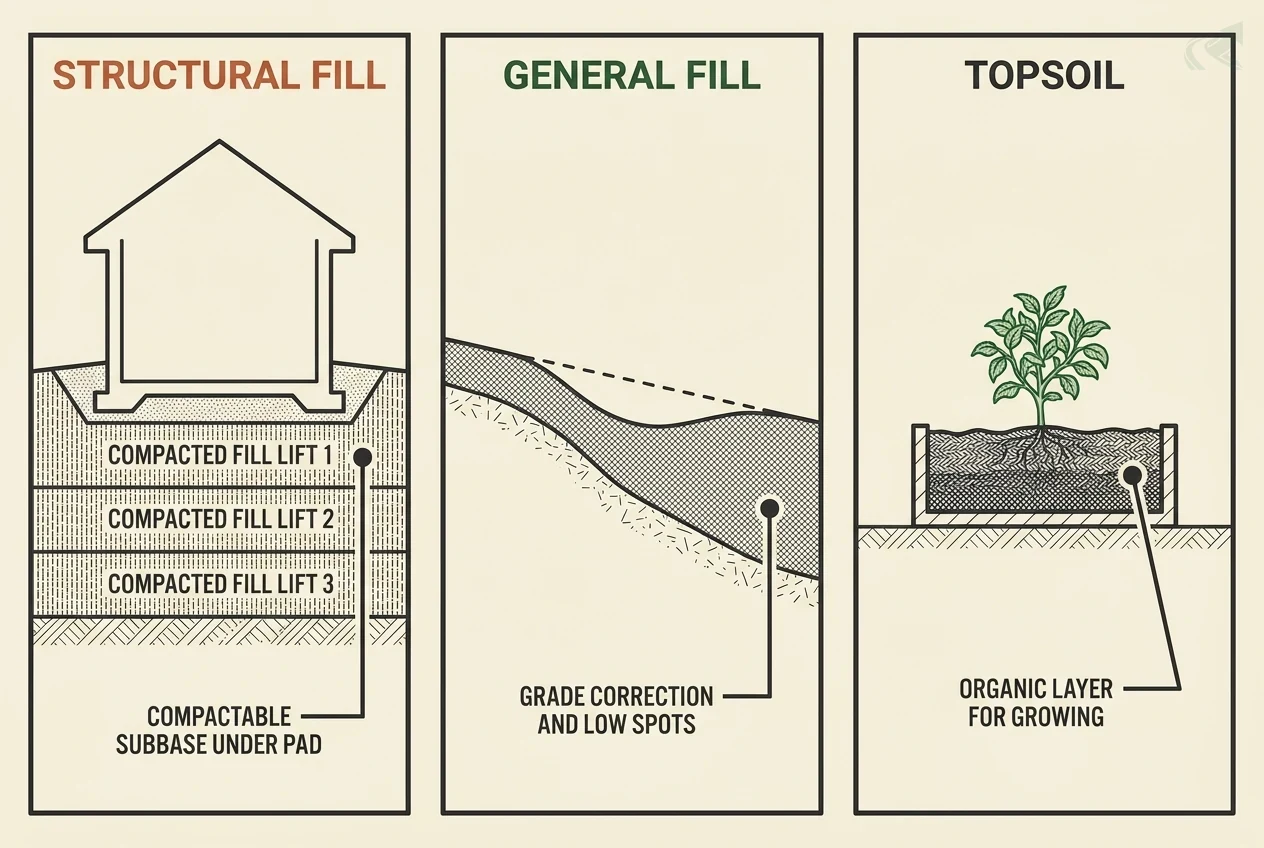
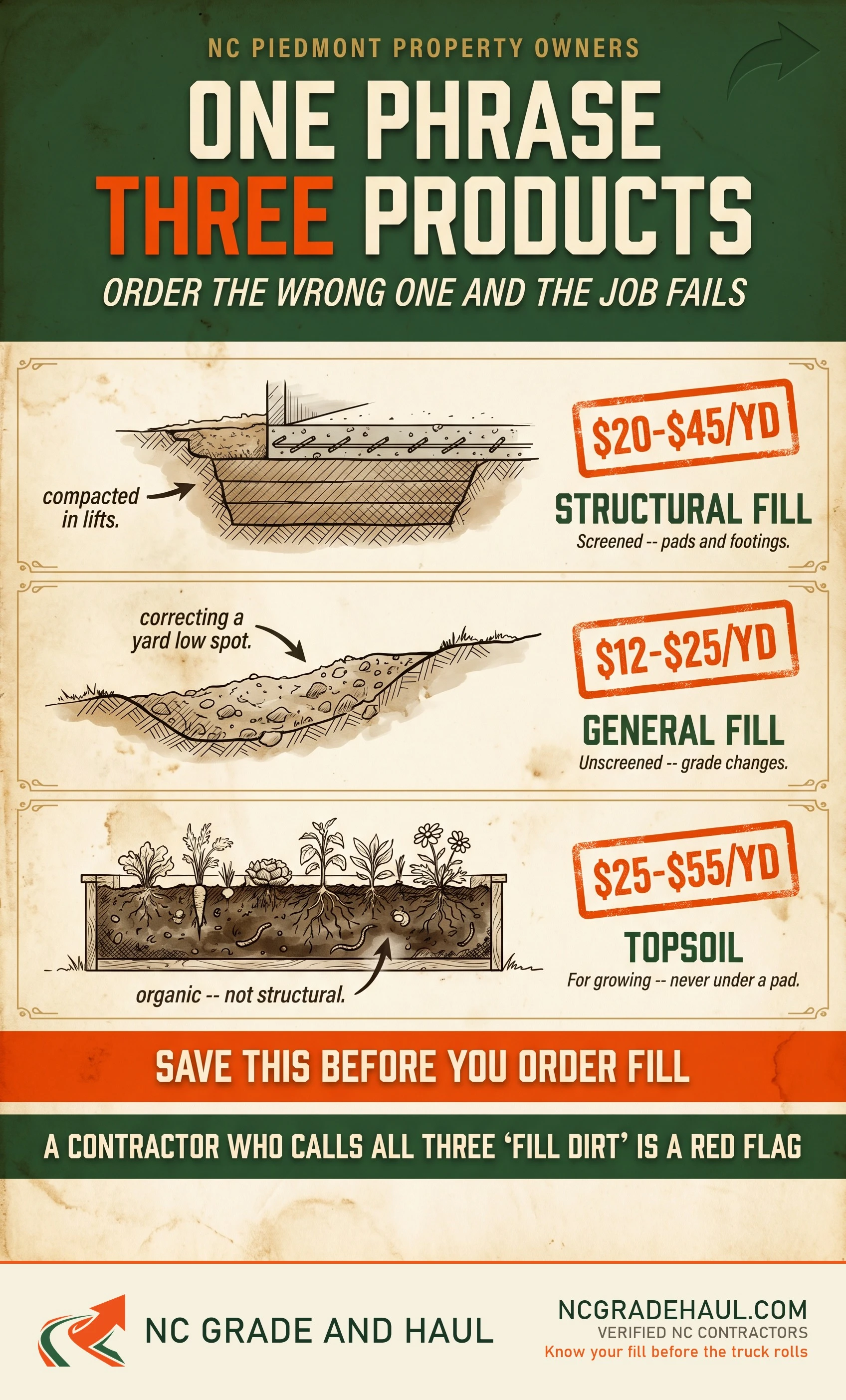
Structural fill, general fill, and topsoil are three different products — and ordering the wrong one either fails the job or wastes money.
North Carolina contractors use the phrase “fill dirt” to mean any of these three things depending on the job. The problem is they don’t always say which one they’re quoting.
- Structural fill: Dense, compactable material used under building pads, driveways, and foundations. Must meet compaction specs. NC red clay can qualify when it’s at the correct moisture content. This is what you need under anything with weight on it.
- General fill: Material for raising grade, filling low spots, or building berms. Doesn’t need to meet compaction specs. Can be less processed. Fine for correcting a yard grade or filling a wet area away from structures.
- Topsoil: The dark, organic-rich top layer of soil. Not structural — it will compress and settle under load. For plant establishment in gardens, lawns, and disturbed turf areas only.
If a contractor is calling all three of these “fill dirt,” ask which one they’re quoting before any trucks roll.
Fill Type Comparison
The type determines the application — and the application determines whether the fill works.
| Type | Use case | Compaction required | Typical cost range |
|---|---|---|---|
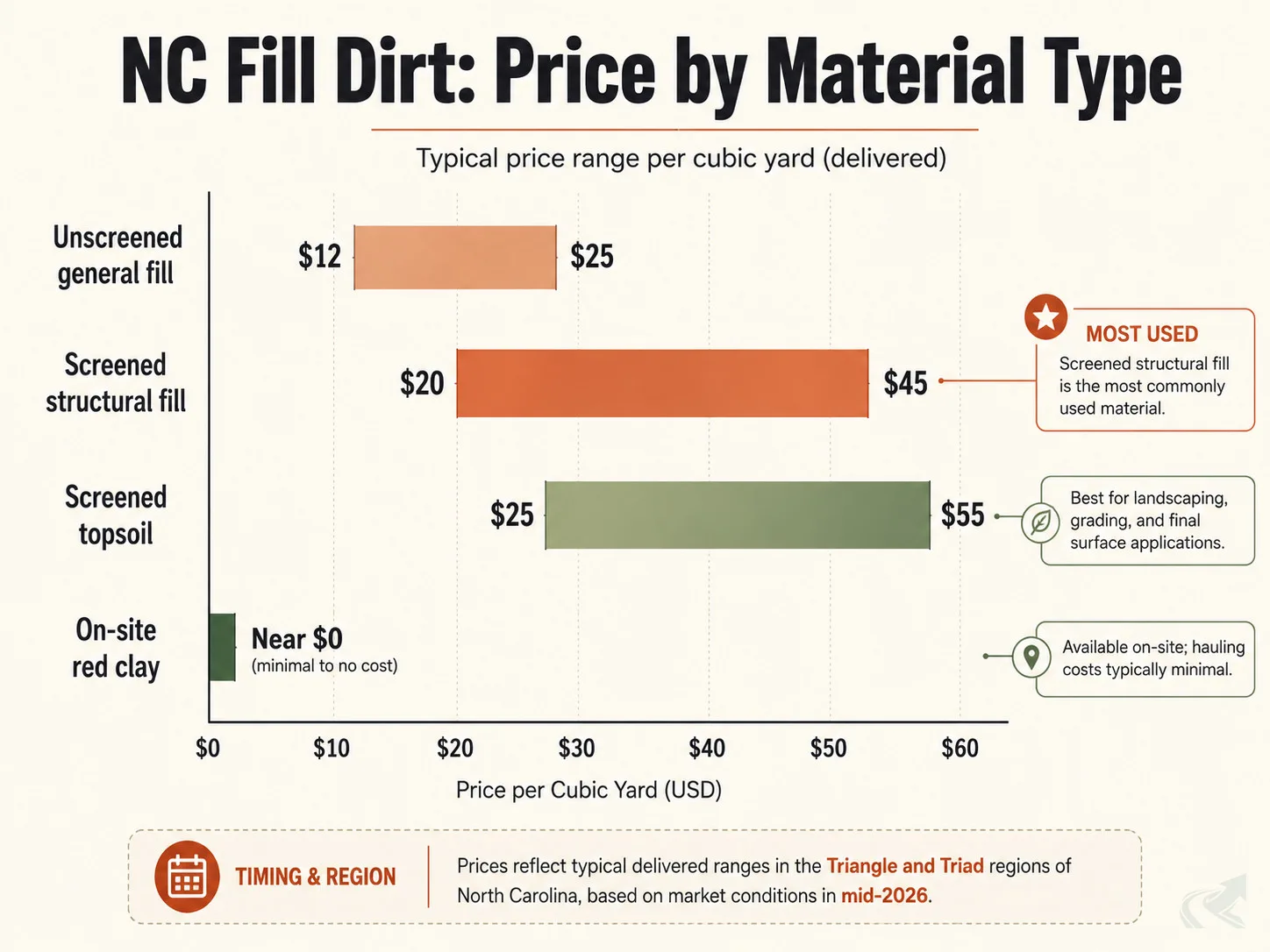
| Structural fill | Pads, foundations, driveways | Yes — spec-driven | $20—$45/yd delivered (screened) |
| General fill | Grade changes, low spots, berms | No spec required | $12—$25/yd delivered (unscreened) |
| NC red clay (on-site) | Structural or general when conditioned | Yes — moisture-critical | Near zero (own site material) |
| Topsoil | Garden, lawn, turf establishment | No | $25—$55/yd screened, delivered |
Price ranges above are working estimates for the Triangle and Triad as of mid-2026. Haul distance, material source, and screening add or subtract. Get an itemized quote for any specific job.
NC Red Clay as Fill — When It Works
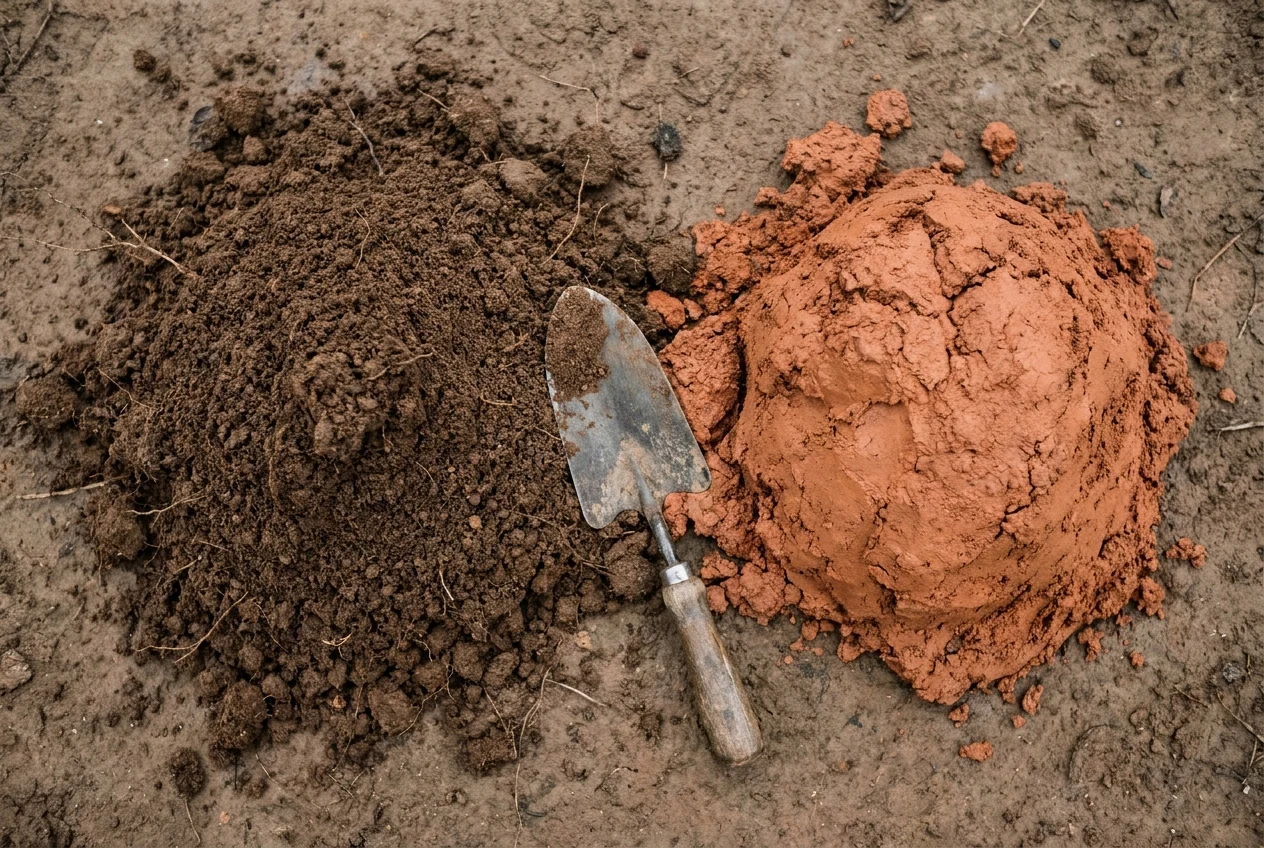
NC red clay works as structural fill when it’s at the right moisture content — usually several percentage points below optimum Proctor. Too wet, it won’t compact. Too dry, it compacts hard but can crack under load.
This is the dual-nature problem with Piedmont clay. The same red clay that makes a solid building pad in July is a slick, unworkable mess in February. Moisture content determines whether it compacts or fails — and you can’t tell by looking at it.
When on-site clay qualifies as fill:
- Grade changes of three feet or less
- Non-structural applications (berms, low-spot fill, ditch backfill)
- Close to the right moisture content at the time of placement
- No compaction spec from an engineer or permit requirement
When to import instead:
- Deep structural fill (3+ feet of lift)
- Building pad under conditioned space or any load-bearing structure
- Anything with a written compaction spec
- On-site clay that’s been sitting wet after recent rain
A proof-roll pass — driving a loaded truck across the surface to reveal soft spots — is standard quality control on any structural fill application before pour or construction begins.
Full detail on NC red clay as fill dirt and when the Piedmont clay profile shifts from asset to liability.
When to Import vs Use On-Site Material
Import fill when: (1) your on-site clay is too wet to compact right now, (2) the fill depth exceeds what you can achieve in manageable lifts, or (3) the spec calls for a material your native clay doesn’t meet.
Using on-site material is almost always cheaper. But it’s only worth it if the material qualifies. A borrow pit run or two of imported screened structural fill costs less than redoing a pad that settled because the clay went in wet.
Three-question decision framework:
- What’s the moisture content of the clay right now? (Wet = import or wait.)
- How deep is the fill? (More than 3 feet in lifts = import spec-grade material.)
- Does the job have an engineer spec? (If yes = import; don’t gamble with on-site clay meeting an unknown standard.)
Import or use on-site material -- three questions
1. What's the clay moisture content right now? -- Wet clay won't compact correctly. Import conditioned material or wait for it to dry. You can't tell by looking -- this is a judgment call based on recent rainfall and how long it's been since. 2. How deep is the fill? -- More than 3 feet of lift? Import spec-grade structural fill. Deep clay fills placed at the wrong moisture content are how building pads fail under load months later. 3. Does the job have an engineer spec? -- If yes, import -- don't gamble on on-site clay meeting a standard you can't verify. The spec exists because the engineer knows the load the fill will carry.
-
What's the clay moisture content right now?
Wet clay won't compact correctly. Import conditioned material or wait for it to dry. You can't tell by looking -- this is a judgment call based on recent rainfall and how long it's been since.
-
How deep is the fill?
More than 3 feet of lift? Import spec-grade structural fill. Deep clay fills placed at the wrong moisture content are how building pads fail under load months later.
-
Does the job have an engineer spec?
If yes, import -- don't gamble on on-site clay meeting a standard you can't verify. The spec exists because the engineer knows the load the fill will carry.
On-site material is almost always cheaper -- but only when it qualifies. Getting this wrong means doing the job twice at full cost.
Import sourcing in North Carolina: local borrow pits, quarry spoil (sometimes near-free if you haul it yourself), and fill from other construction sites giving away excavated material. In the Triangle and Triad, screened imported structural fill typically runs $20—$45 per yard delivered depending on distance.
Screened vs Unscreened Fill
Screened fill has had rocks, roots, and debris removed — it compacts more uniformly and is required for any application near utilities or structures. Unscreened is fine for rough grade fills away from structures.
Unscreened fill costs less because it takes less processing. For filling a low field away from any building or utility line, unscreened red clay from a borrow pit is often exactly right. For anything near a foundation, driveway edge, or buried line, screening matters.
The full breakdown — what screening removes, when it changes the compaction result, and when to require it in the quote — is at screened vs unscreened fill dirt NC.
How Fill Dirt Is Priced in NC
Fill dirt price in North Carolina ranges from near-free (quarry spoil you haul yourself) to $25—$45 per yard for screened delivered material — the variable is screening, haul distance, and material type.
The cheapest fill is unscreened clay from a local borrow pit. If you supply the truck, you’re paying for the material and maybe a small pit fee. Screened structural fill delivered from a quarry to the Triangle or Triad runs roughly $20—$45 per yard all-in.
The unit distinction matters. Some quotes come in cubic yards; some in tons. A yard of dry Piedmont clay weighs roughly 1.4—1.6 tons. If the quote is in one unit and the delivery ticket is in the other, ask for the conversion in writing before the truck leaves. Full math at fill dirt volume in yards vs tons.
Always verify the delivery ticket. The ticket should state the quantity (yards or tons), the material type, and the source. A ticket that says “fill” with no source named is not sufficient documentation. Check it before the driver leaves the site.
Full price breakdown by region and material type at NC fill dirt cost per cubic yard.
Common Mistakes
Three fill dirt mistakes that show up repeatedly on NC job sites:
- Ordering “fill dirt” without specifying structural vs general. The contractor will bring what they have. If they have cheap unscreened clay and you needed screened structural fill for a building pad, you’re doing the job over.
- Using wet red clay as fill. Clay excavated immediately after rain won’t compact correctly. Wait for it to dry to workable moisture content, or import material that’s already conditioned.
- Confusing topsoil with fill. Topsoil placed under a building pad will decompose and settle. Structural fill placed in a garden bed won’t grow anything.
How to Order Fill Dirt Without Getting the Wrong Thing
Tell your contractor the application — pad prep, grade correction, garden bed — and let them specify the material. Then confirm the specification in the quote so you know what you’re getting.
Contractors work with fill material every week. A good one will ask you what the fill is for and spec the right material. What to ask before the job starts:
- What type of fill is this — structural, general, or topsoil?
- Is it screened?
- What’s the source location (quarry name, pit name)?
- Is it appropriate for my specific application?
A red flag: a contractor who doesn’t distinguish between structural and general fill when you ask. That’s not how it works in NC clay country. The material distinction matters for the outcome of the job.
Before ordering fill dirt, ask:
Copy and save this before your next contractor call.
”Is this screened structural fill or topsoil?"
"What is the compaction spec for this material?"
"What type of fill is this — structural, general, or topsoil?"
"Is it screened? What’s the source location?"
"Is it appropriate for pad prep / grade correction / garden bed?”
Get an Itemized Quote for Fill Dirt in NC
A grading and hauling contractor can tell you whether your on-site material qualifies or whether you need to import — and what type.
Ray’s scenario — three quotes, three different materials, no explanation — is common. The way out is to ask for a quote that specifies the fill type, source, and cubic yardage. Not a single-number round figure. An itemized quote.
The tracks licensed contractors. A contractor pulling permits and working under license has accountability that an unlicensed crew doesn’t.
Hire an NC hauling operator who can spec the right material for your job and give you the documentation to prove what was delivered.
See also: red clay fill for building pad preparation in NC if your project involves a structural pad, and NC Piedmont red clay reference for fill decisions for the soil science behind the moisture-content question.