
What Rip-Rap Is and What It Does
Rip-rap is angular armor stone placed at high-velocity water points to absorb energy and stop erosion.
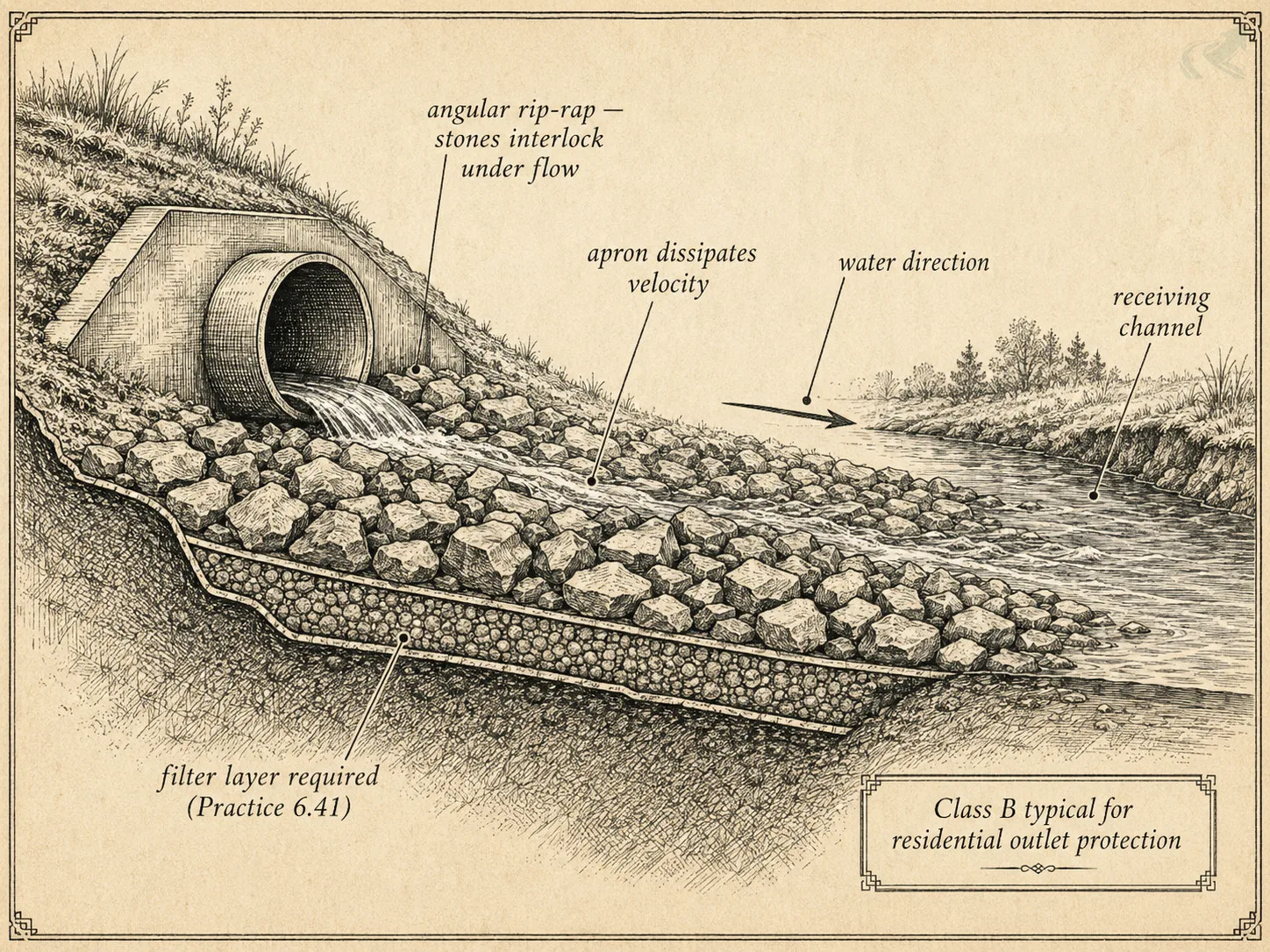
Unlike rounded gravel, rip-rap is angular — the irregular faces interlock under flow. That interlocking is what makes it stay put at culvert outlets, ditch toes, and slope faces where rounded stone would simply roll away.
Water accelerates through a culvert and exits with more energy than the surrounding soil can absorb. Rip-rap spreads that energy across a wider footprint, reducing velocity at contact with the soil below. The result is stabilization rather than ongoing channel cutting.
Rip-rap does not compact. It does not provide a driving surface. It does not filter sediment the way geotextile fabric does. It is a single-purpose product: armor against velocity-driven erosion at points where nothing lighter will hold.
North Carolina Rip-Rap Class Sizing
Class sizing maps rock diameter to the velocity of the water it will face — heavier rock for faster flow.
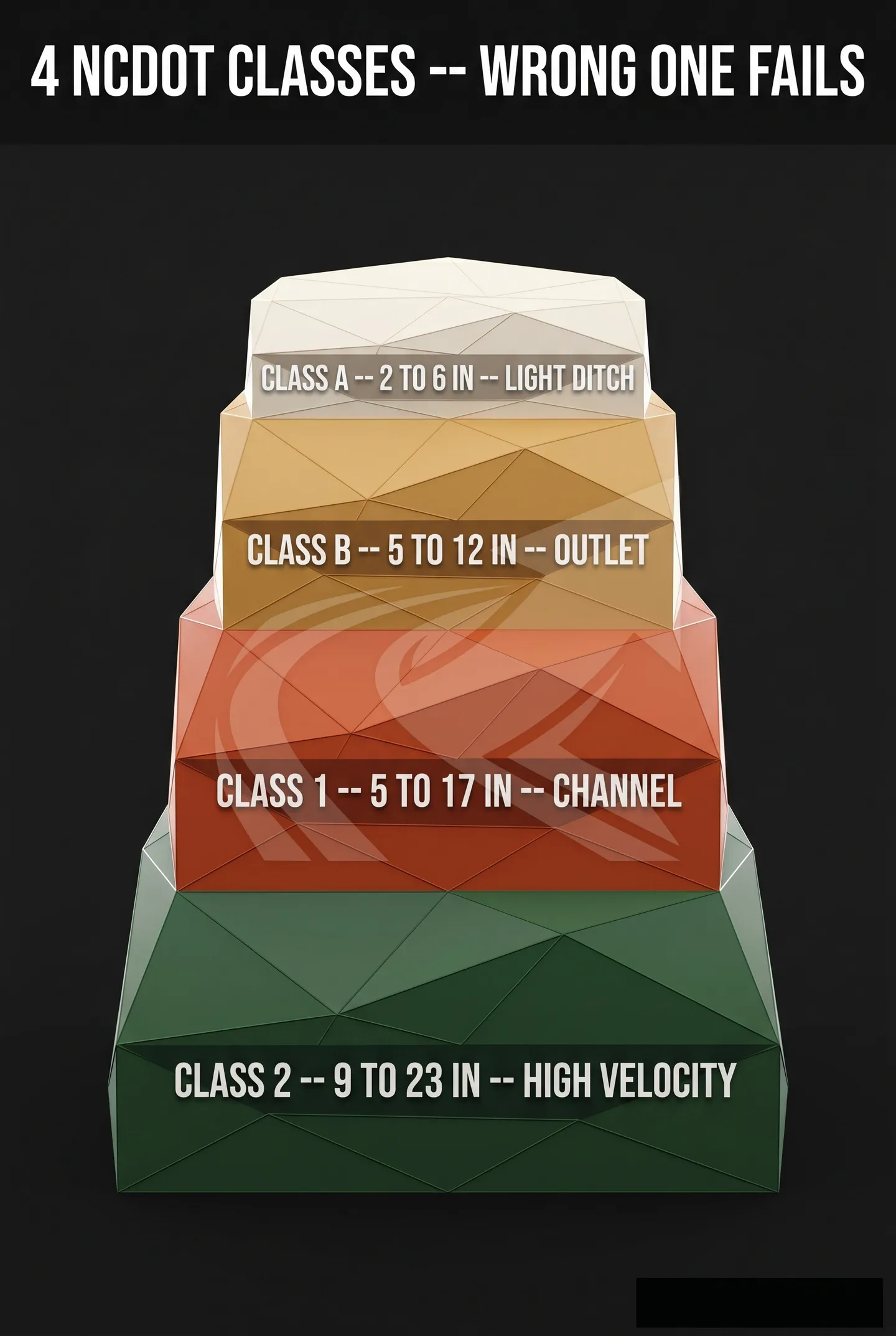
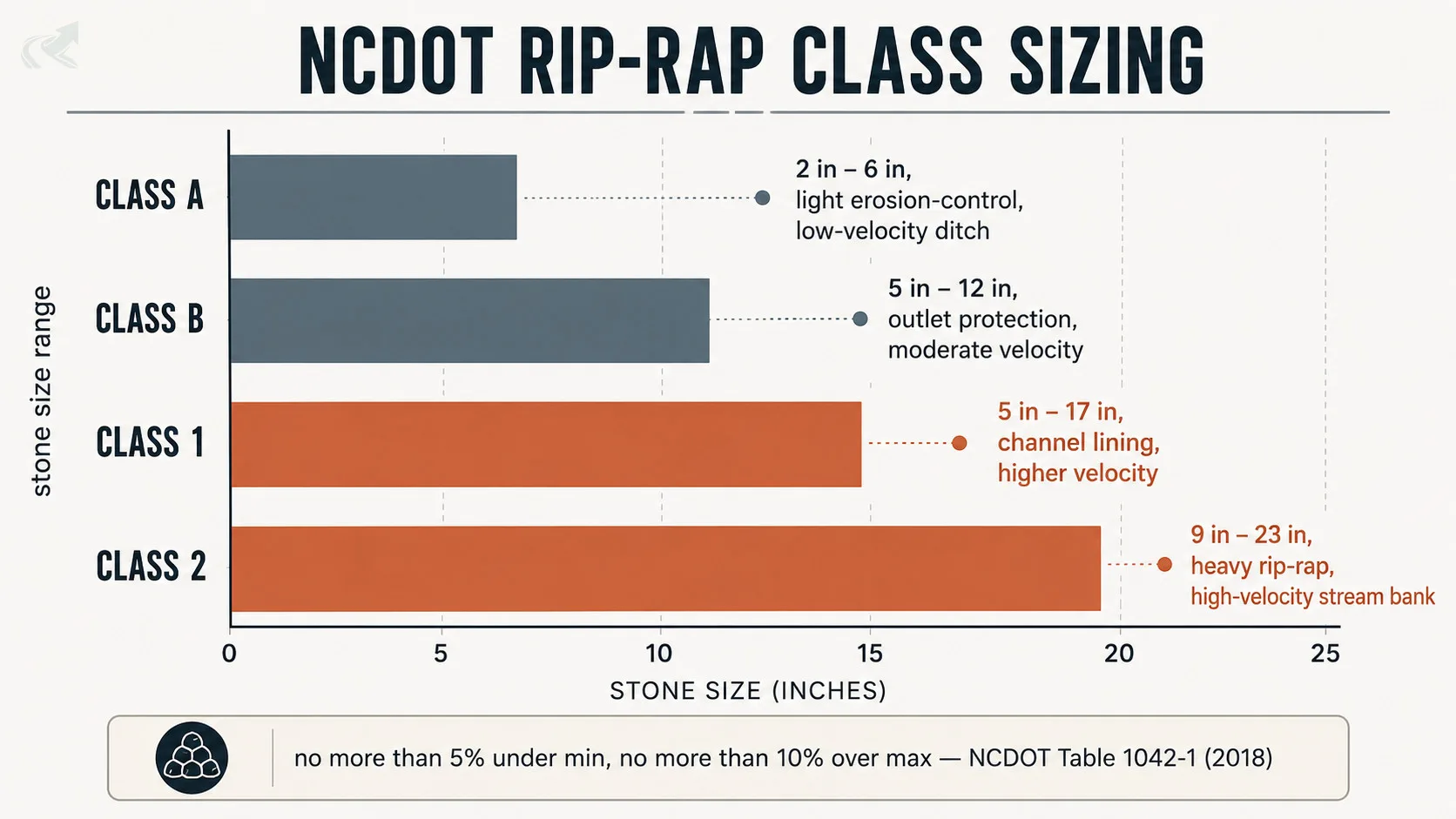
North Carolina’s erosion and sediment control work references NCDOT class designations. NCDOT Table 1042-1 (2018 Standard Specifications) defines four classes by stone size in inches — two erosion-control classes (A and B) and two heavier rip-rap classes (1 and 2). The classes most relevant to residential and light commercial applications are summarized below.
| NCDOT Class | Stone Size Range (Min — Midrange — Max) | Primary Application |
|---|---|---|
| Class A | 2” — 4” — 6” | Light erosion-control stone, low-velocity ditch lining |
| Class B | 5” — 8” — 12” | Outlet protection, moderate-velocity slope toe and roadside channels |
| Class 1 | 5” — 10” — 17” | Higher-velocity channel lining, larger drainage areas |
| Class 2 | 9” — 14” — 23” | Heavy rip-rap for high-velocity flows and stream bank work |
(Sizes are exact per NCDOT Table 1042-1. Note NCDOT uses Arabic numerals — “Class 1” and “Class 2” — not Roman numerals; the erosion-control grades are lettered “Class A” and “Class B.” No more than 5 percent of the material may be under the minimum size and no more than 10 percent over the maximum.)
For a drainage ditch eroding at the outlet — the situation Ray Pettiford is dealing with on his farm — Class A or Class B is the typical starting point. If the ditch carries significant runoff from a large drainage area, or if the outlet drops into a natural channel with higher velocity, the contractor or inspector may specify Class 1 or heavier.
The class is not always the contractor’s call to make alone. If the site is subject to an approved Erosion and Sediment Control Plan, the plan will specify the class. If no plan exists, the North Carolina Erosion and Sediment Control Manual provides sizing guidance: for outlet protection (Practice 6.41), apron length and width are set by the tail-water condition and the receiving channel’s allowable velocity, and the largest stone diameter should be no more than 1.5 times the d50 size.
Applications: Where Rip-Rap Goes
Rip-rap belongs at points of concentrated flow or velocity change — not as a general fill or surface material.
Common North Carolina applications:
- Culvert outlet protection. The most frequent residential use. A rip-rap apron at the outlet dissipates velocity before flow re-enters the natural channel or ditch.
- Ditch toe stabilization. The bottom and lower sides of a drainage ditch where water velocity is highest. Class A or Class B depending on slope and drainage area.
- Slope toe armor. The base of a fill slope where runoff concentrates before leaving the site.
- Stream bank protection. Higher-class material, typically with engineering involvement and possible permit requirements (see the next section).
What rip-rap is not appropriate for:
- Driveways. Angular stone does not compact and creates an unstable driving surface. See rip-rap as a permanent driveway erosion barrier NC for options that do work at driveway edges.
- Foot traffic areas. Same issue — the void space between stones is a tripping hazard and the surface does not stabilize underfoot.
- Sediment filtration. Rip-rap passes water freely. It does not trap sediment. Use sediment control devices upstream.
Stream Buffer Considerations in North Carolina
Placing rip-rap within a riparian buffer or directly in a stream channel can trigger state permitting requirements — including 401 Water Quality Certification.
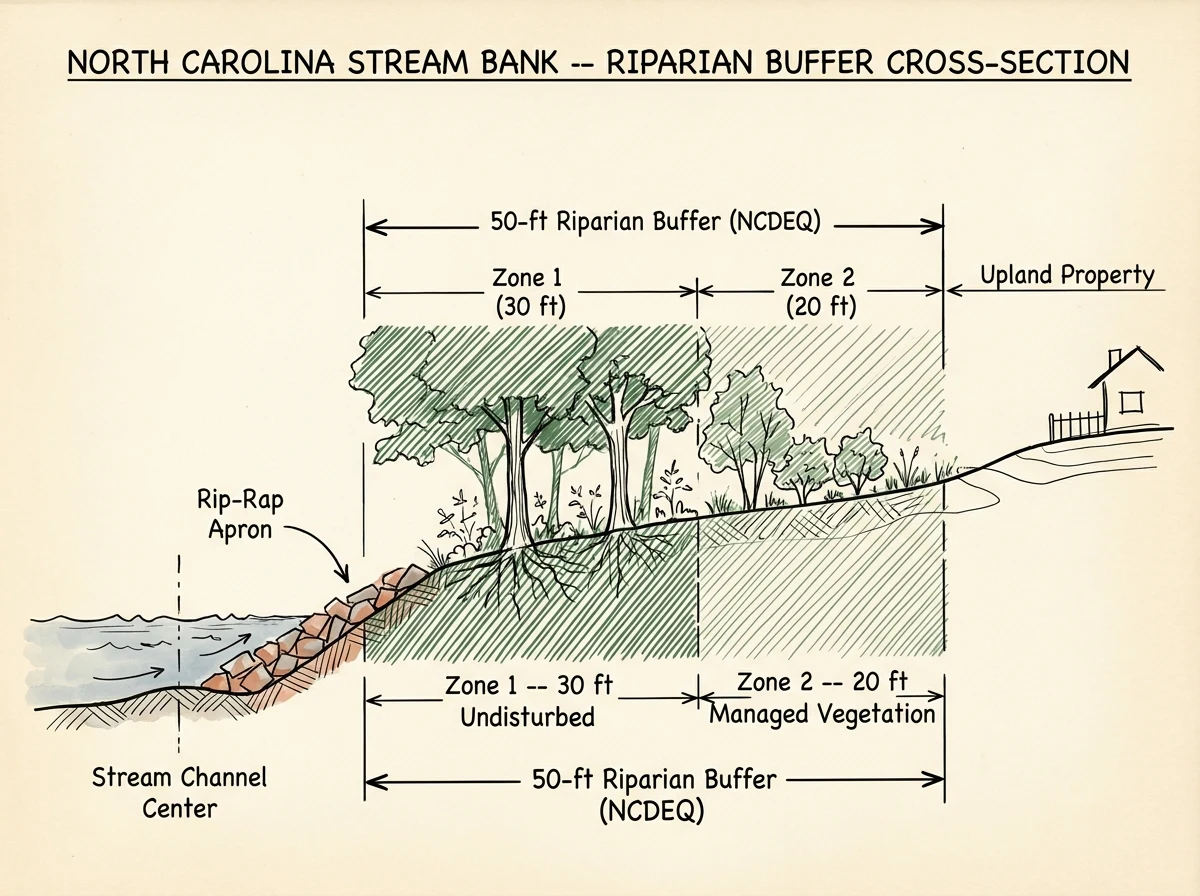
North Carolina’s Riparian Buffer Rules apply to certain river basins. The Neuse, Tar-Pamlico, Catawba, and Jordan Lake watersheds all have adopted buffer rules administered by the . Those buffers are 50 feet wide measured from the top of the stream bank, divided into two zones: Zone 1 (the innermost 30 feet, which must remain undisturbed) and Zone 2 (the outer 20 feet, where managed vegetation is required). Work involving fill material — including rip-rap — within either zone may require a buffer authorization or a 401 Water Quality Certification. (15A NCAC 02B .0233 for the Neuse basin; 15A NCAC 02B .0259 for Tar-Pamlico; parallel rules apply to Catawba and Jordan Lake.)
A 401 Water Quality Certification is issued by DWR and certifies that the proposed activity will not violate water quality standards. It is required whenever a federal permit or license (including a Section 404 permit from the US Army Corps of Engineers) authorizes a discharge to Waters of the US — which can happen when rip-rap is placed in or adjacent to a jurisdictional wetland or stream. DWR issues either a General Certification (for projects covered by a Nationwide Permit) or an Individual Certification (for projects requiring an individual USACE permit). For small residential bank stabilization, the applicable Nationwide Permit type determines which General Certification applies; contact the DWR 401 and Buffer Permitting Branch or the USACE Wilmington District to confirm which permit category covers your site before placing material.
Practical rule for North Carolina property owners: if the rip-rap will go within 50 feet of a stream, creek, or water body, contact DWR before ordering material. The DWR regional offices can confirm whether a buffer authorization or 401 applies to your specific site and basin.
For broader context on the North Carolina erosion law that governs rip-rap channel stabilization, see the NC Erosion and Sediment Control Act.
Calculating and Ordering Rip-Rap
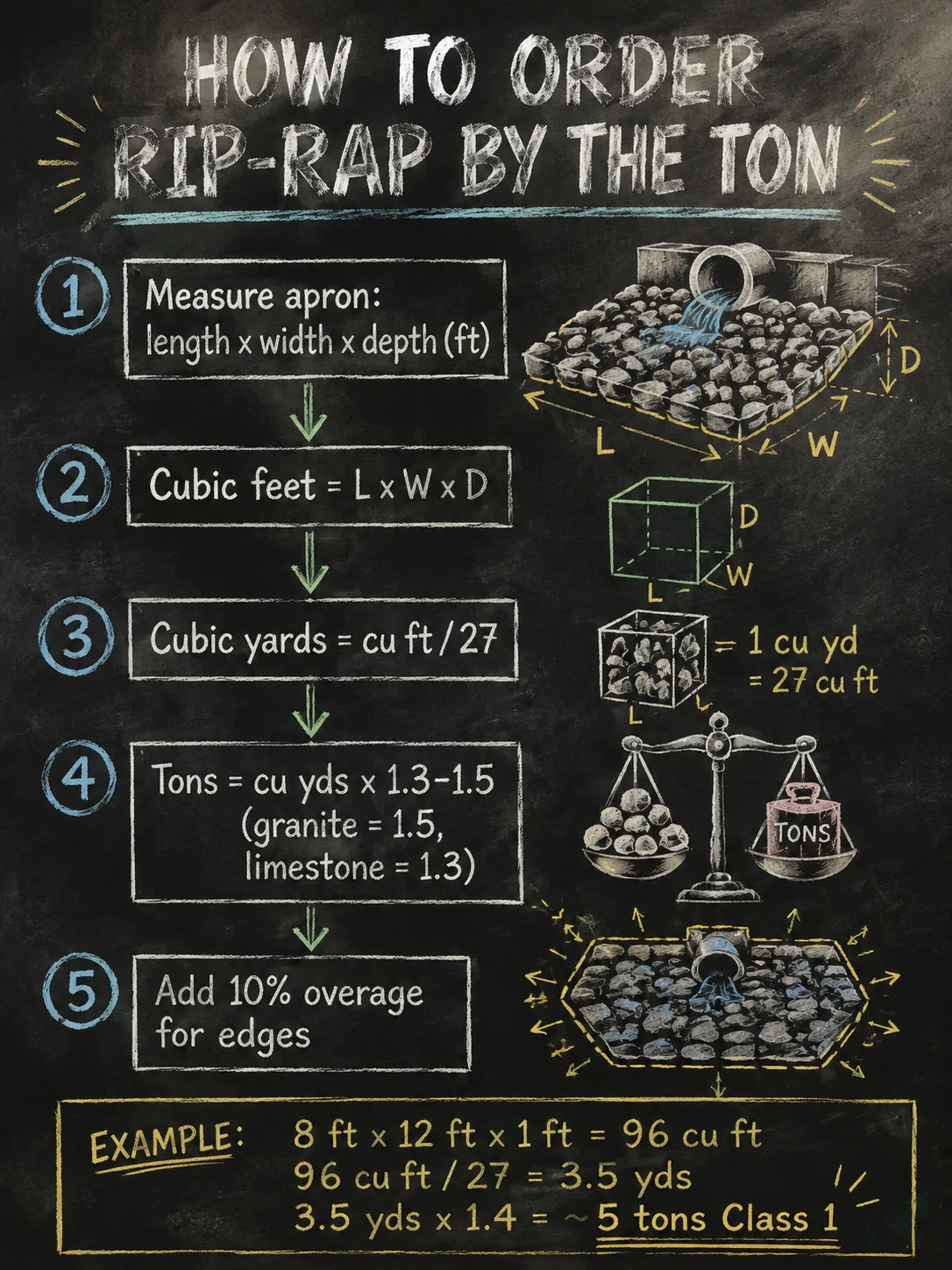
Rip-rap is ordered by the ton — calculate the area and depth of the apron or liner, convert to cubic yards, and apply a tonnage factor.
A typical outlet protection apron for a 15-inch culvert might be 8 feet wide by 12 feet long with a 12-inch depth of rip-rap. That works out to roughly 3.5 cubic yards, which at approximately 1.4 tons per cubic yard (the midpoint of the standard 1.3—1.5 ton/yd³ range for placed rip-rap) yields about 5 tons of Class 1 material.
Steps:
- Measure the apron dimensions. Length and width in feet, depth in feet.
- Calculate cubic feet. Length x width x depth.
- Convert to cubic yards. Divide by 27.
- Apply the tonnage factor. Rip-rap runs approximately 1.3 to 1.5 tons per cubic yard depending on class and stone density (granite quarried stone trends toward the high end; limestone toward the low end).
- Add 10 percent overage for irregular placement and edge tapering.
Filter underlayment is required, not optional. The NC Erosion and Sediment Control Manual (Practice 6.41) directs that a filter — a graded gravel layer or a synthetic filter cloth — be installed between the rip-rap and the soil foundation on every rip-rap outlet structure, regardless of stone class. The filter prevents soil from migrating up through the voids and the armor stone from working down into soft soil over time. Quarries sell rip-rap by scale-weight ticket — get that ticket at pickup or delivery. It is the unit of measure on the invoice and the basis for any dispute.
When getting quotes, use this checklist:
Before calling a quarry or contractor: (1) What is the application — outlet protection, slope toe, or channel? (2) What class is specified (A, B, 1, or 2)? (3) Is this within 50 feet of a stream or water body? If yes — check whether 401 certification is required before placing the order.
Find a Contractor Who Delivers and Places Rip-Rap in North Carolina
NC Grade and Haul connects you with verified North Carolina contractors who handle rip-rap delivery, outlet protection, and ditch stabilization.
Rip-rap is rarely a drop-and-go material. Placement geometry, filter fabric, and apron taper all affect whether the armor holds under the first storm. A contractor who both delivers and places the material owns the outcome.
- Browse rip-rap as a gravel delivery category in NC to understand what quarry delivery covers versus contractor placement.
- If the ditch drains to a swale, see rip-rap for North Carolina swale stabilization for combined system design.
- Hire a verified NC grading and hauling contractor to get itemized quotes that break out material, haul, and placement separately.