
Two questions NC homeowners ask before calling the quarry
What gravel do I need for my NC project?
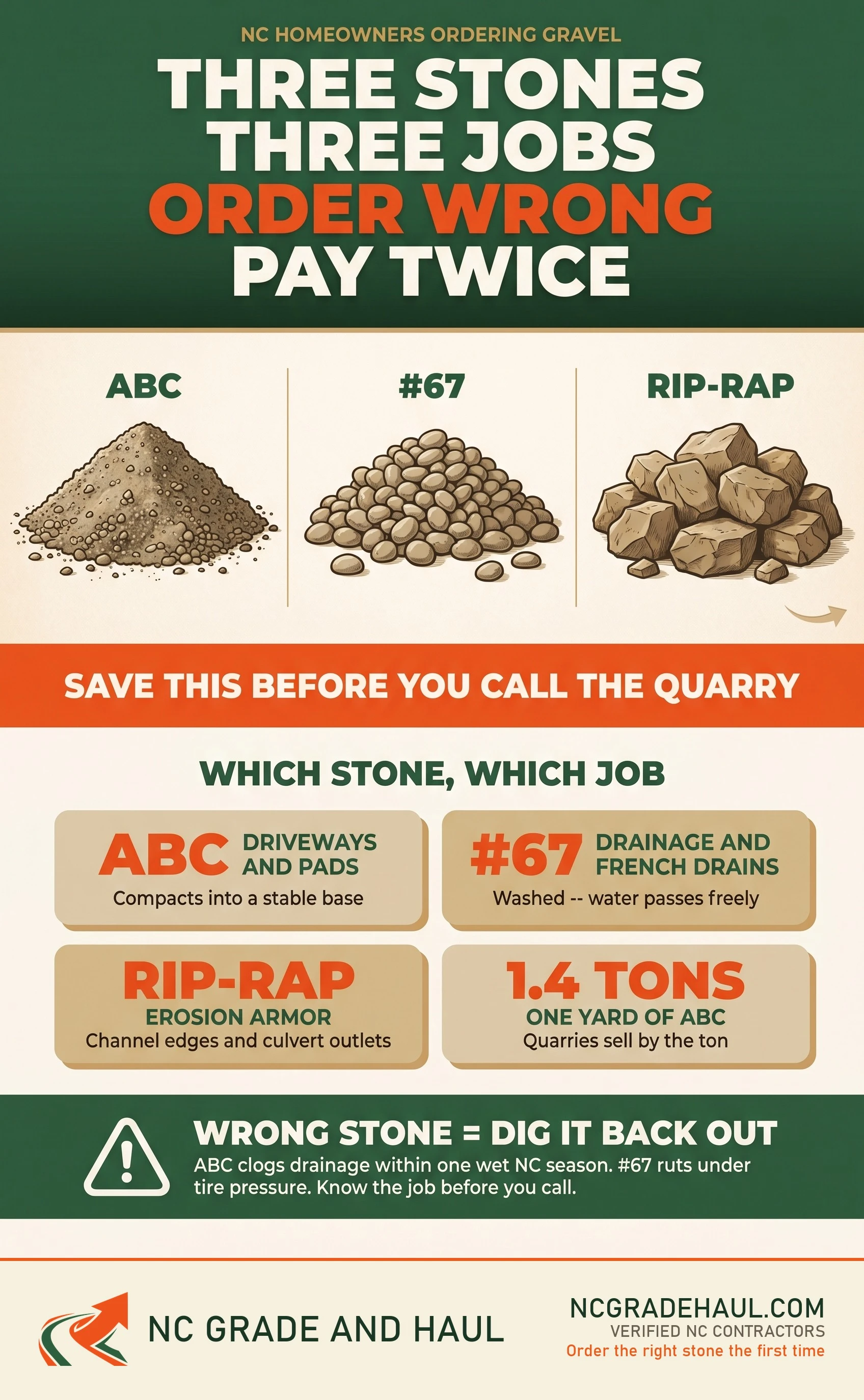
ABC for driveways, pads, and compactable base layers. #67 for drainage applications and French drain aggregate. Rip-rap for erosion control at channel edges, slope toes, and stream banks. Order by tons (quarry scale tickets) unless the contractor specifies yards. Always ask for a scale-weight delivery ticket.
Why does the quarry quote in yards but the invoice says tons?
Quarries price by the cubic yard -- that is what a loader bucket holds. Trucks invoice by the ton because that is what the gate scale reads. Both numbers are correct. One cubic yard of ABC weighs roughly 1.35 to 1.5 tons. Ask for both the yard and ton figures on any quote so you can check the math when the ticket arrives.
Ray Pettiford called the quarry last spring to order gravel for his farm road in Guilford County. The person on the phone asked: “What size?” Ray said “just regular gravel.” The quarry person read back: “We have 78M, #67, ABC, crusher run, #57, CABC, and rip-rap Class I.” Ray said “the regular one.”
This is not a hypothetical. It is the call every first-time orderer makes. The confusion between stone types is real, it costs money, and it is avoidable — because the three gravel types that matter for most North Carolina projects each do a completely different job.
ABC is for compaction. #67 is for drainage. Rip-rap is for erosion armor. Ordering the wrong one means you are paying twice.
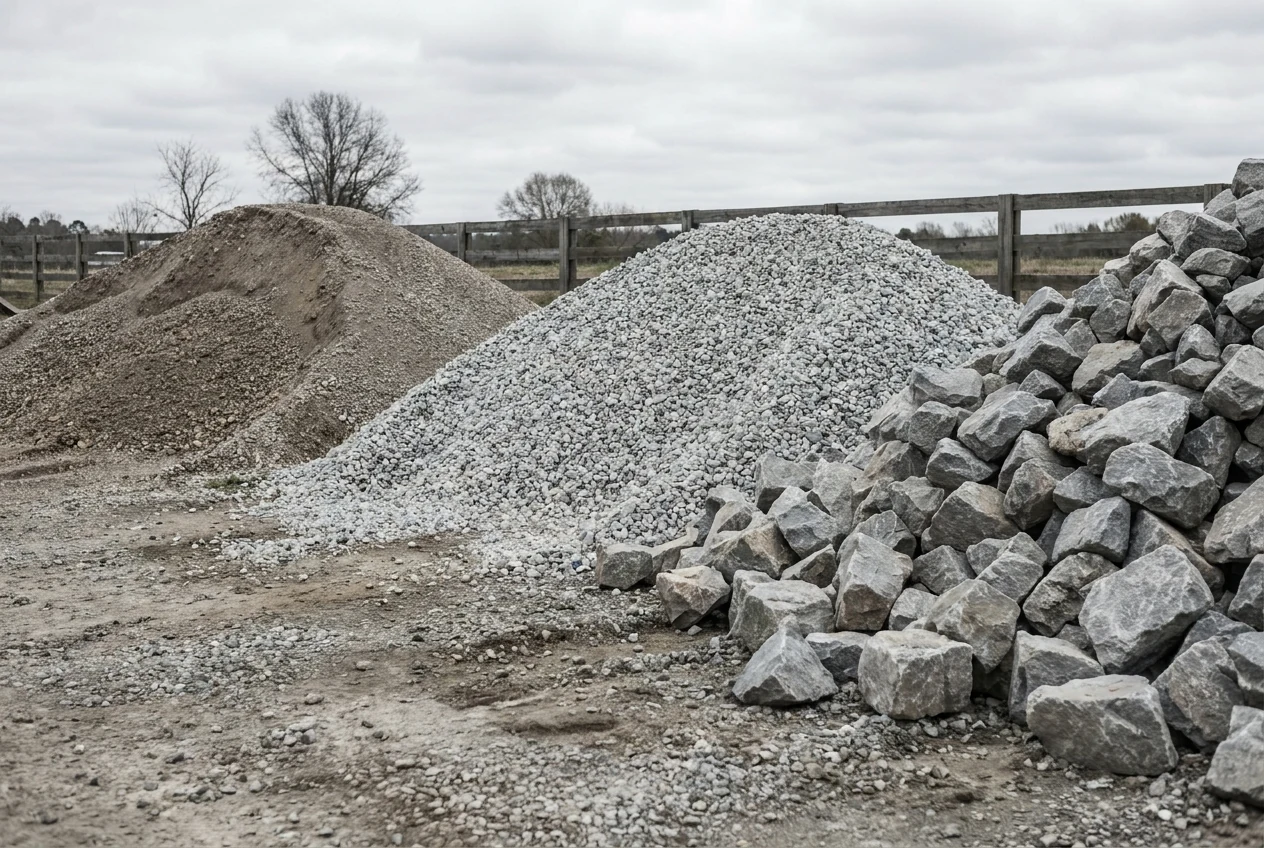
ABC Stone — The Driveways and Pads Choice
is a crushed stone blend specifically engineered to compact into a stable base layer. It is the right choice for driveway bases, building pad subbase, and any application where you need a firm, compacted surface.
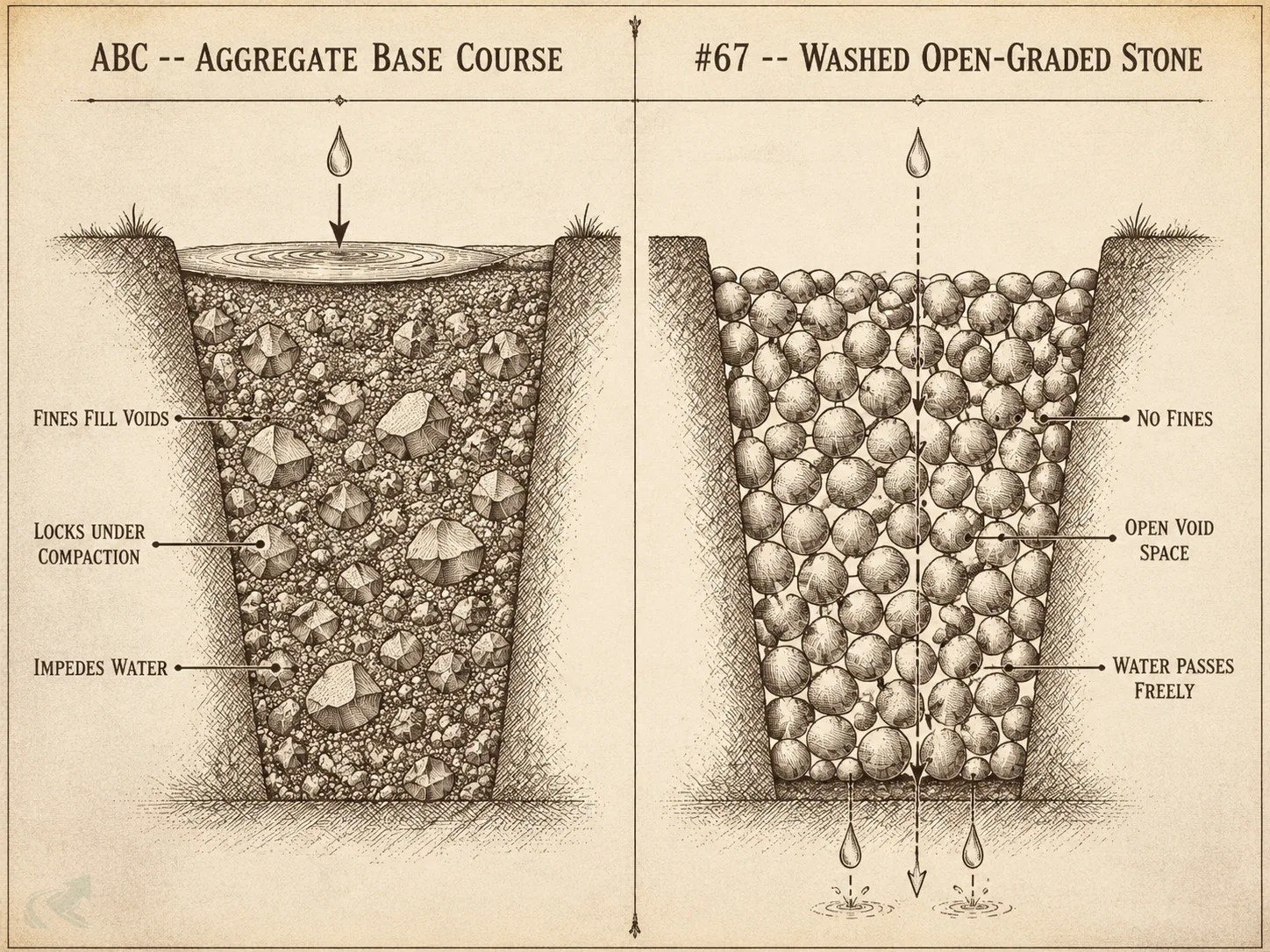
ABC is well-graded crushed granite or limestone sized from 1.5 inches down to dust. That wide particle range is intentional: the fines fill the gaps between the larger pieces and lock everything together when compacted. A proof-roll with a loaded truck will tell you quickly whether your ABC base is solid.
CABC — — is the spec version used on state-contracted work. Most residential quarries call it “crusher run” rather than CABC. The principle is the same: compact it until a loaded dump truck driving over the surface leaves no ruts.
When NOT to use ABC: drainage applications. The fines that make ABC compact so well will clog a drainage layer within one wet NC season. You will be digging it back out.
#67 Stone — The Drainage Choice
#67 stone is an open-graded washed aggregate — it does not compact, it does not clog, and it lets water pass through freely. It is the right choice for French drains, drainage layers, and any application where you need water to move.
#67 is 3/4-inch crushed stone washed to remove fines. The absence of fines is the spec, not a deficiency. Void space between the uniform pieces creates the continuous drainage column that makes a French drain work. NCDOT gradation per Section 1010 defines the acceptable size distribution.
Why it does not compact: without fines to bind the particles together, there is nothing to lock under roller pressure. The stone stays loose. That is exactly what you want in a drainage layer.
Use #67 for: French drain backfill, drainage column in a catch basin, drainage layer under a concrete slab, and driveway gravel top-up delivery NC as a surface course where drainage matters more than firmness.
When NOT to use #67: driveway base or any application requiring a stable surface. Without compaction, vehicles push #67 around. Ruts form within months.
Rip-Rap — Erosion Armor
Rip-rap is large angular rock — typically 6 inches to 24 inches depending on class — used to armor channel edges, slope toes, and outlet protection areas against water velocity erosion. It is not driveway gravel.
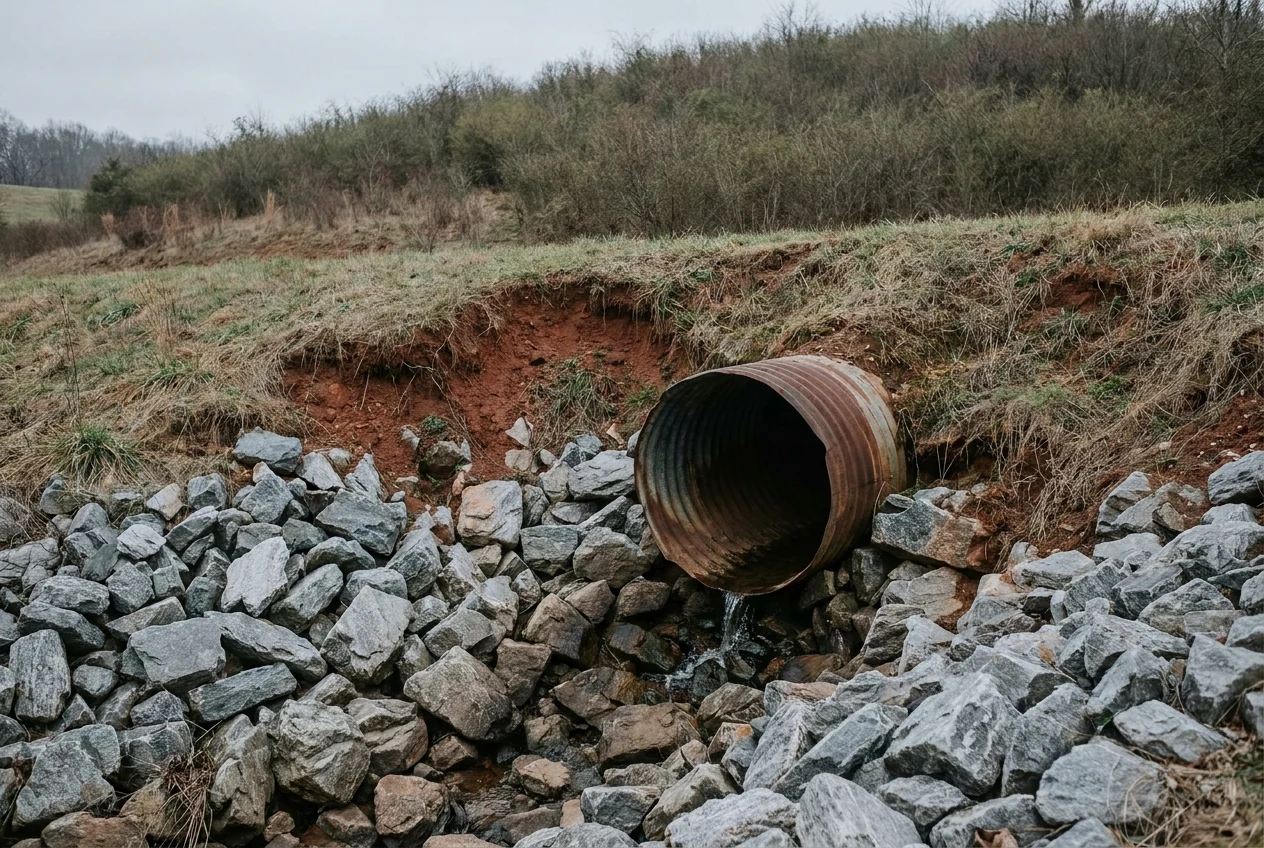
North Carolina uses the NCDOT class system for rip-rap. Class I covers outlet protection and slope-toe work at typical residential drainage velocities. Class II covers higher-velocity channels and stream bank applications. The size range increases with the class number.
Applications: culvert outlet protection, slope-toe stabilization, stream bank protection at bend lines, and construction entrance pad underlayment on wet sites.
Not for driveways. Rip-rap is too large to drive on safely and shifts under foot traffic. It is also the most expensive stone per ton — using it where #67 would serve is a waste.
NC regulatory note: rip-rap placement near jurisdictional waterways in North Carolina may require a 401 Water Quality Certification from NCDEQ and potentially a Section 404 permit from the Army Corps of Engineers. If the stream bank is a regulated water of the state, confirm permit requirements before placing. See NC erosion control silt fence context for more on site work near waterways.
For rip-rap delivery for NC erosion control at culverts and channel outlets, the stone class and quantity need to be on the delivery ticket.
Stone Type Comparison
NC gravel types: use case, compaction, drainage, and typical price range. Prices are Triangle/Triad market estimates as of May 2026 -- confirm current pricing with your quarry.
| Stone type | Typical use | Compacts? | Water drains through? | Typical price (per ton) |
|---|---|---|---|---|
| ABC | Driveway base, building pad subbase | Yes | No | $18--$28 |
| CABC | NCDOT-spec driveway, commercial base | Yes | No | $18--$28 |
| #67 | French drain, drainage layer, driveway surface | No | Yes | $22--$32 |
| #57 | Construction entrance, large French drains | Slightly | Yes | $24--$34 |
| Rip-rap Class I | Outlet protection, slope toe, stream bank | No | N/A | $30--$50 |
ABC
- Typical use
- Driveway base, building pad subbase
- Compacts?
- Yes
- Water drains through?
- No
- Typical price (per ton)
- $18--$28
CABC
- Typical use
- NCDOT-spec driveway, commercial base
- Compacts?
- Yes
- Water drains through?
- No
- Typical price (per ton)
- $18--$28
#67
- Typical use
- French drain, drainage layer, driveway surface
- Compacts?
- No
- Water drains through?
- Yes
- Typical price (per ton)
- $22--$32
#57
- Typical use
- Construction entrance, large French drains
- Compacts?
- Slightly
- Water drains through?
- Yes
- Typical price (per ton)
- $24--$34
Rip-rap Class I
- Typical use
- Outlet protection, slope toe, stream bank
- Compacts?
- No
- Water drains through?
- N/A
- Typical price (per ton)
- $30--$50
Ordering by Tons vs Yards
Quarries sell by the ton — that is the scale weight at the pit. If you are buying direct, you will be quoted in tons. Contractors sometimes quote in cubic yards. Both are valid; just do not mix them when comparing quotes.
The reason quarries use tons: a scale reading is objective and verifiable. A cubic-yard measurement requires volume estimation that is harder to confirm at the point of sale. The scale ticket is the legal record.
Working conversion numbers for North Carolina materials:
- ABC: roughly 1.4 tons per cubic yard (varies with moisture; wet fines weigh more)
- #67 washed stone: roughly 1.25 tons per cubic yard (~2,410 lb/yd3 is the commonly cited figure)
- Rip-rap: varies significantly by class and stone density — confirm with the quarry before calculating
For the full conversion math and a calculator, see gravel delivery quantity in yards vs tons.
What a delivery ticket should say: gross weight (truck plus stone), tare weight (truck empty), and net weight (stone only). If the ticket only says “14 tons estimated,” you have no verified record of what was delivered. Do not let the truck leave until you photograph the ticket.
The question to ask before the truck rolls: “Is this price by the ton or by the yard, and what is the spread factor for this material?”
Minimum Loads and Truck Sizing
Most NC quarries and haulers operate single-axle (10 to 14 ton) or tandem-axle (18 to 22 ton) dump trucks. Minimum orders are typically 10 to 15 tons — below that, you are paying a per-trip fee that makes small loads expensive on a per-ton basis.
A tandem-axle truck carries more per load, which lowers the effective cost per ton on large orders. Tri-axle and transfer trucks carry 22 to 26 tons but need a wider driveway and more room to turn around. The right truck is the largest one that can physically reach your drop point.
NC hauling regulations for gravel delivery govern what trucks can legally carry on state-maintained roads and which weight-posted subdivision streets are off-limits for loaded tandem trucks.
If you are ordering less than a full load, confirm the minimum load fee before scheduling. A 5-ton order on a 10-ton minimum contract means you are paying for 10 tons.
How to Prep for Delivery
Have a clear delivery path, a designated drop spot, and a plan for where you want the material placed — gravel does not move itself once it is on the ground.
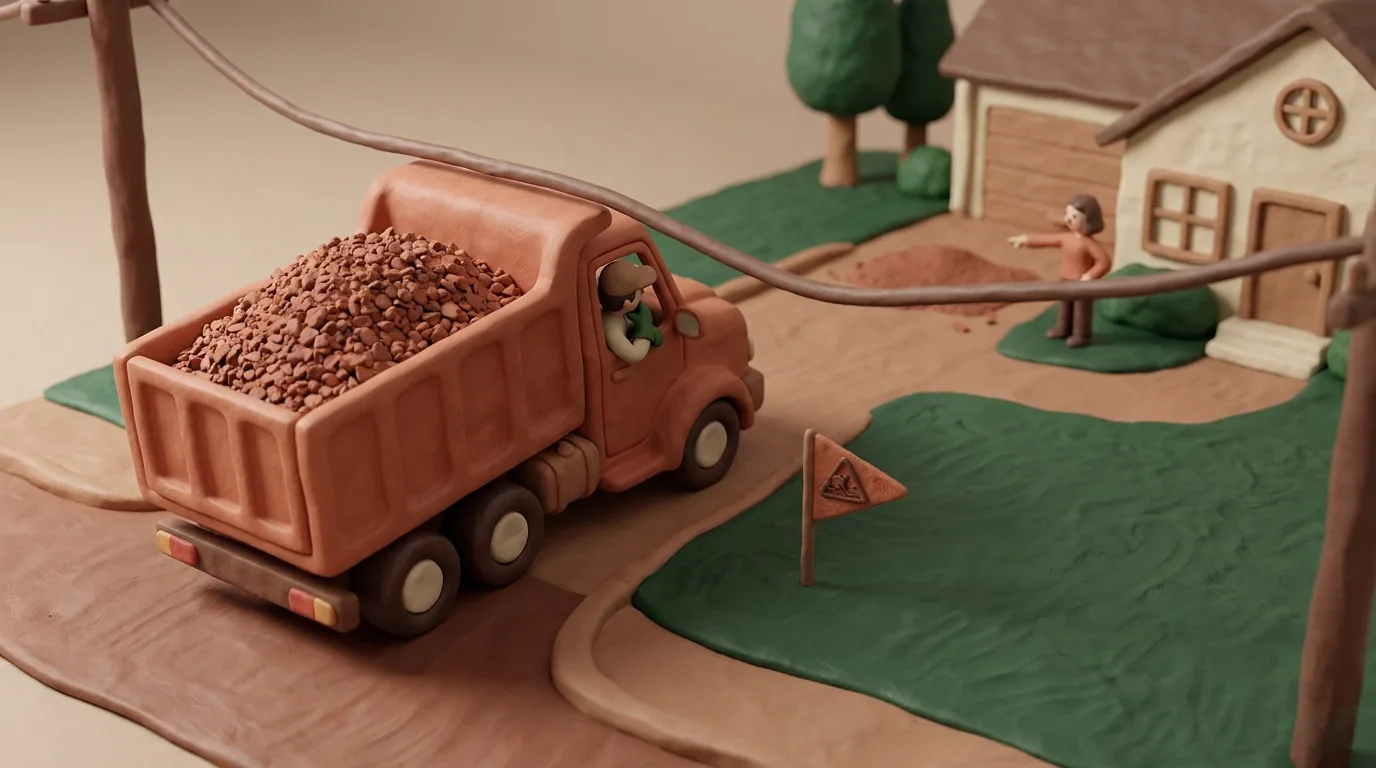
Truck clearance: a standard dump truck needs 14 feet or more of vertical clearance. Check power lines and overhead branches along the full delivery path, not just at the drop point. A driver will not go under a line they are not certain clears.
Soft ground: a loaded tandem-axle truck weighs 40 to 50 tons with material aboard. Wet lawns, soft subgrade over a septic system, and clay-heavy soil after rain will show ruts. Schedule delivery when the ground is firm, or have a temporary access pad in place.
Spread-on-delivery: some haulers will control the dump while moving forward, spreading the material in a windrow rather than a pile. This saves you a spread pass. Confirm whether your hauler does this before scheduling — not all do.
Common Ordering Mistakes
Ordering ABC for a French drain. The fines that make ABC compact well will clog the drainage layer within one wet season. The drain stops draining. You will be digging it back out and starting over with #67.
Ordering #67 for a driveway base. #67 does not compact. Vehicles push the loose stone around and create ruts within months. A driveway needs ABC or CABC as the base course.
Not checking the delivery ticket weight before the truck leaves. The ticket should show gross weight, tare weight, and net weight — not just an estimated quantity. Photograph the ticket. If the driver has already left, you have no verified record of what arrived.
Mixing up the quote unit and the invoice unit. A quarry quote in cubic yards and a delivery ticket in tons are both normal — as long as you know the conversion. If you got a price in yards and the invoice is in tons with no stated conversion factor, you cannot verify the math. Ask for the unit weight before you order.
Copy This Before You Call the Quarry
Get a Quote That Names the Stone Type
If you are not sure which stone type is right for your job, a verified grading and hauling contractor can specify it and deliver with a scale-weight ticket so you know exactly what arrived. The quote should be itemized — stone type, stone size, price per ton, haul cost per trip, and total.
Hire an NC hauling operator who can spec the right material and deliver with documentation. “We’ll bring whatever you want” is not a spec. An itemized quote that names ABC or #67 is.
You can also start with what you know about your job: base layer under a concrete pad = ABC. Drainage trench = #67. Channel outlet protection = rip-rap. If you know the job, you know the stone.
For ABC gravel delivery NC specifically on driveway projects, the base course thickness matters as much as the stone type.