
Ray Pettiford owns 14 acres in rural Guilford County. He plans to clear about 1.2 acres for a septic drain field and access road. Three days after the grading contractor starts, a field inspector shows up and asks for the Certificate of Coverage.
The contractor doesn’t have one. That’s a stop-work order — and civil penalties that can follow the landowner, not just the contractor.
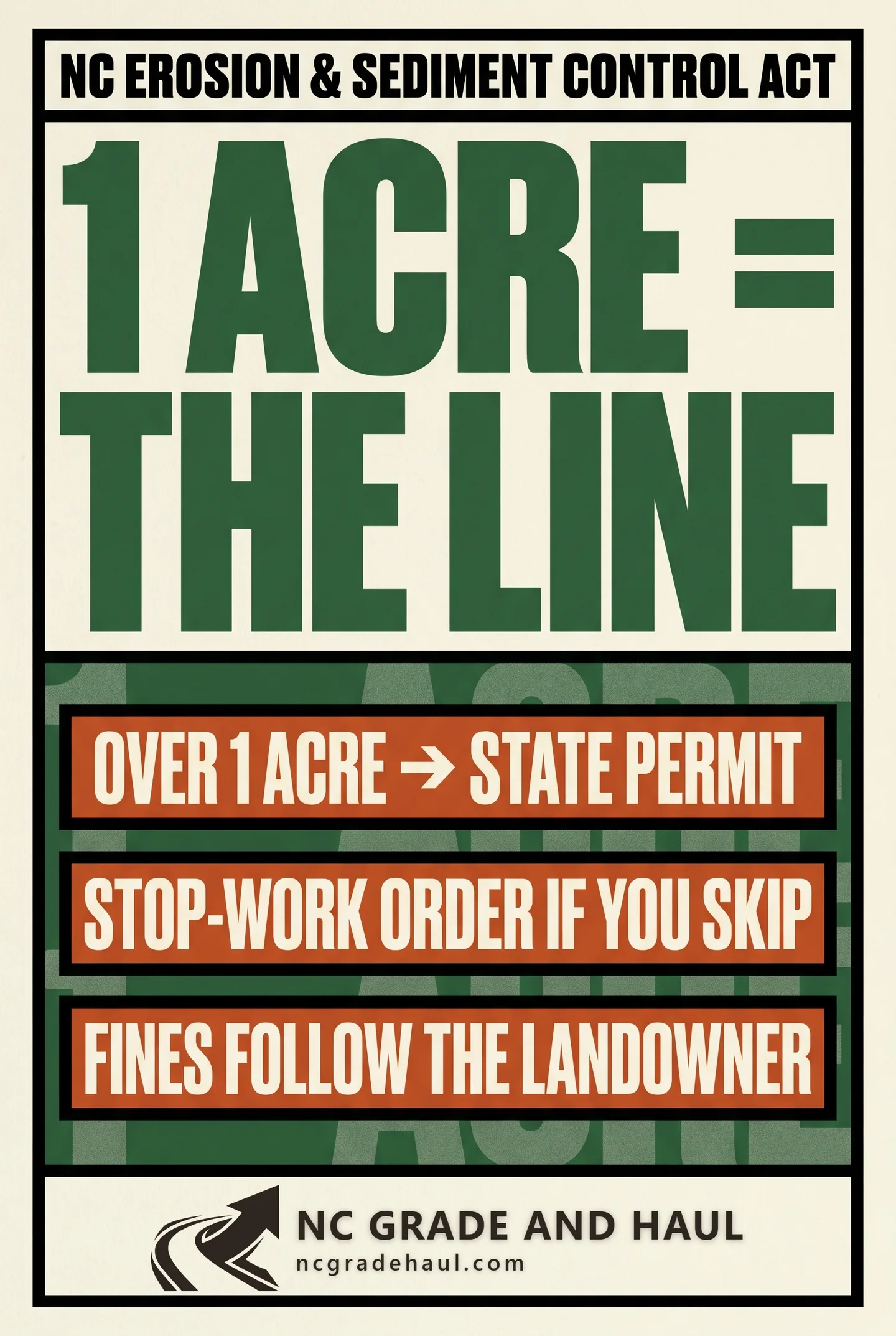
North Carolina’s Sedimentation Pollution Control Act is not fine print. The 1-acre threshold that triggers it is the number Ray came here to find. Everything else on this page explains what that threshold means in practice and what both he and his contractor must do before the first pass of a grader blade.
What the Sedimentation Pollution Control Act Actually Says
NCGS 113A-57 requires an approved plan for any project disturbing more than 1 acre on a tract, filed 30 or more days before work begins.
The formal name is the Sedimentation Pollution Control Act of 1973. The law lives at NCGS Chapter 113A, Article 4 (sections 113A-50 through 113A-66). It gives the authority to require E&S plans and issue permits statewide.
The plain-English summary: if your land-clearing, grading, filling, or excavation touches 1 acre or more, you need state approval before you start. The permit is site-specific — one location, one project, one Certificate of Coverage. It does not transfer between jobs.
NCGS 113A-52(6) defines “land-disturbing activity” as any use of the land in residential, industrial, educational, institutional, or commercial development, and highway and road construction and maintenance, that results in a change in the natural cover or topography and that may cause or contribute to sedimentation. That means a licensed grading contractor, a homeowner self-performing, or a developer — the threshold applies regardless of who holds the shovel. See how the NC erosion act applies to grading projects for what a compliant job site must have in place before any dirt moves.
The 1-Acre Threshold: What Counts as “Disturbed”
Disturbed area includes any land clearing, grading, filling, or excavation — including temporary stockpiles and haul roads. The threshold applies to the “tract”: all contiguous land being disturbed under one project, and a single developer’s combination of lots within a subdivision is aggregated.
The threshold is 1 acre of disturbed area, not 1 acre of parcel size. Ray’s 14-acre property is irrelevant. What matters is the footprint of active disturbance.
Common misconceptions that have cost property owners money:
- “My lot is under an acre total” — the lot size is not the disturbed area. A septic system, access road, and staging pad together can cross the threshold on a half-acre property.
- “The haul road doesn’t count” — it counts. Under 15A NCAC 04B .0111, temporary access and haul roads (except public roads) are considered part of the land-disturbing activity. Temporary construction roads, spoil stockpiles, and staging areas all contribute to the disturbed-area calculation.
- “We’re doing it in two phases” — phased projects on the same tract are evaluated together. Splitting a project into sequential phases to stay under 1 acre per phase is not a reliable workaround, since the threshold applies to total disturbance on the tract. And if your county has a delegated program, it may apply an even lower threshold than the state — see the NC county-by-county permit guide for grading and drainage for what applies in your jurisdiction.
If the total disturbed footprint — clearing plus grading plus stockpile plus access — adds up to 1 acre or more, the permit is required.
Who Enforces It — and Who’s Liable
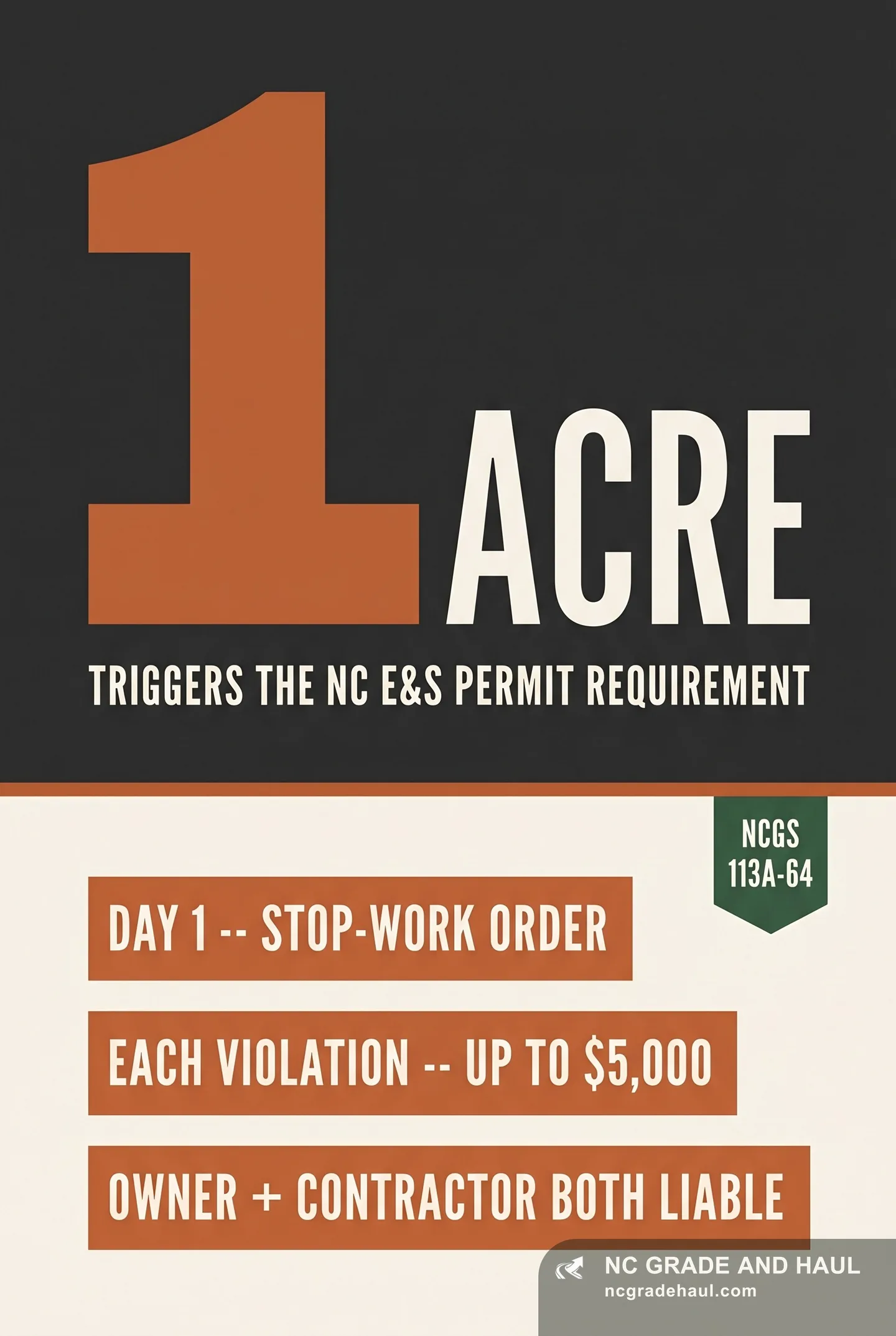
DEMLR field inspectors have authority to issue stop-work orders and civil penalties; liability can attach to the property owner, not just the contractor.
DEMLR enforces the Sedimentation Pollution Control Act statewide. Field inspectors conduct site visits on active projects. When they find unpermitted work, they can issue a Notice of Violation ( ) immediately followed by a stop-work order.
Civil penalties under NCGS 113A-64 can reach a maximum of $5,000, and each day of a continuing violation counts as a separate violation — so penalties can accrue from the first day of unpermitted disturbance. If the contractor was supposed to pull the permit and didn’t, you may still receive the enforcement action as the property owner.
Some NC municipalities and counties have delegated E&S authority — under NCGS 113A-60, local governments may adopt their own erosion and sedimentation control program and, once approved by the Sedimentation Control Commission, enforce the law instead of DEMLR directly. In delegated areas, you work with the local program, not the state office, for permit approval. NCDEQ maintains an interactive jurisdiction map and contact list for all delegated local E&S programs — confirm your county’s status before assuming DEMLR is the permitting authority. Beyond E&S permits, many of these same counties also enforce NC stormwater management ordinances that trigger independently of the 1-acre E&S threshold. (NCDEQ — Local Erosion and Sediment Control Programs)
The accountability hook: if your contractor tells you a permit isn’t required for a project disturbing over 1 acre, ask them to put that in writing. A contractor who won’t document that claim is a contractor who knows better.
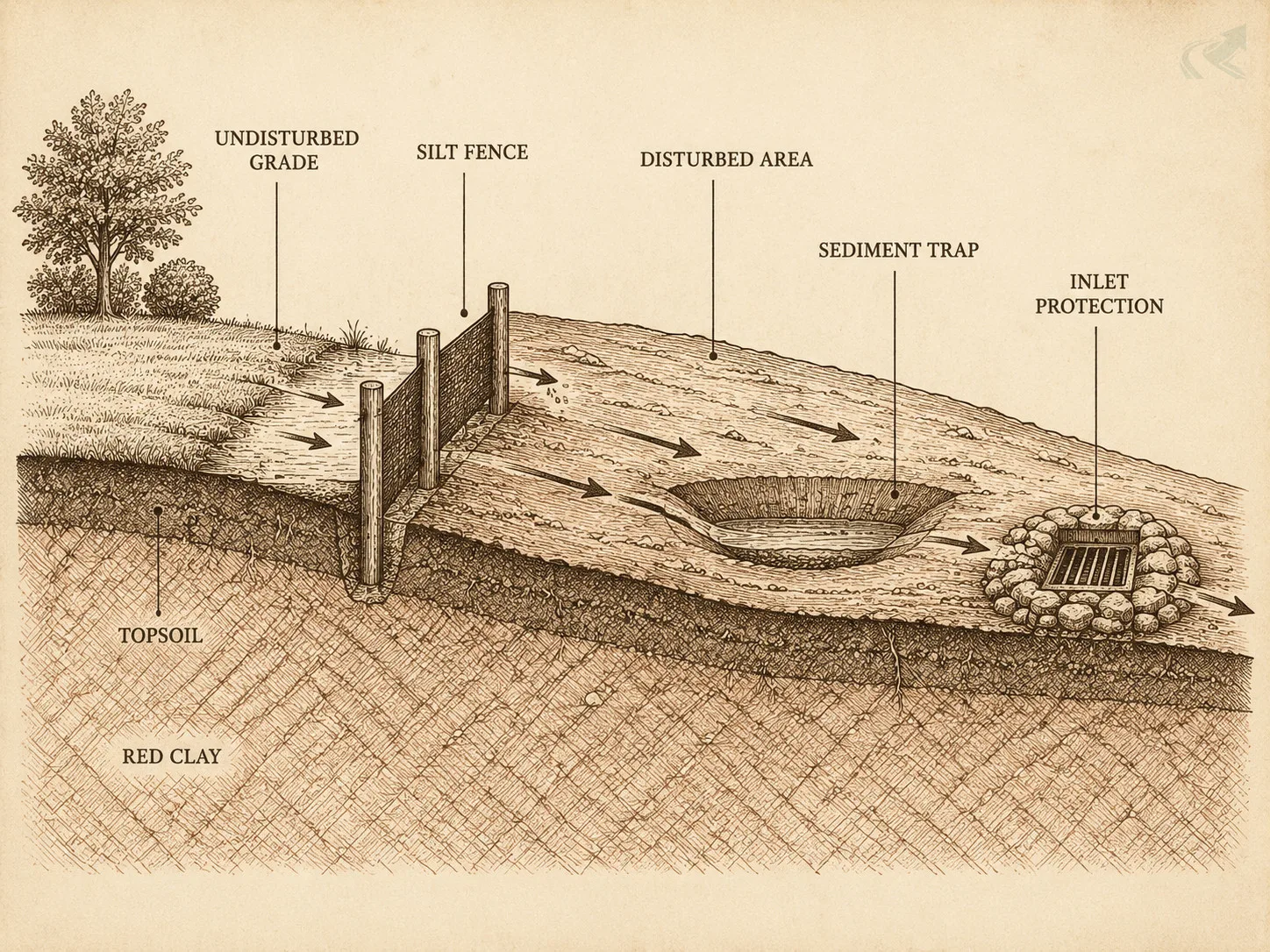
Land-disturbing site: compliant vs unpermitted
Comparison. Compliant site: Silt fence installed before grading starts; Certificate of Coverage posted on-site; Sediment stays inside the work area; Inspection passes -- work continues. Unpermitted site: No silt fence or perimeter controls; Sediment runs straight to the storm drain; No Certificate of Coverage posted; Stop-work order shuts the job down.
- Silt fence installed before grading starts
- Certificate of Coverage posted on-site
- Sediment stays inside the work area
- Inspection passes -- work continues
- No silt fence or perimeter controls
- Sediment runs straight to the storm drain
- No Certificate of Coverage posted
- Stop-work order shuts the job down
Under NC's Sedimentation Pollution Control Act, the controls go in first -- skipping them invites a stop-work order.
The Permitting Process: eNOI, E&S Plan, and Certificate of Coverage
You must file an through NCDEQ AccessDEQ and have an approved E&S plan in place before any dirt moves.
The sequence is linear. Skipping a step means you are working without authorization.
Step 1 — Prepare the E&S plan. The contractor (or their engineer) prepares a site-specific Erosion and Sediment Control plan showing how runoff will be managed during every phase of disturbance. The plan must be submitted for review before work begins.
Step 2 — File the eNOI through AccessDEQ. The construction general permit process runs through NCDEQ’s AccessDEQ portal at deq.nc.gov/accessdeq (the portal that replaced the prior paper-based e-NOI system in May 2025). The NCG01 eNOI form is submitted after the E&S plan is approved, to obtain coverage under the NCG01 construction general permit.
Step 3 — Wait for the Certificate of Coverage. After the eNOI is submitted, DEMLR responds with approval or a deficiency notice within 3 business days; once the annual permit fee is paid, the Certificate of Coverage is issued by email within 3 more business days. The filing alone does not authorize work. The Certificate does.
Step 4 — Keep the E&S plan on-site. Once work begins, the approved E&S plan must be physically present on the job site and current throughout active disturbance. DEMLR inspectors ask to see it.
Step 5 — File the eNOT at completion. At the end of the project, an electronic Notice of Termination ( ) closes out the permit. Source: https://www.deq.nc.gov
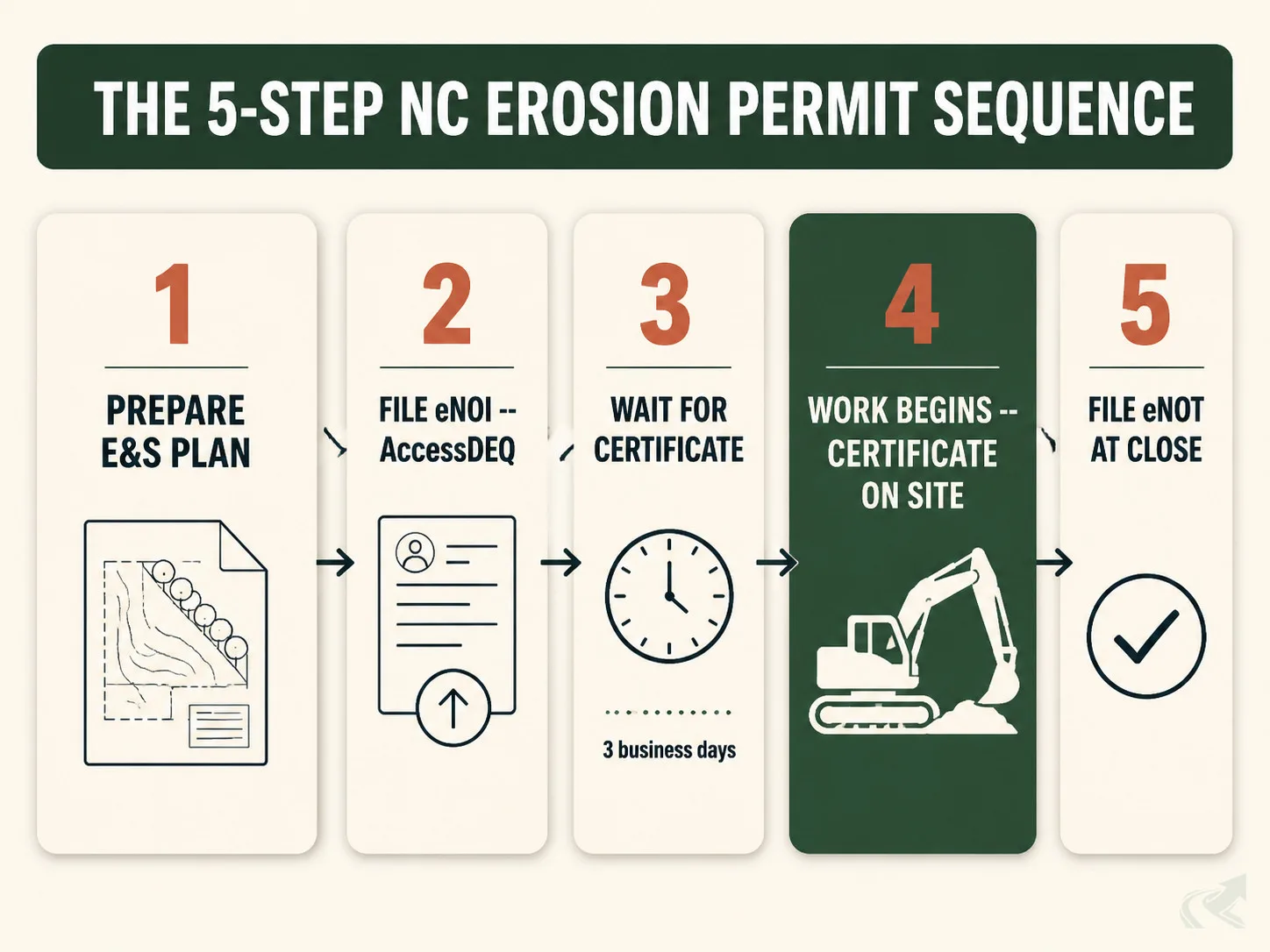
Permitting sequence at a glance: eNOI filed through AccessDEQ — DEMLR review — Certificate of Coverage issued — work begins — eNOT filed at project close.
What an E&S Plan Must Include
An approved E&S plan must show how the contractor will control erosion and sediment during every phase of disturbance — including silt fences, sediment basins, and temporary seeding timelines.
DEMLR reviews submitted plans against the mandatory standards in 15A NCAC 04B and its published E&S plan checklist. The minimum required elements typically include:
- Site map showing the disturbed area boundary, property lines, drainage patterns, and receiving waterways
- Erosion control measures — silt fence placement, check dams, rock outlet structures, inlet protection for any existing storm drains
- Sediment basin or trap if the disturbed area and site drainage volume require one, sized per the 15A NCAC 04B design standards
- Grading sequence — phases of disturbance in the order work will proceed
- Temporary seeding plan — what gets seeded, when, and with what species to stabilize exposed soil
- Permanent stabilization schedule — timeline for converting temporary measures to permanent ground cover
A contractor who can hand you their E&S plan before work starts is a contractor who knows what they’re doing. One who says “we’ll handle all that” without showing the document has not handled it yet. If you’re still selecting a contractor, find a grading operator in North Carolina who can produce these documents on request before any machine rolls.
Common Mistakes That Trigger Stop-Work Orders
- Assuming the contractor filed the eNOI automatically. Permit responsibility defaults to the operator, but “I assumed they handled it” is not a defense in a DEMLR enforcement action. Ask for the Certificate of Coverage number before work begins.
- Starting work before the Certificate of Coverage arrives. The eNOI filing is not the permit. The Certificate is. Days between filing and approval are days you cannot legally move dirt.
- Treating the state permit as a one-time event. DEMLR inspects active sites during construction. The E&S plan must be on-site and current throughout the project — not filed and forgotten.
Local Variations: When Your County Has Stricter Rules
Some NC counties have their own E&S programs with lower thresholds or stricter plan requirements — check with your county before assuming the state minimum applies.
North Carolina allows counties and municipalities to receive delegated E&S authority from NCDEQ. Delegated programs administer and enforce the law locally, sometimes with thresholds below the state 1-acre minimum. The current list of delegated programs — with an interactive jurisdiction map and program contacts — is maintained by NCDEQ. (NCDEQ — Local E&S Programs)
NC counties with delegated E&S programs (vs DEMLR-administered)
1. Mecklenburg County / Charlotte -- Locally administered through Charlotte-Mecklenburg Stormwater Services under UDO Article 28. Submit plans and inspections through the local program, not DEMLR. 2. Wake County / Raleigh -- Wake County operates a delegated program. Raleigh projects go through Wake County Environmental Services, not the state DEMLR office. 3. Durham County / City of Durham -- Delegated to Durham County. The submission portal and inspection contacts differ from the DEMLR state process. 4. Guilford County (Ray's situation -- state-administered) -- Guilford County does NOT have a delegated program. Projects here go directly to DEMLR's regional office. The state 1-acre threshold and AccessDEQ portal apply. 5. All other NC counties: verify with NCDEQ before assuming -- NCDEQ maintains the current delegated-program list with an interactive jurisdiction map. Confirm your county's status before filing -- local and state portals are different.
-
Mecklenburg County / Charlotte
Locally administered through Charlotte-Mecklenburg Stormwater Services under UDO Article 28. Submit plans and inspections through the local program, not DEMLR.
-
Wake County / Raleigh
Wake County operates a delegated program. Raleigh projects go through Wake County Environmental Services, not the state DEMLR office.
-
Durham County / City of Durham
Delegated to Durham County. The submission portal and inspection contacts differ from the DEMLR state process.
-
Guilford County (Ray's situation -- state-administered)
Guilford County does NOT have a delegated program. Projects here go directly to DEMLR's regional office. The state 1-acre threshold and AccessDEQ portal apply.
-
All other NC counties: verify with NCDEQ before assuming
NCDEQ maintains the current delegated-program list with an interactive jurisdiction map. Confirm your county's status before filing -- local and state portals are different.
Delegated counties administer the same law but through a different office, portal, and contact list than DEMLR. Confirm your county's status at deq.nc.gov before filing.
Mecklenburg County operates a delegated E&S program administered jointly by the City of Charlotte and Mecklenburg County Stormwater Services under Charlotte’s Unified Development Ordinance Article 28. The permit threshold mirrors state law at 1 acre of disturbed area, but all land-disturbing activity — even below the acre threshold — must provide erosion control measures adequate to retain sediment on-site. Plan reviews and inspections run through the local program, not DEMLR, so the submission portal, contacts, and inspection schedule differ from the state process.
The practical consequence: a project in Guilford County (Ray’s situation) goes through DEMLR. A similar project in Charlotte may go through Mecklenburg’s local program. The form names, submission portals, and review contacts are different.
For county-by-county threshold detail, see the NC land-disturbance thresholds that trigger the erosion act. For the broader regulatory context including stormwater, see the NC earthwork regulations hub including stormwater.
What to Ask Your Contractor Before Work Starts
Ask for the Certificate of Coverage number and a copy of the approved E&S plan before the first machine rolls onto your property.
A contractor who has done this correctly can answer that request in under a minute. They either have the Certificate or they tell you exactly when it arrives and why there’s a delay.
The questions below are designed to be copied and sent directly to any contractor you’re vetting.
Contractor accountability question — copy and send
“Before any dirt moves, can you show me your E&S Certificate of Coverage number and the filed eNOI? I’d also like a copy of the approved E&S plan before work starts.”
Send this via email so you have a written record of the response. A contractor who pushes back on the question is telling you something important.
Statute citation — copy for contractor correspondence
“NCGS Chapter 113A, Article 4 — Sedimentation Pollution Control Act. NCGS 113A-57 requires an approved Erosion and Sediment Control plan, filed 30 or more days before work begins, for any project disturbing more than 1 acre on a tract.”
Paste this into any email asking your contractor to confirm compliance. The citation gives the conversation a clear reference point.
Find a grading operator who already knows these requirements. Hire a grading operator in North Carolina and ask for an itemized quote that specifies which E&S permits will be pulled before work starts. Also see NC erosion control compliance for construction sites for what a properly run site looks like in practice, and county permit requirements beyond NC land-disturbance thresholds for what your county may require on top of the state E&S permit.