
Two questions homeowners ask after a driveway repair
What's the difference between silt fence, straw wattles, and stabilization mats -- and which one does my repair need?
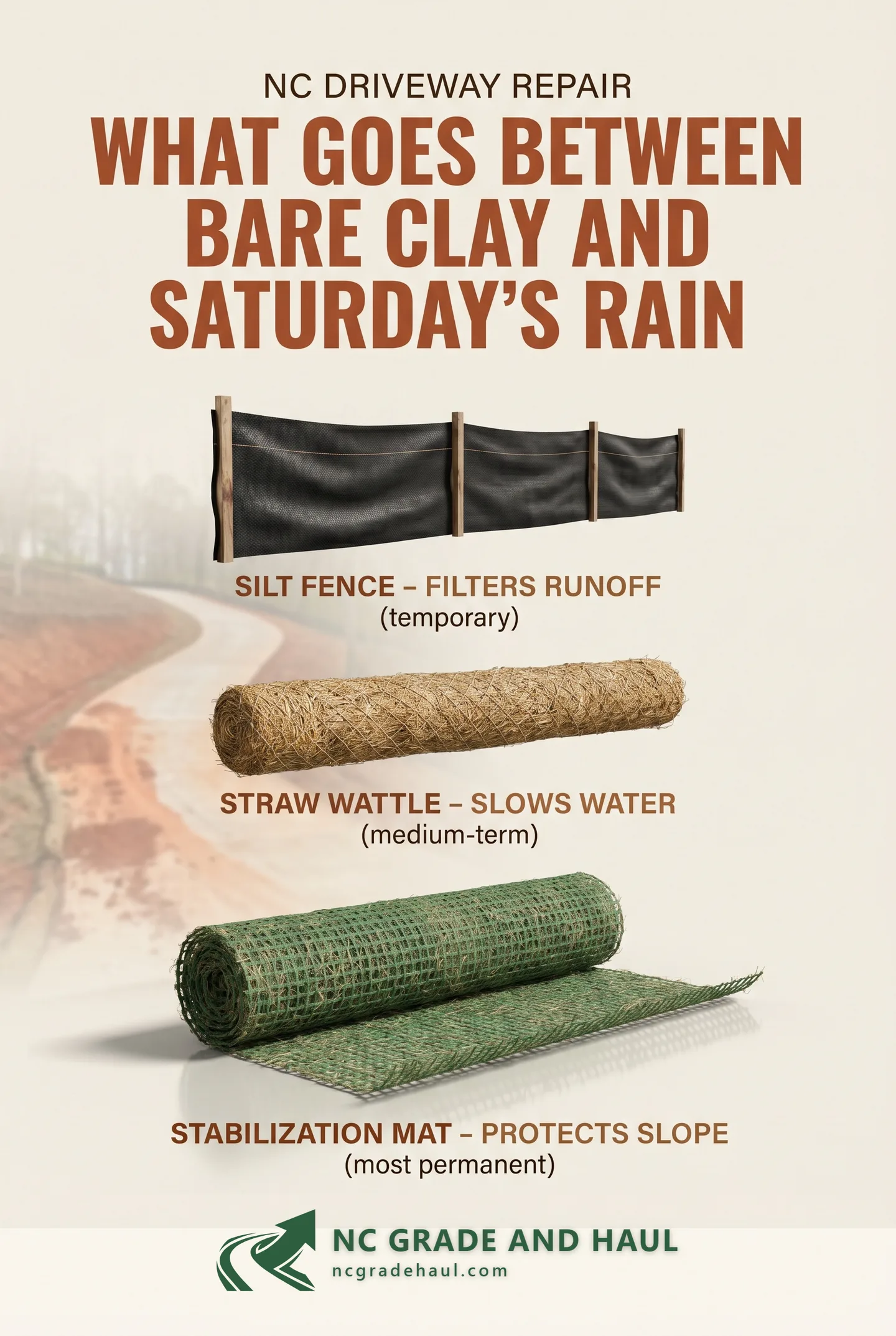
They serve different slope conditions. Silt fence captures sediment at the downslope edge on gentle grades (under 10%). Straw wattles interrupt sheet flow on steeper slopes where silt fence blows out. Stabilization mats protect bare soil at culvert outlets and very steep banks where water velocity exceeds what fabric barriers can handle. A complete repair quote typically includes more than one.
Does NC law require erosion control on a residential driveway repair?
The NC Sedimentation Pollution Control Act requires erosion control measures for disturbances of 1 acre or more. Most residential driveway repairs fall under 1 acre -- but county and municipal thresholds vary. Regardless of the regulatory threshold, leaving bare disturbed clay without temporary protection means the next storm partially undoes the repair. Ask your contractor what erosion control is included in the scope.
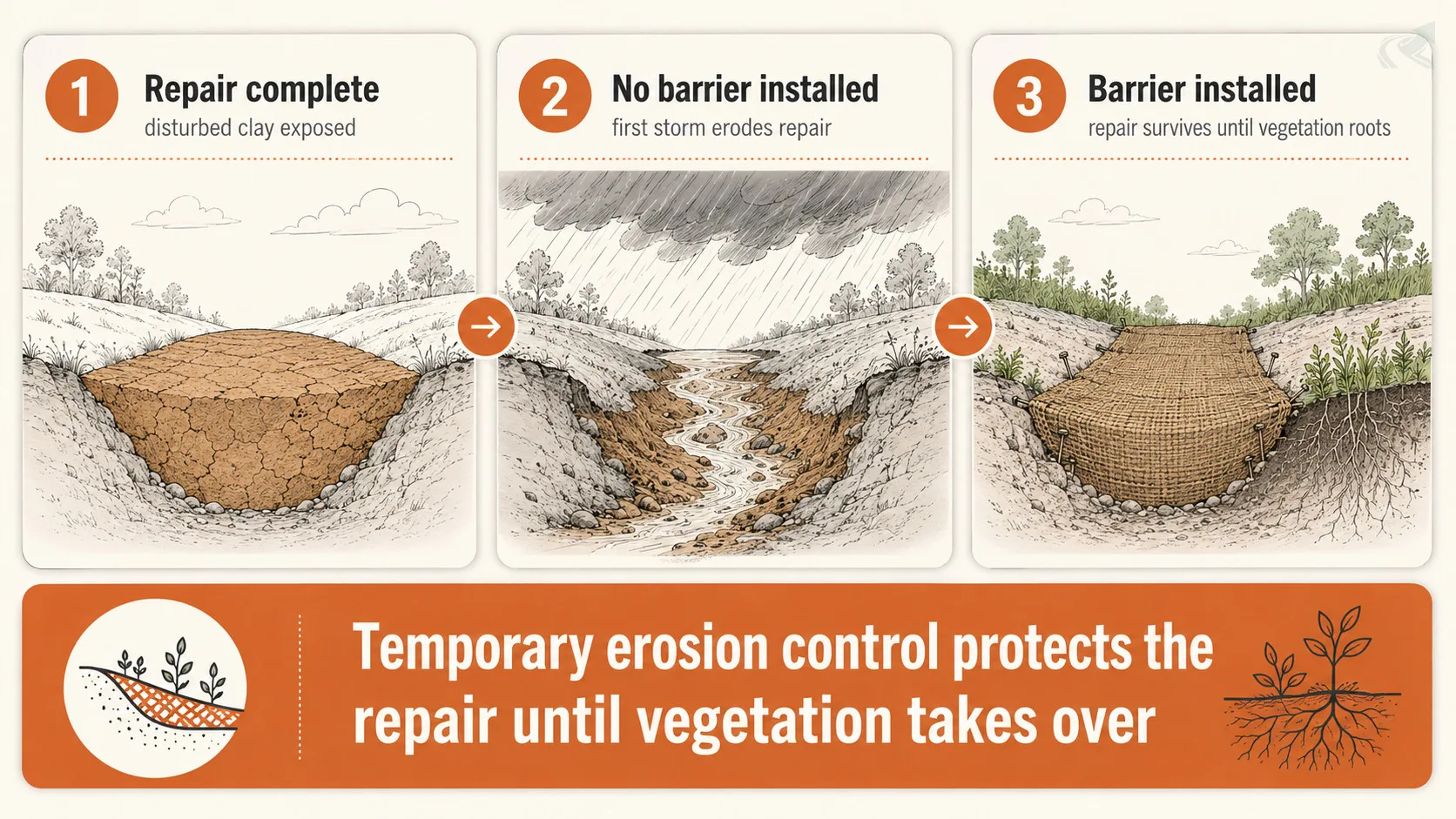
Sarah’s driveway was repaired two weeks ago. The contractor finished, graded the surface, and left. There’s bare red clay on the slope beside the driveway — no vegetation, no barrier. It’s going to rain Saturday.
Is that clay going to move? Almost certainly — unless something is between the exposed soil and the next storm event. This is the timing problem that erosion barriers solve. They’re not the repair. They protect the repair until vegetation or compaction stabilizes the surface.
This page covers the three barrier types used on North Carolina driveway repairs, when each is appropriate, and what a complete repair quote should include.
For the driveway washout repair and erosion barrier installation overview, start with the hub page.
Why Erosion Barriers Are Part of the Repair — Not an Add-On
Bare disturbed soil in NC — especially Piedmont red clay — erodes under the first significant rain if no protection is in place. A repair that leaves exposed soil without barrier installation isn’t complete.
context for North Carolina residential driveway repair:
The NC Sedimentation Pollution Control Act requires — administered through the — to regulate land disturbance of 1 acre or more statewide. Below 1 acre, county and municipal thresholds take over. Requirements vary: some NC counties require erosion control for any residential grading work; others apply higher disturbance thresholds. Wake, Mecklenburg, Guilford, and Buncombe counties each carry their own E&S ordinances for residential work.
Below whatever regulatory threshold applies, the practical argument still stands: Piedmont red clay is among the most erodible surface types in North Carolina. First storm after a repair, bare clay moves. The cost of temporary erosion control on a typical driveway repair is a small fraction of the total — far less than redoing the work after the next storm.
A legitimate repair quote for any job involving base disturbance should include temporary erosion control as a named line item. If the quote doesn’t mention it, ask specifically before signing.
Silt Fence — What It Does and When to Use It
Silt fence slows water flow at the downslope edge of the disturbance and captures sediment — it does not stop water, it slows it enough for sediment to fall out of suspension.
How it works: a geotextile fabric is staked perpendicular to slope direction at the downhill edge of the disturbed area. Water flowing downslope hits the fence, velocity drops, and sediment settles behind the barrier. Water ponds briefly, then passes through the permeable fabric at reduced velocity and sediment load.
When silt fence is appropriate:
- Gentle to moderate slopes (under 10%)
- Disturbances near property lines or drainage channels where sediment control is required
- Temporary protection during and immediately after repair
When silt fence is NOT adequate:
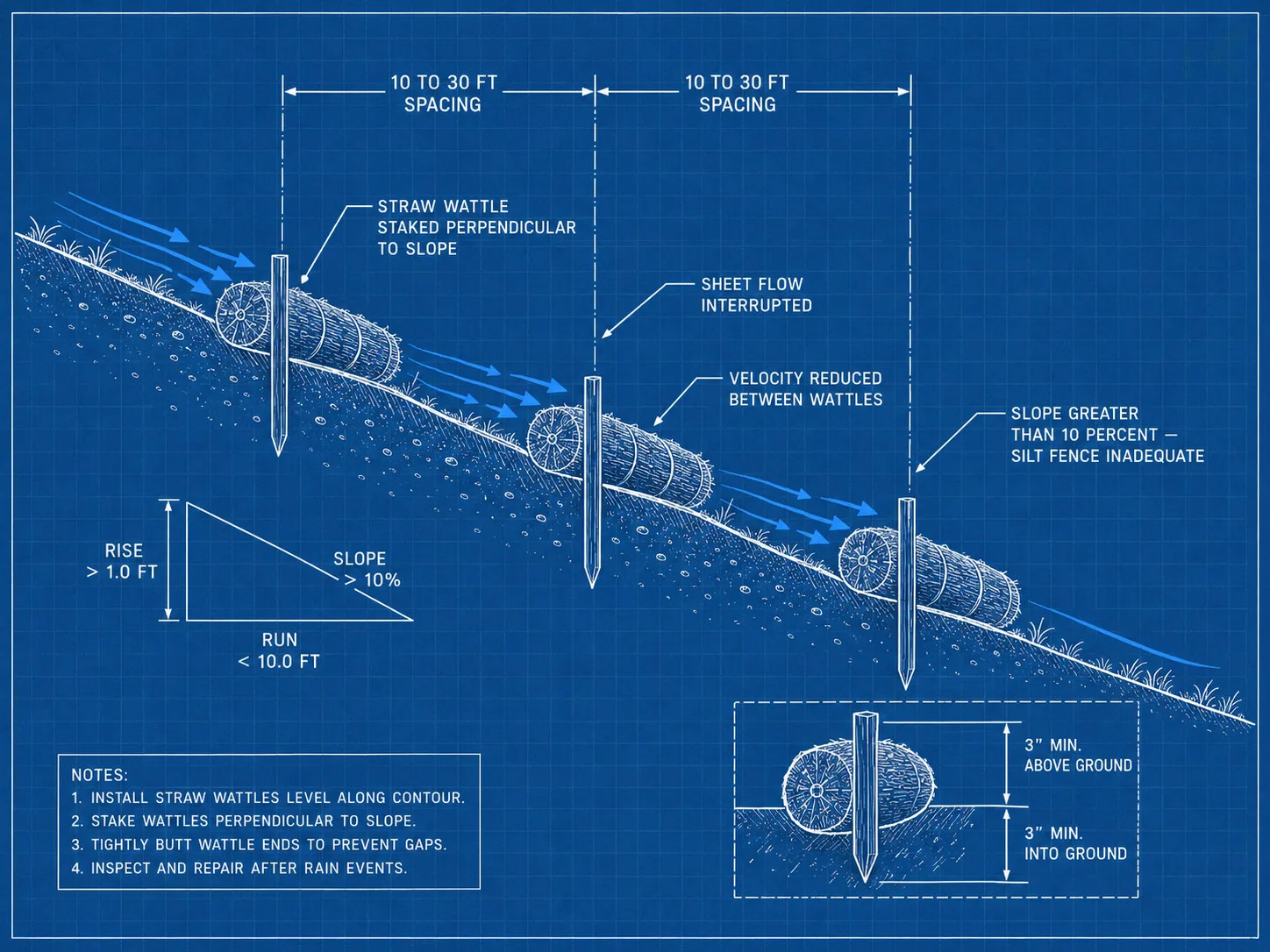
- Steep slopes over 10%. Water velocity is too high — the fence blows out or water bypasses around the ends.
- Concentrated flow channels. Silt fence is designed for sheet flow, not channelized flow. It fails at channels.
- Culvert outlets. Outlet velocity is too concentrated for fabric barriers. Use rip-rap or a stabilization mat instead.
Installation requirement: silt fence must be trenched in at the base — the fabric bottom is buried in a J-trench so water cannot flow beneath it. A fence staked on the surface but not trenched fails at the first storm. It looks installed, but it isn’t. Ask your contractor how they install silt fence and whether trenching is included.
For silt fence for NC driveway slope control specifics on grade requirements and installation standards, see the dedicated page.
Silt fence trenched in vs staked on the surface
Comparison. Trenched in correctly: Fabric bottom buried in a J-trench at the base; Staked perpendicular to slope direction; Water cannot flow beneath the barrier; Sediment settles and builds up behind the fence. Staked but not trenched: Fabric sits on the surface with an open gap below; Water flows straight under at the first storm; The barrier is bypassed -- it only looks installed; Sediment reaches the drainage channel anyway.
- Fabric bottom buried in a J-trench at the base
- Staked perpendicular to slope direction
- Water cannot flow beneath the barrier
- Sediment settles and builds up behind the fence
- Fabric sits on the surface with an open gap below
- Water flows straight under at the first storm
- The barrier is bypassed -- it only looks installed
- Sediment reaches the drainage channel anyway
Trenching the fabric base takes about 20 minutes -- skip it and the silt fence looks installed but stops nothing.
Straw Wattle and Compost Sock — Slope Interruption
Straw wattles — and their heavier alternative, compost socks — are placed across the slope face to interrupt sheet flow and reduce erosion energy on steeper grades where silt fence is not adequate.
How they work: a cylindrical tube of straw or compost is staked perpendicular to slope direction, typically 10 to 30 feet apart depending on grade. Water hits the wattle, pools briefly, slows, then passes through or around at reduced velocity. Multiple wattles in series reduce cumulative erosion energy across the length of the slope.
When straw wattles are appropriate:
- Slopes over 10% where silt fence cannot handle the velocity
- Bare graded slopes adjacent to a driveway repair where sheet flow is the primary risk
- Temporary protection during vegetation establishment — before grass roots form and stabilize the surface
WNC mountain context: straw wattles are a primary tool on steep western North Carolina slopes where water velocity exceeds silt fence capability. A post-Helene repair on any slope above 10% adjacent to the work area should include wattles on those sections. For more on WNC-specific erosion issues, see erosion barriers for steep NC driveways from WNC Helene context.
Maintenance: wattles shift and gap after storms. A contractor who installs wattles and never checks them is providing protection that degrades with each event. Ask whether the scope includes a post-storm inspection.
Stabilization Mats — High-Velocity Protection
Erosion control blankets (stabilization mats) are woven or bonded mats that physically protect bare soil from raindrop impact and sheet flow until vegetation establishes — used where slope grade or outlet velocity exceeds what silt fence or wattles can handle.
When mats are used:
- Culvert outlet scour zones. Outlet velocity after a rain event can scour bare soil rapidly. A mat covers the soil surface and provides traction for grass establishment or backing for rip-rap. See rip-rap delivery for driveway slope stabilization for outlet armor options.
- Very steep slopes over 15%. Where both silt fence and wattles are insufficient, a blanket physically anchors the soil until root systems form.
- Bare clay banks adjacent to repairs. Piedmont red clay is particularly susceptible to raindrop splash erosion — individual raindrops detach clay particles before any runoff begins. A mat prevents this detachment at the surface level.
Types used on North Carolina driveway repairs:
- Biodegradable straw or coir mats. Photodegrades over 12 to 24 months. Vegetation grows through the mat as it breaks down. Used for slope stabilization where the mat is intended to disappear once grass establishes. NCDEQ recognizes biodegradable erosion control blankets as an approved temporary measure.
- Polypropylene woven mats. Longer lifespan. Used for high-energy or permanent installations — culvert outlets, steeply graded aprons, and areas where the design doesn’t rely on mat degradation.
For driveway slope limits and erosion barrier requirements by grade percentage, see the slope spoke.
What the Repair Scope Should Include
A complete driveway washout repair scope includes the repair itself AND the erosion control measures to protect it until the surface stabilizes — erosion control should appear as a separate line item, not bundled into the overall labor total.
What to look for in an itemized quote:
- Silt fence. Listed by linear feet, with installation method called out (trenched vs staked). If only staked is mentioned, ask why.
- Straw wattles (if any slope over 10%). Listed by linear feet and staking spacing. Ask how far apart they plan to install them.
- Stabilization mat (if bare slopes or culvert outlets are involved). Listed by square footage and type — biodegradable straw/coir for temporary use, polypropylene for permanent. The distinction matters for long-term maintenance.
- Temporary seeding. Bare soil adjacent to a repair should be seeded with a NCDEQ-recommended temporary erosion control seed mix within the first available growing window after work completes. Ask what seed mix the contractor uses for clay slopes.
The contractor evaluation question:
Erosion Control Scope Question — Ask Before Signing
”What temporary erosion control measures are included in the repair scope, and where do you plan to install them?”
Follow up: ask for the specific barrier type, linear footage, and installation method for each location. If the answer is vague or omits slope sections you can see, ask for the breakout before work starts.
Common Mistakes on Driveway Erosion Control
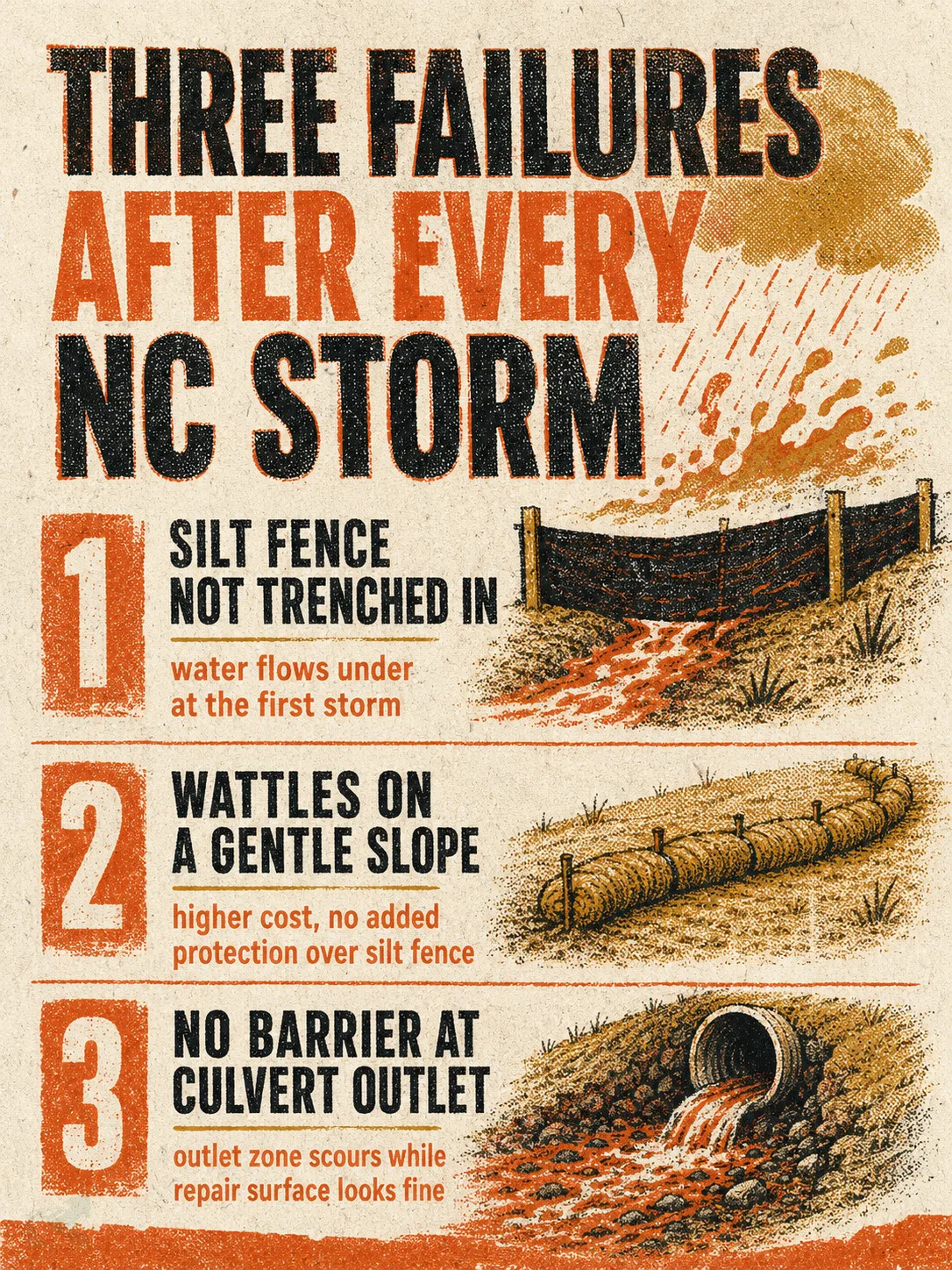
The three installation failures that appear after every significant storm in North Carolina.
- Silt fence not trenched in. Water flows under the fabric at the first storm. The fence looks intact but the sediment is already past it. Trenching takes 20 minutes and is not optional.
- Wattles installed on gentle slopes where silt fence is adequate. Wattles cost more than silt fence per linear foot. On a 5% grade where sheet flow velocity is low, silt fence handles the job. Mismatched barriers mean higher cost with no added protection.
- No erosion control at culvert outlet. This is the most common single-point failure after a repair. The outlet velocity continues to scour bare soil at the apron, and the repair visible at the driveway surface looks fine while the outlet zone deteriorates downstream.
An itemized repair quote for a driveway washout repair and erosion barrier installation in North Carolina should name the barrier type, quantity, and installation method as separate line items. If erosion control is bundled without specifics, ask for the breakout. The cost is a small fraction of the repair total — and not installing it correctly can mean repeating the work after the next storm event.
For swale drainage for sloped driveways that directs water away from the repair zone before it reaches the barrier, see the drainage spoke.
Find a grading operator in North Carolina who specifies erosion control in their repair scopes.