
Ray Pettiford has a swale on his Guilford County property that’s been washing out for two seasons. The bottom is bare soil now — a groove worn into the red clay, getting a little deeper after every hard rain.
The grass won’t hold. The water moves too fast on that slope.
A contractor told him he needs rip-rap. He didn’t know what that meant. This page explains it: what rip-rap is, where it goes, what size stone matters, what the installation actually includes, and what a lined section costs to haul and place in North Carolina.
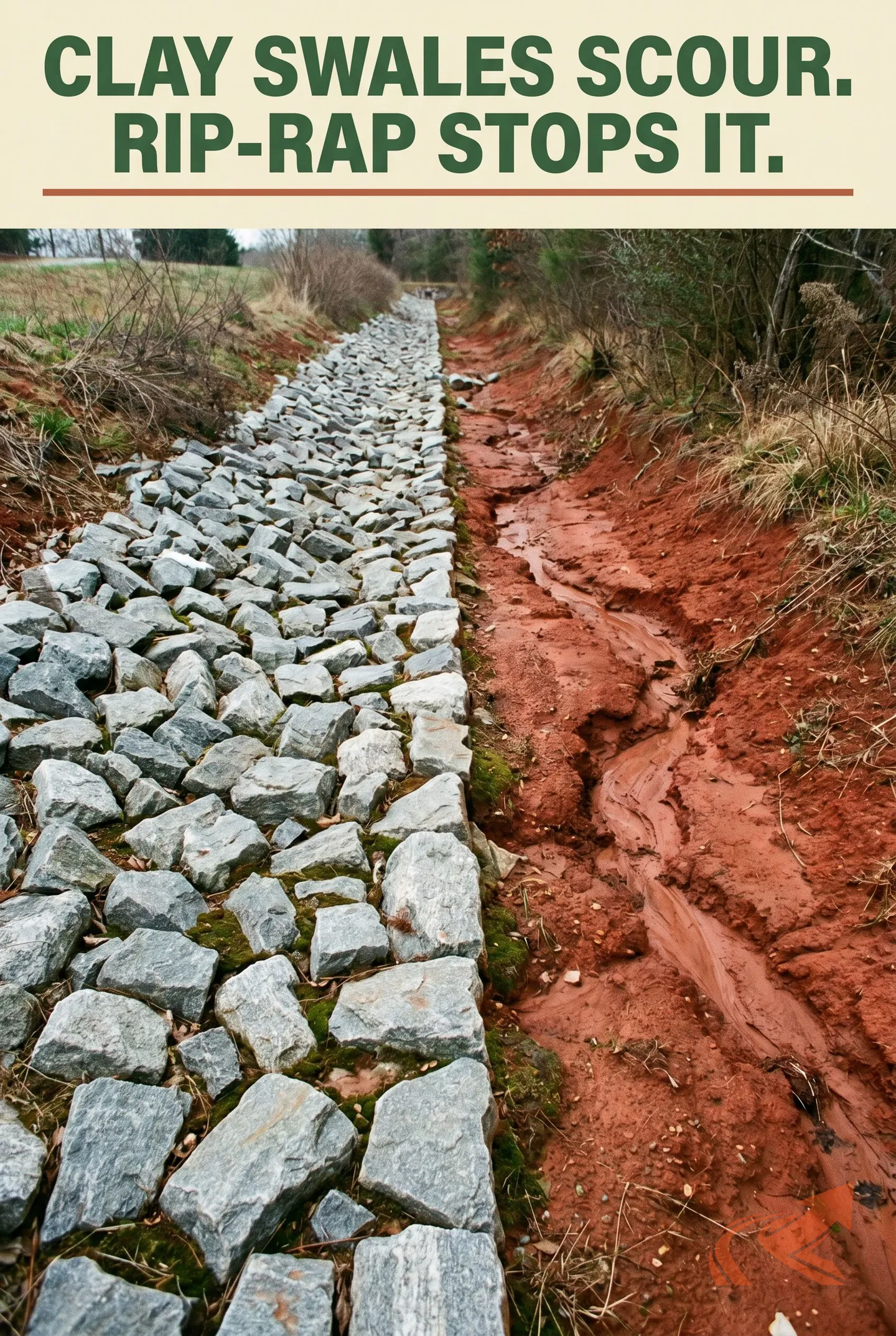
Why NC Clay Swales Scour
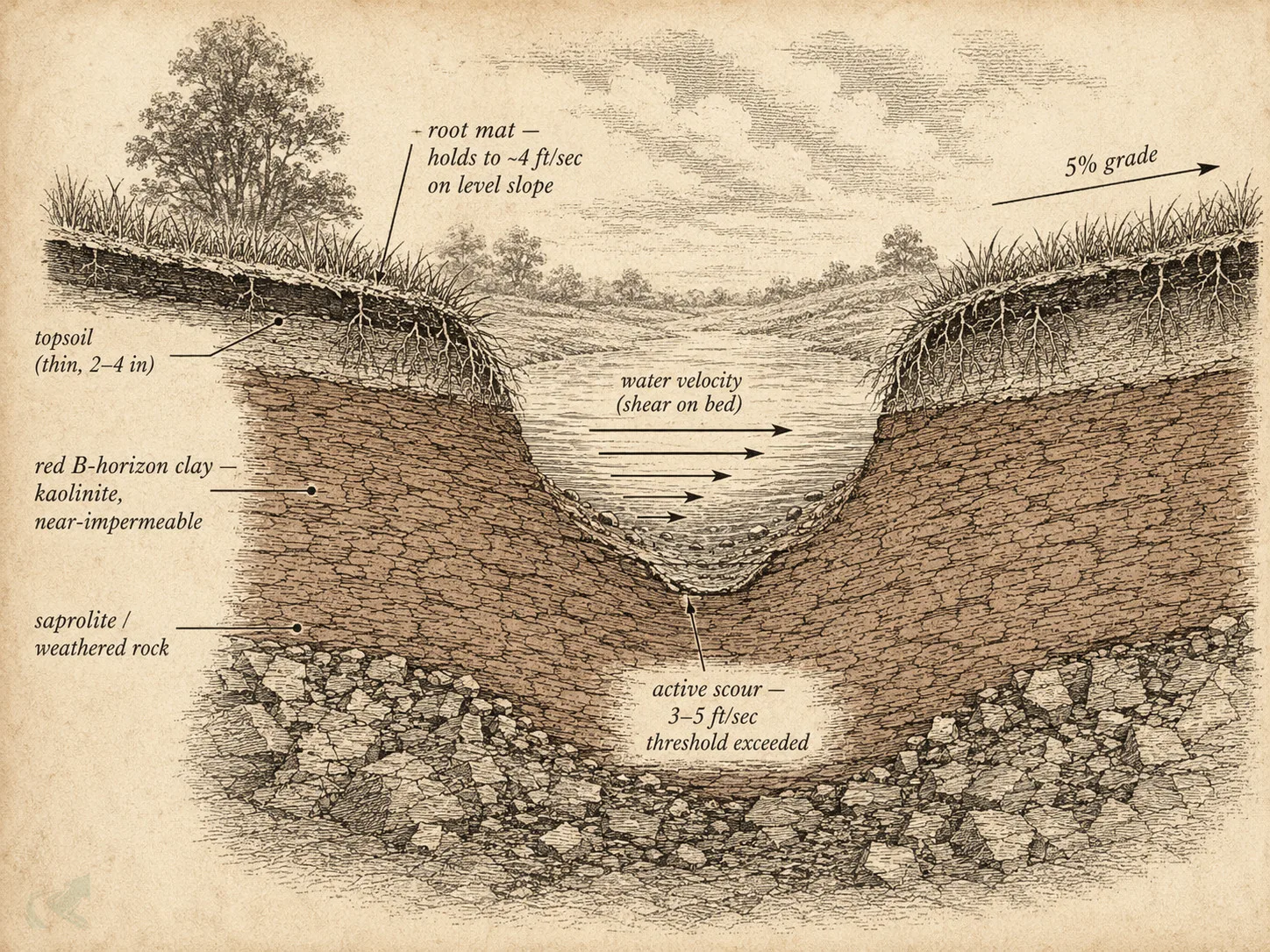
NC Piedmont clay can’t withstand fast-moving water — once it’s wet, it erodes quickly at the channel bottom and sides.
NC clay has a counterintuitive problem. Dry, it’s nearly rock-hard — contractors sometimes need a breaker to cut through it in summer. Wet, it’s slippery and easily displaced. The same material that feels indestructible in August turns to a soft, mobile mass when saturated.
Grass-lined clay channels — the NC yard drainage swale design most homeowners start with — handle velocity up to roughly 3-5 ft/sec when the turf is well-established. Beyond that threshold, water shear force overcomes what the root mat can hold. The clay beneath starts moving.
Three conditions push a North Carolina swale past that threshold — the same dynamics covered in the NC yard drainage severity guide for diagnosing why a yard holds water after a storm:
- Slope above 3%. Steeper grade = faster water = higher shear. A swale on a 5% grade without velocity protection will scour.
- Sharp direction changes. At curves, centrifugal force pushes water into the outside bank. The outside curve of any bend sharper than 45 degrees is a scour target.
- Concentrated inflow. Downspouts, catch basins, or paved surfaces dumping high-volume flow into the swale create a local velocity spike at the entry point.
These three triggers explain why a swale can be half-fine and half-failed on the same property.
Where Rip-Rap Goes (and Where It Doesn’t)
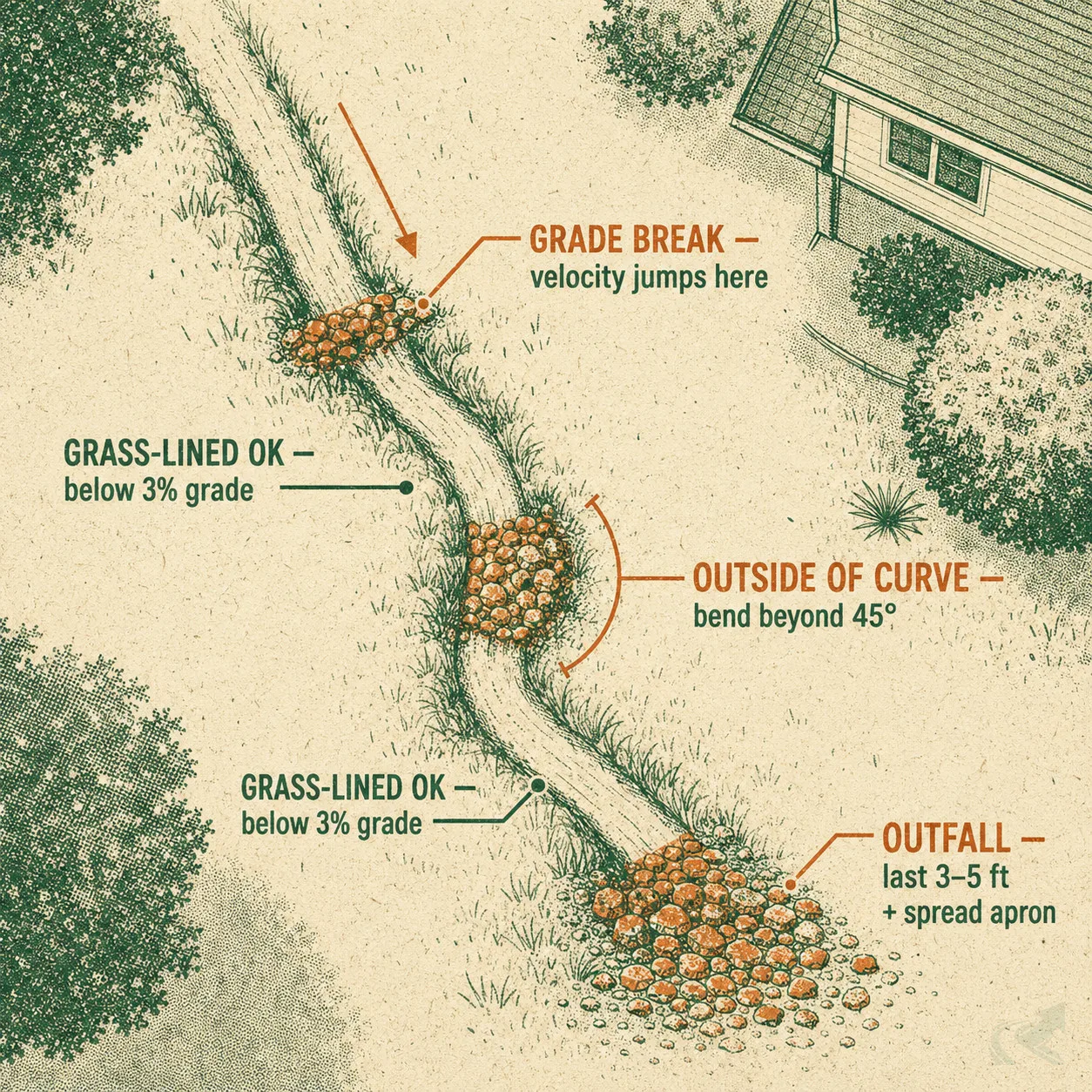
Rip-rap goes at velocity transition points — curves, steep grades, outfall points. It does not go in every linear foot of swale.
Three zones consistently need rip-rap in NC drainage work:
- Outfall. Where the swale discharges to a ditch, road edge, or open yard. This is almost always a rip-rap location — the velocity is highest at the exit, and a scour hole immediately downstream of an unlined outfall is the most common swale failure pattern. The standard treatment is rip-rap on the last 3-5 feet of the channel plus a spread apron beyond the daylight point.
- Outside of curves. Any bend that redirects the flow sharply concentrates energy on the outside bank. The outside curve of a bend beyond 45 degrees needs rip-rap armor.
- Grade breaks. Where the swale steepens abruptly, velocity jumps within that transition zone. Rip-rap the steeper section and a few feet above the break point.
What doesn’t need rip-rap: gentle straight runs below 3% grade with established grass and no concentrated inflow. Lining those sections is more expensive and creates sediment traps between stones where fines accumulate.
Rip-rap everywhere is not the right answer. A contractor who proposes to line an entire 200-foot swale when only the 20-foot outfall and one curve are scouring is either over-speccing or not diagnosing the actual problem.
Stone Size: #57 vs Rip-Rap Classes
#57 stone is for drainage beds — not for velocity protection. Rip-rap for swales needs Class A, B, or heavier stone depending on velocity and slope.
This distinction matters because #57 shows up on a lot of NC quotes. It’s the right call for French drains, septic field stone, and drainage beds — subsurface drainage applications where the stone holds water back rather than deflecting moving surface flow. It’s not the right call for a scouring swale. #57 is rounded-ish washed stone, 3/4 to 1 inch in size. In high-velocity water it moves — which is exactly the behavior rip-rap is supposed to prevent.
Rip-rap is angular. The irregular faces interlock and resist movement that rounded stone doesn’t.
North Carolina erosion and sediment control (E&S) guidance defines rip-rap classes by median stone size. Working values used in NC practice:
- Class A — approximately 6-inch median stone size. The standard for residential swales on slopes below 8% with normal runoff volumes. Angular quarry stone, not rounded river rock.
- Class B — approximately 9-inch median stone size. Appropriate for steeper grades, larger drainage areas, or concentrated flow from gutters and downspout connections.
- Heavy rip-rap — larger still, typically 12-inch-plus median. Engineered applications — outfalls from culverts, high-velocity commercial drainage. Requires a spec from an engineer, not a rule of thumb.
The rule of thumb for most NC homeowners with a residential swale: slopes below 8%, Class A. Steeper than that, or receiving concentrated flow from roof drainage, find a verified NC grading contractor to evaluate Class B.
Swale lining: rip-rap done right vs the bare-clay scour
Comparison. Lined right: Angular Class A stone interlocks and stays put; Geotextile filter fabric under the stone stops clay piping; Channel holds its shape through high-velocity flow. Bare clay scour: Grass-lined clay gives way once velocity exceeds 3-5 ft/sec; A scour hole opens at the outside of the curve; No fabric base -- clay keeps washing out beneath the surface.
- Angular Class A stone interlocks and stays put
- Geotextile filter fabric under the stone stops clay piping
- Channel holds its shape through high-velocity flow
- Grass-lined clay gives way once velocity exceeds 3-5 ft/sec
- A scour hole opens at the outside of the curve
- No fabric base -- clay keeps washing out beneath the surface
NC Piedmont clay erodes fast when wet -- rip-rap belongs at curves, steep grades, and outfalls, over a filter fabric base.
One more spec point that gets skipped on under-priced jobs: the bedding layer. Rip-rap placed directly on bare clay will still fail — the fine clay particles migrate up through the stone voids under hydraulic pressure, a process called piping. The fix is a layer of granular bedding (3 inches of #57 stone) or a geotextile filter fabric between the clay and the rip-rap. Without it, the stone settles unevenly and the clay beneath it continues to erode.
Installation Spec: What the Work Includes
Rip-rap placement is not dumping stone on the channel — it requires prepared base geometry and a correct outfall shape.
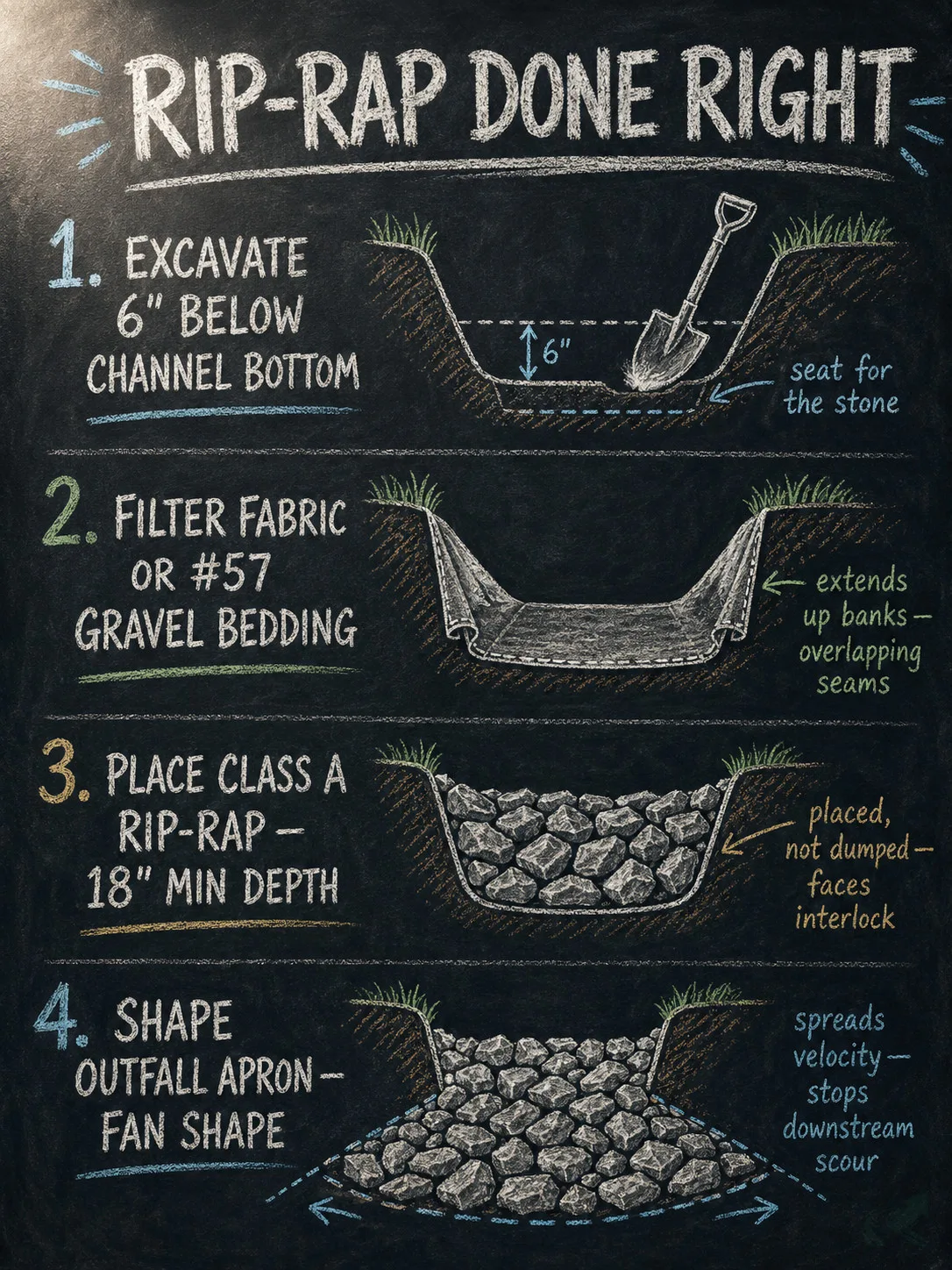
A properly installed rip-rap section in a North Carolina swale follows this sequence:
- Excavate 6 inches below the channel bottom along the lined section. This creates the seat for the stone — so the finished rip-rap surface sits at the original channel grade rather than riding high and catching debris.
- Install filter fabric or gravel bedding. Geotextile fabric is more common on residential jobs — it’s faster and lighter than a gravel bedding layer. It needs to extend up the channel sides and overlap at seams. The fabric is what protects the clay from piping beneath the stone.
- Place rip-rap in the specified class and thickness. Standard practice for Class A residential applications is an 18-inch minimum depth of stone in the channel bottom. Stone is placed, not dumped — random placement rather than a dumped pile allows the angular faces to interlock properly.
- Shape the outfall apron. The outfall end of the rip-rap section needs a spread apron — a fan-shaped zone where the stone widens beyond the channel width. This spreads velocity as the flow exits so it doesn’t concentrate into a scour point immediately downstream of the lined section.
What an under-specced rip-rap job looks like: stone dumped without excavation, no fabric under it, outfall edge cut off vertically with no apron. The scour hole reappears just past the last stone within a year.
What a complete itemized quote covers: excavation quantity, filter fabric (square footage), stone class and tonnage, placement labor, and outfall apron dimensions. If a quote comes back as a single number with no spec attached, ask for the breakdown before signing.
Cost Range and Hauling Logistics
Class A rip-rap typically runs $40-$80 per ton delivered in NC; the full installed cost depends on access, section length, and how much excavation the base prep requires.
Stone pricing varies by county and distance from the quarry. The $40-$80 range is a working field estimate for delivered Class A angular rip-rap in the Piedmont — not a contract figure. Class B runs higher per ton because the larger stones are slower to handle and some quarries treat them as a separate product line.
The logistics for a residential swale section:
- A 20-foot rip-rap section at standard depth and width uses roughly 3-5 tons of stone, depending on channel width and stone class.
- Delivery is by dump truck, which needs reasonable access to within a short distance of the work. If the swale is in a backyard with a narrow gate, the contractor may need to wheelbarrow stone from the street — that adds labor and time.
- Placement is by hand, skid steer, or small excavator bucket depending on site access. A backhoe staging the stone and an operator hand-placing it is the typical residential setup.
Installed cost for a typical 20-40 foot residential rip-rap section in North Carolina runs somewhere in the $1,500-$4,000 range, depending on excavation depth, fabric, stone class, and whether the outfall requires an apron spread. That’s a wide range — the excavation step and the apron work are the variables that move the number.
For rip-rap delivery logistics and how to order by stone class, see rip-rap delivery NC — class sizing and placement.
To find a contractor who can assess whether your swale needs rip-rap and which class applies, see hire a grading operator in North Carolina.