
You’ve been told “you can get their permits yanked.” You don’t know if that’s a real thing or something people say when they’re angry and out of options.
The answer: it’s a real mechanism. It has a specific trigger, specific evidence requirements, and a realistic outcome that is usually a correction notice — not an immediate permit revocation. That’s still leverage, because correction notices affect the builder’s ability to proceed on related projects.
This page tells you exactly how the mechanism works, what the county inspector needs from you, and what to say when you call.
What “Yanking Permits” Actually Means — and What It Doesn’t
“Yanking permits” means triggering a county inspector re-inspection that results in a correction notice or stop-work order — not pressing a button that makes the builder’s permits disappear.
The distinction matters. Most successful homeowner escalations produce a correction notice: a documented requirement that the builder address a specific as-built deviation before certain work can proceed. A full permit revocation — where the builder cannot work at all — is rarer. It typically requires a pattern of violations or a major structural safety issue.
What you are actually aiming for is a correction notice on the file. A correction notice:
- Documents the deviation officially in the county’s inspection record
- Requires the builder to remedy the condition before the next inspection phase on related permits
- Creates ongoing pressure, because builders who accumulate correction notices know the county inspection office is watching
A correction notice isn’t dramatic. But it’s on the record — and builders who collect them know what that means.
What Inspectors Need to Act — The Evidence Standard
Inspectors need documented evidence of a specific, measurable deviation from the approved permit — not a description of standing water.
“My yard floods” is a symptom. It tells the inspector nothing about what was supposed to be built versus what actually got built. The inspector’s job is to compare the as-built conditions to the approved grading plan. Your job is to give them something to compare.
What makes evidence actionable:
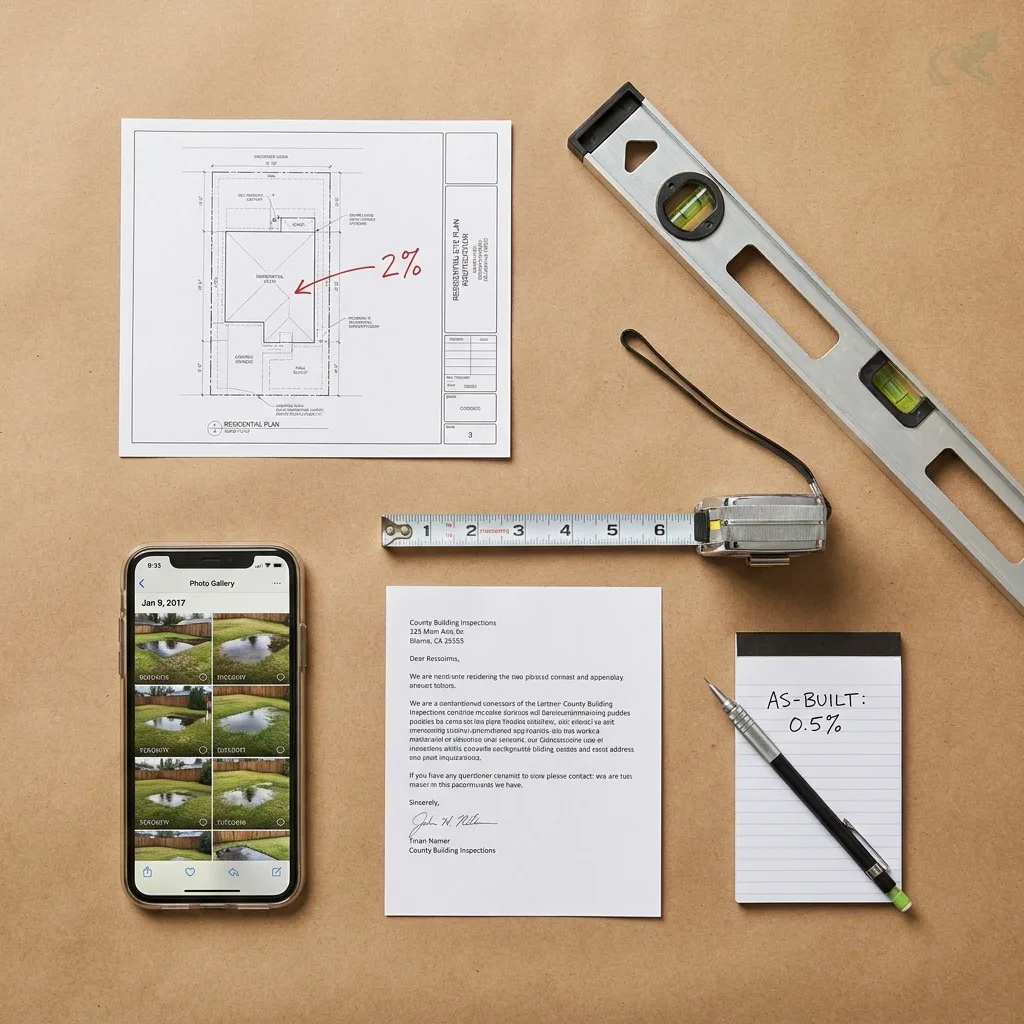
- A specific measurement that deviates from the approved plan. If the plan shows a 2% slope at the foundation and your as-built slope measures 0.5%, that’s a deviation. Not a complaint — a measurable gap between what was approved and what was built.
- A documented discharge-point mismatch. If the approved plan shows downspouts routing to the lot boundary and yours terminate 3 feet from the foundation, photograph the distance and the discharge point with a tape measure in frame.
- Date-stamped photos of standing water events. These support your case but don’t replace the plan comparison. Positive drainage away from the foundation is a grading standard; if the as-built conditions produce standing water against the foundation wall, that’s a pattern worth documenting over multiple rain events.
What doesn’t work as evidence:
- “My yard floods” without the comparison plan
- Before photos without the approved plan to show what the builder was supposed to build
- A general complaint that the contractor did bad work
What the inspector can act on vs what gets dismissed
Comparison. An actionable deviation: Approved plan shows a 2% slope at the foundation; As-built slope measures 0.5% -- a documented gap; Downspout routed to the lot perimeter on the plan; Photos and tape-measure readings show the mismatch. What gets dismissed: "My yard floods" with no plan to compare against; Before photos without the approved plan; A general complaint that the contractor did bad work; Splash block 3 feet from the wall, but no plan reference.
- Approved plan shows a 2% slope at the foundation
- As-built slope measures 0.5% -- a documented gap
- Downspout routed to the lot perimeter on the plan
- Photos and tape-measure readings show the mismatch
- "My yard floods" with no plan to compare against
- Before photos without the approved plan
- A general complaint that the contractor did bad work
- Splash block 3 feet from the wall, but no plan reference
Inspectors act on a measurable deviation from the approved plan -- not on a description of standing water. Pull the plan first.
The As-Built vs Approved Plan Comparison — How to Do It
Request the approved site plan from your county permit office, then document your as-built conditions against it measurement by measurement.
This is a public records request. The approved grading plan is on file at the county permit office. In most North Carolina counties you can request it in person, by phone, or through an online portal. Wake County, Durham County, and Mecklenburg County all have permit record lookup systems — call the county building inspections department directly if you can’t locate the online portal.
Once you have the plan:
-
Read the grading plan. Look for slope percentages shown at the foundation (arrows with a percentage grade label), downspout discharge routes (dashed lines running from the structure to the lot perimeter or a swale), and any drainage easement locations.
-
Measure your as-built slope. Place a 4-foot level against the grade 1 foot from the foundation. Measure how far the low end drops below the high end. Divide by 48 (inches) and multiply by 100 to get the slope percentage. North Carolina residential construction standards expect positive drainage — slope running away from the foundation, typically 2% or more for the first 10 feet. A result below 1% at the foundation wall is measurable and significant.
-
Document downspout discharge. Where does the water from each downspout go? Photograph the terminus. Measure its distance from the foundation. If the approved plan shows the downspout routing to daylight at the lot perimeter or into a piped system and yours terminates in a splash block 3 feet from the house, photograph and measure it.
-
Compare systematically. For each element on the approved plan — slope at each foundation wall, each downspout route, swale location — document what you actually see. If the as-built matches the plan, you have a different problem: the plan itself may be marginal, which routes the dispute back to the warranty path or to a licensed engineer’s review.
If the comparison shows a deviation, you have an evidence package. Now you can contact the inspector.
How to Contact the Inspector and What to Say
Contact the county building inspection office directly — not through the builder — and request a re-inspection of grading and drainage conditions at your property.
Do not call the builder and ask them to schedule a re-inspection. Contact the county directly. Most North Carolina counties have a building inspections office separate from the permit office — the same department that performed the original inspections during construction.
What to say when you call:
“I’m the homeowner at [address]. I have the approved grading plan from the permit office and I’ve documented several as-built conditions that appear to deviate from the approved plan. I’d like to request a grading re-inspection. Can you tell me the process for submitting a homeowner re-inspection request?”
What not to say: do not open with “I want to get the builder’s permits yanked.” That framing signals you want an adversarial outcome before the inspector has reviewed any evidence. Let the documentation make the case.
After the call, follow up in writing. Email the inspection office a brief summary: the address, the permit number (from the approved plan you pulled), a description of the deviations you documented, and your re-inspection request. Attach your evidence package.
North Carolina county building inspection offices are public agencies. Homeowners can request re-inspections. The process varies by county — some require the request to come through an online portal, some accept email, some require a form. Ask when you call and confirm the submission path.
What Happens After the Re-inspection
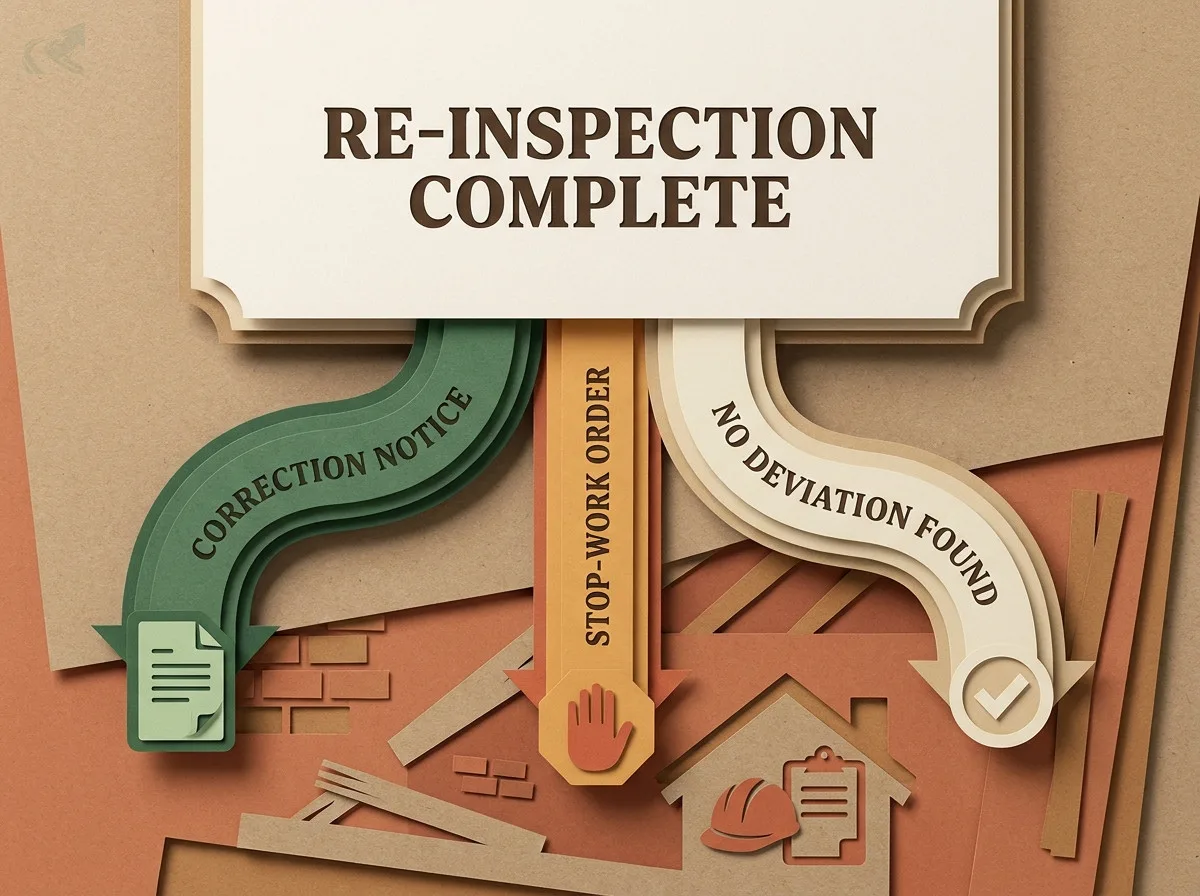
The inspector documents their findings — and if they identify a deviation, issues a correction notice that the builder must address before proceeding with related work.
Three possible outcomes:
-
Correction notice issued. The inspector found a deviation from the approved plan. The builder must remediate the condition and pass re-inspection before moving to the next phase on related active permits. This is the most common productive outcome for residential grading disputes. It’s not a permit pull, but it’s a documented requirement with enforcement teeth.
-
No deviation found. The as-built conditions technically conform to the approved plan. This is frustrating — but it’s informative. If the plan itself is the problem (the approved grades were marginal to begin with), the dispute path shifts. That may mean an engineer’s assessment of whether the plan met applicable standards, or a return to the warranty escalation described in the NC home warranty vs county inspector decision.
-
Stop-work order. Rare for residential grading, but possible when the inspector finds a significant deviation or when a pattern of violations exists across the builder’s active permits in the county. A stop-work order halts related work until the condition is corrected and re-inspected.
After a correction notice, document the notice number and date. Follow up to confirm remediation was performed and that re-inspection passed. If the builder doesn’t remediate, contact the inspection office again — the open correction notice is now the lever.
For the full sequence of escalation options, including what to try before reaching the permit office, see the builder accountability playbook NC.
Common Mistakes at This Stage
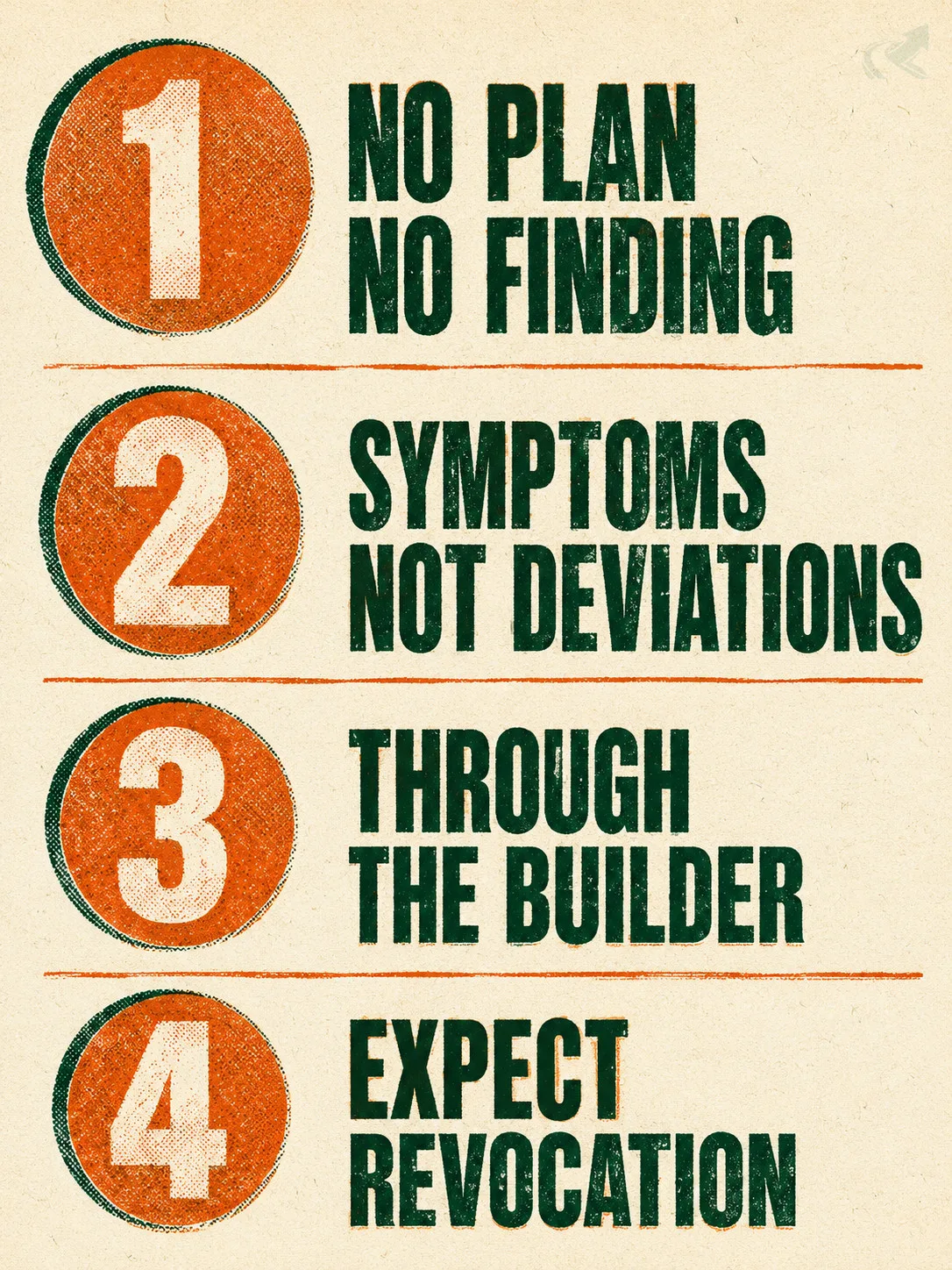
Requesting re-inspection before you have the approved plan. The inspector compares your evidence to the approved plan on file. If you don’t have it, you can’t show the deviation — the re-inspection produces a conversation, not a finding. Get the plan first.
Describing symptoms instead of deviations. “My yard floods” is a symptom. “My as-built slope at the north foundation wall is 0.5% and the approved plan shows 2%” is a deviation. Inspectors act on deviations from the approved plan, not on descriptions of what happens when it rains.
Contacting the inspector through the builder. Always contact the county building inspection office directly. Routing through the builder gives them advance notice to control the narrative before the inspector sees anything.
Expecting a permit revocation as the outcome. A correction notice is the realistic outcome for residential grading re-inspection. Do not discount it because it isn’t a full permit pull. A correction notice on the builder’s record, with an open remediation requirement, is leverage — especially if the builder has active work in the same county.
Your Re-inspection Request Script
Copy and use this when you call the county building inspection office.
Re-inspection request script
“I’m the homeowner at [your address]. I have the approved grading plan from the permit office and I’ve documented several as-built conditions that appear to deviate from the approved plan. I’d like to request a grading re-inspection. Can you tell me the process for submitting a homeowner re-inspection request?”
Your Evidence Package Checklist
Gather these before you contact the inspection office.
Evidence package checklist
- [ ] Approved grading plan from county permit office (public records request)
- [ ] As-built slope measurements at each foundation wall (4-foot level + tape measure)
- [ ] Photos of each downspout discharge point with distance from foundation measured
- [ ] Date-stamped photos of standing water events (minimum 3 separate rain events)
- [ ] Permit number from the approved plan
- [ ] Name of the builder/general contractor of record on the permit
- [ ] Written summary listing each as-built deviation vs the approved plan
Finding a Contractor to Document the Deviations
If you need a licensed professional to take the slope measurements and prepare the evidence package, a verified NC grading contractor can produce the documentation an inspector needs.
When you contact a contractor for this, ask for:
- A written certification letter documenting the as-built slope percentages at each foundation wall
- Documentation of downspout discharge points and their distance from the foundation
- A statement comparing the as-built conditions to the approved plan
The issues the license that a grading contractor must hold to perform this work. A contractor who can’t give you their license number on request isn’t licensed.
Hire a verified NC grading contractor in the directory to get an itemized quote for the documentation visit.
If you haven’t exhausted the warranty path, read warranty vs inspector — which path works first. The permit-office lever is most effective when the inspector finds a documented deviation — and having a contractor’s certification letter in hand before you call gives the inspector something concrete to work with.
For situations where the subcontractor performing the grading work may not hold the required license, the NC unlicensed sub escalation path describes a parallel route that can apply to the same dispute.