
You sent the certification letter for your NC drainage dispute. The builder missed the deadline. Now you have two options on the table: push the warranty team or call the county inspector. Your neighbor said inspector. Your contractor said warranty. Neither explained what either path actually triggers.
Here is what they actually do — and why most homeowners make the mistake of picking one when they should be running both.
What the Warranty Team Can — and Can’t — Do
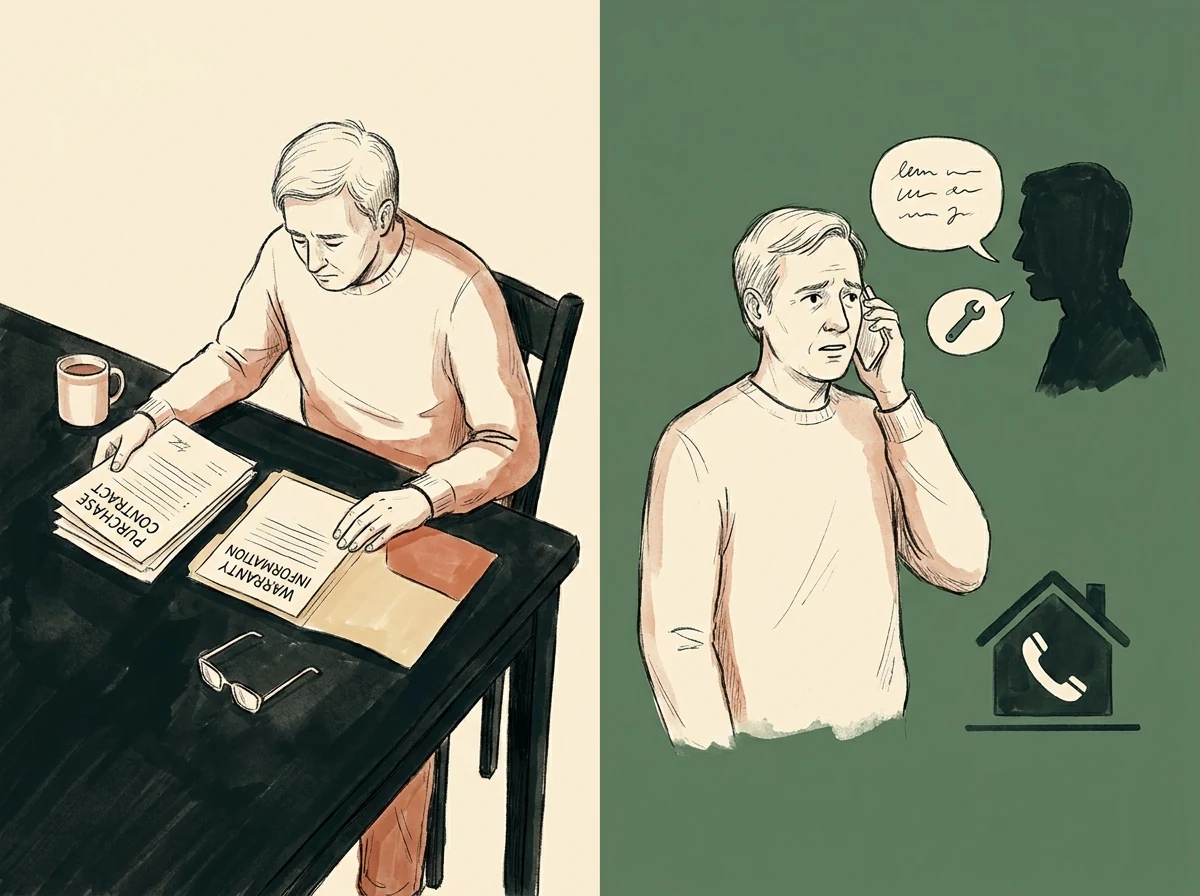
The warranty team operates on your purchase contract and North Carolina’s new home warranty statute — they can fix what the contract covers, and they can close tickets for things they say it doesn’t.
North Carolina law establishes minimum warranty periods for new residential construction: one year for workmanship defects, two years for mechanical systems, and ten years for structural defects. Your individual contract may extend or narrow those minimums — check the actual language.
The problem is drainage. Builders routinely classify grading complaints as “drainage conditions caused by owner landscaping modifications.” That language appears in many purchase contracts and gives the warranty team a door to close your ticket without fixing anything.
The warranty team’s leverage is documentation. Written requests generate paper trails. A formal certification letter for your NC drainage dispute creates a timestamped record of the claim and the deadline — and forces the warranty team to respond in writing, not by phone.
When it works: you are within the warranty period, the defect is clearly covered, and you have documentation.
When it doesn’t: the builder classifies standing water as an “acceptable condition” or the warranty period has expired.
What the County Inspector Can — and Can’t — Do
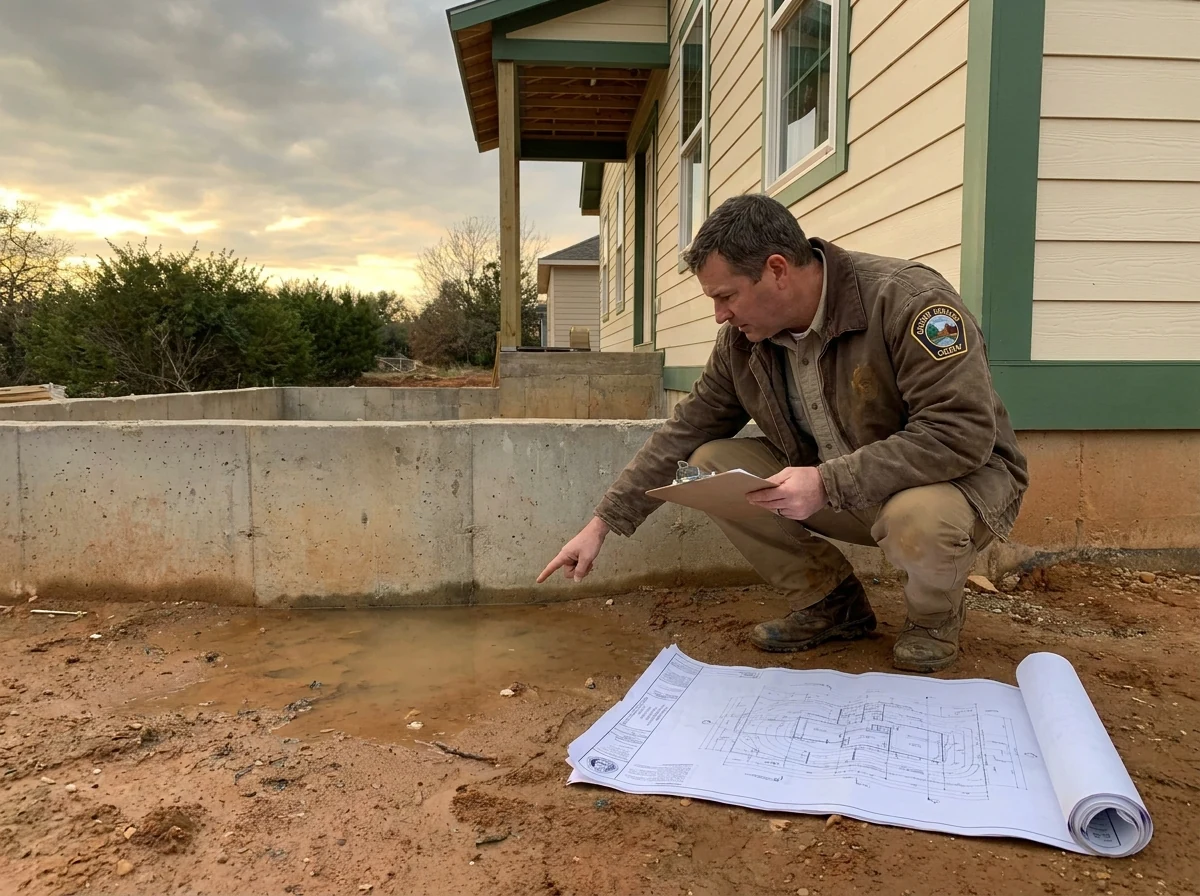
The county inspector has authority to require correction if the as-built grading deviates from the approved permit — and unlike the warranty team, the inspector is not a party to the builder’s financial interests.
Here is what they can do: inspect the as-built conditions against the approved site plan, issue a correction notice if deviation is found, and require the builder to remedy before issuing a certificate of occupancy on that same project. That is where the real leverage lives on a new build — the builder cannot close the home without the CO, and the CO cannot issue while a documented deviation remains open.
One thing the inspector cannot do: NC General Statutes 160D-1110(h) explicitly prohibits counties from withholding permits on unrelated properties to force compliance elsewhere, unless there is a direct public safety issue. A grading correction notice on one lot does not automatically block the builder’s permits on other lots — that leverage does not exist in NC law. For more on escalating within the permit system, see NC county inspector permit escalation.
What they cannot do: order a complete regrading based on homeowner preference. Their authority is limited to code compliance and permit conformance — not to “what performs well in NC Piedmont clay.”
The limitation: county inspectors inspect to code minimums. If the as-built technically conforms to the approved plan — even if that plan was marginal — the inspector may not act. Their authority is to enforce the approved plan, not to upgrade a marginal plan.
When it works: you have the approved site plan, can document the as-built deviation with slope measurements and photos, and the deviation is objectively measurable.
When it doesn’t: the as-built technically conforms to the approved plan.
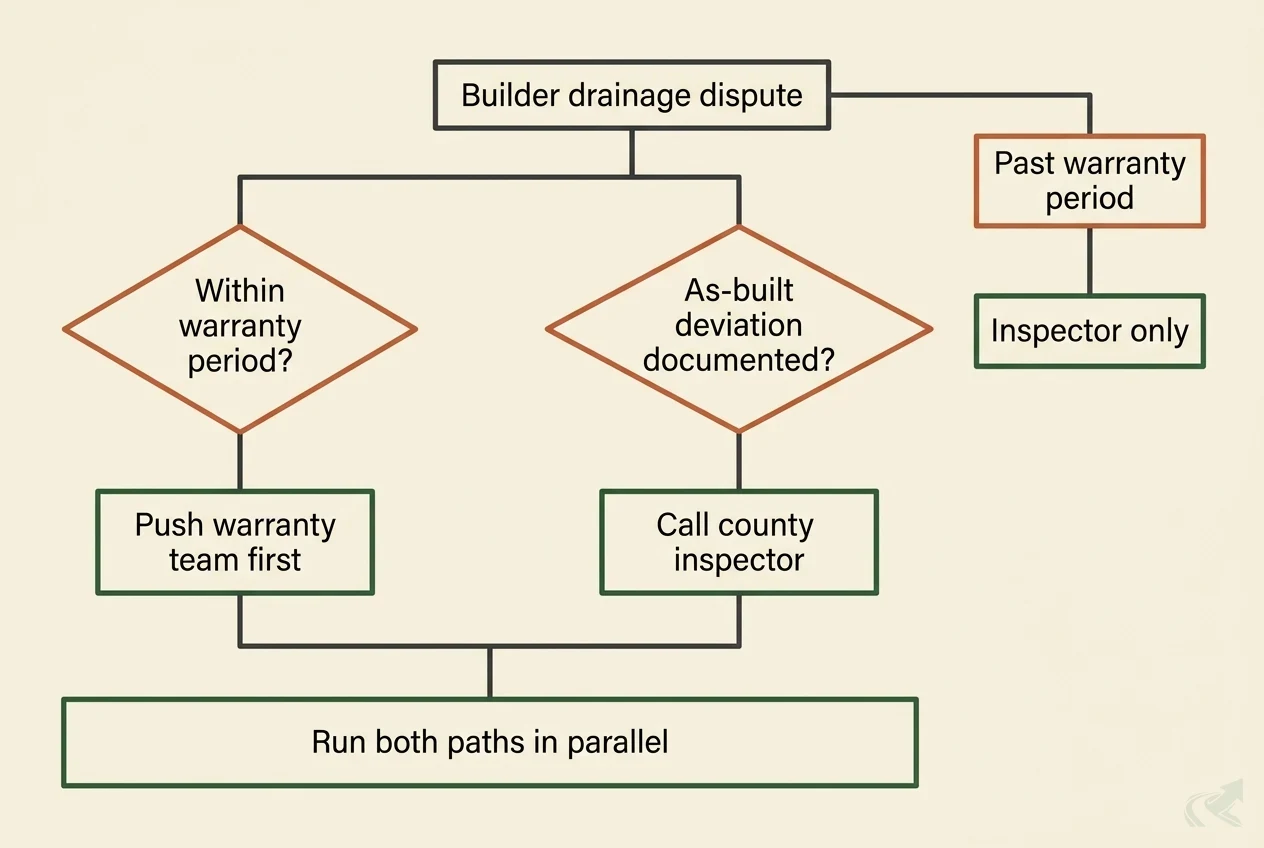
How to Run Both Paths at the Same Time
Warranty and inspector paths do not interfere with each other — there is no reason to choose one and wait before starting the other.
They operate on different authority bases. The warranty team is contractual. The inspector is regulatory. Most builders respond better when both are active simultaneously because stalling one path does not neutralize the other.
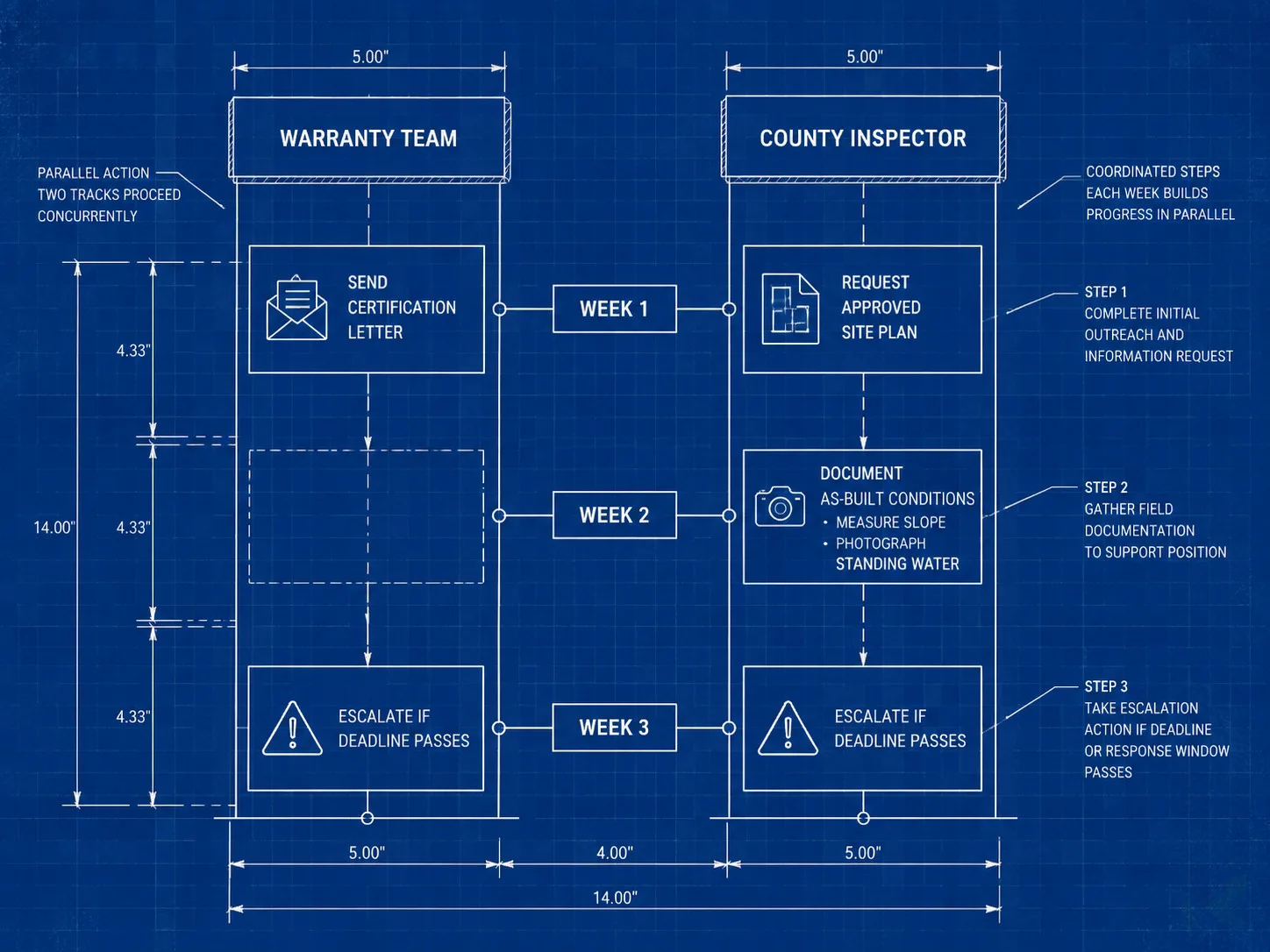
Week 1:
- Send the certification letter (or your next documented warranty follow-up) by certified mail and email
- Request the approved site plan from your county permit office — it is a public record and you are entitled to it
Week 2:
- Document the as-built conditions: measure slopes to check for positive drainage (the 2% minimum slope away from the foundation), photograph standing water 24-48 hours after rain, note downspout discharge locations
- Compare your as-built documentation against the approved site plan
Week 3:
- If the warranty deadline passes without written response, contact the county inspection office and describe the as-built deviation with your documented measurements
- Continue the warranty paper trail in parallel — do not stop because the inspector is now involved
The warranty team stalls. The inspector does not care about stalling. Running both removes the stalling strategy.
Warranty Team vs County Inspector — Side by Side
| Factor | Warranty Team | County Inspector |
|---|---|---|
| Who they answer to | The builder (internal function) | The county government (regulatory) |
| Timeline | Faster to respond (days to weeks) | Slower to act (weeks to months) |
| What they can require | Fix what the contract covers | Correction of as-built deviations from the approved permit |
| What they cannot require | Anything outside contract scope | Regrading beyond code minimums |
| Best evidence to bring | Certification letter, written claim, contract language | Approved site plan, as-built measurements, photo documentation |
| What stalling looks like | "We are reviewing your claim" with no deadline | Inspector delays site visit without explanation |
| When it fails | Builder classifies defect as excluded or warranty expires | As-built technically conforms to the approved (marginal) plan |
Who they answer to
- Warranty Team
- The builder (internal function)
- County Inspector
- The county government (regulatory)
Timeline
- Warranty Team
- Faster to respond (days to weeks)
- County Inspector
- Slower to act (weeks to months)
What they can require
- Warranty Team
- Fix what the contract covers
- County Inspector
- Correction of as-built deviations from the approved permit
What they cannot require
- Warranty Team
- Anything outside contract scope
- County Inspector
- Regrading beyond code minimums
Best evidence to bring
- Warranty Team
- Certification letter, written claim, contract language
- County Inspector
- Approved site plan, as-built measurements, photo documentation
What stalling looks like
- Warranty Team
- "We are reviewing your claim" with no deadline
- County Inspector
- Inspector delays site visit without explanation
When it fails
- Warranty Team
- Builder classifies defect as excluded or warranty expires
- County Inspector
- As-built technically conforms to the approved (marginal) plan
When to Skip Both and Involve an Attorney
Skip warranty and inspector routes and involve an attorney when the defect is severe, the warranty period is expiring, and the builder has a documented record of prior denials.
Three scenarios that warrant attorney involvement:
- Foundation damage present. If standing water has caused or is causing structural damage, the dollar amount and liability exposure are past warranty-team resolution. An attorney can assess whether you have a construction-defect claim.
- Warranty period expiring. If you are within 60 days of the end of your warranty period, an attorney can advise on preserving claims before the period closes. Once the period closes, the warranty path closes with it.
- Multiple documented denials. If the builder has denied three or more warranty claims on the same drainage issue, you have a paper trail an attorney can use. The 8-point builder drainage dispute checklist walks through what to bring.
What to tell the attorney: bring the certification letter, the builder’s response or non-response, the approved site plan, your as-built documentation, and any correspondence from the county inspection office. For the full context on the NC builder accountability process, see the NC builder accountability documentation.
Common Mistakes
Calling the inspector before documenting the deviation. County inspectors respond to documented evidence — measurements, photos, site-plan comparisons. Calling to describe the problem without documentation gives the inspector nothing to act on.
Treating warranty and inspector as competing paths. They are parallel tracks. Most North Carolina homeowners use only one and wonder why it is not working. The warranty team can stall; the inspector cannot be stalled if you have documented a code violation.
Waiting too long to act. The warranty period is not indefinite. Once it expires, the contractual path closes. If you are inside your warranty period right now, document everything and send the next certified communication this week.
Accepting a verbal warranty response. Always request written confirmation of any warranty decision. A phone call saying “we looked at it and it’s normal” is not a denial you can appeal. A written denial is.
Copy-to-Clipboard: What to Say When You Call the County Inspection Office
“I am a homeowner at [address]. I have a new construction home and I believe the as-built grading deviates from the approved site plan — specifically, I am seeing standing water within [X feet] of the foundation [X] hours after rain. I have the approved site plan from the permit office. I would like to request an inspection and understand the process for documenting a possible deviation from the approved grading plan.”
Your Next Step
If you have not yet sent a formal certification letter, that is the starting point. See make your builder put the fix in writing for the letter format.
If the warranty period is running out and the builder has ignored your claims, the inspector path is the parallel move — not the replacement for the warranty process. See how to get a builder’s permits revoked in NC for how permit pressure actually works.
If you are hiring a contractor to fix what the builder will not, verify they are licensed before they start. The license lookup is the first check. You can also verify a contractor’s before any work begins. If your contractor pulls work without a license, see stop work if your grading sub is unlicensed.
When you are ready to hire someone you can verify, hire a licensed NC grading contractor in your metro.