Two questions to answer before you do anything else
I just found out my contractor isn't licensed -- what do I do right now?
If work hasn't started: stop it before it does. If work is underway: tell the contractor in writing you need to pause until licensing is verified -- do not pay any further invoices. If work is complete: document everything, then choose between the NCLBGC complaint path and the county permit office path.
Can I get my money back if they were unlicensed?
Possibly. If the project exceeded the $40,000 contract-value threshold requiring a license and the contractor misrepresented their status, you may have a claim through civil action. The NCLBGC Homeowners Recovery Fund covers homeowners harmed by a licensed general contractor -- or by an unlicensed contractor who fraudulently represented themselves as being licensed (G.S. 87-15.5(5)). The fund requires you to first sue the contractor and obtain an unsatisfied judgment, so consulting an attorney is appropriate before deciding which path to take.
Bianca checked the portal. Her contractor’s name doesn’t appear. Or the license shows “Suspended.” Or the license class is Limited and the project is $90,000.
Equipment may already be on her property. She signed a contract. She doesn’t know whether to stop the job, who to call, or what happens next.
This page gives her — and you — the answer in order of urgency.
First, Confirm What You’re Dealing With — License vs. No License vs. Wrong Class
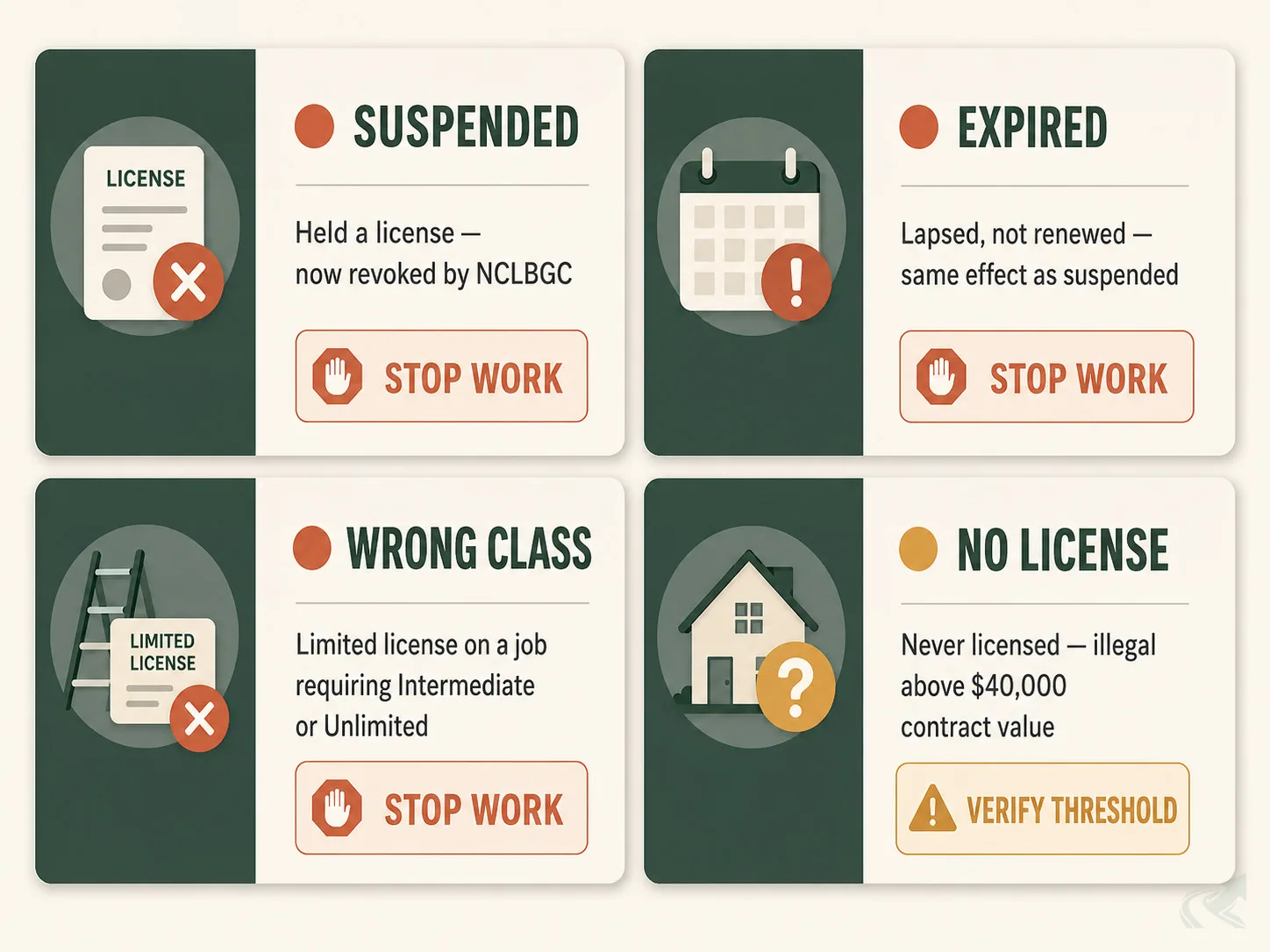
Not all license problems are the same — a suspended license, an expired license, and the wrong license class each trigger different actions.
Suspended license: the contractor held a license and it was suspended. Working on any project that requires licensure while suspended is a current legal violation. Stop work.
Expired license: the license lapsed and was not renewed. Same practical effect — stop work, then file a complaint.
Wrong class: the contractor holds a Limited license but is working on a project that requires Intermediate or Unlimited. This is a class-scope violation — sometimes unintentional, still a violation.
No license at all: the contractor never held a license. Below the $40,000 land-disturbance threshold, this may be legal. Above $40,000, it is a violation requiring licensure under NC grading license requirements.
Verify current status directly at the NCLBGC public license search (portal.nclbgc.org/Public/Search). Screenshot the result — that screenshot is your evidence for every escalation path below.
Before Work Starts — The Easiest Scenario
If no contract is signed and no money has changed hands, you can walk away cleanly — do so.
Action steps:
- Send a written notice (email is sufficient) stating that you are not proceeding because you were unable to verify license status.
- Do not pay any deposit if you have not already done so.
- If you paid a deposit, send a written demand for return citing inability to verify the NCLBGC license thresholds.
If the contractor says their license is “pending” or “in process”: a pending license is not a license. Do not proceed until the NCLBGC portal shows an active, current license in the correct class for your project scope.
The better path from here is to hire a licensed NC grading contractor through a verified directory. Before signing anything, run the contractor’s name on the NCLBGC portal yourself.
Review the common contractor red flags to watch for before starting your search over.
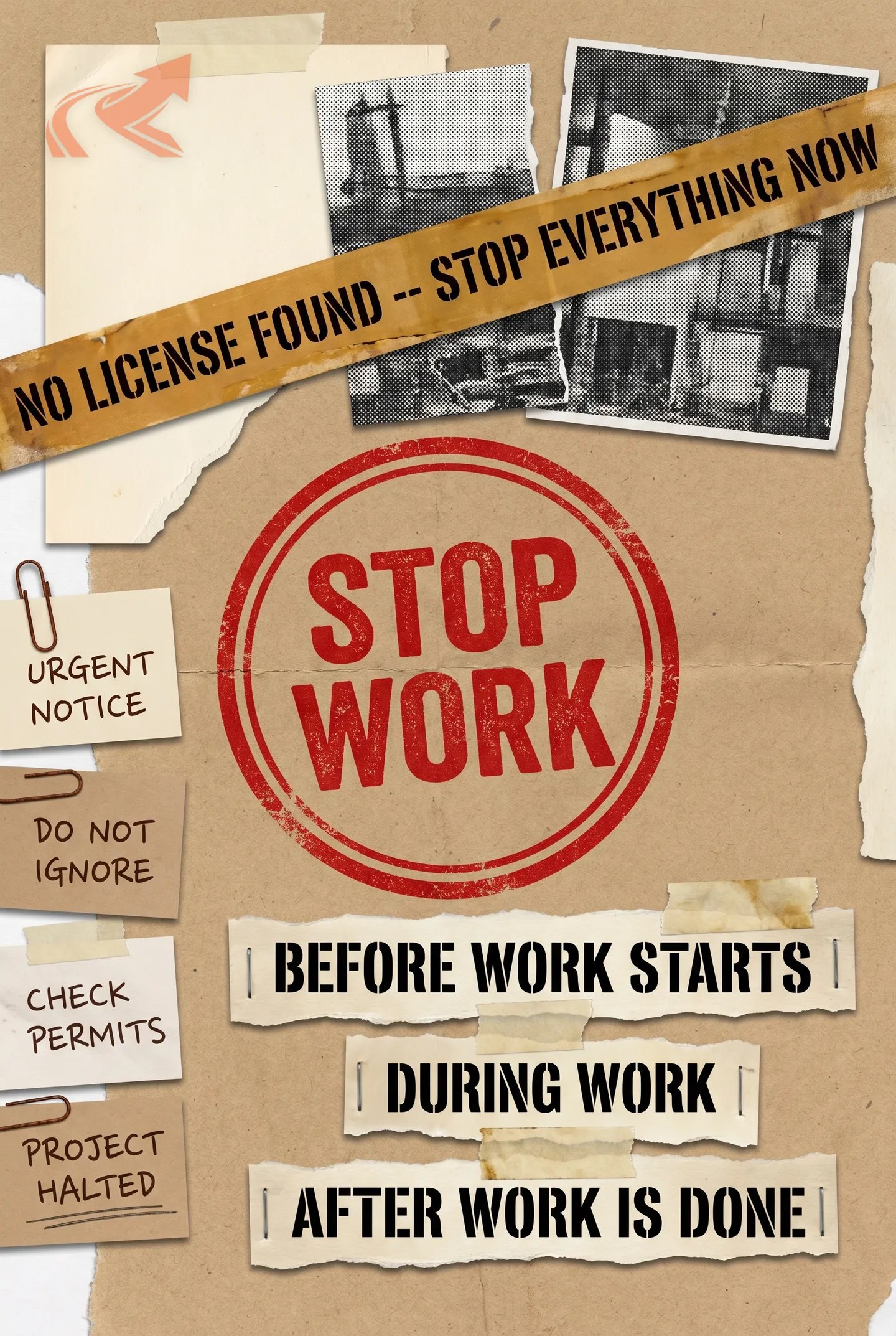
During Work — The Most Urgent Scenario
If work is underway and you have discovered the license problem, pause payments immediately and request written confirmation of license status before the next payment.
Stop paying. Do not write further checks while the license question is unresolved. Every payment you make reduces your leverage and complicates any future recovery.
Tell the contractor in writing — text or email, timestamped — that you need to verify their license before proceeding with payment. Keep that message.
Attempt to verify license status yourself at the NCLBGC public license search (portal.nclbgc.org/Public/Search).
If the license is suspended, expired, or absent: notify the contractor in writing that you are suspending the project pending licensing verification.
If they resist stopping or threaten a lien: in North Carolina, a contract entered into by a contractor who lacked the required license is treated by the courts as void — the unlicensed contractor cannot enforce the contract or compel payment, and that bars enforcing a lien based on it. This is a general framing only; consult an attorney for your specifics. If they file or threaten to file a lien, consult an attorney.
County stop-work authority: if a permit was pulled for the project, the county building inspection office can issue a written stop-work order under G.S. 160D-404(b) when work is undertaken in substantial violation of state or local law — using an unlicensed contractor on a project that requires licensure can support that finding. Contact the county building inspections department with the permit number, the contractor name, and your NCLBGC search screenshot.
After Work Is Complete — Filing the NCLBGC Complaint
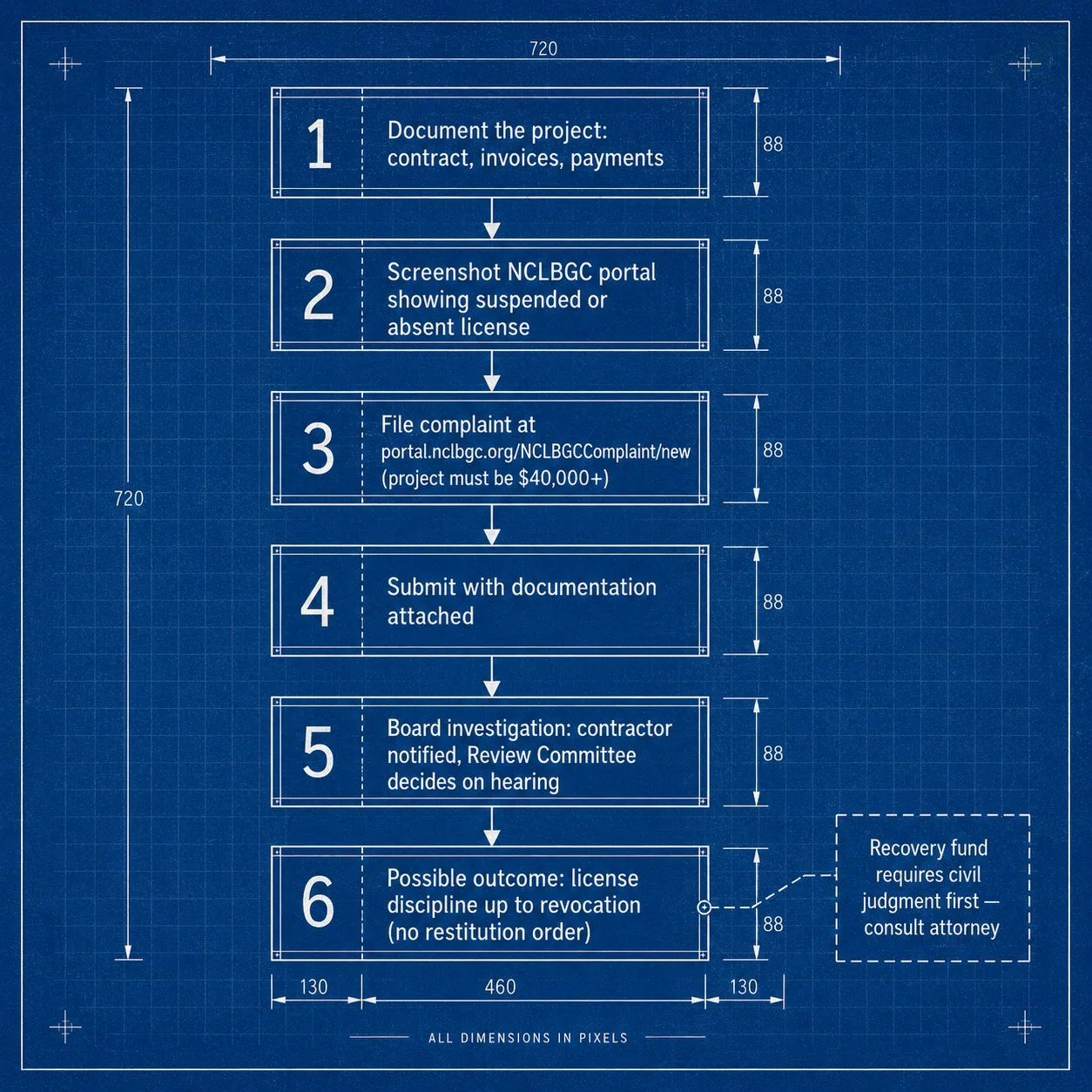
Once work is complete, the primary escalation path is an NCLBGC complaint — which can trigger investigation, license revocation, and in some cases recovery fund review.
NCLBGC complaint process:
- Document the project: contract, invoices, payments, scope of work, and timeline.
- Verify the license status at the NCLBGC portal and screenshot the result showing the suspended, absent, or wrong-class status.
- File the complaint through the NCLBGC online complaint form (portal.nclbgc.org/NCLBGCComplaint/new). For an unlicensed contractor, the Board has statutory authority only when the project cost was $40,000 or more.
- Submit the complaint with your documentation attached.
- The NCLBGC will investigate: the contractor is notified and given a chance to respond, then the case goes to the Board’s Review Committee, which decides whether a hearing should be held. Investigation timelines vary and the Board does not publish a standard response window — expect the process to take several months from submission to resolution.
- Possible outcomes: discipline of the contractor’s license up to revocation. Note the Board cannot order the contractor to pay restitution, refund money, or complete the work — that requires civil action.
Recovery fund: North Carolina’s Homeowners Recovery Fund (G.S. 87-15.5) reimburses homeowners for a reimbursable loss in constructing or altering a single-family residential dwelling caused by the dishonest or incompetent conduct of a licensed general contractor — or by an unlicensed contractor who fraudulently represented themselves as being licensed. Eligibility requires exhausting other remedies first, including suing the contractor and obtaining a judgment that remains unsatisfied. Consult an attorney before deciding whether to rely on the complaint path alone or pursue civil action alongside it.
The County Permit Office Route — When the Job Had a Permit
If a permit was pulled for the work, the county permit office is a second escalation path — they can require the contractor of record to demonstrate active licensure.
No building permit may be issued for work that statute or ordinance requires be done by a licensed contractor unless the work is to be performed by one, so the county inspections office has a direct interest in the licensure of the contractor of record. Contact the county building inspection office and report that the contractor of record may not hold a valid license.
Bring to that conversation:
- The permit number
- The contractor’s name as listed on the permit
- Your NCLBGC search screenshot showing the license status
If the county inspector confirms a violation on an open permit, that finding becomes independent documentation for the NCLBGC complaint and for any civil action.
See the full NC permit revocation escalation pathway and how to trigger a permit revocation in NC for the detailed mechanics. For broader context on holding your NC builder accountable, that resource covers the full lever sequence.
Three scenarios -- what to do when you discover the license problem
1. Before work starts -- walk away -- Send written notice of non-proceeding. Do not pay any deposit if not yet paid. Demand return if already paid. A pending license is not a license -- do not proceed until the NCLBGC portal shows active status. 2. During work -- stop payments immediately -- Notify the contractor in writing that you are suspending further work and payments pending license verification. Contact the county building inspector if a permit was pulled. Every payment you make reduces your leverage. 3. After work is complete -- document and file -- Screenshot the NCLBGC portal result showing suspended or absent status. File an NCLBGC complaint at portal.nclbgc.org/NCLBGCComplaint/new. Consult an attorney if recovery fund eligibility or civil action is in question.
-
Before work starts -- walk away
Send written notice of non-proceeding. Do not pay any deposit if not yet paid. Demand return if already paid. A pending license is not a license -- do not proceed until the NCLBGC portal shows active status.
-
During work -- stop payments immediately
Notify the contractor in writing that you are suspending further work and payments pending license verification. Contact the county building inspector if a permit was pulled. Every payment you make reduces your leverage.
-
After work is complete -- document and file
Screenshot the NCLBGC portal result showing suspended or absent status. File an NCLBGC complaint at portal.nclbgc.org/NCLBGCComplaint/new. Consult an attorney if recovery fund eligibility or civil action is in question.
The right action depends entirely on where you are in the project. Escalation paths differ -- but documenting the license problem at each stage is always the first step.
Three-Scenario Comparison
The right action depends entirely on where you are in the project — before, during, or after work.
| Before work starts | During work | After work is complete | |
|---|---|---|---|
| License problem discovered | Before signing or paying | While equipment is on-site, work is active | Job is done, payment made |
| Immediate action | Walk away — send written notice of non-proceeding | Stop payments; notify contractor in writing; verify NCLBGC status yourself | Document everything; screenshot NCLBGC result |
| Payment guidance | Do not pay any deposit if not yet paid; demand return if paid | No further payments until license verified in writing | Payments already made — document for potential recovery |
| Escalation path | Written non-proceeding notice; demand deposit return | Written suspension notice; county inspector if permitted | NCLBGC complaint; county permit office if permitted; civil action |
| Attorney recommended? | No — unless deposit recovery is refused | If they threaten or file a lien | Yes — especially if recovery fund or civil action is in question |
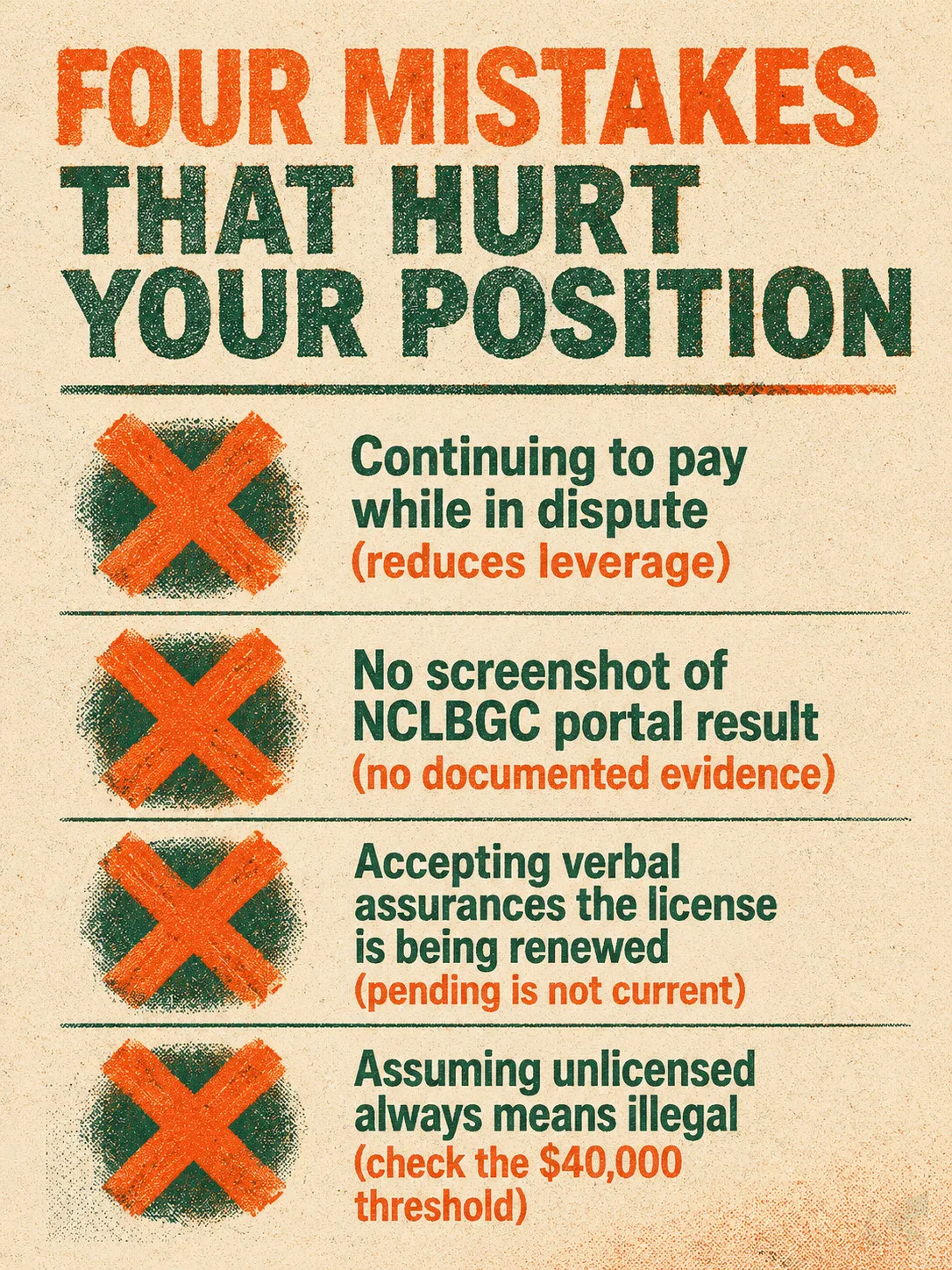
Four Mistakes That Hurt Your Position
Continuing to pay while the dispute is active. Every payment reduces your leverage and complicates recovery. Stop writing checks the moment you identify the license problem.
Not documenting the license verification attempt. A verbal claim that “I couldn’t find them” carries no weight. Screenshot the NCLBGC portal result showing the suspended or absent license and save it with a timestamp.
Accepting verbal assurances that “the license is being renewed.” A pending renewal is not a current license. Do not allow work to resume or make further payments until you have verified an active license on the NCLBGC portal yourself.
Assuming unlicensed always equals illegal. Below the $40,000 contract-value threshold, unlicensed grading work may be legal in North Carolina. The key is confirming which side of that threshold your project sits on before deciding how to escalate.