
You have three bids. The cheapest worries you. The most expensive feels like the contractor is betting you won’t ask questions. The middle one is a lump sum with no line items.
This is the scenario frankkej123 described on Reddit — and it’s more common than contractors want to admit. The problem isn’t that any of them are dishonest. The problem is structural: a lump-sum number is impossible to compare, dispute, or audit after the work starts.
This page gives you the full line-item dictionary, a realistic sample quote, and the exact ask that gets a North Carolina operator to itemize without friction.
Why Lump-Sum Quotes Hide Padding
A lump-sum number is impossible to dispute — you can’t compare what you can’t see.
A lump sum is not a scam. Some operators prefer lump-sum pricing for efficiency — it avoids per-line negotiation on every sub-item. But the format has a structural problem: once you sign, there is no baseline to point to.
If the dump truck runs six loads instead of three, you have no way to know. If the operator spec’d Piedmont red clay fill but delivered mixed debris, you have no line showing what was promised. If the contingency is 25% of the job baked into the total, it’s invisible.
The issue isn’t honesty. It’s accountability. An itemized quote creates a paper record of what was scoped. A lump sum removes it.
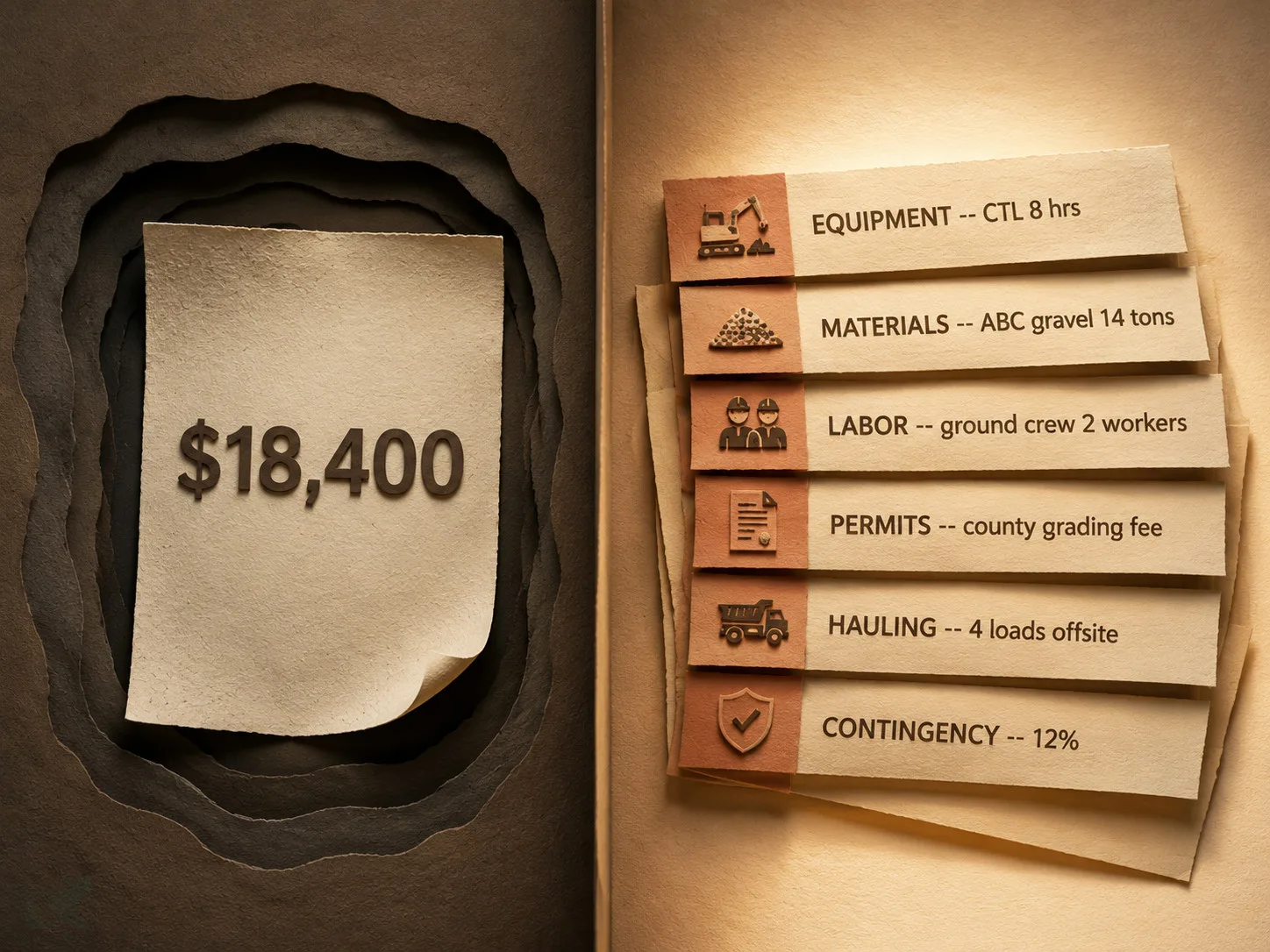
Six factors where quote format determines what you can actually hold a contractor to.
| Factor | Itemized Quote | Lump-Sum Quote |
|---|---|---|
| Line-item visibility | Equipment, materials, labor, permits, hauling, and contingency each named and priced separately | Single total; all components hidden |
| Change-order accountability | Each addition priced against an existing line -- you see exactly what changed and why | Any change modifies an opaque total; no baseline to compare against |
| Dispute leverage | You can point to a specific line and ask "why is this $X?" -- the contractor must defend the number | Nothing to point to; contractor's word against yours |
| Cross-quote comparability | Compare contractor A's ABC gravel tonnage vs contractor B's -- same spec, different price, visible | Can only compare totals; no way to know if they're scoping the same job |
| Padding detectability | Equipment days that don't match the job scope are visible in the quote | Padding is invisible by design |
| Contingency transparency | Called out as its own line; you see the buffer reserved for unforeseen site conditions | Rolled into the total; no visibility on how much is reserved |
Line-item visibility
- Itemized Quote
- Equipment, materials, labor, permits, hauling, and contingency each named and priced separately
- Lump-Sum Quote
- Single total; all components hidden
Change-order accountability
- Itemized Quote
- Each addition priced against an existing line -- you see exactly what changed and why
- Lump-Sum Quote
- Any change modifies an opaque total; no baseline to compare against
Dispute leverage
- Itemized Quote
- You can point to a specific line and ask "why is this $X?" -- the contractor must defend the number
- Lump-Sum Quote
- Nothing to point to; contractor's word against yours
Cross-quote comparability
- Itemized Quote
- Compare contractor A's ABC gravel tonnage vs contractor B's -- same spec, different price, visible
- Lump-Sum Quote
- Can only compare totals; no way to know if they're scoping the same job
Padding detectability
- Itemized Quote
- Equipment days that don't match the job scope are visible in the quote
- Lump-Sum Quote
- Padding is invisible by design
Contingency transparency
- Itemized Quote
- Called out as its own line; you see the buffer reserved for unforeseen site conditions
- Lump-Sum Quote
- Rolled into the total; no visibility on how much is reserved
Itemized quote vs lump-sum quote: what you can and can't hold a contractor to
Comparison. Itemized quote: Equipment named by machine, operator, and hours -- CTL, mini excavator, dump truck each priced separately; Materials by spec and quantity -- ABC gravel in tons, fill dirt in cubic yards, silt fence in linear feet; Labor split: ground crew and foreman listed at their own rates; Permits named and priced as a separate line; Hauling: load count and per-load rate visible; Contingency called out as 10-15% -- the buffer is visible, not hidden. Lump-sum quote: One total number -- no equipment breakdown, no hours, no machine names; Materials rolled in -- no spec, no quantity, no unit price; Labor invisible -- no roles, no hours, no rates; Permits may be included or skipped -- no way to know; Hauling may be estimated or absent -- no load count visible; Contingency baked into the total or absent -- arrives as a change order when conditions require it.
- Equipment named by machine, operator, and hours -- CTL, mini excavator, dump truck each priced separately
- Materials by spec and quantity -- ABC gravel in tons, fill dirt in cubic yards, silt fence in linear feet
- Labor split: ground crew and foreman listed at their own rates
- Permits named and priced as a separate line
- Hauling: load count and per-load rate visible
- Contingency called out as 10-15% -- the buffer is visible, not hidden
- One total number -- no equipment breakdown, no hours, no machine names
- Materials rolled in -- no spec, no quantity, no unit price
- Labor invisible -- no roles, no hours, no rates
- Permits may be included or skipped -- no way to know
- Hauling may be estimated or absent -- no load count visible
- Contingency baked into the total or absent -- arrives as a change order when conditions require it
Same job, two formats. The itemized quote gives you a paper record for every line. The lump sum removes it.
Once you have itemized quotes in hand, the next step is comparing NC contractor bids line by line — not total by total.
What an Itemized NC Grading Quote Actually Contains
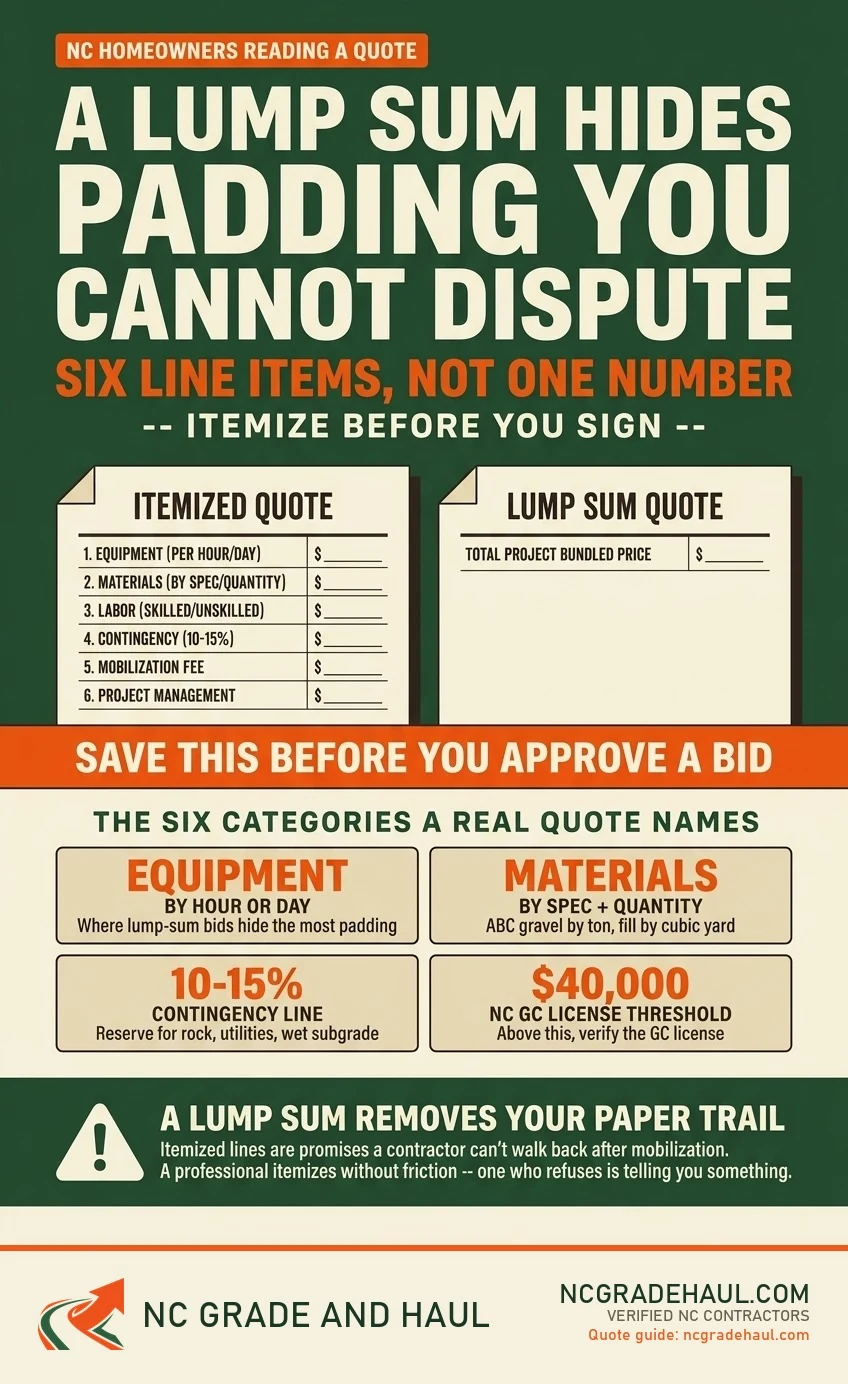
Six categories. If any one is missing, the quote is incomplete.
A professional grading operator in North Carolina quotes six categories as separate line items. Here’s what each category means and why it matters.
Equipment
Equipment is where lump-sum contractors hide the most padding.
A real quote names each piece of equipment, the operator, and the hours — or days — it runs. The common equipment types on NC grading jobs:
- Compact track loader ( ) — the workhorse for residential lot regrading. Quoted per operator-hour.
- Mini excavator — for foundation drainage, French drain trenching, and confined-access work. Quoted per operator-hour.
- Skid steer — site cleanup, material spreading, finish grading. Sometimes included in the CTL line; sometimes separate.
- Dump truck (haul and return) — moves cut material off-site and delivers fill if needed. Quoted per load or per day.
- Plate compactor or roller — required for any compacted-lift fill work. Sometimes included in labor; should be named.
If the equipment section says “grading equipment — $X,XXX” without naming the machines or hours, ask for the breakdown.
Materials
Materials are sold by the ton or by the cubic yard — and the unit matters.
Here’s the split that trips up NC homeowners (nblm-query2 #11 — “am I getting conned?”): gravel and stone are sold by weight (tons), while earthwork fill is sold by volume (cubic yards). Both can appear on the same quote. A contractor who mixes the units without labeling them is not being dishonest — that’s how the industry works — but you need both the unit and the quantity to check the math.
Key materials that should appear by name and spec:
- gravel — quoted in tons at a per-ton rate, with the source quarry ideally named.
- — used on heavy-load pads and commercial driveways; higher cost per ton than standard ABC.
- Fill dirt (select borrow) — quoted in cubic yards, compacted in lifts. The spec matters: “clean fill” and “structural fill” are not the same material.
- Silt fence — quoted per linear foot. Required by North Carolina erosion and sediment (E&S) rules on nearly every grading job that disturbs soil.
Labor
Labor should separate the equipment operator from the ground crew.
On most NC grading jobs, the equipment operator’s time is bundled into the equipment line. What should appear separately:
- Ground crew (2 workers typical for residential) — quoted per hour or per day
- Foreman / site supervisor — quoted per hour or included in the day rate
- Any specialty labor (rebar for a concrete pad, utility marking, survey layout)
Permits
The permit fee belongs on the quote — not buried in overhead.
North Carolina requires a grading permit for most residential jobs disturbing more than a minimum threshold of soil — the exact acreage varies by county. The permit is pulled in the homeowner’s name on many jobs; on others, the contractor pulls it as part of the scope. Either way, the fee should be named.
A quote that says nothing about permits is either planning to skip the permit (a problem) or forgot to include the line (ask). For county-specific thresholds and fee schedules, see NC contractor licensing thresholds.
Disposal / Hauling
Excess cut material has to go somewhere — that cost should be visible.
Regrading almost always produces excess soil. Every load off-site costs money: driver time, dump truck wear, and disposal fees at the receiving site. A real NC grading quote itemizes this as:
- Number of loads estimated
- Rate per load (or per day for the truck)
- Disposal fee if the material is going to a paid facility
If the disposal line is missing, either the contractor is planning to spread the cut material on-site (fine if that’s what you agreed to) or the cost is buried in the total somewhere you can’t see it.
Contingency
Contingency is not markup. It is a reserve for conditions the operator can’t see from the surface.
In NC Piedmont clay, a well-run grading job sets aside 10-15% as a contingency line. That buffer covers:
- Buried utilities that aren’t on the dig-safe map
- Rock ledge that wasn’t visible in the pre-job assessment
- Saturated subgrade that requires additional compacted lifts (a proof-roll can diagnose this, but saturated clay doesn’t always reveal itself until the machine is on it)
- Unforeseen drainage structures required by the county inspector
If the contingency is missing, ask where the buffer lives. “We don’t do contingency — our quotes are all-in” is one answer. If that answer comes from a contractor who’s been operating in Guilford County Piedmont clay for ten years, it might be honest. If it comes from an unknown operator on a first job in your neighborhood, that’s a risk.
The Sample Itemized Quote
This is the format a professional operator uses. Hold any quote you receive to this standard.
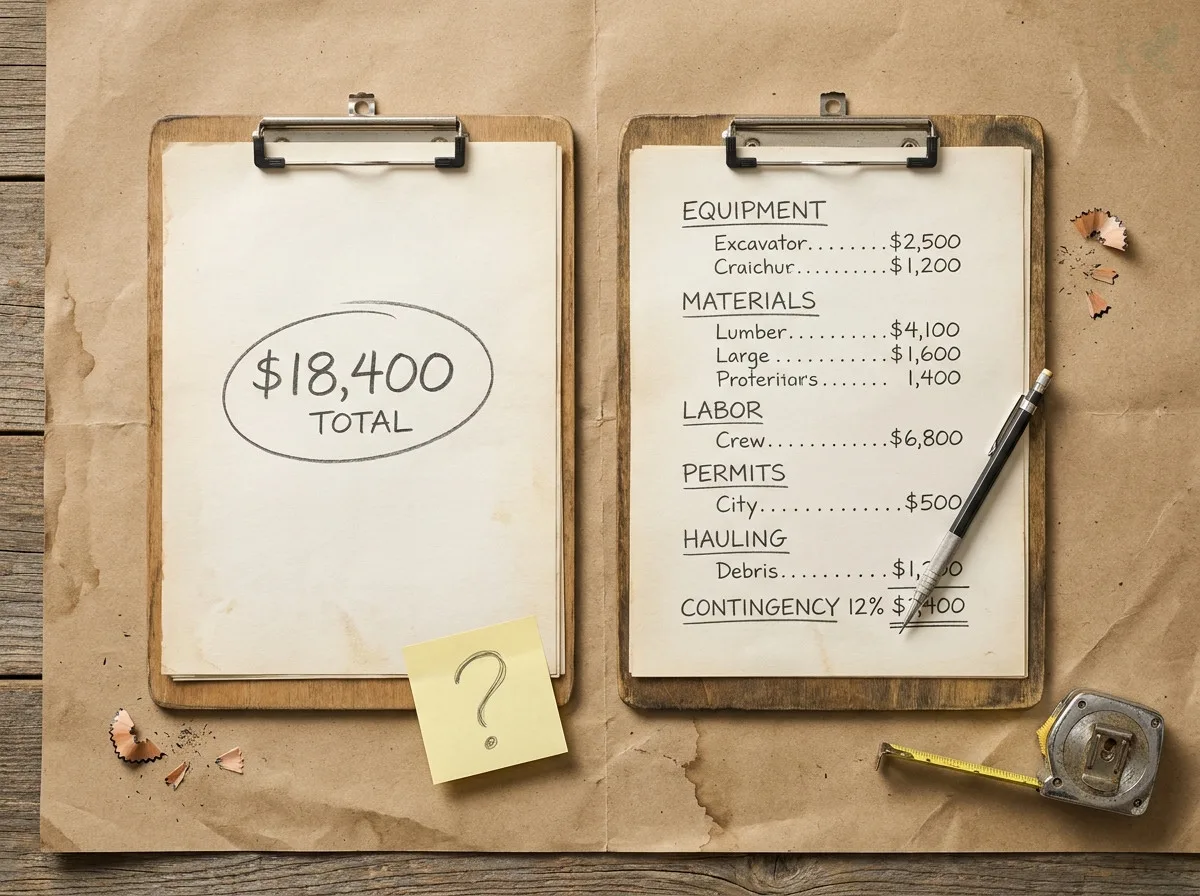
Residential Lot Regrading — Sample Itemized Quote
Project: Backyard drainage + positive drainage slope away from foundation • Location: [County], NC
Equipment
Materials
Labor
Permits
Disposal / Hauling
Contingency (10-15%)
This is what a legitimate NC grading quote looks like. If you receive a quote missing any of these categories, ask for it before you sign.
Dollar figures are intentionally left blank — the structure is the artifact, not the rates, which vary by contractor, site, and market. A contractor who refuses to provide this level of detail is telling you something. See warning signs in a grading bid for what that refusal pattern usually signals.
How to Ask for Itemization Without Losing the Contractor
A professional itemizes without resistance. One who refuses is telling you something.
The friction most homeowners fear — “will asking for a breakdown insult them?” — rarely materializes with operators who run legitimate jobs. A professional has already done the math by line item to produce the lump sum. Asking them to show it takes five minutes.
The ask that works: send it in writing. Copy this to your contractor:
A contractor worth hiring answers “sure” and sends a revised quote within a day. A contractor who refuses — or who says “that’s just how we price it” without further explanation — is a red flag in NC grading quotes. Add it to your checklist.
While you’re asking, request a current listing your address as the job site. A professional has both ready without being asked.
Comparing Two Itemized Quotes Side-by-Side
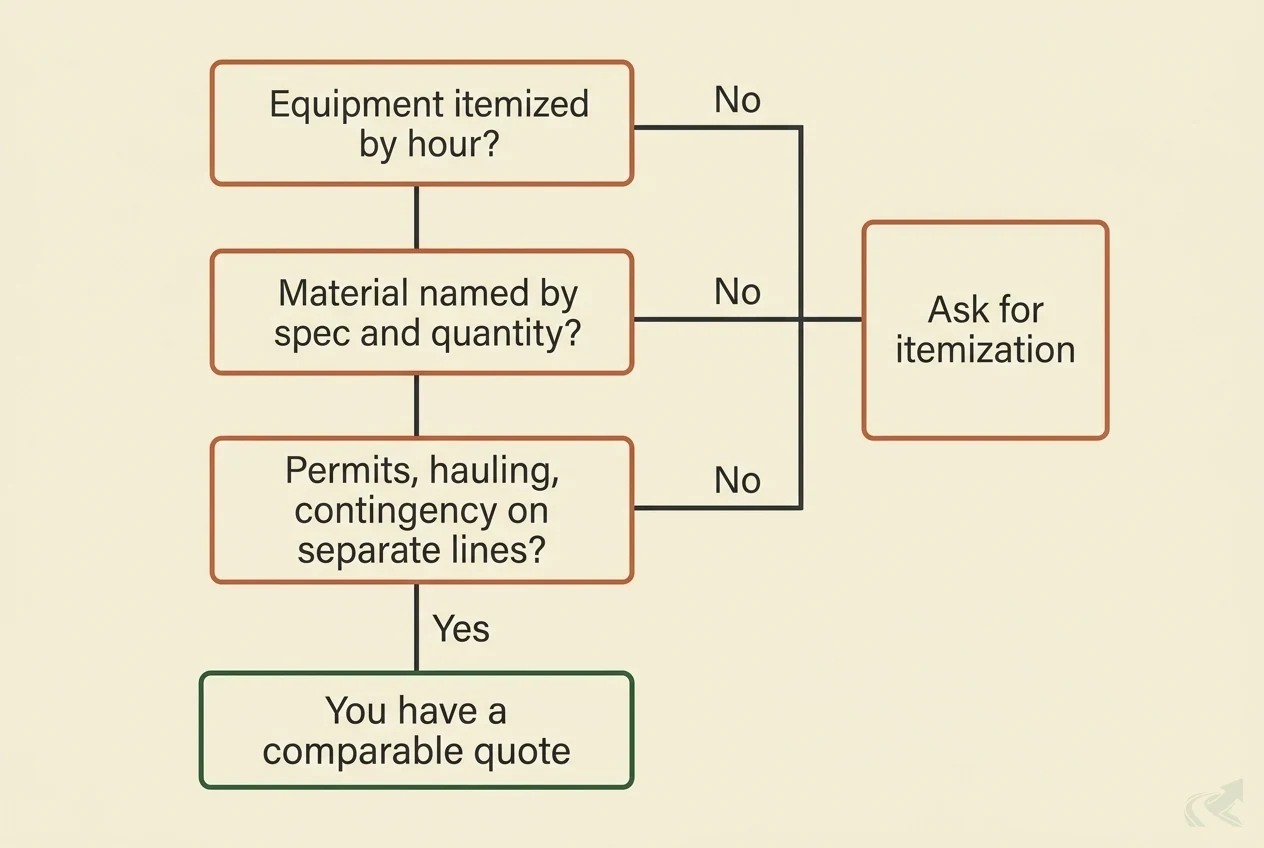
Itemized quotes let you compare line by line — not total by total.
Once you have two itemized quotes, the comparison is mechanical. Start at equipment and work down.
Equipment: Are they scoping the same machine count and hours? If contractor A has 8 CTL hours and contractor B has 12, ask contractor B why. Maybe the site is tighter. Maybe they’re padding. Maybe contractor A is under-scoped and will hit you with a change order on day two.
Materials: Are they quoting the same spec? ABC gravel and #67 stone are not interchangeable. If one contractor is quoting crusher run where the other is quoting NCDOT-spec ABC, the cheaper price per ton is not the same thing.
Hauling: Are they estimating the same number of loads? Excess cut material varies with the site — but wildly different load counts for the same scope deserves a question.
Contingency: One contractor includes 10%. The other doesn’t mention it. That doesn’t mean the second quote is cheaper. It often means the contingency is buried in the equipment or materials line, or they’re planning to call it a change order when conditions require it.
This is also when why two bids price the same job differently becomes useful — the bid-spread diagnostic walks through the mechanics of why quotes for identical scopes come back at 2-3x price spreads in NC Piedmont clay work.
Comparing two itemized quotes -- start at the top, work down
1. Equipment hours -- Are both quoting the same machine count and hours? A 4-hour gap on a CTL pass deserves a question -- one contractor may be under-scoped and planning a change order on day two. 2. Material spec -- ABC gravel, #67 stone, and crusher run are not interchangeable. A lower price per ton is not the same product. Make sure both quotes name the same material spec before comparing totals. 3. Hauling loads -- Excess cut material varies with the site. Wildly different load counts for the same scope means either one is guessing or the scopes are actually different -- find out which. 4. Contingency -- One contractor includes 10% as a separate line. The other doesn't mention it. That doesn't make the second quote cheaper -- it means the contingency is buried, or it arrives as a change order when conditions require it.
-
Equipment hours
Are both quoting the same machine count and hours? A 4-hour gap on a CTL pass deserves a question -- one contractor may be under-scoped and planning a change order on day two.
-
Material spec
ABC gravel, #67 stone, and crusher run are not interchangeable. A lower price per ton is not the same product. Make sure both quotes name the same material spec before comparing totals.
-
Hauling loads
Excess cut material varies with the site. Wildly different load counts for the same scope means either one is guessing or the scopes are actually different -- find out which.
-
Contingency
One contractor includes 10% as a separate line. The other doesn't mention it. That doesn't make the second quote cheaper -- it means the contingency is buried, or it arrives as a change order when conditions require it.
A quote missing any of these line items can't be compared honestly -- ask for the breakdown before you compare totals.
What the $40,000 License Threshold Means for Quotes
Projects above $40,000 require a licensed NC general contractor. Your quote total is one signal.
North Carolina requires any contractor performing work above $40,000 in contract value to hold a license issued by the . This threshold was raised from $30,000 in 2023 per NCGS §87-1.
If your itemized quote total is approaching or exceeds $40,000, verify the contractor’s GC license number before signing. You can look it up directly at the NCLBGC portal.
Two things to watch for:
- Quote splitting — a contractor who prices a single job as two separate sub-$40,000 contracts to avoid the licensing threshold. If the work is logically one project, the combined value applies.
- Unlicensed subs — a licensed often uses specialty subs. Ask who’s on-site and what their license status is.
The itemized quote makes this easier: the total is visible, the scope is named, and the contractor is on record for what they agreed to provide. For the full picture on what the licensing system covers, see NCLBGC license verification.
Ready to Request an Itemized Quote?
An itemized quote is not a special request. It’s the baseline expectation for any contractor quoting a professional grading job in North Carolina.
Use the clipboard card above to ask for it. When you have itemized bids in hand, the NC contractor vetting checklist covers the other questions to ask before you commit — license verification, COI, references, and permit history.
Hire a verified NC grading contractor who provides itemized quotes as a matter of course.