
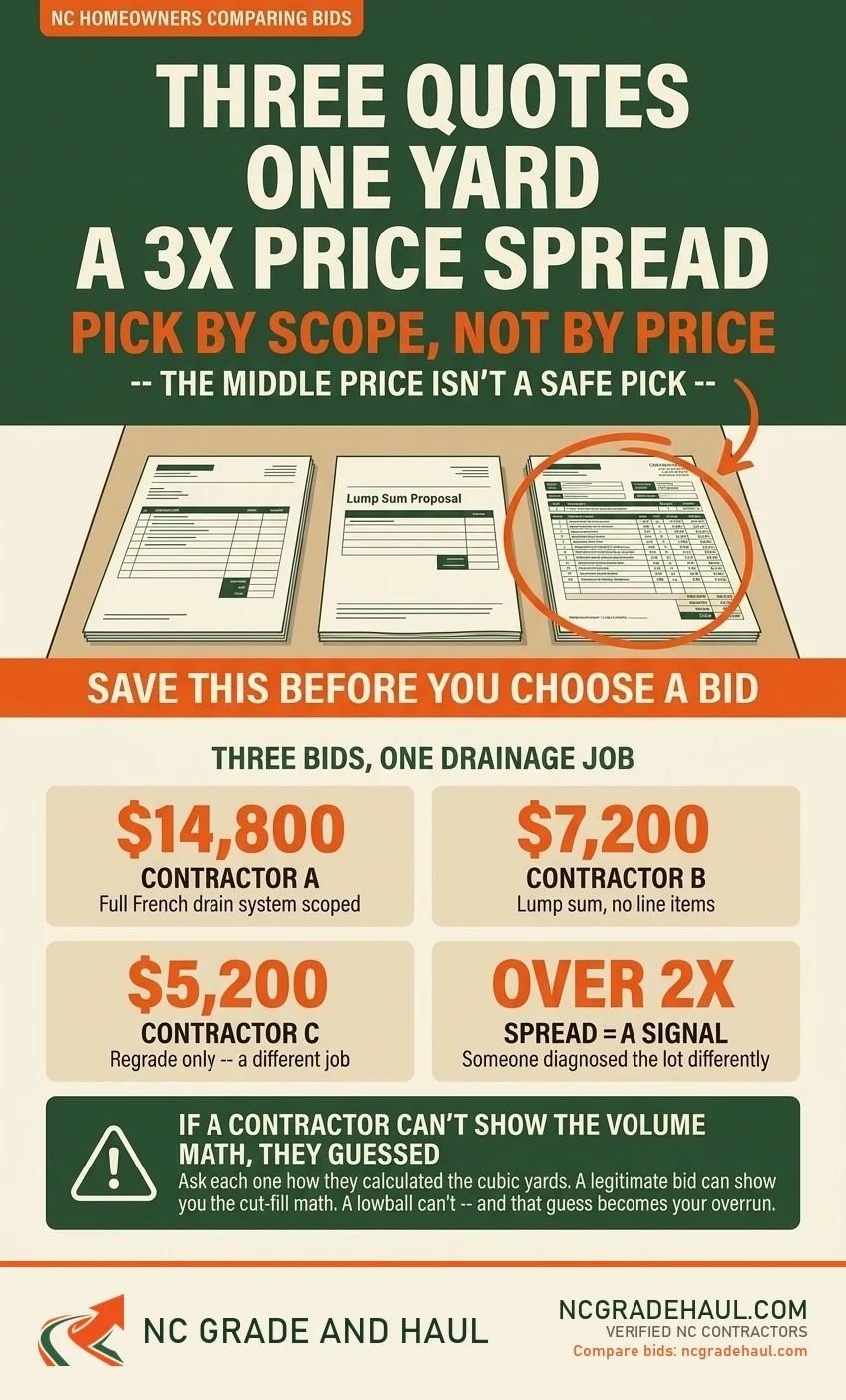
You asked three contractors the same question — “can you fix my yard drainage?” — and got three different answers with three different price tags. $14,800. $7,200. $5,200.
The problem isn’t the spread. The problem is that you don’t know which answer is right for your lot. Before you pick a number, you need to figure out which contractor actually diagnosed your yard.
Step 1 — Check the Scope, Not the Total
If two quotes list different scopes, you’re comparing two different jobs. The price difference tells you nothing until you reconcile what each contractor actually proposed to do.
Pull out all three quotes and look for these specific details:
- Square footage or cubic yards stated? A quote that says “grade the yard” versus one that says “regrade 2,400 sq ft, move approximately 45 cubic yards of Piedmont clay, establish 2% slope toward street” — those are not the same quote.
- Drainage destination named? “Install French drain” tells you nothing about how French drain systems NC actually behave in Piedmont clay. “Daylight a 4-inch perf pipe to the swale at the property boundary” tells you where the water actually goes.
- Compaction method stated? “Grade and seed” will settle after the first rain. “Compact in 6-inch lifts with vibratory plate, proof-roll before seed” won’t.
Most low-budget grading quotes skip the compaction spec entirely — leaving you to solve yard drainage solutions NC all over again after the first heavy rain.
A one-line quote vs a quote that names the scope
Comparison. Itemized quote: Square footage and cubic yards of clay to be moved; Compaction spec -- lift depth, equipment, proof-roll; Drainage destination named, not just "French drain"; Material type and haul-off broken out as line items. One-line lump sum: "Grade yard and drainage" and a single price; No volume math behind the number; No compaction spec -- grade shifts after the first rain; Nothing the contractor can be held to after mobilization.
- Square footage and cubic yards of clay to be moved
- Compaction spec -- lift depth, equipment, proof-roll
- Drainage destination named, not just "French drain"
- Material type and haul-off broken out as line items
- "Grade yard and drainage" and a single price
- No volume math behind the number
- No compaction spec -- grade shifts after the first rain
- Nothing the contractor can be held to after mobilization
Pick by scope specificity, not by price -- the most itemized quote came from the contractor who actually diagnosed your lot.
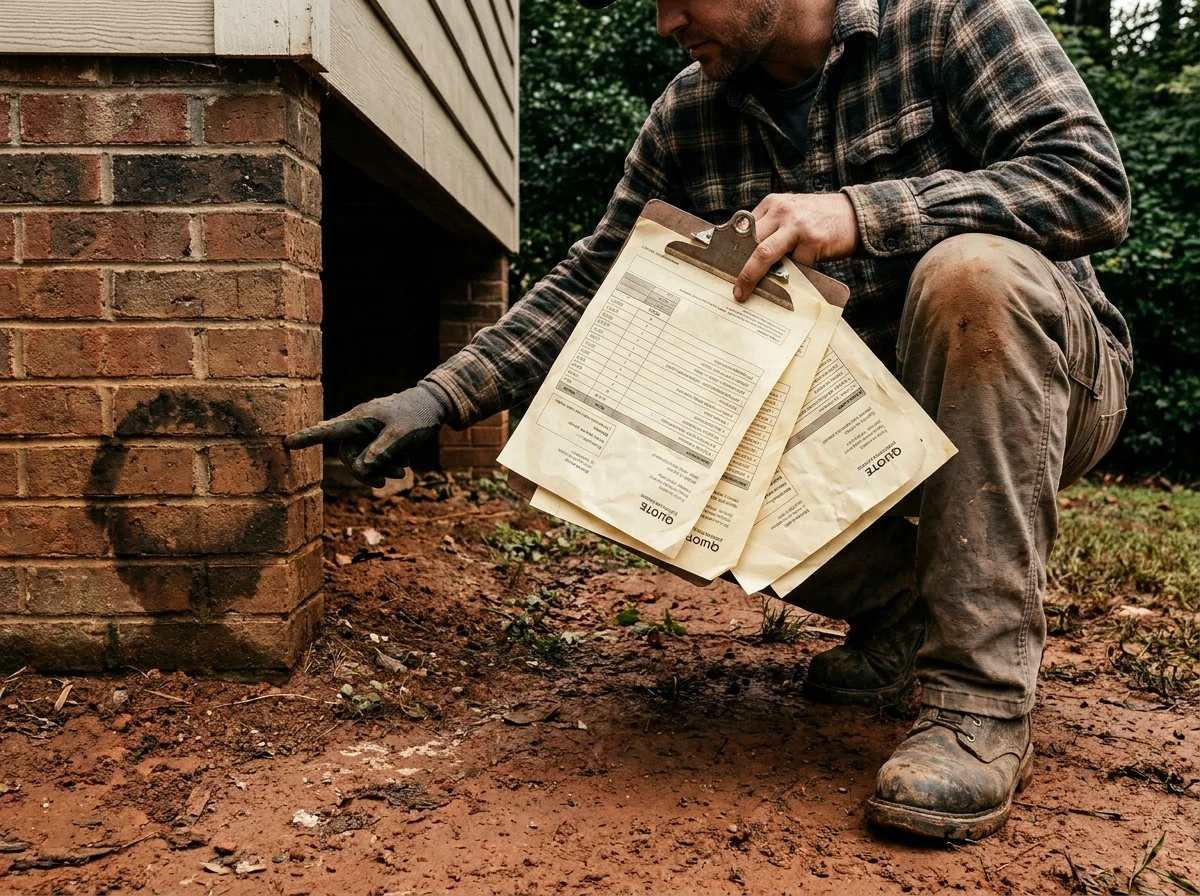
Step 2 — Reconcile the Volume Calculation
Ask each contractor to walk you through their volume estimate — how many cubic yards do they plan to move, and how did they arrive at that number?
A legitimate grader — the kind you can find when you hire a verified NC grading contractor — has done a cut-fill calculation. They know approximately how much Piedmont clay moves out (cut) and how much needs to come back in (fill). A contractor who “eyeballed it” during a 10-minute walkthrough probably hasn’t run the numbers.
What to ask: “Can you show me how you calculated the cubic yards?”
A good answer sounds like: “I measured the low point at X and the high point at Y, figured about Z yards of cut to get you to a 2% slope with positive drainage toward the street.”
A bad answer sounds like: “I’ve done a lot of these, I know what it costs.”
If a contractor can’t explain the math, they haven’t done the math. That’s what gets you a 3x overrun after mobilization.
Step 3 — Read the Line Items
An itemized quote protects you by making promises specific — each line item is a commitment the contractor can’t walk back after mobilization.
What to look for line by line:
- Mobilization — a reasonable flat fee on a residential job; becomes a red flag if it’s 30% or more of the total on a small residential regrade
- Equipment — does it name the machine? A skid steer, track hoe, and motor grader are three different tools for three different jobs
- Material — if fill is coming in, what kind? Structural fill, screened topsoil, and red clay each have different compaction properties
- Haul-off — if cut material leaves the site, who pays for disposal and where does it go?
- Erosion control — is silt fence and seeding included? North Carolina’s regulations require erosion controls for most ground disturbances over 10,000 square feet — confirm with your county, as thresholds can differ at the local level
Lump-sum bids aren’t necessarily dishonest. The problem is you lose the ability to verify whether the work matched the agreement. See what a line-item grading quote should contain for the full line-item breakdown.
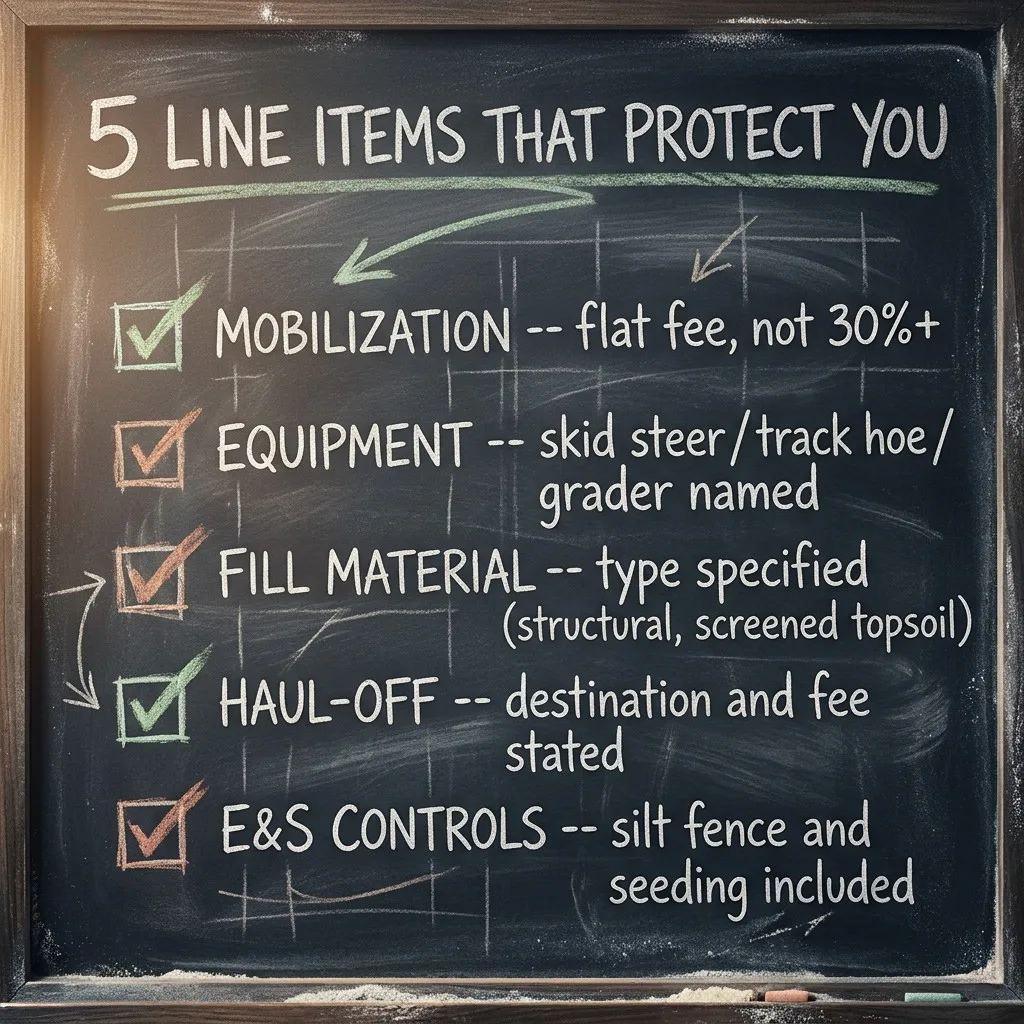
Line items that protect you vs a number that doesn't
Comparison. What a real line item commits to: Mobilization stated as a flat, justifiable fee; Equipment named -- skid steer, track hoe, or grader; Fill material specified by type, not just "gravel"; Erosion control and haul-off each their own line. What a vague total hides: A single price with no breakdown behind it; No way to verify the work matched the agreement; Missing E&S controls that NC rules may require; Padding -- like a 30%-of-total mobilization fee -- is invisible.
- Mobilization stated as a flat, justifiable fee
- Equipment named -- skid steer, track hoe, or grader
- Fill material specified by type, not just "gravel"
- Erosion control and haul-off each their own line
- A single price with no breakdown behind it
- No way to verify the work matched the agreement
- Missing E&S controls that NC rules may require
- Padding -- like a 30%-of-total mobilization fee -- is invisible
Each line item is a promise the contractor can't walk back after mobilization -- a bundled total gives up that leverage.
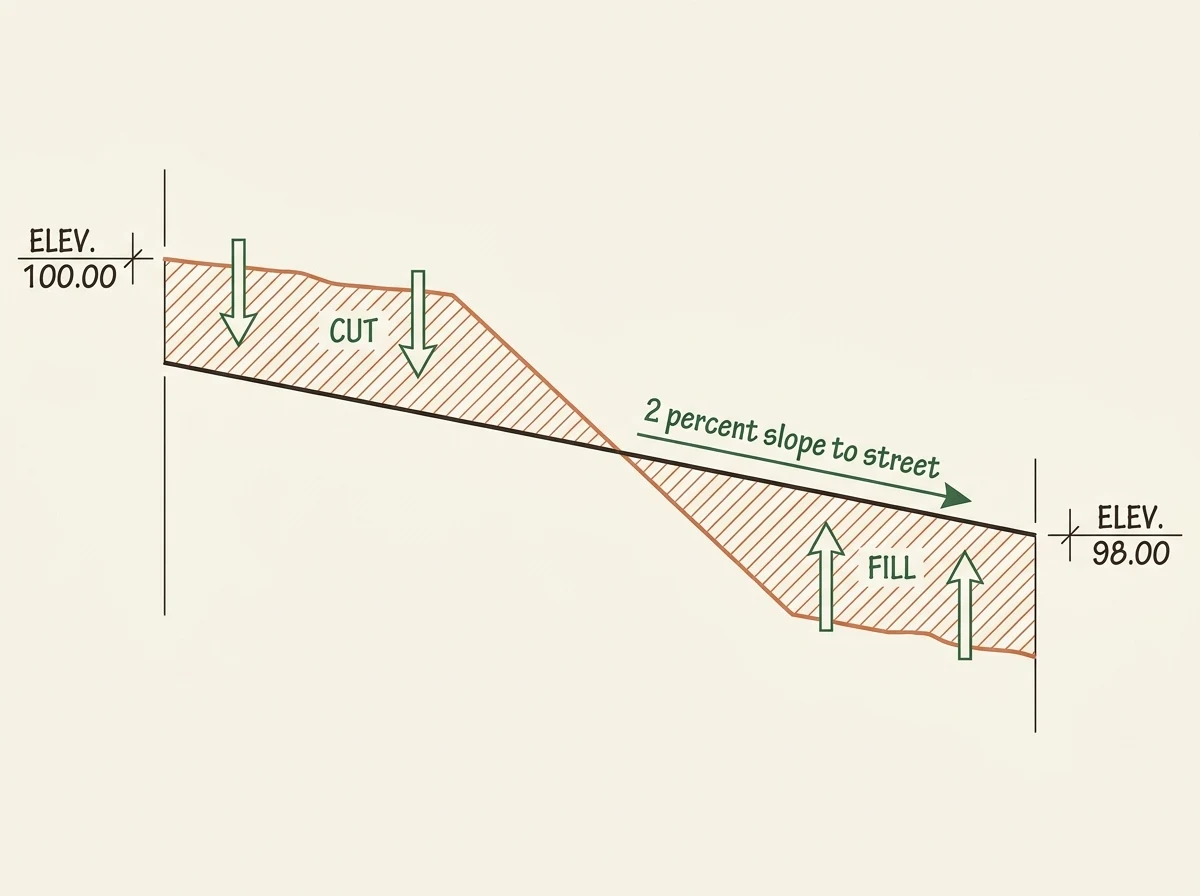
Step 4 — The Bid-Spread Diagnostic
If the spread is more than 2x between high and low bids, someone diagnosed your lot differently — or someone didn’t diagnose it at all.
A wide spread is actually diagnostic data. Here’s what’s usually behind it:
- Spread from different scope: Contractor A plans to install a full French drain system with daylit outlets. Contractor C plans to regrade only. Same yard, completely different fix.
- Spread from padding: Contractor A’s mobilization is $4,200. Contractor B’s is $1,800. Ask both to justify it.
- Spread from lowball: Contractor C’s price assumes no haul-off, no E&S controls, and self-compacting Piedmont clay. None of those assumptions hold in NC.
When the spread is over 3x, get a fourth quote — or ask Contractor C to scope-match. “Can you price it with the same drainage spec as Contractor A?” puts all three on comparable footing.
Read more about how to interpret a wide bid spread — that page covers the diagnostic interpretation after you’ve worked through the scope reconciliation here.
The One Flag That Kills a Bid Outright
If a contractor can’t give you an active license number when asked, stop the evaluation process.
Price comparison is secondary to qualification. Before comparing line items, confirm each contractor has:
- An active NC license — verify directly at the NCLBGC portal (nclbgc.org), not just their word
- A with general liability coverage that names your project
Everything else — the spread, the scope, the line items — only matters if you’re comparing licensed, insured contractors.
See red flags that kill a bid outright and NC contractor licensing requirements for the full qualification checklist.
The Comparison Matrix — What’s in a Vague Bid vs a Good One
Quote quality by what's on the page -- three tiers
| Line item | Lump-sum bid | Adequate itemized bid | Detailed itemized bid |
|---|---|---|---|
| Scope statement | "Grade yard and drainage" | Area named, approximate fix described | Square footage, slope target, drainage destination |
| Volume estimate | Not present | General cubic yards mentioned | Cut-fill calculation with low/high point measurements |
| Compaction method | Not present | "Compacted" stated | Lift depth, equipment named, proof-roll specified |
| Drainage destination | Not present | "French drain" named | Pipe diameter, daylight point, swale connection |
| Material type | Not present | Fill type named (ABC, structural fill) | Material spec with source or supplier |
| Haul-off | Not stated | Yes/No stated | Destination and fee structure named |
| Mobilization fee | Bundled into total | Flat fee stated | Flat fee + equipment list |
| E&S controls | Not present | "Silt fence" listed | Silt fence, seeding spec, NC permit reference if applicable |
Scope statement
- Lump-sum bid
- "Grade yard and drainage"
- Adequate itemized bid
- Area named, approximate fix described
- Detailed itemized bid
- Square footage, slope target, drainage destination
Volume estimate
- Lump-sum bid
- Not present
- Adequate itemized bid
- General cubic yards mentioned
- Detailed itemized bid
- Cut-fill calculation with low/high point measurements
Compaction method
- Lump-sum bid
- Not present
- Adequate itemized bid
- "Compacted" stated
- Detailed itemized bid
- Lift depth, equipment named, proof-roll specified
Drainage destination
- Lump-sum bid
- Not present
- Adequate itemized bid
- "French drain" named
- Detailed itemized bid
- Pipe diameter, daylight point, swale connection
Material type
- Lump-sum bid
- Not present
- Adequate itemized bid
- Fill type named (ABC, structural fill)
- Detailed itemized bid
- Material spec with source or supplier
Haul-off
- Lump-sum bid
- Not stated
- Adequate itemized bid
- Yes/No stated
- Detailed itemized bid
- Destination and fee structure named
Mobilization fee
- Lump-sum bid
- Bundled into total
- Adequate itemized bid
- Flat fee stated
- Detailed itemized bid
- Flat fee + equipment list
E&S controls
- Lump-sum bid
- Not present
- Adequate itemized bid
- "Silt fence" listed
- Detailed itemized bid
- Silt fence, seeding spec, NC permit reference if applicable
Common Mistakes
Choosing the middle price by default. Middle price doesn’t mean middle quality — it means someone bid $4,000 under the detailed contractor without showing why.
Not asking for volume math. If a contractor can’t explain how they got to their cubic-yard estimate, they guessed. That guess becomes your problem during construction.
Comparing totals without reconciling scope. Two quotes pricing two different jobs is not a comparison. It’s two contractors solving two different problems at two different prices.
Ignoring the mobilization line. On small residential jobs, a padded mobilization fee can account for half the spread between bids. Ask both high-bid and low-bid contractors to justify it.
Get a Verified Contractor’s Itemized Quote
The contractors listed on NC Grade and Haul are verified against active NCLBGC license status. When you hire a verified NC grading contractor, you start the evaluation process knowing the baseline qualification question is already answered.
Ask any contractor on our directory for an itemized quote — not a single number, not a “free estimate.” A line-item quote with cubic yards, compaction spec, and drainage destination named.
Questions to Copy and Text to Each Contractor
Scope-clarification questions — copy and send to each contractor
Question 1 — Volume math
”How many cubic yards are you estimating for this job, and how did you calculate that?”
Question 2 — Haul-off
”Is haul-off included in this price? Where does the material go?”
Question 3 — Compaction spec
”What’s your compaction spec? How are you verifying it?”