
Before you call a contractor
Why do my grading quotes disagree by 3x?
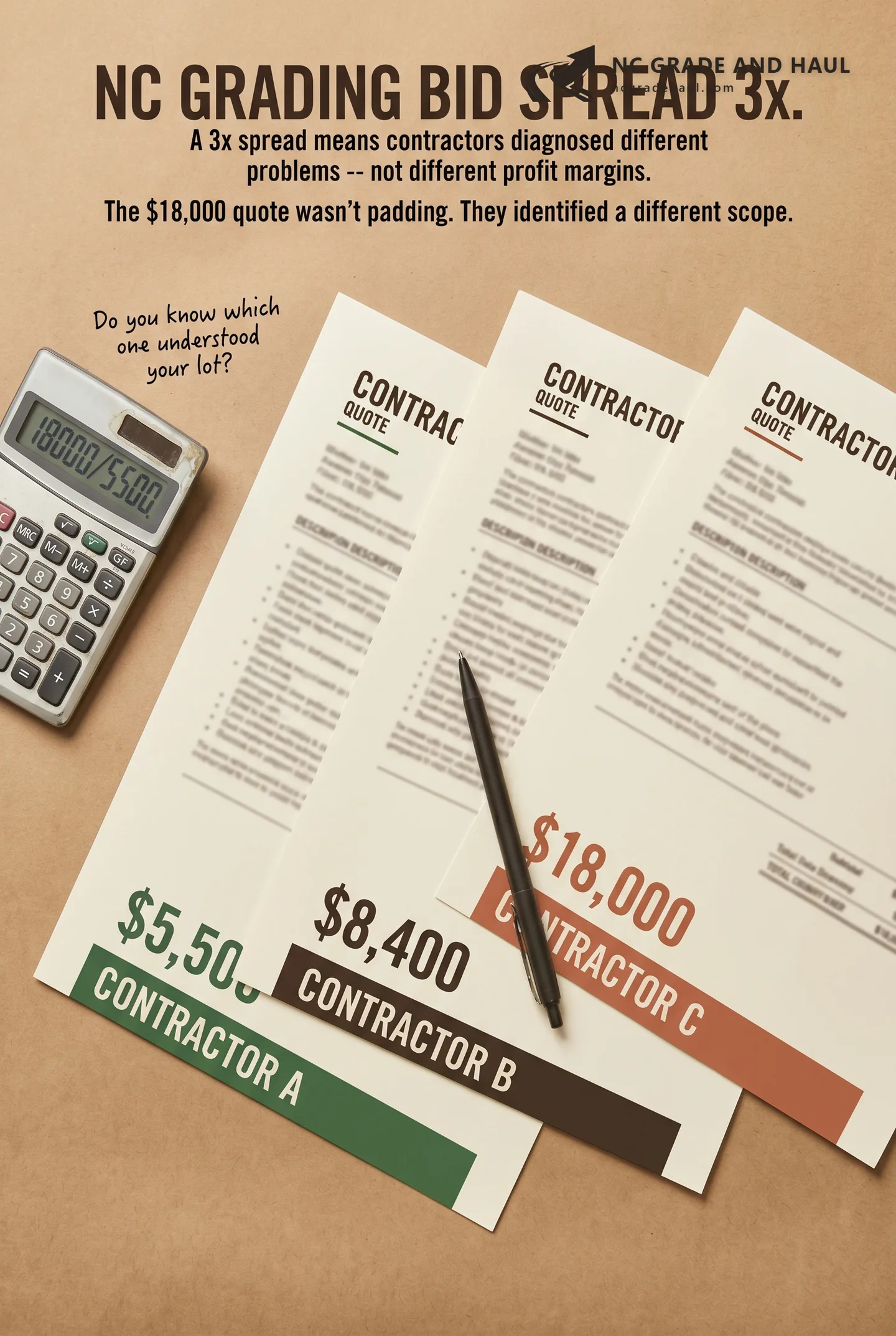
Usually one of three reasons: they scoped different work, they diagnosed different problems, or one didn't really assess your lot at all. Price tells you very little until you know what each contractor actually proposed to do.
Which one should I pick?
The one who can explain their diagnosis in specific terms -- what they saw, what they plan to fix, and why their approach works in NC Piedmont clay. Price is a byproduct of diagnosis, not a starting point.
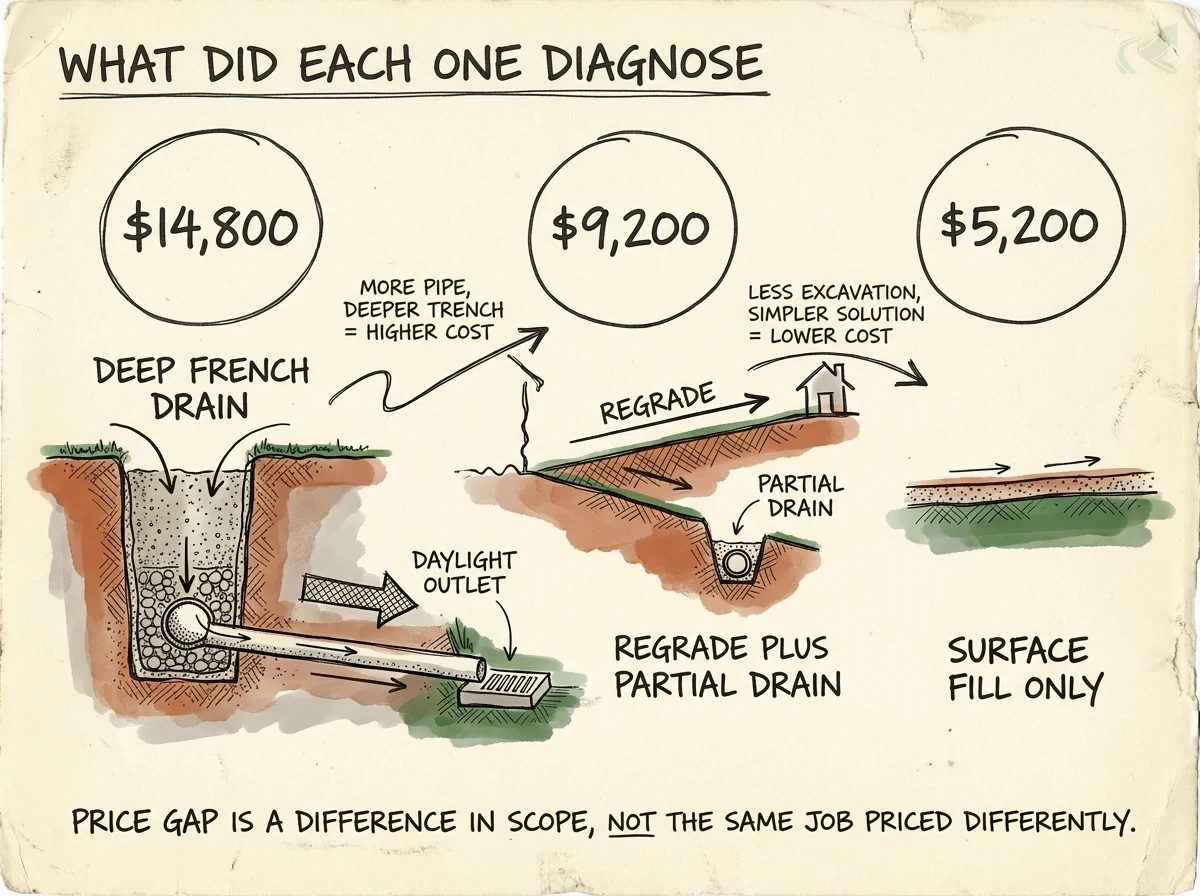
Contractor A: $14,800. Contractor B: $9,200. Contractor C: $5,200. Three quotes, same week, same yard, same question.
Most advice stops at “get three quotes.” Nobody explains what to do when those three quotes land 3x apart and tell three completely different stories about what’s wrong with the lot.
That’s what this page is for. The spread is a clue — and once you know how to read it, you’ll know which contractor actually understood the problem.
The Three Reasons Bids Disagree
Bids disagree for three reasons — different scope, different diagnosis, or one contractor didn’t actually assess your lot.
Different scope: Contractor A includes a French drain to daylight, downspout extensions, and full regrading. Contractor C includes regrading only. They’re pricing two different projects. Neither is lying. They just heard different versions of “fix my drainage.”
Different diagnosis: Contractor A believes the water problem comes from a high clay-water table at 18 inches. Contractor C thinks it’s a surface grading problem fixable with 6 inches of compacted fill graded to a 2% slope. Both diagnoses can be internally consistent — the question is which one matches your actual lot.
No real assessment: Contractor C spent 12 minutes on site and quoted from the driveway. Contractor A spent 45 minutes probing the soil and tracing the drainage path. The price difference often reflects the assessment quality, not the work quality.
The cheapest quote isn’t always the lowball. But the quote from the contractor who spent 12 minutes on your lot usually is.
The Diagnostic-Variation Reframe
When bids diverge 3x, they’re not pricing the same job differently — they’re answering different questions about what’s wrong with your yard.
Emily asked “can you fix my drainage?” That’s a vague question. Each contractor answered a slightly different version of it based on what they observed — or assumed — on the property.
To make the divergence productive, ask each contractor two questions directly:
- “What specifically do you think is causing the drainage problem?”
- “What would happen to the standing water if you did only what’s in your quote — nothing more?”
Their answers reveal whether they’re solving the same problem or different ones.
If Contractor A says “your lot has a high clay-water table that needs a deep French drain to a daylight point” and Contractor C says “you need about 4 inches of fill compacted to 2% slope to redirect surface flow” — those are different diagnoses, not different prices. One of them is right. Your job is to figure out which one matches what you’re actually seeing on the ground.
How to Tell If It’s Padding vs. a Real Difference
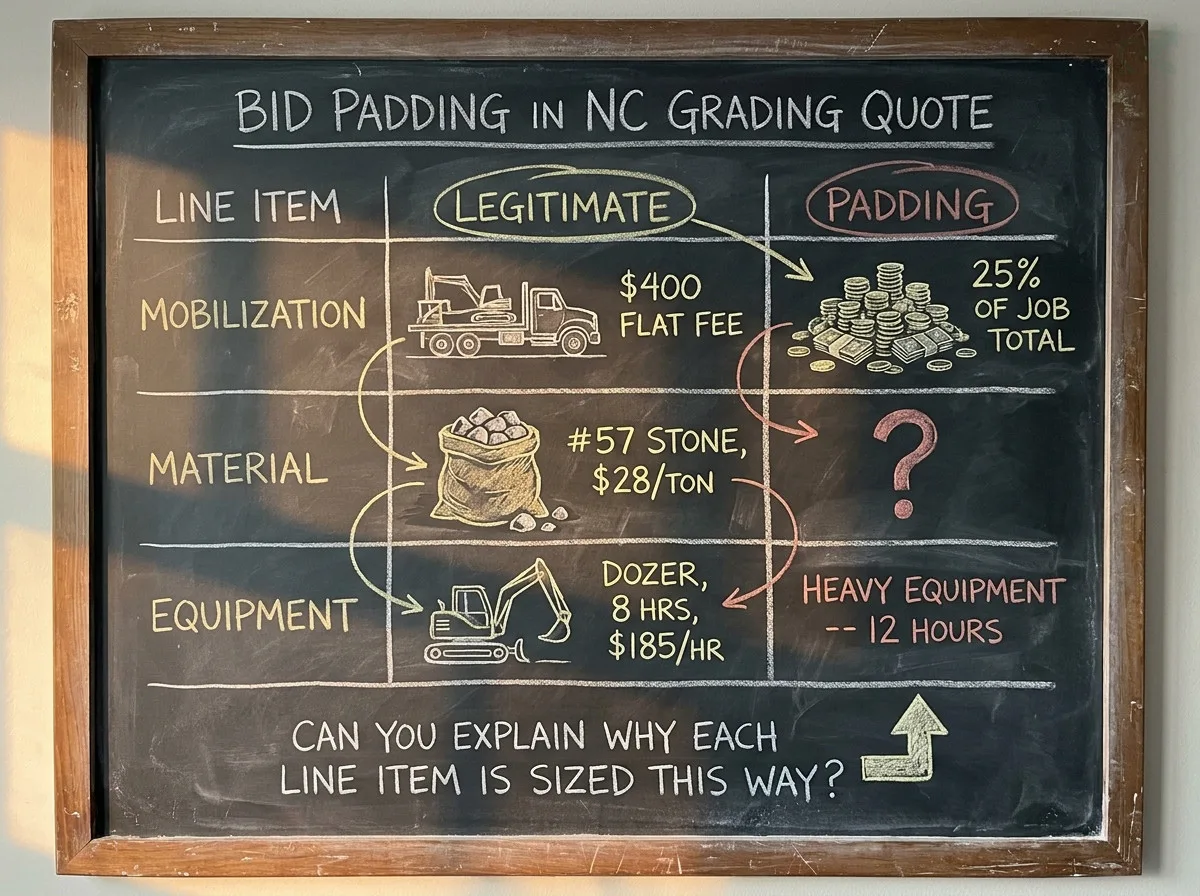
Padding shows up as inflated line items — typically mobilization, material markup, or equipment hours — that can’t be explained by what the contractor actually observed on your property.
Three places padding typically appears in North Carolina grading bids:
Mobilization: A legitimate mobilization fee covers moving equipment to your site. For a residential job within 30 miles of a contractor’s yard, mobilization should be a flat fee — not 25% of the project total. [Typical NC Triangle residential grading mobilization ranges $300—$800 for standard hauls; verify with your bids.]
Material markup: If a bid includes “drainage aggregate” at a dollar amount per ton without naming the material type — CABC, #57 stone, #67 stone — you can’t verify whether the markup is fair. Ask for the material spec and the supplier name.
Equipment hours: A bid that says “heavy equipment — 12 hours” without naming the machine is unverifiable. Ask: what machine, what operator rate, and what’s the planned task breakdown per hour?
The diagnostic question that separates padding from real scope: “Can you explain why each major line item is sized the way it is?” A contractor who walked your lot and planned the job can answer this. A contractor who padded from a template usually can’t.
For a full walkthrough of what an itemized quote breakdown should include, and why line-item quotes expose bid spread causes more clearly than lump-sum, see the linked page.
The Tiebreaker — How to Find Out Which Diagnosis Is Right
The fastest tiebreaker is a 30-minute follow-up with each contractor where you ask them to explain the specific problem they’re solving.
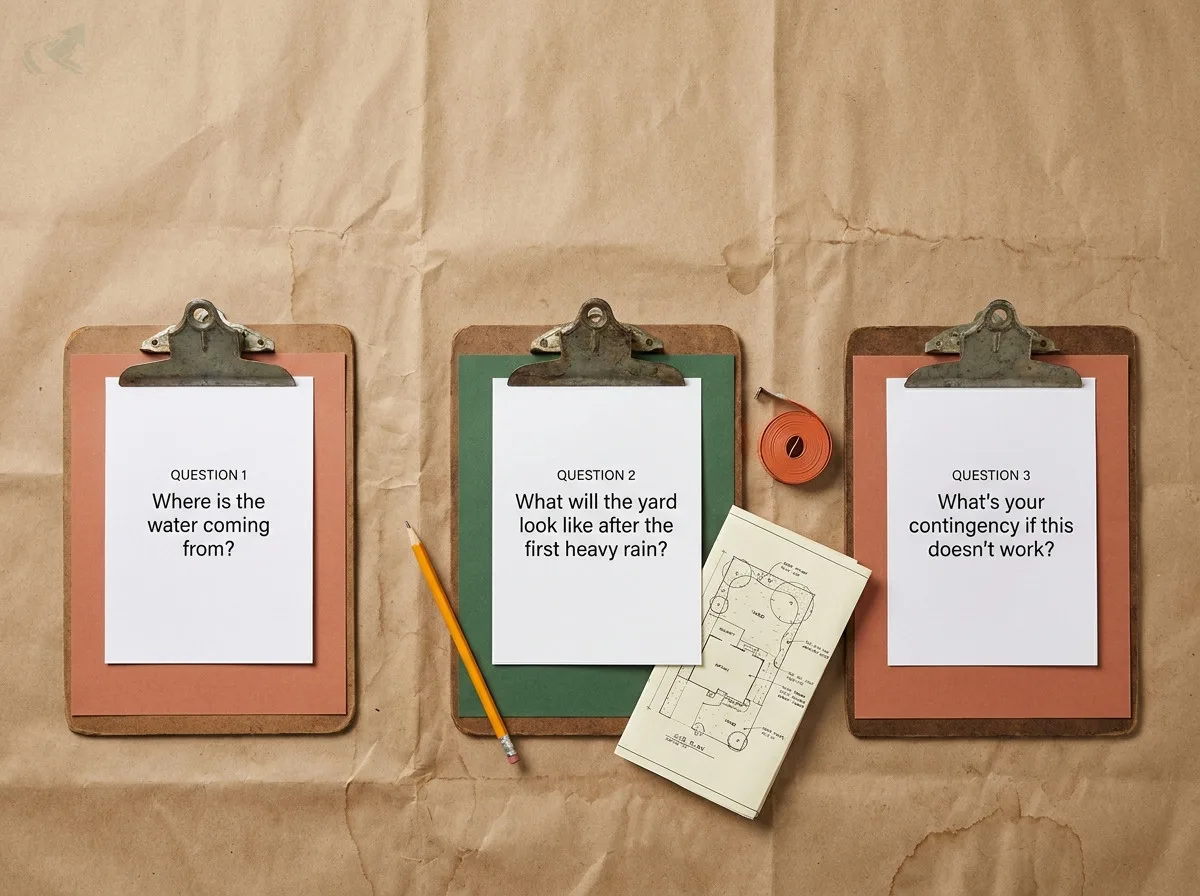
Three tiebreaker questions to put to each contractor:
1. “Can you show me where the water is coming from?” A contractor who walked the lot thoroughly can point to the source — high-clay water table, failed downspout discharge, insufficient slope, or a low point collecting neighbor runoff. One who didn’t can’t.
2. “What will the yard look like after the first heavy rain?” Make them describe the outcome, not the process. Vague answers (“it should drain better”) mean the contractor hasn’t thought past the work itself. A specific answer tells you they modeled the result.
3. “What’s your contingency if this fix doesn’t solve it?” Legitimate North Carolina grading contractors have an answer — either a follow-up diagnostic scope or a plan to extend the drain path. “It’ll work” without a contingency is a flag.
The contractor who answers all three in specific terms — and whose answers match what you’ve observed on your own property — is your candidate. Price comes after you’ve verified diagnosis.
See also: how to evaluate 3 grading quotes for a step-by-step process once you’ve narrowed the field, and which bid actually understood your project for the scoring framework.
When the Spread Is Still Unexplained After All This
If two contractors have equally specific diagnoses and equally itemized quotes and their prices are still 2x apart, ask for a fourth quote from a contractor who has reviewed the other proposals first.
This is the tiebreaker approach. A fourth NC grading contractor who has seen both prior proposals and can explain why they diverged is worth a diagnostic visit. Some grading contractors in North Carolina offer a paid 1-hour site assessment that produces a written diagnostic rather than an immediate quote — useful when the diagnosis itself is contested. [Verify availability with contractors in your market; not all offer this.]
To find verified contractors in your area: NC grading contractor near me.
Bid-Spread Diagnostic Matrix
Use this table to categorize each contractor’s proposal before comparing prices.
| Signal | Scope Mismatch | Diagnosis Mismatch | Likely Padding |
|---|---|---|---|
| Observable signal | One proposal includes French drain; another doesn’t mention drains | Both address drainage but disagree on root cause | Line items exist with no field-observable justification |
| Question to ask | ”What exactly is included in your quote?" | "What specifically is causing the drainage problem?" | "Can you explain why this line item is sized this way?” |
| What a real answer looks like | Itemized list with material specs and linear footage | Named cause — water table depth, slope failure, discharge point | Named material, named machine, named task with hour estimate |
| What a vague answer looks like | ”We’ll take care of everything" | "Your yard just needs fixing" | "That’s just how we price it” |
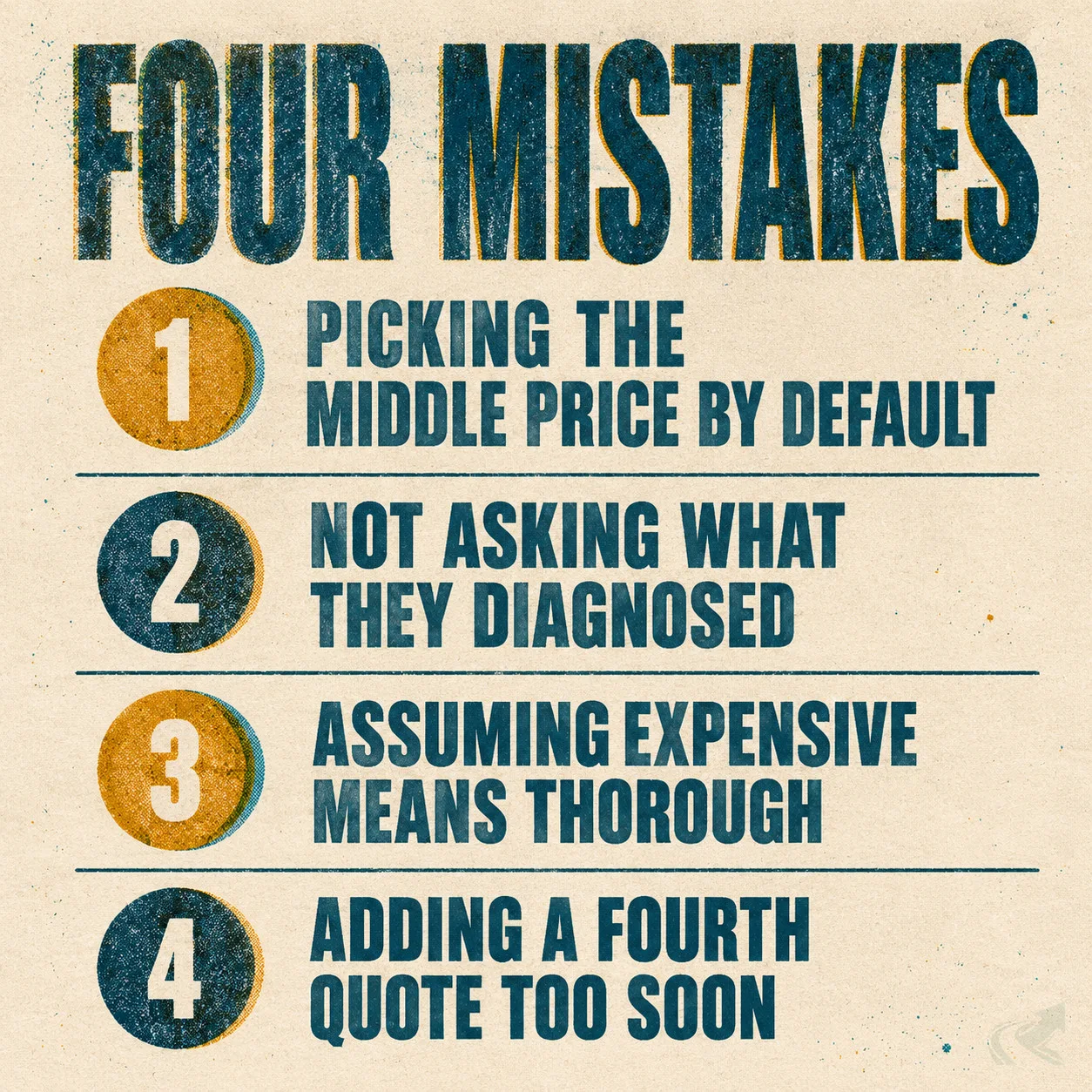
Common Mistakes When Comparing Grading Bids
Picking the middle price by default. The middle price doesn’t mean middle quality or middle scope. It may mean middle padding. Scope alignment matters more than price position.
Not asking what they diagnosed — only what they’ll do. Scope without diagnosis is a guess. If a contractor can’t tell you what’s causing the NC yard drainage solutions problem, they’re proposing a fix to an unknown source.
Assuming the expensive quote is the real one. Padding is real and common in NC residential grading. Expensive doesn’t mean thorough — and cheap doesn’t mean underpowered if the diagnosis is correct and the scope matches.
Getting a fourth quote before understanding the first three. More quotes don’t clarify if you can’t evaluate the ones in hand. Work through the tiebreaker questions with the first three before adding another contractor to the stack.
If your property also has foundation water intrusion, make sure the grading proposals specifically address slope away from the foundation — a drainage fix that doesn’t protect the foundation grade is an incomplete solution.
Three Questions to Send Each Contractor Right Now
Copy and paste to text or email each contractor:
- What specifically do you think is causing the drainage problem on my lot — and where is the water coming from?
- What will the yard look like after the first heavy rain if you do exactly what’s in your quote — nothing more?
- If the fix doesn’t fully resolve the standing water, what’s your contingency?
Contractors who answer specifically are diagnosing. Contractors who answer vaguely aren’t. That gap usually explains more of the price spread than material cost or equipment rates.