
Two questions NC homeowners ask about scheduling
What time of year should I book grading in NC?
Late spring through early fall -- roughly May through October -- is the best window for most NC grading work. Ground is dried from winter, rain events are schedulable around, and compaction holds. Expect 4-8 weeks lead time; quality operators book out.
Is a contractor offering same-week starts in January a red flag?
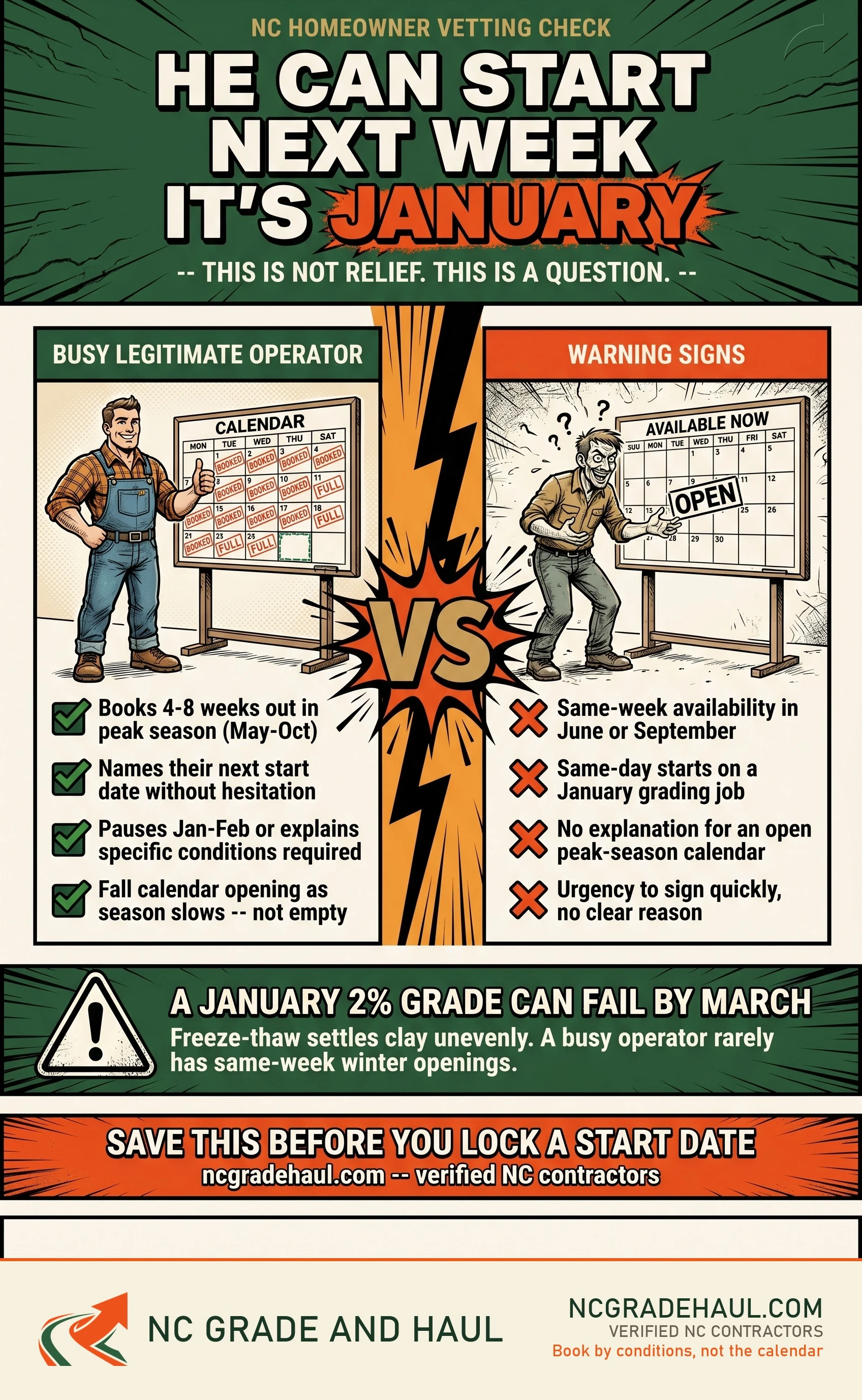
Often yes. Piedmont clay is freeze-thaw compromised January through February. A busy, legitimate operator rarely has same-week availability in winter. If someone's offering same-day starts on a sizable grading job in January, ask why their calendar is open.
Priya got a quote she likes. The contractor called back Thursday and said he can start next week. It’s January. She doesn’t know whether to feel relieved or suspicious.
That instinct — the pause before saying yes — is worth listening to. North Carolina grading has five distinct scheduling contexts, and the timing of a contractor’s availability tells you something a quote sheet can’t. This page maps each seasonal window, explains why Piedmont clay makes January a different animal, and names why post-Helene WNC operates under entirely different rules than the rest of the state.
The Five NC Grading Seasons
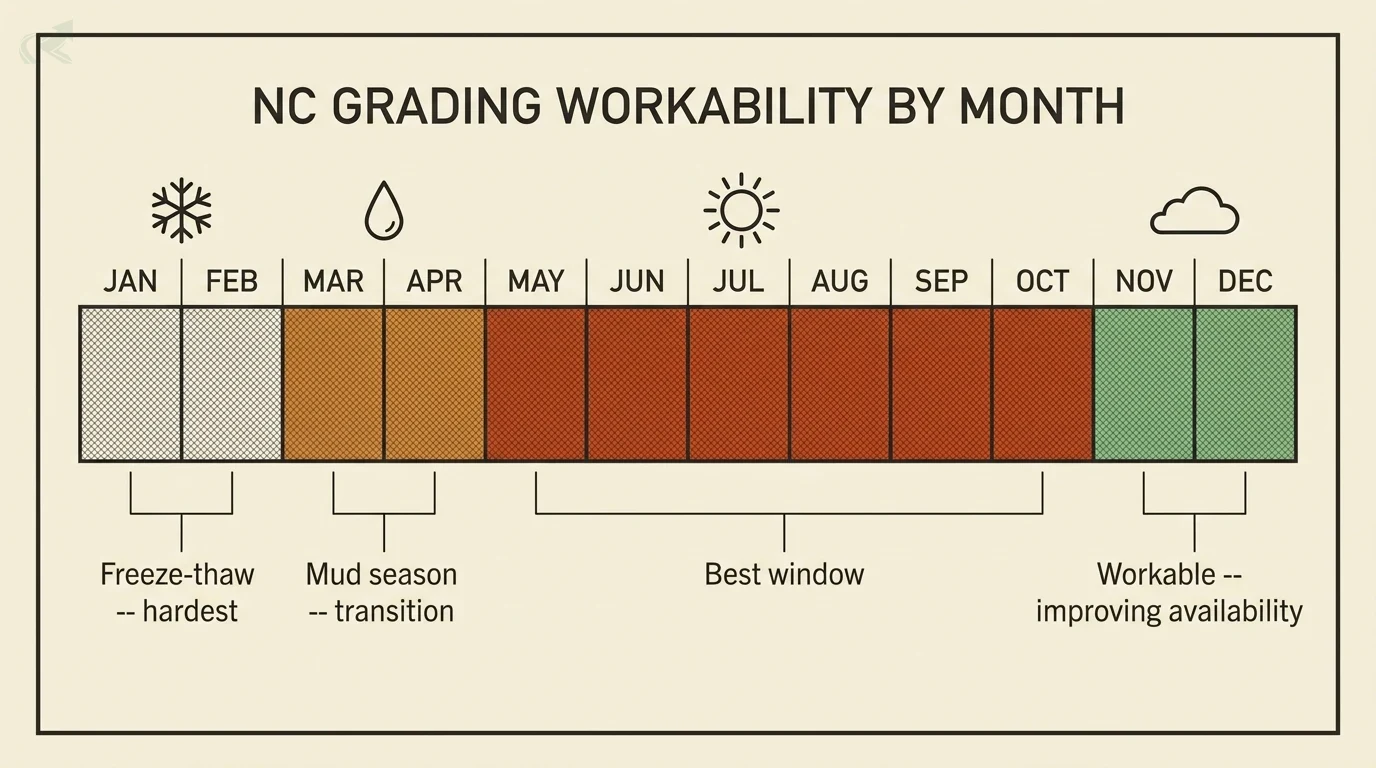
NC grading has five distinct scheduling contexts — one ideal, two workable, one hard, one surge-only.
North Carolina spans three physiographic zones, and each zone runs on a different seasonal clock. A Piedmont contractor in Holly Springs operates around red clay and mild freeze-thaw. A WNC operator in Buncombe County deals with deeper freezes, shorter windows, and — since Helene — a backlog that makes normal scheduling logic irrelevant. A Coastal contractor near Wilmington works with sand-dominant soil that drains faster but sits inside hurricane season.
The matrix below frames all five contexts side by side. Prose for the two most consequential windows — the hardest (January—February) and the surge (WNC post-Helene) — follows in dedicated sections.
NC Grading Season Windows
| Factor | Best Window (May-Oct) | Workable (Nov-Dec) | Hardest (Jan-Feb) | Post-Disaster WNC |
|---|---|---|---|---|
| Ground workability | Dry, compaction reliable | Variable; rain delays possible | Freeze-thaw; inconsistent compaction | Varies; access-road damage common |
| Operator availability | Booked 4-8 weeks out | Often improving | Most available (some stop residential) | 6-12 month backlog in affected areas |
| Typical lead time | 4-8 weeks | 2-4 weeks | Same-week = warning sign | First available wins; no queue |
| Quote-quality risk | Low -- clear scope, dry site | Medium -- rain-delay clauses matter | Higher -- proof-roll reliability varies | Medium -- verify license even in surge |
| What to ask | Start date + itemized quote | Rain-delay policy + proof-roll plan | Why they can work now; conditions check | License number + COI before anything else |
Ground workability
- Best Window (May-Oct)
- Dry, compaction reliable
- Workable (Nov-Dec)
- Variable; rain delays possible
- Hardest (Jan-Feb)
- Freeze-thaw; inconsistent compaction
- Post-Disaster WNC
- Varies; access-road damage common
Operator availability
- Best Window (May-Oct)
- Booked 4-8 weeks out
- Workable (Nov-Dec)
- Often improving
- Hardest (Jan-Feb)
- Most available (some stop residential)
- Post-Disaster WNC
- 6-12 month backlog in affected areas
Typical lead time
- Best Window (May-Oct)
- 4-8 weeks
- Workable (Nov-Dec)
- 2-4 weeks
- Hardest (Jan-Feb)
- Same-week = warning sign
- Post-Disaster WNC
- First available wins; no queue
Quote-quality risk
- Best Window (May-Oct)
- Low -- clear scope, dry site
- Workable (Nov-Dec)
- Medium -- rain-delay clauses matter
- Hardest (Jan-Feb)
- Higher -- proof-roll reliability varies
- Post-Disaster WNC
- Medium -- verify license even in surge
What to ask
- Best Window (May-Oct)
- Start date + itemized quote
- Workable (Nov-Dec)
- Rain-delay policy + proof-roll plan
- Hardest (Jan-Feb)
- Why they can work now; conditions check
- Post-Disaster WNC
- License number + COI before anything else
Best Window — Late Spring Through Early Fall
May through October is the best window for most NC residential and light-commercial grading.
The Piedmont soil dries out from winter saturation by early May in most years. Piedmont clay — the red substrate that dominates Wake, Guilford, Mecklenburg, and most of the central counties — becomes fully workable after the mud-season transition. Compaction proof-rolls pass reliably, and grade-and-drain corrections hold through the summer.
Rain events still happen. Spring and summer NC weather includes regular afternoon thunderstorms. But the pattern is predictable enough that most operators schedule around it — a morning start, a rain-hold, back the next dry morning. That’s different from January, where a saturated clay site might not be workable again for a week.
The availability consequence is real. Quality operators in the Triangle, Charlotte, and Triad metros typically run 4-8 weeks of lead time from May through October. That number is directional, not guaranteed — project complexity and operator scale vary — but it’s the right expectation to set before you call. If your project targets a spring start, get your itemized quote now and lock the schedule.
Workable But Harder — Mid-Fall and Early Winter
November through December is viable in NC — shorter days and occasional saturation, but compaction is achievable and availability often improves.
This window is underrated. Homeowners pull back from scheduling as temperatures drop, which means operator calendars open up. The wait from quote to start date often shortens compared to peak season. Some operators note that fall can mean better responsiveness than the summer booking frenzy.
The risks are real but manageable. Saturated clay after a heavy fall rain can delay a job by two to four days — not weeks, assuming the contractor is monitoring conditions and comes back when the site dries. Shorter daylight limits the number of productive hours per day, which can stretch a multi-day project across more calendar days than the same job in July.
The key question to ask in this window: what’s your rain-delay policy, and do you proof-roll the subgrade before stone goes down? A contractor who gives you a straight answer on both — “I come back the next dry morning” and “yes, always” — is telling you they understand compaction. One who waves it off is telling you something else.
For the deeper trade-off analysis between dry-season and wet-season NC grading, see dry season vs wet season NC grading.
Hardest Window — January and February
Freeze-thaw plus saturated Piedmont clay makes January—February the window where compaction can’t be trusted — and where same-day availability is a warning sign.
North Carolina isn’t a deep-freeze state. The Piedmont doesn’t get the sustained below-zero temperatures that characterize the upper Midwest. But it gets enough freeze-thaw cycling — nights below 32, days warming into the 40s and 50s — to compromise the subgrade in ways that show up weeks later. A proof-roll on a January clay pad can look solid when the temperature is 48 degrees and the ground surface is dry. By March, when the subgrade goes through two more freeze-thaw cycles, that same pad has settled unevenly.
Good operators respond to this one of two ways. Some stop residential grading entirely in January and February — they shift to interior work, planning, or commercial jobs with engineered subgrade specs. Others will schedule if the forecast is bone-dry for ten or more days and temperatures stay above freezing overnight. Either approach is defensible. What’s not defensible is a contractor who says conditions don’t matter.
The same-day-start flag is the load-bearing vetting signal here. A busy, legitimate grading operator in Piedmont NC has a real calendar in January — not a same-week opening on a sizable job. If someone has that kind of availability in the hardest scheduling window, the question isn’t whether to feel relieved. The question is: why is their calendar open?
For the full list of signals that pattern identifies, see red flags in NC grading quotes. The same-day-start urgency is already catalogued there. This section is where it gets its mechanical explanation.
Regional note: WNC mountains freeze deeper and longer than the Piedmont — some operators there pause residential grading from December through March. Coastal NC sand drains and recovers faster than clay; the January freeze-thaw argument in this section applies primarily to the Piedmont. Coastal readers: the concern is storm drainage and hurricane recovery, not freeze-thaw.
Post-Disaster Surge — WNC After Helene
In Helene-affected WNC counties, normal scheduling logic doesn’t apply — backlog is months-long and the first legitimate operator who answers is often the one who’ll do the work.
The reports from homeowners in Buncombe, Henderson, and Rutherford counties in late 2024 and into 2025 were consistent: years of work ahead, operators booked deep, contractors answering phones who shouldn’t be. The scale of Helene’s damage to driveways, culverts, and land-drainage systems outpaced the regional contractor pool by a wide margin. As of early 2026, that backlog has not cleared.
In this environment, the normal three-quote comparison process breaks down. If you’re in an affected WNC county and you find a credible operator, the right move is to schedule them — not wait for two more quotes that may never materialize. The option set is genuinely thin.
Three vetting basics still apply even in surge conditions: a valid license number, a current , and a written itemized quote with scope defined. The post-disaster contractor who shows up without those three things is not a legitimate operator regardless of how backed up the market is.
Verify license status at the portal before any money changes hands. For the full vetting framework, see hire a grading operator in North Carolina. For the step-by-step post-hurricane booking workflow specific to WNC, see how to book grading after a NC hurricane.
Booking Timing as a Vetting Signal
The operator who books 4-6 weeks out in peak season is the busy one. The operator offering same-day starts in January is not.
This is the pattern. After walking through five seasonal windows, it becomes visible: legitimate operators have real calendars. They can tell you their next available start date without hesitation because they have one. That’s a signal the same way a clear answer on rain-delay policy is a signal.
Booking timing as a vetting signal
Comparison. Signs of a busy, legitimate operator: 4-8 weeks lead time in peak season (May-Oct); Can name their next available start date without hesitation; Pauses residential grading in Jan-Feb, or explains specific conditions required to proceed; Fall availability improving -- calendar opening as season slows, not empty. Warning signs: Same-week availability in June or September; Same-day starts on a sizable January job; No explanation for an open calendar in peak booking window; Urgency to sign quickly without a clear reason.
- 4-8 weeks lead time in peak season (May-Oct)
- Can name their next available start date without hesitation
- Pauses residential grading in Jan-Feb, or explains specific conditions required to proceed
- Fall availability improving -- calendar opening as season slows, not empty
- Same-week availability in June or September
- Same-day starts on a sizable January job
- No explanation for an open calendar in peak booking window
- Urgency to sign quickly without a clear reason
The operator who books 4-6 weeks out in peak season is the busy one. Availability in January tells a different story -- read it.
The inverse works too. An operator with open availability in June or September — peak booking window for Piedmont NC — may not be busy for a reason. It’s worth asking why they can start next week when every other operator you called is four weeks out.
The ten vetting questions from hire a grading operator in North Carolina read differently once you know the seasonal context. Question 5 — “What’s your rain-check policy?” — carries more weight in November than in June. Question 10 — “Can you name one recent local project I can look at?” — carries more weight in January, when you’re asking whether they worked through conditions that would have stopped a careful operator.
NCLBGC license verification applies year-round, not just in surge conditions. The NCLBGC license verification page covers the license-threshold rules and how to run the lookup. Cross that off the list regardless of season.
The commercial conversion signal for this page is simple: the contractor who volunteers the honest answer about January conditions — “we don’t start new residential jobs in February, here’s why” — is more credible than the one who says they can start whenever you want.
Regional Differentiation — Not All NC Grading Is Piedmont Clay
Seasonal windows shift by NC physiographic zone — Piedmont, WNC mountains, and Coastal Plain each have different freeze depth, drainage rate, and hurricane-season exposure.
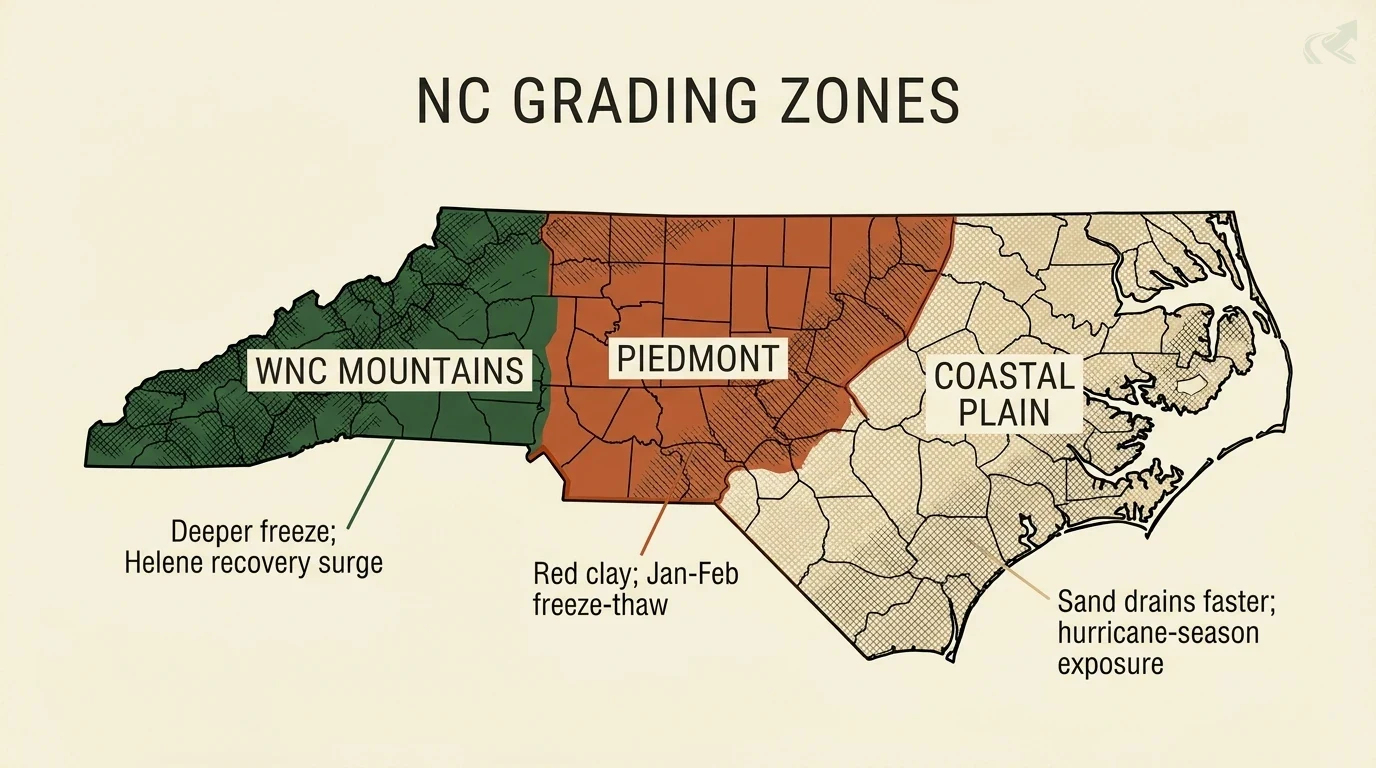
Piedmont (Wake, Guilford, Mecklenburg, Forsyth, and most of central NC): Red clay subgrade, real but mild freeze-thaw in January—February, mud-season transition in April—May, solid workable window May through October. Most of what’s covered in this article applies directly here.
WNC mountains (Buncombe, Henderson, Rutherford, and surrounding counties): Freezes run deeper and last longer. Some operators pause residential grading from December through March. Helene adds a separate surge layer on top of the normal winter slowdown — the availability problem isn’t seasonal, it’s structural. Normal seasonal guidance doesn’t apply until the backlog clears.
Coastal Plain (Brunswick, New Hanover, Pender, and surrounding counties): Sand-dominant soil drains significantly faster than Piedmont clay. A saturated coastal site recovers in one or two days; a saturated Piedmont clay site can stay unworkable for four to seven days after a hard rain. The January freeze-thaw concern largely doesn’t apply here. What does apply is hurricane season — June through November — which adds weather unpredictability and periodic post-storm surges that look like a smaller-scale version of the WNC Helene situation.
What to Do Right Now
The right action depends on your situation, not on a generic CTA.
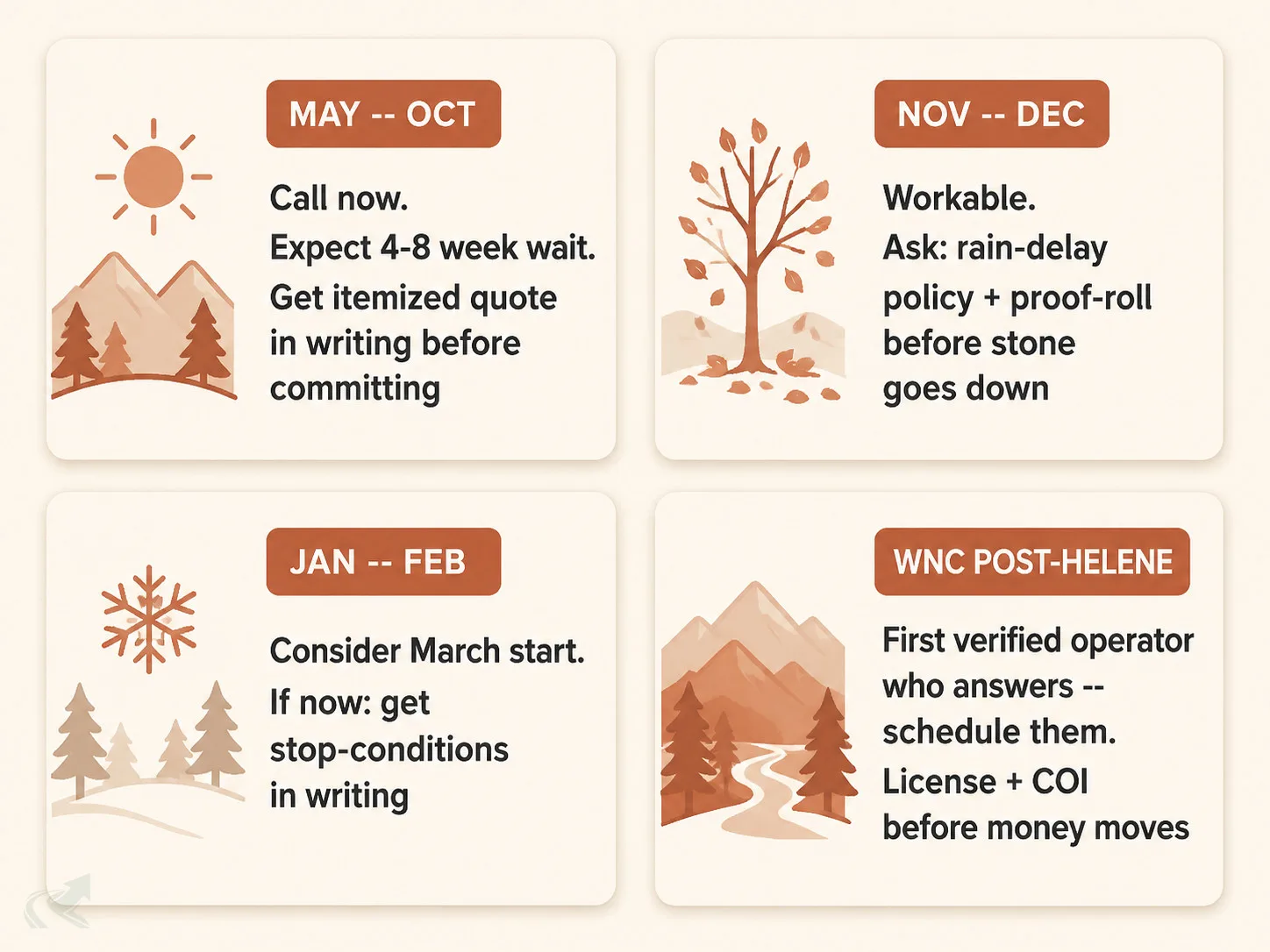
If it’s May through October: Call now. Expect 4-8 weeks of wait for a quality operator in Piedmont NC. Get the itemized quote in writing before you commit to a start date — not a ballpark, a line-item quote with scope defined.
If it’s November through December: Workable. Ask the operator two things: how they handle rain delays (specific — do they come back the next dry day?) and whether they proof-roll the subgrade before stone goes down. Both answers tell you whether they understand compaction.
If it’s January through February: Consider whether you can schedule for a March start instead. If you need work done now, ask the contractor specifically what conditions will cause them to stop — and get that in writing. A contractor who can’t answer that question clearly is telling you something.
If you’re in WNC post-Helene: The first verified operator who answers and can provide a license number and current COI — schedule them. Don’t wait for three quotes. Verify the license at portal.nclbgc.org and get the scope in writing before any money moves.
To find a grading contractor in my county, start with the verified NC contractor directory.
Scheduling Questions to Ask a Contractor
Copy these before your next call:
1. What's your next available start date for a project my size?
2. What's your rain-delay policy -- do you come back the next dry day, or do I wait weeks?
3. Do you proof-roll the subgrade before stone goes down?
4. If you start in winter, what conditions will cause you to stop?
5. Do you have references from projects in the last 90 days in my county?
Common Mistakes
Waiting for a dry-weather guarantee. North Carolina’s spring and fall have regular rain events. Waiting for a 10-day dry stretch in April means you start in July. Work around the weather, not against it.
Scheduling for convenience, not conditions. Booking the cheapest start date — often January — and trusting the operator to manage conditions is how you end up with a pad that settles by spring. Conditions matter more than calendar date.
Not asking about rain-check policy in winter. A contractor who won’t come back after a January rain to check compaction is telling you something about how they think about the work.
Comparing quotes across seasons without accounting for scope change. A December quote may not include the rain-delay contingency language a May quote does. Ask what changes between the two versions.