
Before you call a contractor
When is the best time to book grading work in NC?
Late October through November for most grading and drainage work in the Piedmont. The clay is dry, contractors have open schedules, and the finished grade has all winter to settle before the spring rain season. Spring looks good on paper -- in practice, North Carolina clay in March and April is often too wet to compact properly.
Can grading be done in the wet season if I need emergency work?
Yes -- emergency grading (erosion control, washout repair, drainage failure) happens year-round. The limitation is compaction quality: wet-season grading on clay produces less durable compaction. For emergency work, the goal is stabilization; for planned work, the goal is optimal performance.
The call comes in March. A homeowner wants a driveway graded and a swale cut before the summer rains. The contractor’s first open slot is late June. The homeowner books it, figures spring is prime outdoor season anyway, and wonders why the estimate felt rushed.
Here is what most homeowners are not told: the conventional “spring is for outdoor projects” logic that applies to mulching and planting does not transfer to NC earthwork. North Carolina Piedmont clay has its own seasonal rules — and spring is consistently the most congested, most moisture-compromised window on the calendar.
The contractors who can tell you when not to book are worth finding. The best time to book grading in NC is not spring.
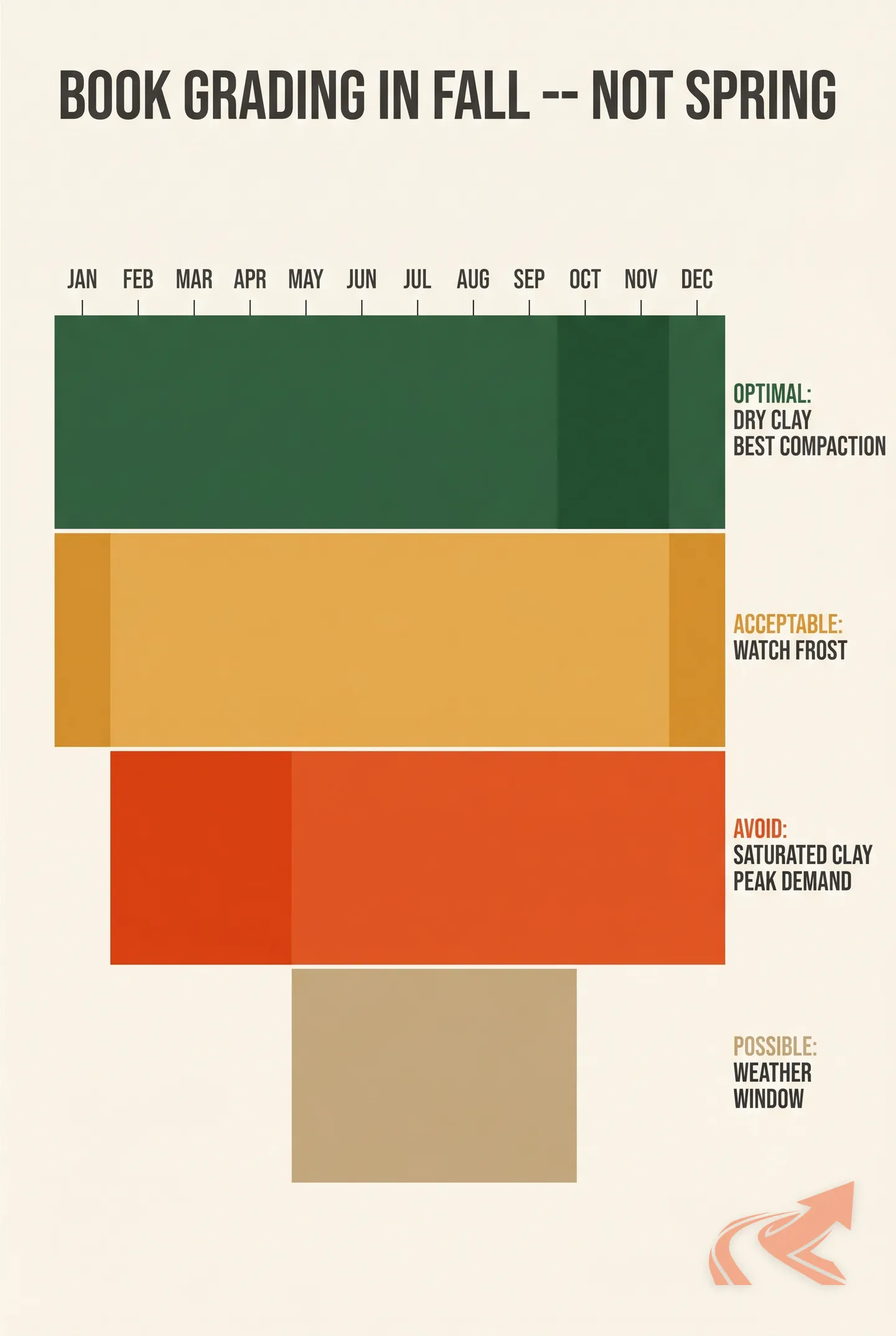
Why Spring Is Oversold for NC Clay Grading
Spring in the NC Piedmont means saturated clay — and saturated clay means compromised compaction, which is the single most important quality factor in grading and drainage work.
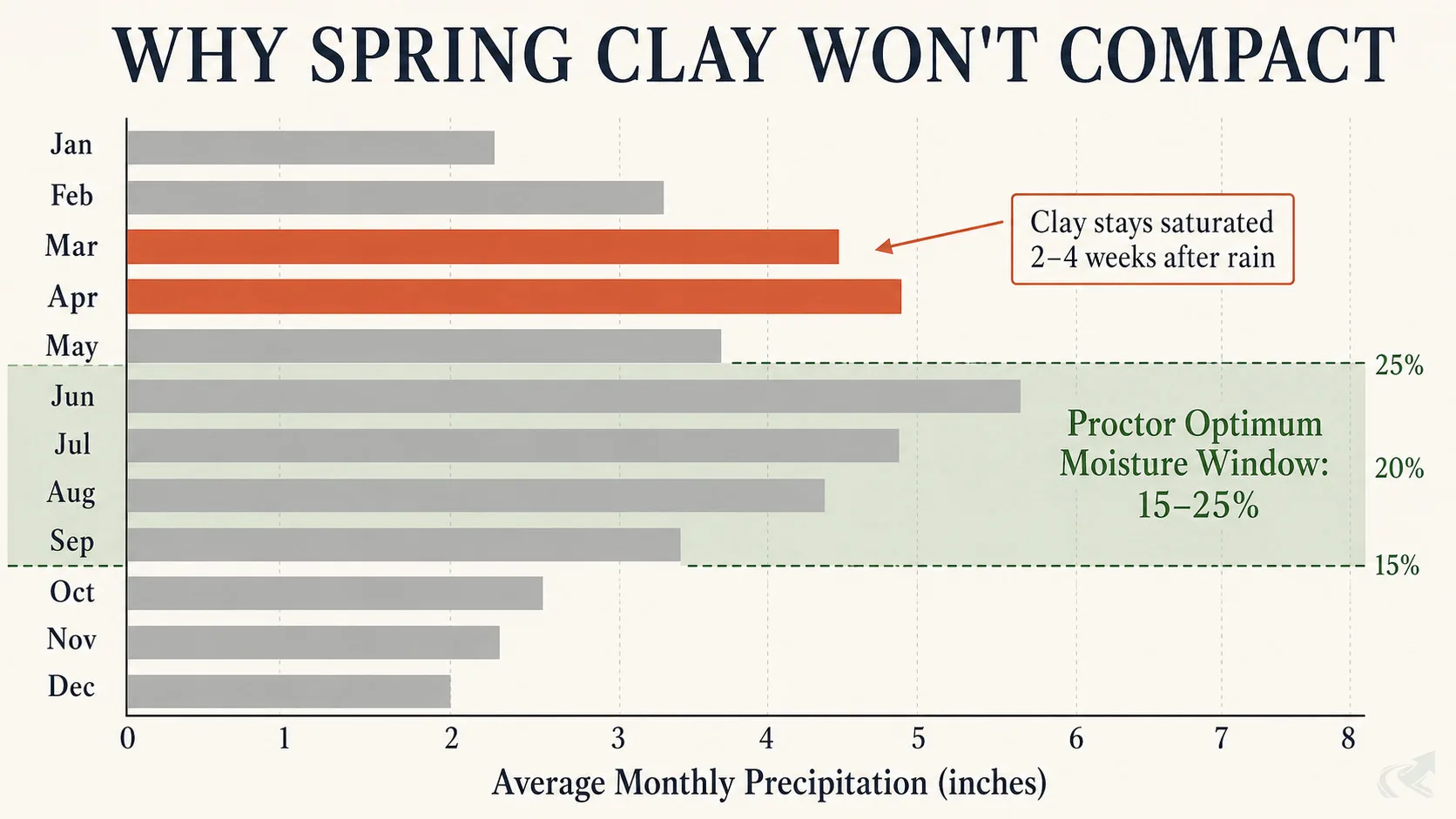
The NC Piedmont averages 4 to 5 inches of precipitation in both March and April — among the wettest months of the year in the region. Piedmont clay holds that moisture for two to four weeks after significant rain events. The window between rain events that would allow the soil to dry to workable conditions is narrow and unpredictable in spring.
Compaction in saturated clay is fundamentally less effective than compaction in dry or moderately moist clay. Soil engineers measure this through Proctor optimum moisture content — the specific moisture level at which a given soil achieves its maximum compaction density. For NC Piedmont clay, that optimum is typically in the 15 to 25 percent moisture range by weight. In a wet March, field moisture content commonly exceeds that window by a wide margin. The same limits apply to sub-base work — driveway compaction requirements NC are met only when the soil is within the workable moisture band.
Work done on saturated clay settles after the water table drops. Graded surfaces that appeared flat in April can show differential settlement by July as the clay dries and contracts beneath the surface.
Spring schedules reflect the demand spike. Contractor lead times stretch, crews are moving faster through backlogs, and weather windows get pushed through rather than waited on.
“Everyone books in spring. That’s why spring work gets done fast and in wet conditions.”
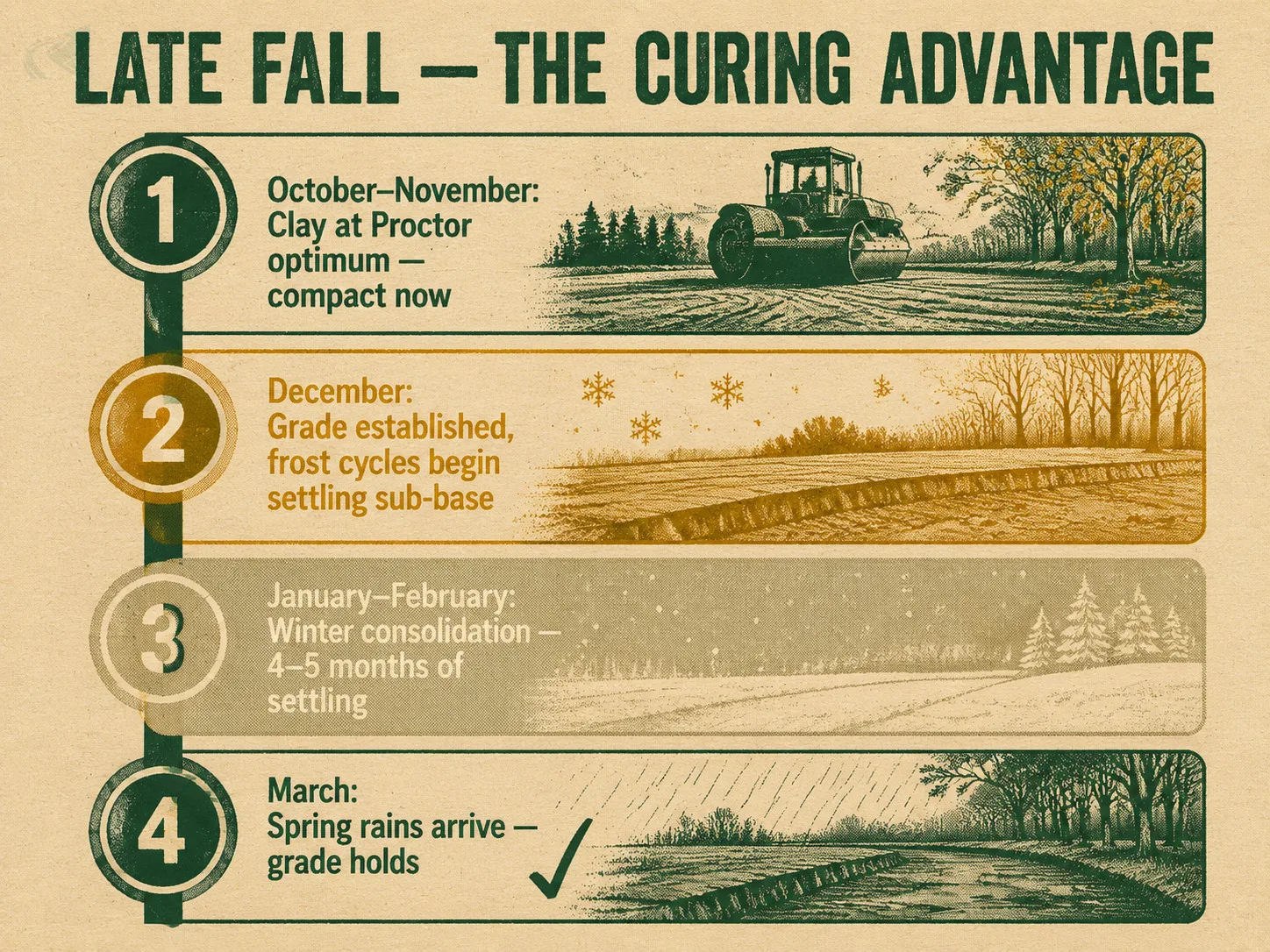
Why Late Fall Is the Underrated Window
October through November in the NC Piedmont delivers dry clay, open contractor schedules, and a natural winter curing period before the spring rain season — a combination that is difficult to match at any other point in the year.
Dry clay. By late October, the clay has had summer and early fall to shed its moisture load. Compaction at or near the Proctor optimum is routinely achievable. The grade established in fall holds through winter settling rather than contracting and shifting under summer drying.
Winter curing. A drainage system or driveway sub-base installed in November has four to five months to consolidate under natural frost cycles before the first spring rain loads it with water. That settling period produces more durable finished grades than spring-installed work that is immediately stress-tested by rain. For homeowners dealing with standing water yard drainage solutions NC, that four-month winter cure is the difference between a system that holds and one that shifts with the first wet season.
Contractor availability. Residential grading volume concentrates in spring. Late fall contractors historically have open scheduling windows and more flexibility to hold slots around weather. For homeowners willing to book in October, that flexibility translates to tighter project timelines and more attention per job.
Drainage visibility. Fall grading happens after leaf-drop, giving crews full visibility into site drainage patterns without foliage interference. For drainage diagnosis and positive drainage slope layout specifically, bare-yard sight lines are useful — water pathways that are hidden in summer are visible in a leafless late-fall yard.
The NC grading seasonal schedule is counterintuitive: the window that looks least appealing from a landscaping mindset is the window that produces the most durable earthwork results.
The Compaction Limit in Wet-Season Work
Wet-season grading produces less durable compaction — plan for that if emergency work is unavoidable, and do not schedule planned drainage or driveway work during saturated conditions.
Emergency grading happens year-round regardless of season. Active erosion, washout from storm drainage failure, and flooding from a failed swale do not wait for October. In these situations, the contractor’s job is stabilization — stopping the active problem — not building the optimal system.
What wet-season emergency work looks like in practice:
- Temporary erosion control. Silt fence, straw wattles, and rip-rap on exposed slopes to hold soil in place until conditions allow finish work.
- Rough grading for drainage flow. Re-establishing the basic drainage path to get water moving away from the structure, without attempting final compaction.
- Stabilization materials. Geotextile, aggregate base, or soil stabilization fabric on access paths and disturbed areas.
A contractor doing emergency wet-season work may also recommend a proof-roll pass — driving a loaded roller across the compacted surface to check for weak spots that deflect under load. In wet conditions, a proof-roll often reveals areas that need re-compaction once the soil dries. To find a verified NC grading contractor who uses proof-roll quality checks, look for operators whose process includes a post-work moisture and compaction verification step.
If emergency work was done in wet conditions, plan a compaction and grade check in October. The emergency fix stabilized the problem. The fall pass optimizes it.
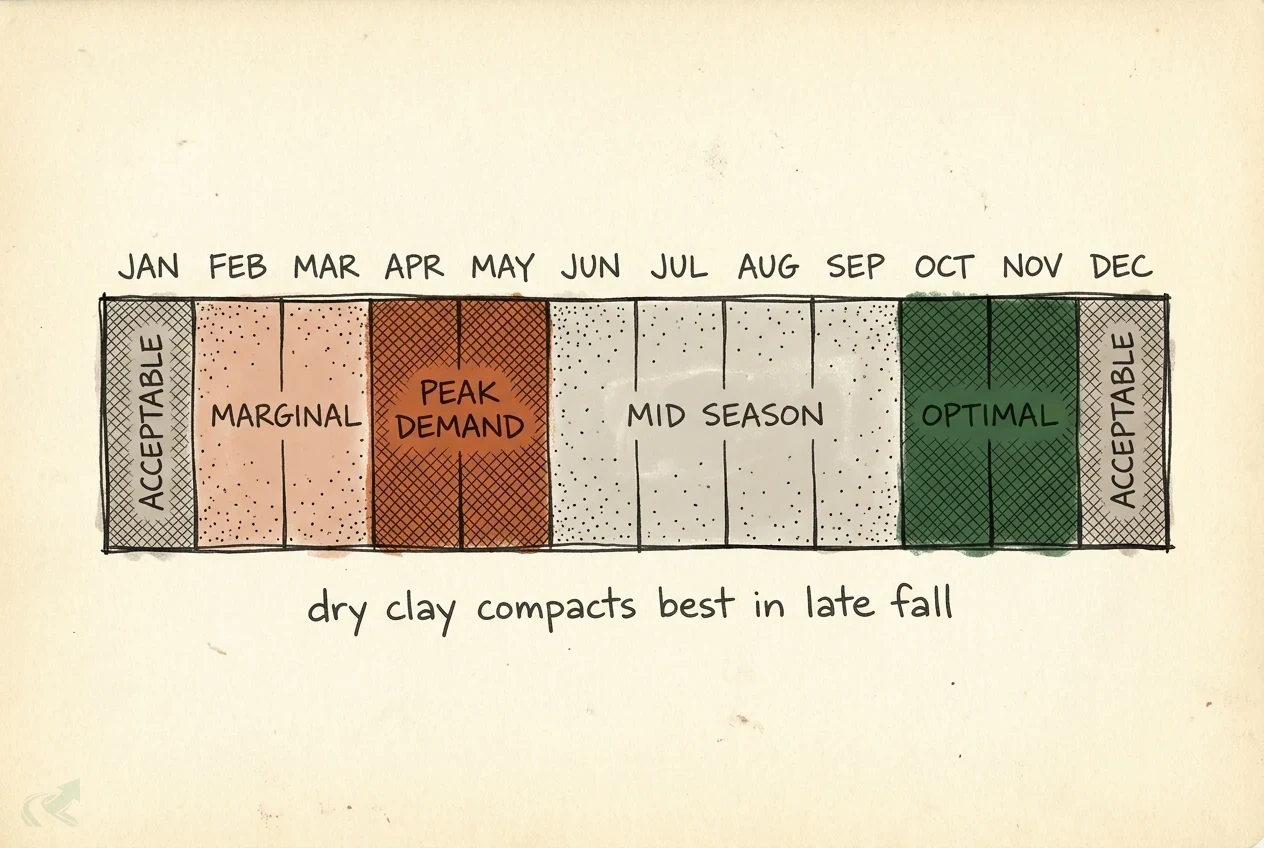
Seasonal Booking Windows at a Glance
The table below covers the NC Piedmont. It does not apply to western North Carolina, where shallow-soil and rock terrain behave differently under seasonal moisture.
| Season | Clay Moisture | Compaction Quality | Contractor Availability | Settlement Period | Best For |
|---|---|---|---|---|---|
| Late Fall (Oct-Nov) | Dry | High — near optimum | Good — open slots | All winter before spring rain | Planned grading, drainage, driveways |
| Winter (Dec-Jan) | Varies | Moderate — frost risk | Good | Remainder of winter | Acceptable if forecast is dry; watch frost |
| Spring (Feb-Apr) | Saturated | Low — often above optimum | Poor — peak demand | Immediately rain-tested | Emergency work only |
| Summer (May-Sep) | Varies week to week | Moderate — watch recent rain | Fair | Summer settling | Possible with weather-window approach |
What to Do If You Cannot Wait for the Optimal Window
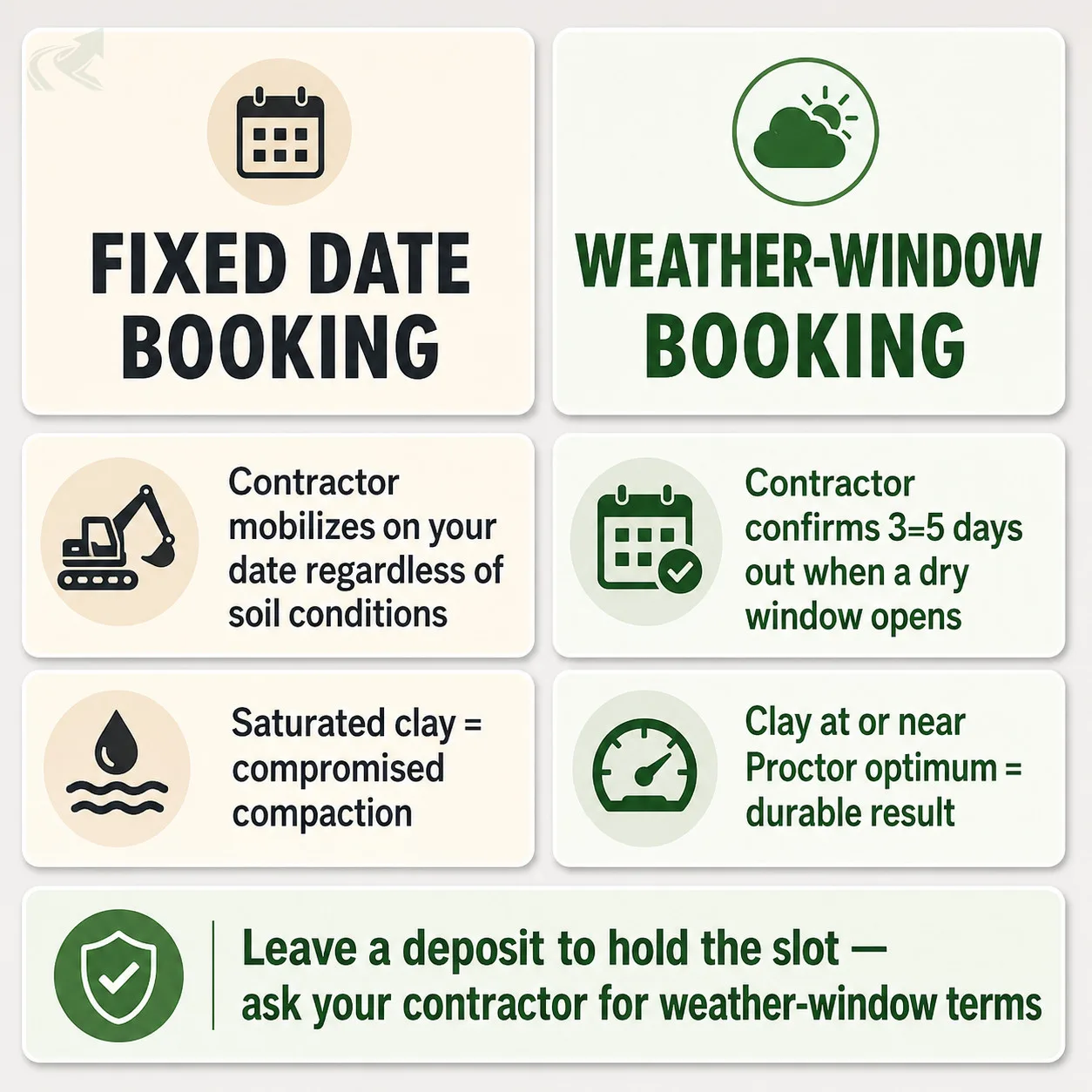
If the project cannot wait for fall, book a weather-window slot — a short-notice agreement that the contractor mobilizes when a dry-soil window opens in the forecast.
The weather-window approach is straightforward:
- Book the contractor with a general project start range, not a fixed date.
- Agree that the contractor will confirm mobilization three to five days in advance when a dry window appears.
- Leave a deposit to hold the slot in the schedule.
Most contractors on smaller residential jobs will accommodate weather-window booking. It protects the contractor from mobilizing into conditions that compromise the work, and it protects the homeowner from receiving a substandard result.
When wet-season emergency work cannot wait, the framing to give the contractor is direct: “I know the timing is not ideal — can we do the stabilization now and schedule a final compaction pass and grade check in October?”
That framing does two things: it acknowledges the limitation, and it commits both parties to completing the optimization pass rather than leaving emergency-condition work as the permanent result.
For drainage failures or erosion from a storm event, see booking grading after a NC hurricane — the post-storm contractor surge in NC creates its own scheduling constraints beyond the seasonal moisture question.
Common Scheduling Mistakes
Booking in spring because “it’s outdoor season.” Spring availability and spring soil conditions both work against quality grading results in NC Piedmont clay. The landscaping calendar and the earthwork calendar are not the same thing.
Waiting for ideal conditions on emergency work. Stabilization now is better than optimal later when active erosion or drainage failure is the problem. Get it stabilized and plan the optimization pass.
Not specifying the weather-window approach with the contractor. Most contractors will accommodate flexible mobilization timing on smaller residential jobs. Asking for it is not unusual — not asking means accepting whatever date lands on the calendar regardless of soil conditions.