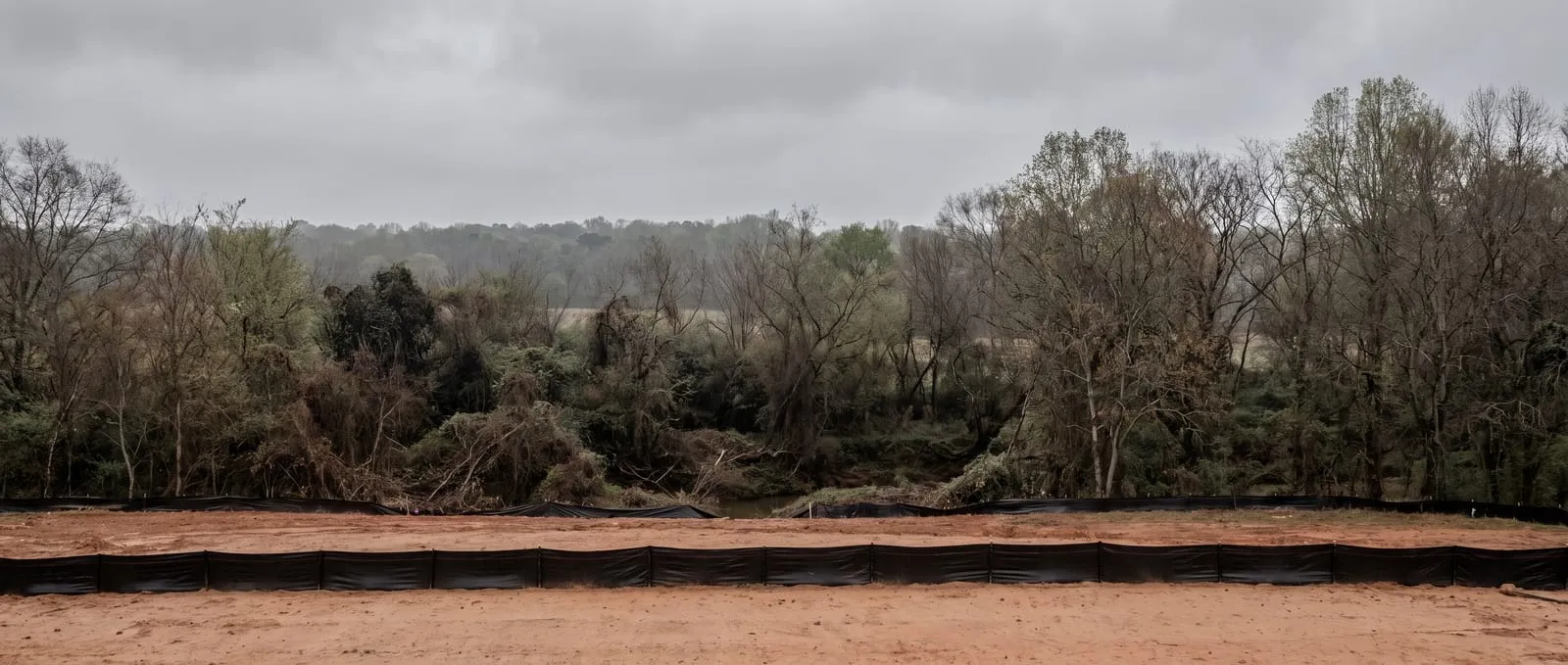
A homeowner in south Charlotte plans a back-yard regrade and a new patio. The state rule requires an erosion plan at one acre, and the project is a fraction of that — so it should be simple.
In Mecklenburg County it often isn’t. Adding the patio counts as new built-upon area, which can trigger a stormwater review well below an acre. If the lot backs onto a creek, a protected buffer may put part of the yard off-limits entirely. And if the work is part of a larger development, the land-development process requires a posted bond before dirt moves.
Mecklenburg is, in one way, simpler than the Triangle — one unified program instead of a different office in every town. But that program is strict, and it bites in places the statewide one-acre rule never mentions. This page translates it: the thresholds, the buffers, the process, and every county resource worth bookmarking.
Do you need a permit? The thresholds that actually bite
An erosion control permit triggers at one acre — but a stormwater management plan can trigger at 12,000 square feet, or the moment you add built-upon area. For most homeowners, the stormwater line is the one they hit first.
“Land-disturbing activity” — clearing, grading, filling, excavating — is what counts, and Charlotte-Mecklenburg Storm Water Services administers it across jurisdictions. The stack:
| What you need | Requirement | Triggers at |
|---|---|---|
| Adequate erosion control measures | Any land disturbance, any size | Silt fence, construction entrance — required even under an acre |
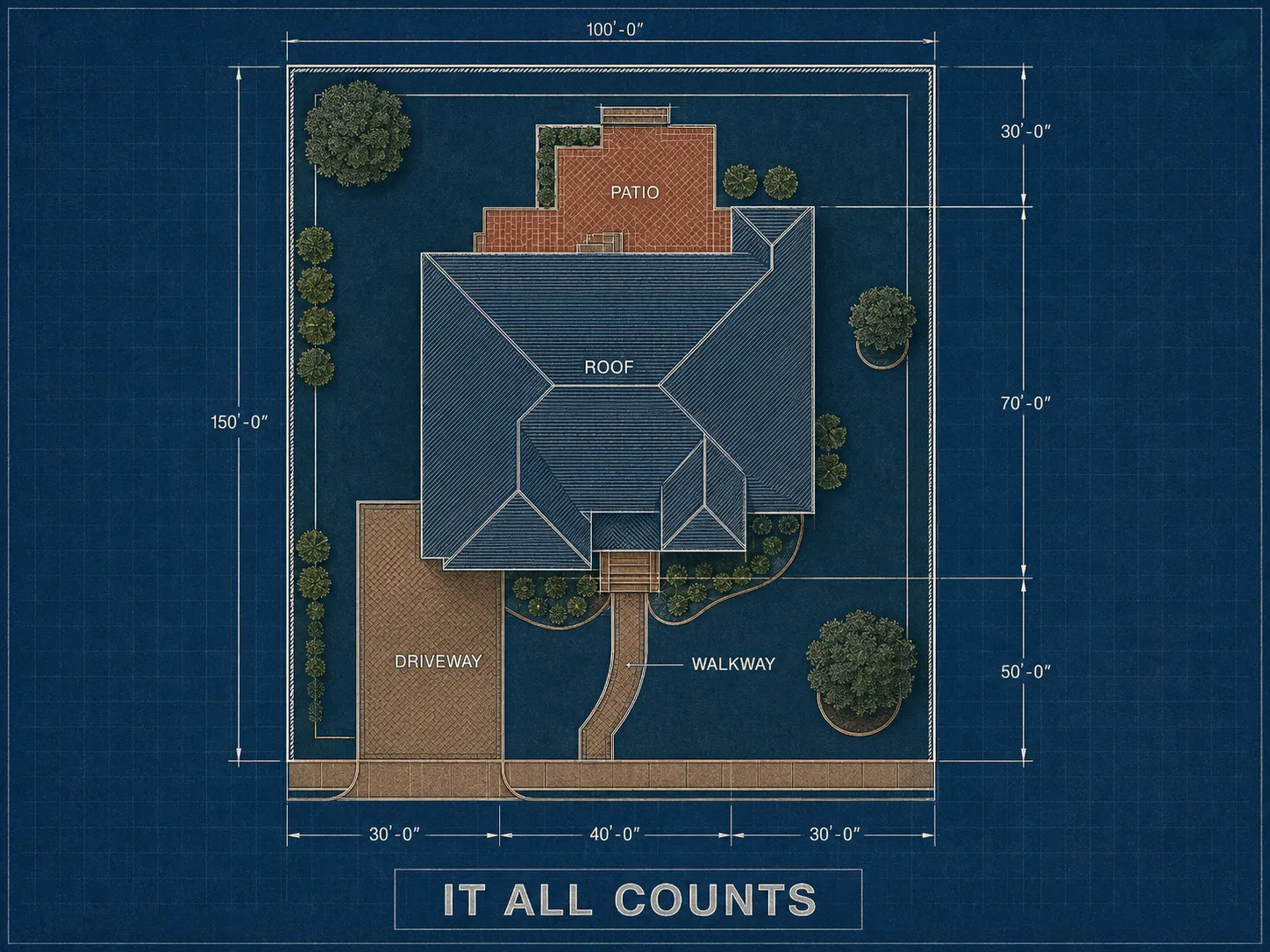
| Stormwater management plan | 12,000 sq ft disturbed, OR any new built-upon area | Roof, driveway, patio all count as built-upon area |
| Erosion control permit | 1 acre of disturbance | Aligned with the state Sedimentation Pollution Control Act |
| Post-construction stormwater rules | Often 0.5 acre, regardless of built-upon area | Peak control kicks in above 10-12% built-upon area in many watersheds |
Adequate erosion control measures
- Requirement
- Any land disturbance, any size
- Triggers at
- Silt fence, construction entrance — required even under an acre
Stormwater management plan
- Requirement
- 12,000 sq ft disturbed, OR any new built-upon area
- Triggers at
- Roof, driveway, patio all count as built-upon area
Erosion control permit
- Requirement
- 1 acre of disturbance
- Triggers at
- Aligned with the state Sedimentation Pollution Control Act
Post-construction stormwater rules
- Requirement
- Often 0.5 acre, regardless of built-upon area
- Triggers at
- Peak control kicks in above 10-12% built-upon area in many watersheds
Two more things that surprise people:
- A surety bond in land development. When a project goes through the land-development process — subdivisions and builder-driven work especially — Storm Water Services requires a posted bond (letter of credit, surety bond, or cash deposit) before improvements begin. There’s an exception for owner-occupants of a single-family home doing repairs, alterations, or extensions under a set value, so a homeowner leveling a yard usually isn’t posting a bond — but it’s a real line item for anything development-scale.
- A built-in penalty. Violations of the erosion and sedimentation control ordinance can run up to $5,000 per day, and sites keep an inspection log maintained by a “Competent Person” — weekly, plus after any rainfall of half an inch or more.
When you can’t tell which line your project crosses, treat it as a question for Storm Water Services, not a judgment call. That’s the office with the answer.

Stream buffers: the part of your lot you may not own the use of
Mecklenburg’s SWIM stream buffers are among the strictest in North Carolina — vegetated no-build strips that can run 100 feet or more from a stream, with no grading, clearing, or structures allowed inside.
If your lot backs onto or contains a stream, this is the rule most likely to change your plans. buffers, plus post-construction and water-supply-watershed buffers, protect the land next to streams and lakes. Widths vary by watershed and drainage area — commonly 100 feet on perennial streams and 50 feet on intermittent ones, and as wide as 200 feet on sensitive watersheds like Six Mile Creek, plus the FEMA floodplain.
Inside a buffer, new structures — outbuildings, pools, home expansions, most fill — are generally not allowed, and runoff has to enter the buffer as diffuse flow rather than a concentrated channel. There are narrow exceptions (a small storage building in the upland zone, permitted crossings), but the default is: that strip is protected, and assuming otherwise is how people end up with a stop-work order. Confirm your buffer with the county’s GIS before you design anything near water.

What the permit process looks like
Everything runs through Accela, and residential plan review typically takes 10 to 15 business days. The sequence:
- Create an Accela account — Mecklenburg County’s portal is the only intake; paper applications aren’t accepted.
- Determine your triggers — disturbance area, new built-upon area, and whether a stream buffer or floodplain touches your lot.
- Prepare the submittal — a clear site plan (boundaries, structures, setbacks, easements, driveways, drainage paths); a form; and, for an acre or more, an erosion-control narrative and stormwater calculations. Complex drainage work may need sealed plans from a licensed professional.
- Get zoning approval first — a zoning use permit clears before plan review proceeds.
- Post a bond if the land-development process requires one (development-scale work).
- Hold the pre-construction meeting — for an acre or more, meet the erosion-control inspector at least 48 hours before disturbing ground.
- Keep the approved plan and permit on site, maintain the inspection log, and pass inspections through construction.
Fees are calculated on the project; confirm the current schedule when you apply. For questions, Mecklenburg County Code Enforcement is at 980-314-CODE (2633), 2145 Suttle Avenue in Charlotte.
Every Mecklenburg resource you’ll need
Grouped by what you’re trying to do.
If your yard holds water, start with yard drainage in Charlotte — it diagnoses the cause before you price a fix, and covers the built-upon-area trap above.
Before you dig
- NC 811 — call before you dig. Free and legally required: notify utility owners at least two business days before you break ground. Call 811 or 1-800-632-4949.
Before you hire
- NCLBGC license lookup. Any contractor on a project of $40,000 or more must hold an active license. Search at the license portal — no account needed.
- Our verified Charlotte directory. Every contractor in our Charlotte-area directory is cross-checked against that NCLBGC record before listing.
Applying and tracking
- Accela Citizen Access. Apply, upload plans, post bonds, and track review through Mecklenburg County’s Accela portal. Code Enforcement: 980-314-CODE.
- Charlotte-Mecklenburg Storm Water Services. Land-development plan review, erosion control, and stormwater permitting for the city, county, and towns — stormwaterservices.mecknc.gov.
Site conditions
- Stream buffer + floodplain check. Confirm SWIM buffers and flood status on the county’s GIS before designing anything near water — it’s the single biggest source of Mecklenburg surprises.
- USDA Web Soil Survey. Pull soil and drainage ratings for your parcel at Web Soil Survey — Charlotte sits on the same slow-draining Piedmont red clay as the rest of the region.
- Red clay, explained. Our Piedmont red clay guide and the NC clay French drain methodology cover why the soil drives every drainage decision here.
Which towns this covers
Charlotte-Mecklenburg Storm Water Services is the through-line, but the towns layer their own post-construction rules on top. The unified program covers the City of Charlotte and unincorporated Mecklenburg County, and the county’s erosion program extends into Cornelius, Davidson, Matthews, Mint Hill, and Pineville. Huntersville runs a notably stricter Low Impact Development regime of its own.
So the erosion-control and stormwater basics are consistent county-wide — a real contrast with the Triangle, where the office and the threshold change with every town line — but the post-construction details (buffer widths, built-upon-area limits, LID requirements) do vary by town. Confirm your specific jurisdiction before you design.
What this means for your project
Mecklenburg rewards checking three things before you spend a dollar on design: whether you’re adding built-upon area, whether a stream buffer touches your lot, and whether your project is development-scale enough to need a bond. None of the three is obvious from the state’s one-acre rule, and all three are enforced.
For the wider Charlotte picture — red clay, fast-growth drainage, and how the region’s earthwork fits together — start at the Charlotte earthwork hub. And if you’re vetting a contractor for a Mecklenburg job, the Charlotte directory lists only operators whose licenses we’ve checked against the public record.
We’re a directory, not a permit office — we can’t file, expedite, or influence anything. What this page can do is get you to the right counter with the right questions already answered.
Verified contractors in Mecklenburg County
Every licence number below links to that contractor’s own record on the NC Licensing Board — we don’t ask you to take our word for it.
From our directory
Verified contractors across Mecklenburg County
Every listing is cross-checked against the NC Licensing Board public record before it appears. Pick your city:
Or browse the full NC contractor directory.