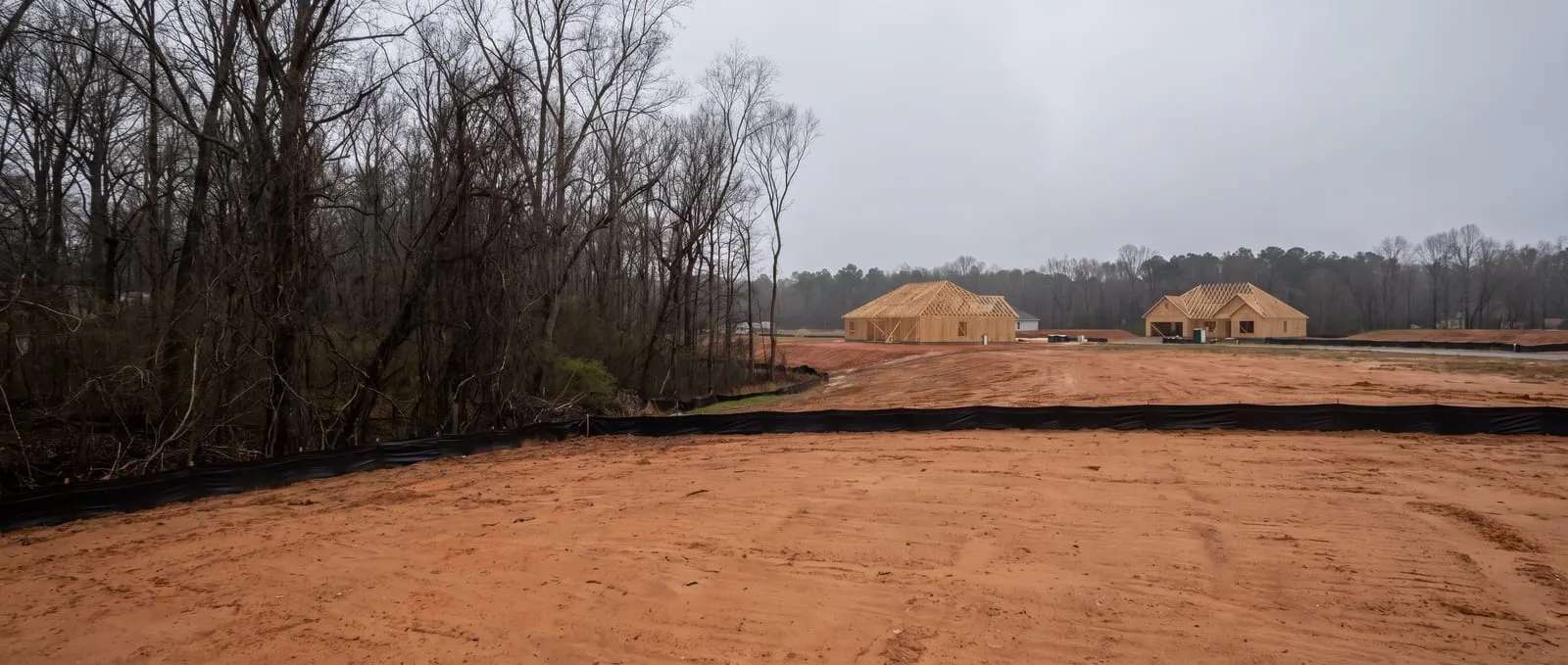
Two things Charlotte homeowners ask first
Why does water sit in my Charlotte yard instead of draining?
The same Piedmont red clay that defines the whole region — dense, slow-draining, more ceramic bowl than sponge. Water pools on top and in any hole you dig instead of soaking down. A French drain built for sandy soil often fails here; the fix usually needs surface catch basins, not just a buried pipe.
Do I need a permit to grade my lot in Charlotte?
Charlotte-Mecklenburg runs one unified stormwater program, which makes the 'who do I call' question simple. But it's strict: an erosion permit at one acre, a stormwater plan as low as 12,000 square feet or the moment you add a driveway or patio, and stream buffers that can put part of your lot off-limits. Check before you dig.
Charlotte earthwork starts from the same place as the Triangle’s — deep Piedmont red clay, a fast-growth market, and new-build lots where the grading was somebody else’s problem. The soil physics are identical: water that won’t soak in, drains that fail if they’re built for sand.
Where Charlotte diverges is the rulebook. The Triangle is a jurisdiction maze — a different permit office and threshold in every town. Charlotte is the opposite: one program, Charlotte-Mecklenburg Storm Water Services, covering the city, the county, and most of the towns. Simpler to navigate — but strict in ways the statewide one-acre rule never hints at, especially if a creek touches your lot.
This page is the map. Below: why red clay behaves the way it does, what Charlotte’s unified-but-strict permit regime actually requires, the stream buffers that catch people, and every Charlotte guide we’ve published — sorted by the problem you’re trying to solve.
What’s actually different in Charlotte
Same clay as the Triangle, opposite rulebook. The soil is Piedmont red clay — and everything the region’s drainage guides say about it applies here without modification. What sets Charlotte apart is regulatory character.
The soil is slow-draining red clay. Most of the Charlotte region sits on the same dense, fine Piedmont clay found across the Triangle and Triad. Water pools rather than percolating; a hole fills and stays full. Our red clay guide covers the soil science, and the NC clay French drain methodology covers what actually changes about an install here.
The permit program is unified, not fragmented. Where a Triangle homeowner has to figure out which town office has jurisdiction, a Charlotte one deals with Charlotte-Mecklenburg Storm Water Services across the board. That’s genuinely simpler — but it’s a strict program.
Stream buffers are load-bearing. More on this below — Mecklenburg’s buffers are among the strictest in the state, and they’re the rule most likely to change what you can build.
The market is new construction. Charlotte is one of the fastest-growing metros in the country, and most earthwork pain traces to a recently built lot: compacted clay, quick grading, and a builder whose obligations ended at closing.

The permit regime: unified, but strict
Charlotte-Mecklenburg Storm Water Services runs one program for the city, the county, and most towns — but a stormwater plan can trigger at 12,000 square feet, an erosion permit at one acre, and development-scale work requires a posted bond.
The threshold most homeowners hit first isn’t the one-acre erosion line — it’s the stormwater plan, which can trigger at 12,000 square feet of disturbance or the moment you add any built-upon area (roof, driveway, patio). And regardless of size, every land-disturbing activity needs adequate erosion control.
| What you need | Requirement | Triggers at |
|---|---|---|
| Erosion control measures | Any land disturbance, any size | Silt fence + construction entrance, even under an acre |
| Stormwater management plan | 12,000 sq ft, OR any new built-upon area | Driveway and patio both count |
| Erosion control permit | 1 acre of disturbance | Aligned with the statewide rule |
| Surety bond | Land-development / builder-scale work | Owner-occupant single-family exception for small jobs |
Erosion control measures
- Requirement
- Any land disturbance, any size
- Triggers at
- Silt fence + construction entrance, even under an acre
Stormwater management plan
- Requirement
- 12,000 sq ft, OR any new built-upon area
- Triggers at
- Driveway and patio both count
Erosion control permit
- Requirement
- 1 acre of disturbance
- Triggers at
- Aligned with the statewide rule
Surety bond
- Requirement
- Land-development / builder-scale work
- Triggers at
- Owner-occupant single-family exception for small jobs
The details — exact thresholds, the bond, the process, the fees, and the town-by-town variations — live on the Mecklenburg County page. For any other NC county, use the permit lookup tool. Verify your number with the county before you break ground; the built-upon-area rules in particular surprise people who assumed only an acre mattered.
What counts as built-upon area
Every hard surface on the lot — not just the house.
- Pervious — lawn, beds, open ground
- Roof
- Driveway
- Patio and walkways
Built-upon area is the whole hard footprint, and it accumulates with every addition. Proportions here are illustrative — your county measures your actual lot.
Stream buffers: the rule that changes what you can build
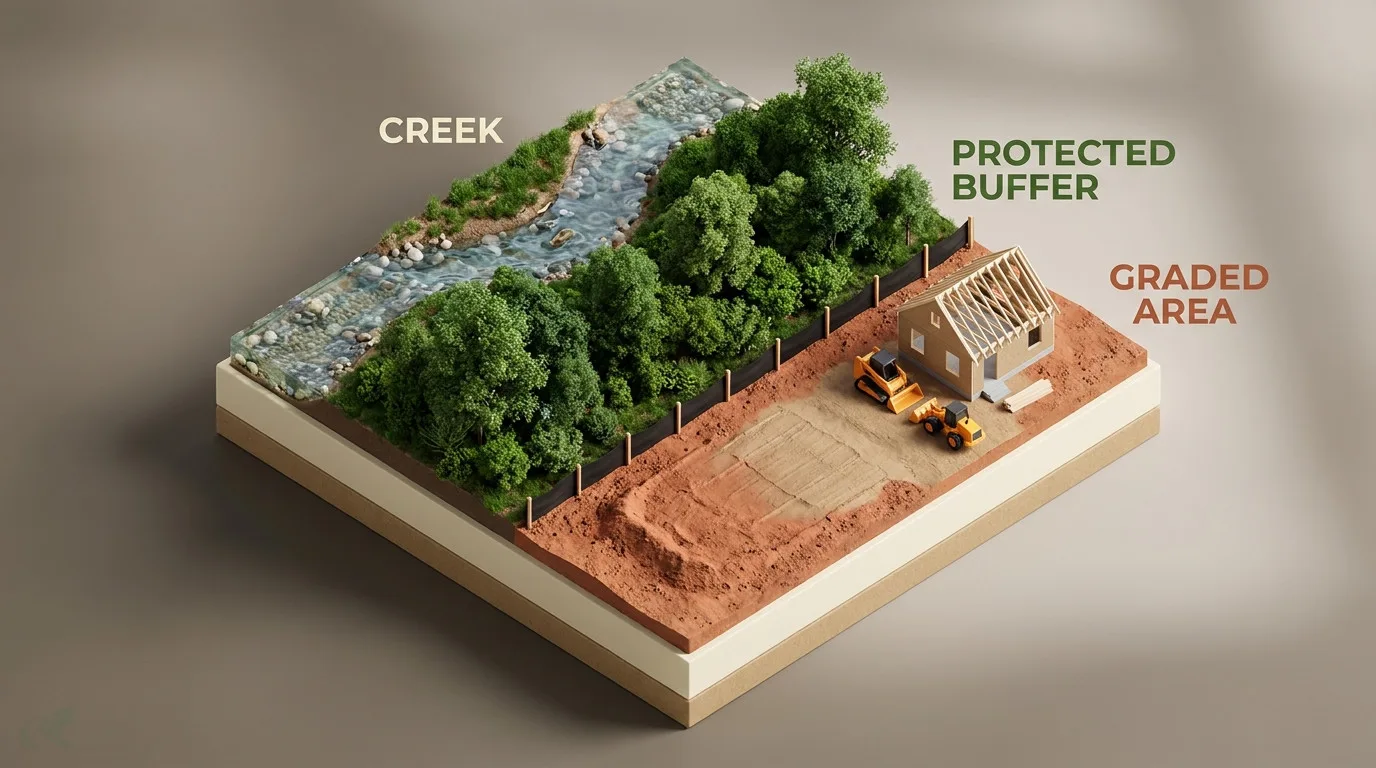
If a creek touches your lot, Mecklenburg’s stream buffers may put part of it off-limits — no grading, no clearing, no structures, sometimes for 100 feet or more from the bank.
This is Charlotte’s signature regulatory feature and the one most likely to derail a plan. buffers are vegetated no-build strips protecting the land next to streams and lakes. Widths run commonly 100 feet on perennial streams and 50 feet on intermittent ones, and up to 200 feet on sensitive watersheds like Six Mile Creek.
Inside a buffer, new structures — outbuildings, pools, home expansions, most fill — generally aren’t allowed, and runoff has to enter as diffuse flow rather than a concentrated channel. A homeowner who assumes the whole lot is buildable, then discovers a third of the back yard is a protected buffer, is a common Charlotte story. The Mecklenburg County page has the buffer detail; the practical rule is: check the county GIS before you design anything near water.
Every Charlotte guide, by problem
Start with the problem you actually have.
- Water sits in my yard and won’t drain — Standing water fix · Red clay, explained
- A French drain didn’t work in my clay — NC clay French drain methodology · French drains in NC clay
- My new build floods and the builder won’t fix it — When the work is done wrong
- I need a permit — Mecklenburg County · statewide lookup
- A creek runs through my lot — Mecklenburg stream buffers
- I need a contractor now — Verified Charlotte contractors
For the underlying methods — how grading, drainage, and hauling work statewide — start at drainage, driveways, or hauling and materials.
Cities and towns we cover
Our Charlotte coverage centers on Mecklenburg County — Charlotte, Huntersville, Matthews, Mint Hill, Cornelius, Davidson, and Pineville — and the fast-growing collar of Waxhaw, Weddington, Indian Trail, and Concord just beyond it. All share the same Piedmont red-clay reality; the permit details are consistent within Mecklenburg under the unified program, and vary once you cross into Union or Cabarrus County.
If you’re outside Mecklenburg, the soil and drainage guidance on this page still applies. Verify your permit thresholds with your own county before you break ground — the NC permit lookup covers all 100 counties.
From our directory
Verified Charlotte-area contractors by city
Every listing is cross-checked against the NC Licensing Board public record before it appears. Pick your city:
Or browse the full NC contractor directory.