
What NC clay actually changes
What does NC red clay actually change about a French drain install?
Five decisions, and they compound in this order: where the trench goes, how deep it goes, whether the trench wall gets scratched, what fabric goes where, and what happens to the excavated clay. National install videos change none of these because the soils they're filmed in don't require it — which is why a technically clean install can still underperform here.
Why won't anyone give me an exact trench depth for NC clay?
Because in clay the correct depth is set by two site-specific things — the horizon where water is actually moving laterally, and the seasonal shrink zone — and the deeper of the two governs. A number pulled from a video filmed in Michigan loam or Florida sand isn't conservative or aggressive here; it's just unrelated to your site. Any contractor quoting a depth before assessing your soil profile is guessing.
Nearly every drainage guide on this site ends at the same sentence: clay changes things. The soil-science page explains why Piedmont red clay behaves the way it does. The clay-physics page explains which properties matter. The fabric page settles the geotextile argument. The methodology comparison explains why four YouTube channels disagree.
What none of them give you is the order.
This page is that: the applied sequence. Five decisions, in the order a crew actually faces them on your lot, with what NC clay does to each one and what to demand at each step. It is deliberately short on universal numbers, for a reason covered below that’s worth understanding before you accept any quote.
The five decisions clay changes
Kaolinite changes the fabric call. Lateral flow changes placement and depth. Trench-wall glazing adds a prep step that doesn’t exist in other soils. Shrink-swell sets a depth floor. And the spoil you dig out stops being backfill.
Every one of these traces to a documented property of NC Piedmont clay, not to a preference:
| Clay property | What NC clay does | What it changes in the install |
|---|---|---|
| Kaolinite platey structure | Fine platey particles migrate into and clog geotextile over time | Trench-wrap fabric comes out in high-clay zones; the pipe sock stays in |
| Lateral flow dominance | Water travels sideways along a subsurface horizon instead of percolating down | Trench is placed to intercept the flow path, not next to the puddle |
| Trench-wall glazing | Excavation smears the clay face into a sealed slick | A scratch pass becomes a required prep step before stone goes in |
| Shrink-swell (dual nature) | Clay swells wet and shrinks dry through a seasonal active zone | Pipe must sit below that zone — this sets a depth floor |
| Low permeability overall | Surface water sits on top instead of soaking in | Surface capture stops being optional and becomes part of the system |
Kaolinite platey structure
- What NC clay does
- Fine platey particles migrate into and clog geotextile over time
- What it changes in the install
- Trench-wrap fabric comes out in high-clay zones; the pipe sock stays in
Lateral flow dominance
- What NC clay does
- Water travels sideways along a subsurface horizon instead of percolating down
- What it changes in the install
- Trench is placed to intercept the flow path, not next to the puddle
Trench-wall glazing
- What NC clay does
- Excavation smears the clay face into a sealed slick
- What it changes in the install
- A scratch pass becomes a required prep step before stone goes in
Shrink-swell (dual nature)
- What NC clay does
- Clay swells wet and shrinks dry through a seasonal active zone
- What it changes in the install
- Pipe must sit below that zone — this sets a depth floor
Low permeability overall
- What NC clay does
- Surface water sits on top instead of soaking in
- What it changes in the install
- Surface capture stops being optional and becomes part of the system
Notice what isn’t in that table: a number. That’s deliberate, and it’s the single most important thing on this page.

The sequence, in the order it happens
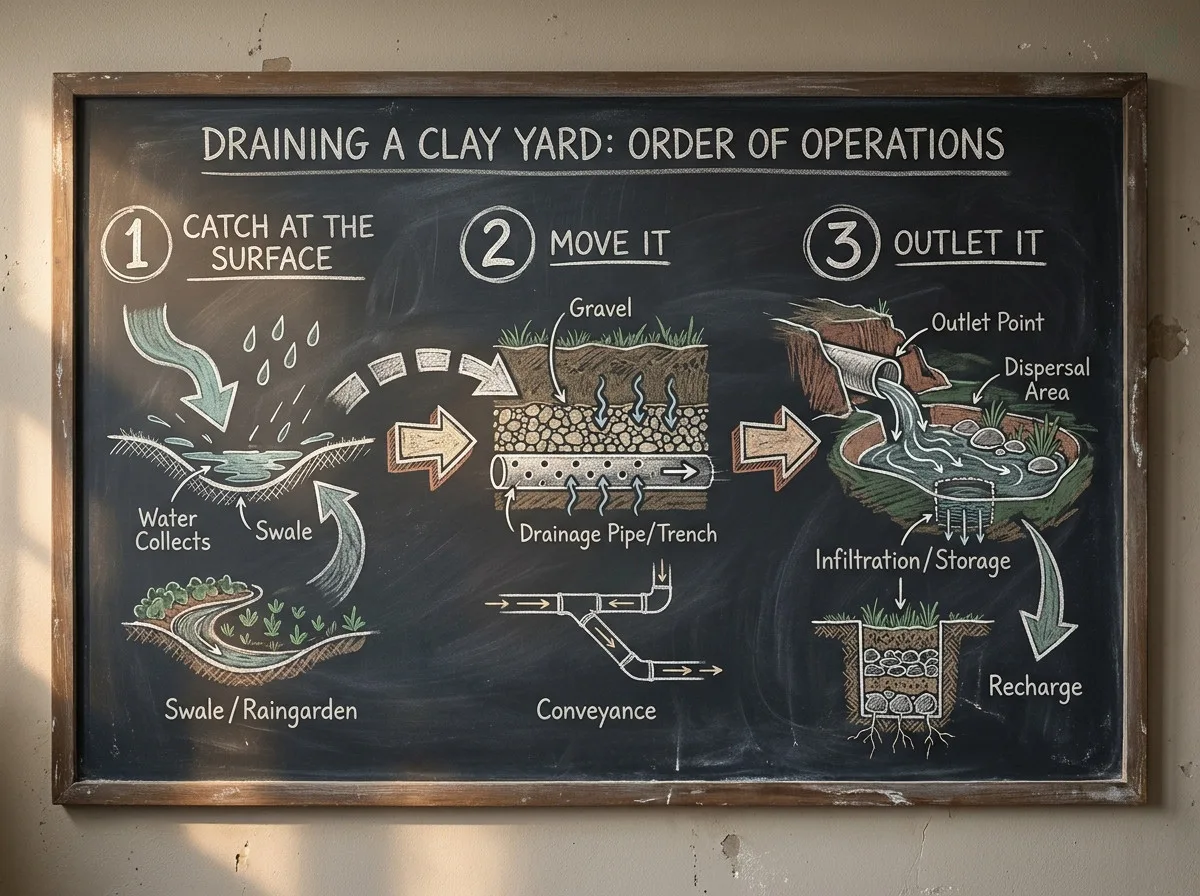
1. Establish where the water is actually moving — before anything is dug. In sandy soil you can put the drain near the wet spot and it works, because water moves down. In clay it moves laterally along a subsurface horizon, so the trench has to intercept that path. A drain installed beside a puddle in clay can miss the flow entirely and still look correct on the surface. This is why a site assessment isn’t a sales formality here — it’s the step that determines whether anything downstream matters.
2. Set depth from the deeper of two constraints. Depth is governed by (a) the horizon where lateral flow is travelling and (b) the seasonal shrink zone the pipe must sit below. The deeper of the two governs. Both are site-specific. This is the honest reason no one can hand you a depth over the phone.
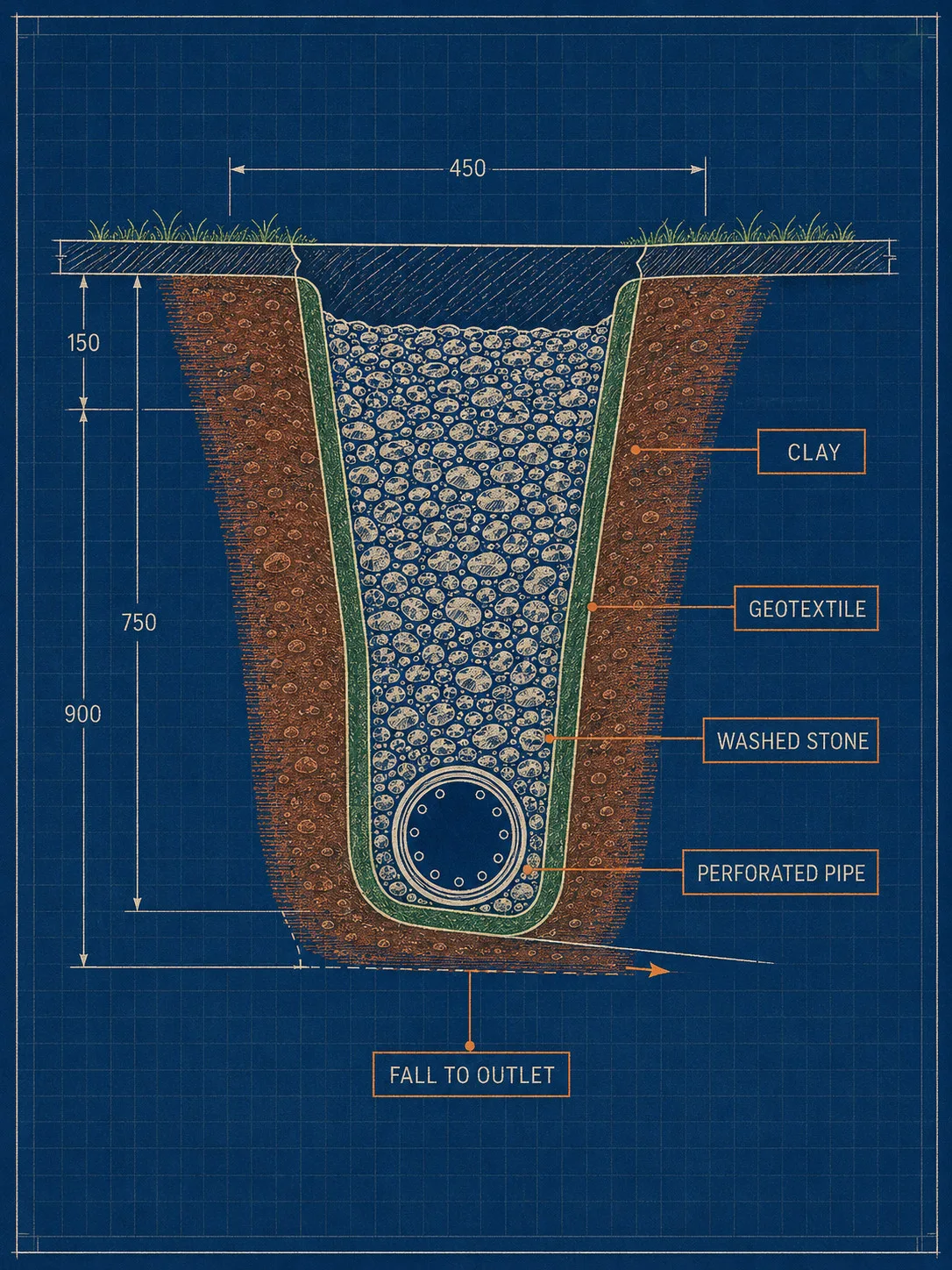
3. Scratch the trench wall. Excavating clay glazes the cut face — the bucket smears the platey structure into a sealed slick. That glaze will refuse water no matter how good your stone and pipe are. A scratch pass to break the glazed surface is a required prep step in clay and simply doesn’t exist as a step in installs filmed in sand or loam. Its absence is one of the clearest tells that a crew is running an out-of-region playbook.
4. Make the fabric call by soil zone, not by channel. This is where the internet argument lives, and it resolves cleanly once you stop treating it as one decision. Trench-wrap fabric and the pipe sock are two different calls. In high-clay Piedmont, NCGH’s position is no trench wrap (kaolinite fines clog it over time) but yes to the sock (it protects the pipe slots). In sandy coastal soil, the trench wrap earns its place. In mixed or fill soil — most new subdivisions — the honest answer is assess before committing. The fabric page carries the full soil-zone table and the two mistakes homeowners make because of the YouTube debate.
5. Get the spoil off the lot. Excavated clay is not backfill. Laying it back over a finished drain caps the system with the least permeable material on site. It leaves, and what goes back on top is chosen for permeability, not convenience.
Running through all five: the crew that assesses flow path, sets depth from site constraints, scratches the wall, makes the fabric call by soil zone, and hauls the spoil is running the NC method. A crew that skips straight to trenching beside the wet spot is running someone else’s.
Why this page won’t give you a trench spec
Because the specs that circulate for French drains come from soils that behave differently, and importing the number is exactly the failure mode this whole cluster documents.
It’s worth being blunt about the evidence here, because the confident numbers you’ll find elsewhere often aren’t as sourced as they look. The widely circulated install parameters trace back to content filmed in Michigan loam and Florida sand. Neither soil has NC’s lateral-flow dominance, its glazing behaviour, or its kaolinite clogging profile. A depth or fall figure lifted from either isn’t wrong so much as unrelated to your lot.
Two numbers do circulate legitimately in NC and get misapplied constantly: the six inches of fall in ten feet guidance and the regrade to below sill plate figure. Both are surface grading specifications — they govern how the ground slopes away from your house. Neither is a French drain trench spec, and seeing them quoted as one is a reliable sign the source is repeating rather than understanding.
The genuinely correct answer is the unsatisfying one: in clay, the numbers are outputs of a site assessment, not inputs to a quote. Which is precisely why the vetting questions below matter more than any spec sheet.
What to demand from a contractor
The five decisions above convert directly into five questions. A clay-calibrated installer answers all of them without hesitation; someone running a national template will generalise on at least three.
The tell isn’t the answer itself — reasonable installers differ. The tell is whether the answer is about your lot or about drains in general. Question 3 is the sharpest filter: a crew that has never heard of scratching a glazed trench wall has not installed many drains in Piedmont clay.
If you want to check the operator before the conversation, every contractor in our verified directory is cross-checked against the North Carolina Licensing Board public record, and our guide on hiring a grading contractor covers the wider vetting process.
What this means for your project
The reason four drainage channels can all be competent and still contradict each other is that they’re each right about their own soil. NC Piedmont clay is the exception that breaks the national template, and the break shows up in five specific places rather than everywhere at once.
You don’t need to adjudicate the internet’s methodology war. You need a crew that can tell you where your water is going, why they’re digging where they’re digging, and what they’re doing about a glazed trench wall. Everything else on this page is context for judging those answers.
For the deeper background: why NC requires different drainage methods, the four-channel comparison, and the clay physics underneath all of it.