
Ray Pettiford has a 3-point hitch box blade on his tractor and a problem: a 300-foot driveway section on his Guilford County property has developed a series of wash ruts and high shoulders after years of erosion.
He watched the YouTube tutorials. He adjusted his settings. The results weren’t right. The videos were tuned for loam. His soil is Piedmont clay.
That gap — between generic box blade advice and what actually works in NC — is what this page covers. The technique vocabulary here applies whether you’re operating a box blade yourself or reading a contractor’s quote that lists it as part of the scope.
Understanding what a box blade can and cannot do in North Carolina conditions is how you avoid misapplied passes that leave a worse surface than you started with.
What a Box Blade Is and How It Works
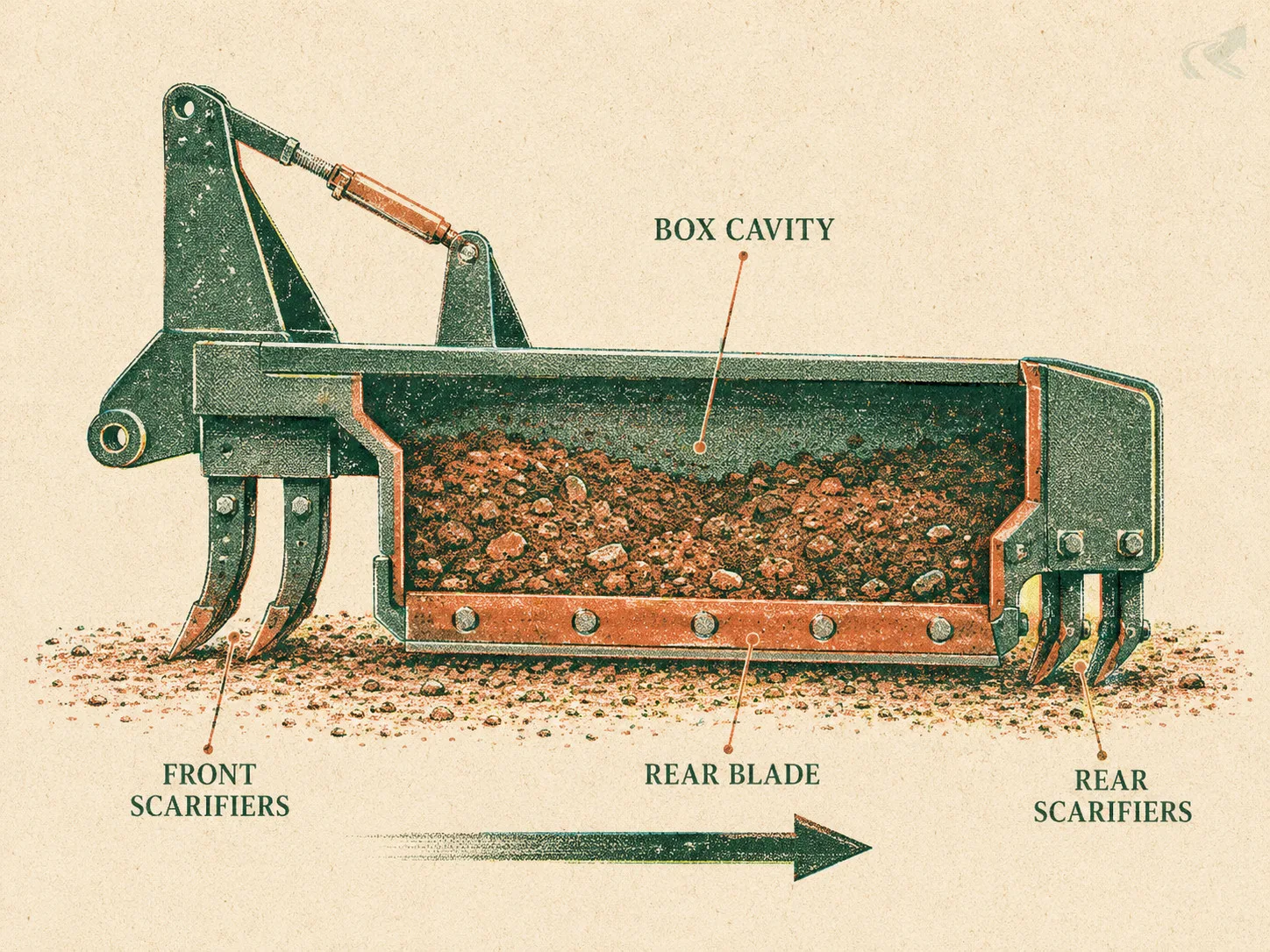
A box blade is a 3-point hitch attachment with a rear blade and front and rear scarifiers that grades by simultaneously cutting high spots and depositing material into low spots.
Four components do the work:
- Rear blade — the cutting edge that determines the finished grade height. Its pitch angle controls how aggressively it cuts.
- Front scarifiers (teeth) — break up compacted material ahead of the blade before the blade arrives. Depth is independently adjustable.
- Rear scarifiers — on reversible box blades, allow pulling material from behind the blade on a reverse pass.
- Box cavity — traps cut material and carries it forward to deposit in the next low spot.
The grading action works in sequence. As the blade travels over a high spot, the scarifiers loosen the material, the blade cuts it to the desired grade height, and the box carries the displaced material to the next depression. Multiple passes refine the grade. The first pass does the heavy work; follow-up passes knock down the rough spots left behind.
This is a redistribution tool. It moves existing material from where you have too much to where you don’t have enough — it doesn’t haul anything off the site.
Box Blade Settings for NC Clay
NC clay requires different scarifier depth and blade pitch settings than sandy soil, and the correct setting changes between dry-summer clay and wet-season clay.
This is the part the generic tutorials skip. North Carolina Piedmont clay behaves differently across seasons, and the wrong setting for the conditions produces a worse surface.
Dry summer clay (hard-pan conditions): NC clay bakes hard in July and August. Scarifiers need deeper penetration than you would use in loam — if the teeth aren’t cutting down into the surface, you’re dragging the blade across the top without moving material. This is the most common mistake. You’ll hear the tractor work harder but the surface won’t change. Drop the scarifiers deeper and make another pass.
Wet clay: Reduce blade pitch to a flatter angle to avoid smearing wet clay rather than cutting it. Smeared clay creates a glazed surface that sheds water poorly and compacts into a slick layer. This is the opposite problem from dry clay — here the material moves too easily and the blade pushes it around instead of cutting it cleanly.
Two to four days after a significant rain: This is the best cutting window in North Carolina. Clay is workable but not yet saturated. The blade cuts cleanly, material carries into the box without sticking, and deposits in low spots without the smearing problem. If you have scheduling flexibility, this is when to run the box blade.
The table below summarizes settings by condition:
| Condition | Scarifier Depth | Blade Pitch | What Goes Wrong If Wrong |
|---|---|---|---|
| Hard-dry summer clay | Deeper than loam baseline | Standard cutting angle | Blade skims surface, no material moves |
| Wet clay | Standard | Flatter (less aggressive) | Smearing — glazed surface, poor drainage |
| 2-4 days post-rain | Standard | Standard | Best window — no adjustment needed |
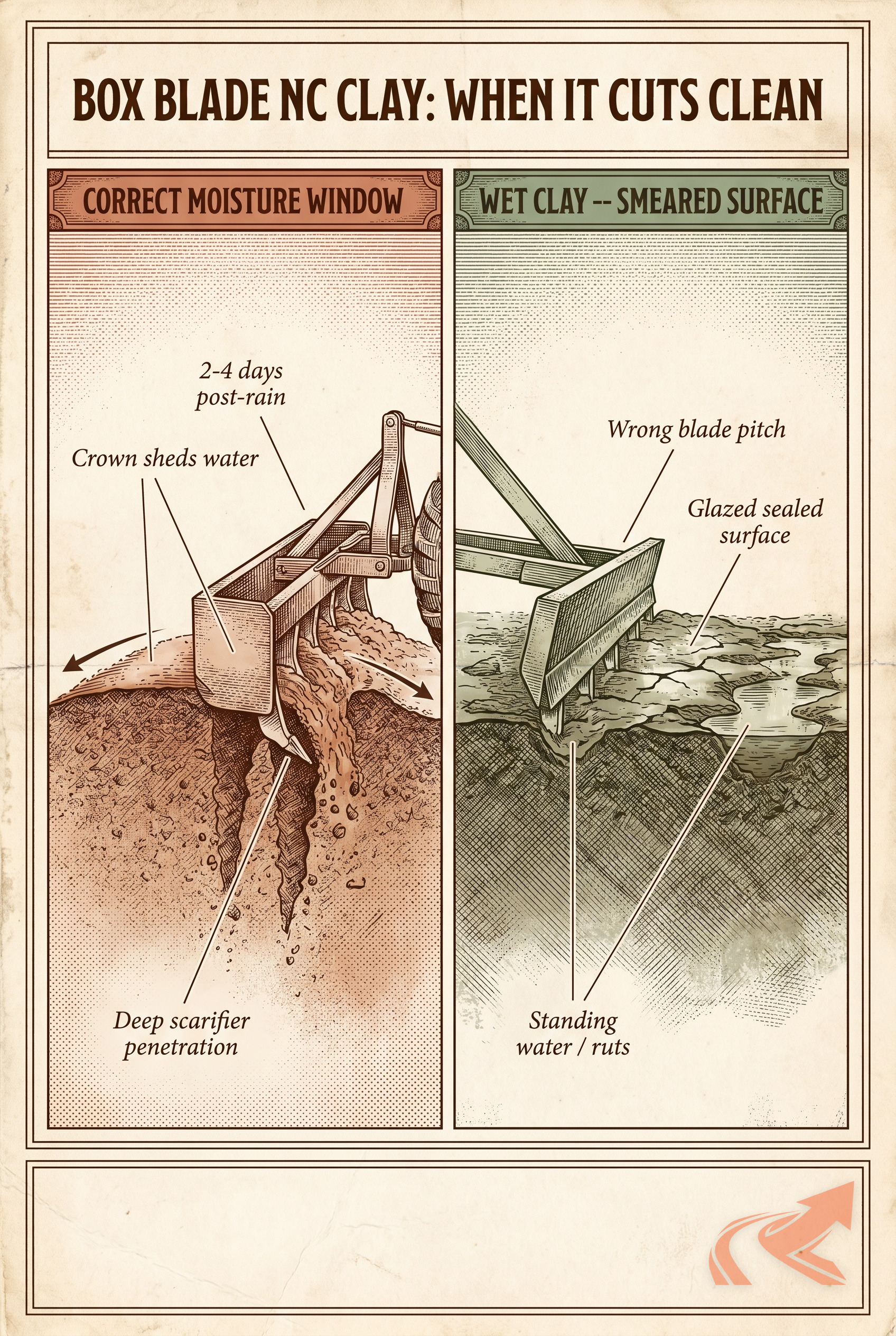
Box blading NC clay: correct crown vs a smeared surface
Comparison. Crown cut right: Soil cut and moved, not pressed flat; A center crown sheds water to both sides; Worked when clay is at the right moisture; Surface drains instead of holding water. Smeared wet clay: Wrong blade pitch presses clay instead of cutting; Surface ends up flat with a glazed skin; Glaze sheds nothing -- water sits in pools; No crown means standing water and ruts.
- Soil cut and moved, not pressed flat
- A center crown sheds water to both sides
- Worked when clay is at the right moisture
- Surface drains instead of holding water
- Wrong blade pitch presses clay instead of cutting
- Surface ends up flat with a glazed skin
- Glaze sheds nothing -- water sits in pools
- No crown means standing water and ruts
Box blading wet NC clay smears a sealed, flat surface -- the crown has to be cut, not pressed.
What a Box Blade Does Well in NC
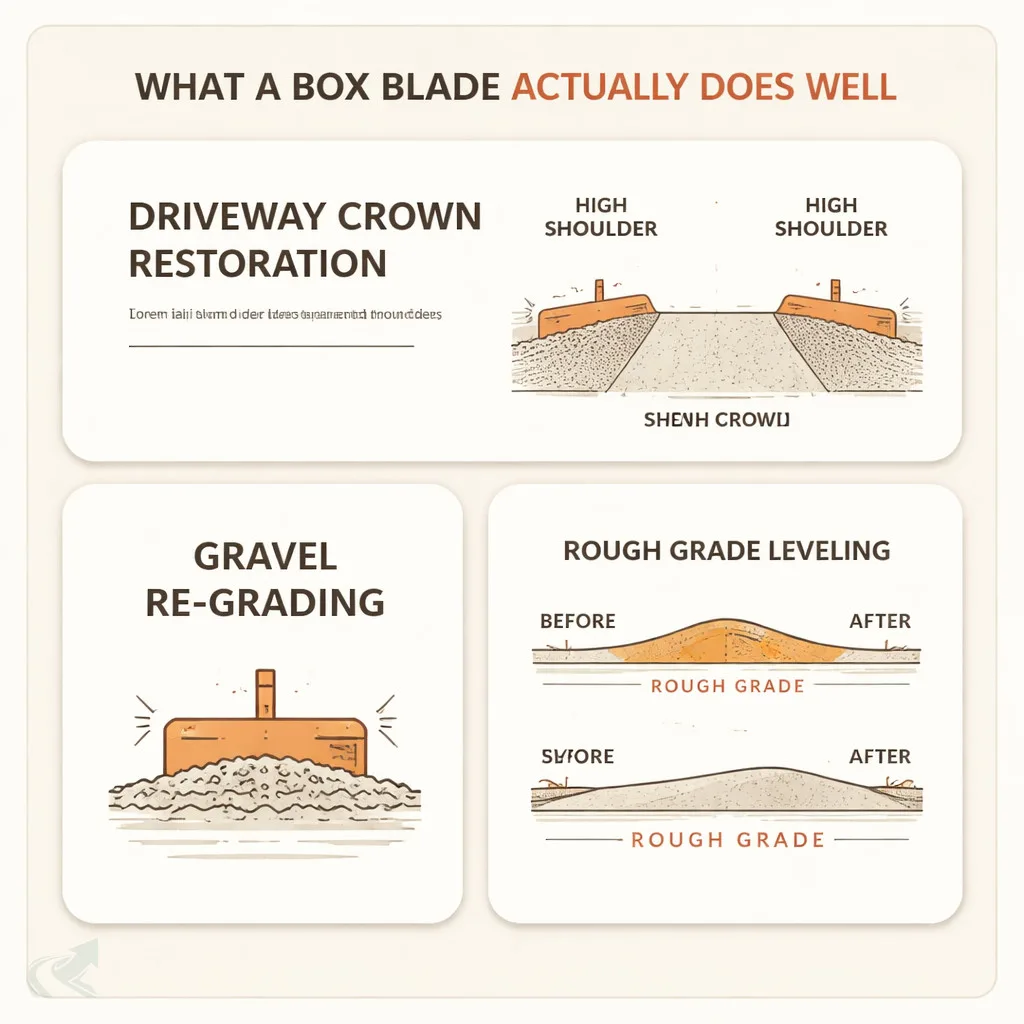
Driveway crown restoration and rough grade leveling are the strongest uses of a box blade in NC clay — it excels at redistributing existing material.
Three applications where a box blade earns its keep in North Carolina:
Driveway crown restoration — a properly-set box blade can pull material from the high shoulders of a rutted driveway back toward center, rebuilding the crown that sheds water. This is exactly what Ray’s driveway needs. The scarifiers bite into the built-up shoulder material; the blade cuts it; the box carries it to the low centerline. Multiple passes rebuild the 2% slope that makes the driveway drain.
Rough grade leveling — redistributing soil from high spots to low spots across a defined area before final finishing work. The box blade handles the heavy lifting; a follow-up attachment handles the finish.
Gravel re-grading — spreading and leveling existing gravel on a driveway surface. Gravel moves differently than clay — it flows into the box more freely. Adjust scarifier depth up to avoid dragging gravel out of the surface instead of leveling it.
For more on how a box blade fits into NC driveway grading, see the full driveway grading overview.
When a Box Blade Is the Wrong Tool
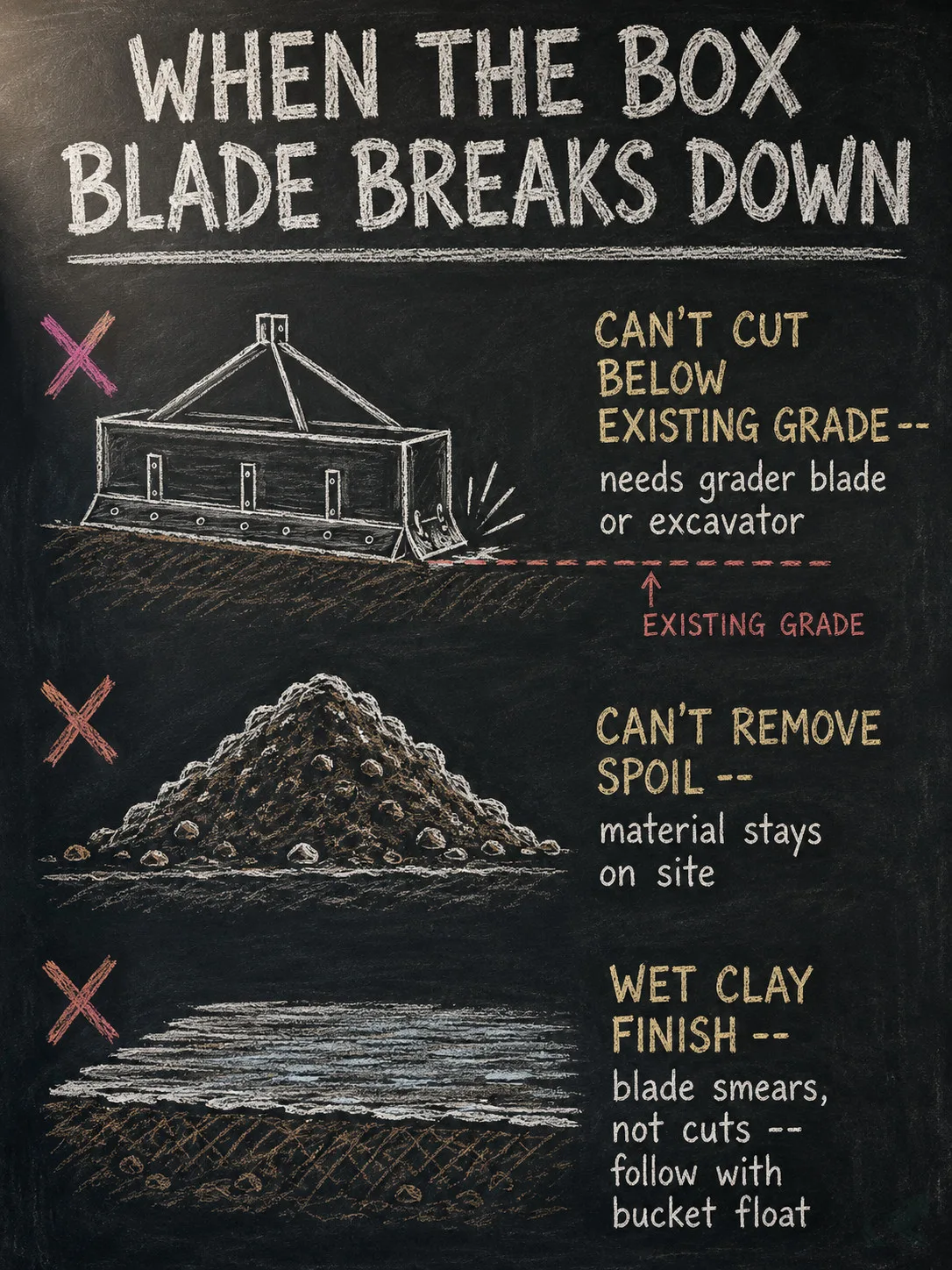
A box blade can’t dig below its current grade, can’t handle material removal, and can’t achieve finish grade precision in clay without supplementary machine work.
These limits are where the tool breaks down — and where a lot of DIY driveway projects go sideways.
No cut below existing grade. If you need to lower the driveway centerline by more than the depth of the cutting edge, the box blade can’t do it. Lowering a high center requires a grader blade attachment or an excavator. The box blade only redistributes what’s already at or above the current surface.
Can’t remove spoil. Everything the box blade displaces stays on the site. If the driveway has accumulated high spots over decades — from resurfacing, erosion deposits, or overfilled sections — the excess material has nowhere to go except to the next low spot. If there are no low spots left to accept the material, you need removal, not redistribution.
Finish precision in wet clay. The box blade leaves a rough, slightly ridged finish — this is normal. For a smooth finish grade, follow up with floating the bucket after box blade passes. Trying to achieve finish grade with additional box blade passes in wet conditions usually smears more than it smooths.
See also heel grading alongside box blade for NC driveway shaping for the follow-up technique that completes what a box blade starts.
Vocabulary for Talking to a Contractor Who’s Using a Box Blade
If the contractor’s scope includes box blade work, these are the questions that tell you whether they’ve dialed it in for your conditions.
A contractor who answers all three specifically is doing the work correctly. These are not trick questions — they’re the questions any operator running a box blade in NC clay should be able to answer without hesitation.
“Pulling from shoulders to center” tells you the contractor is thinking about crown restoration, not just dragging a blade across the surface. “Rear-blade pitch for the current conditions” tells you they’re adjusting for the soil state, not running one setting year-round.
If the contractor can’t answer what the pitch setting is or why they’re running it, the spec hasn’t been thought through. That’s worth knowing before the machine arrives.
Use these questions alongside the NC DIY grading triage before choosing attachments checklist to sort your job correctly before anyone picks up a phone.
When the scope exceeds what a box blade can handle — material removal, precision finish grade, or cut below existing grade — hire a licensed NC grading contractor who can bring the right machine for the actual conditions.