
Shauna is walking a newly graded backyard the day after a contractor finished. The surface has ripples — repeating ridges spaced about 18 inches apart, all running in the same direction. It doesn’t look right.
She asks the contractor about it. He says: “That’s just how it comes out of a skid steer.”
That is not accurate — not for an operator who floats correctly.
The ridges she’s seeing are the product of a skid steer operated without float mode. Each grading pass left a slight elevation change where the bucket made uneven contact with the surface. In North Carolina clay, those ridges don’t erode flat in a few months. They stay, and the low spots between them collect standing water after every rain.
Float technique eliminates them. This page explains what float mode is, why NC clay makes it non-optional for finish work, and how Shauna can ask one question that reveals whether the operator uses it.
What Float Mode Is
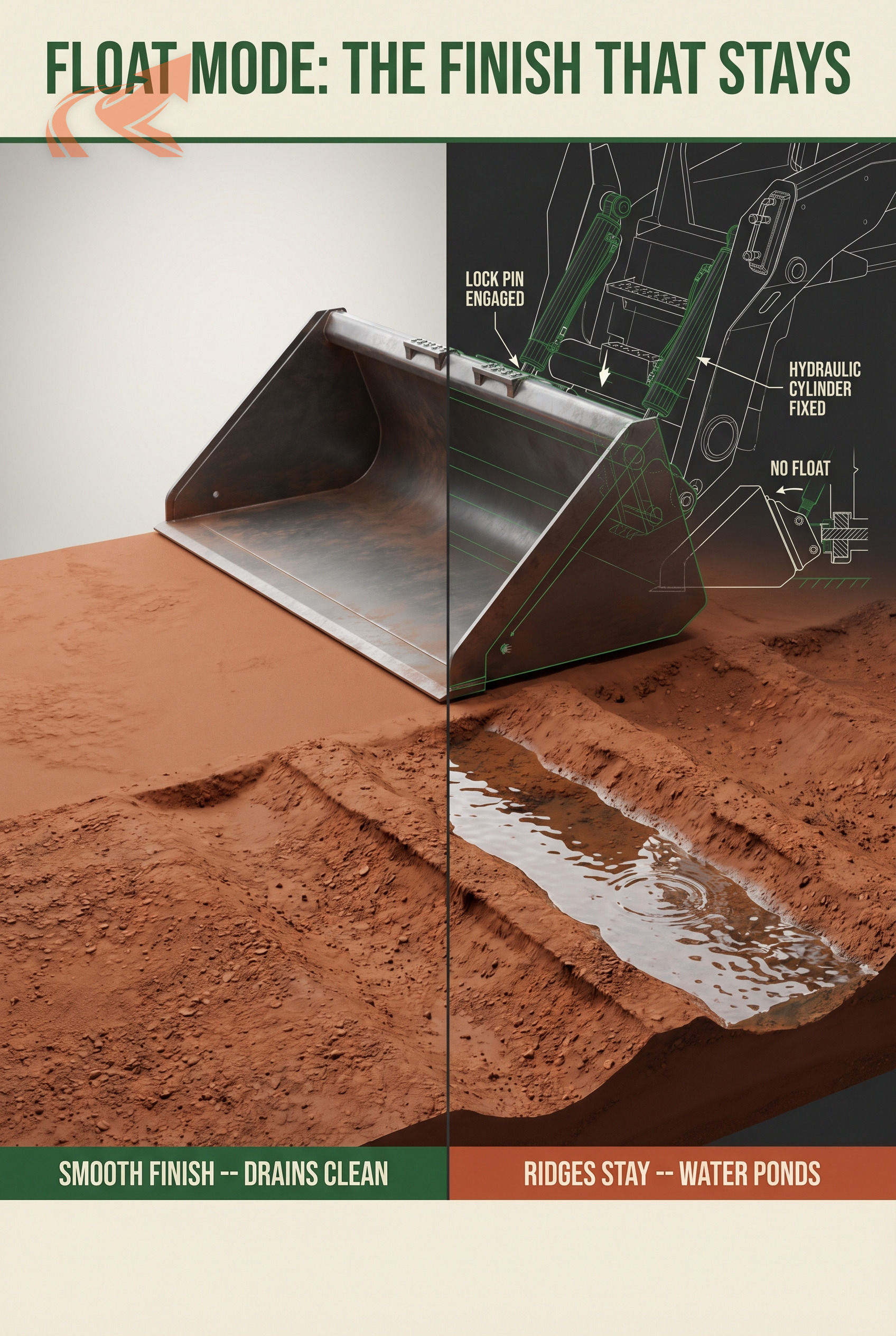
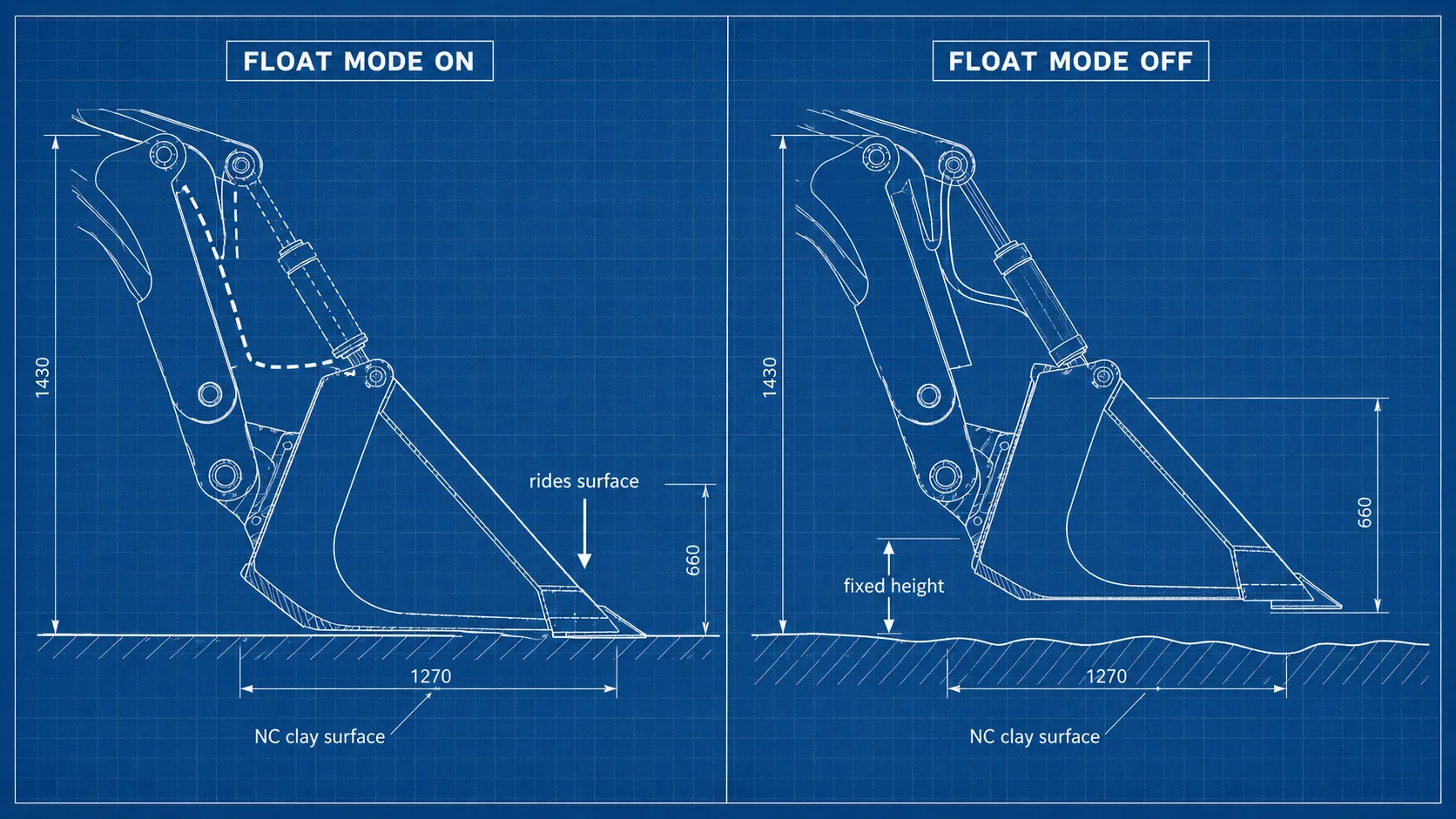
Float mode disengages the hydraulic hold on the bucket and lets it ride the surface freely — the bucket follows the ground, not the operator’s hand position.
Most skid steers have a float position on the lift control. It drops the bucket to ground contact and removes hydraulic lift pressure. When engaged during a grading pass, the bucket rides whatever surface contour it encounters rather than holding a fixed height set by the operator.
The result is a surface that’s smoother and more consistent than what manual-controlled passes produce. The bucket isn’t fighting variation — it’s conforming to it.
How to tell if float is engaged: in float mode, the machine’s weight can push the bucket slightly into the surface. If the bucket holds rigid at a fixed height regardless of what’s underneath it, float is not engaged.
Float mode is a standard feature on most rental-class skid steers — Bobcat, Caterpillar, and John Deere all include a dedicated float position on the lift control across their common residential and light commercial models.
Why NC Clay Makes Float Mode Non-Optional for Finish Work
NC clay’s density creates more resistance to the bucket than sandy soil — the bucket mark pattern from non-float grading is more pronounced and more permanent in Piedmont clay.
Three reasons NC clay amplifies the problem:
- Clay resists bucket passage — each pass compresses the surface at a slightly different contact point, creating micro-ridges. In sandy or loam soil those ridges break down quickly. In NC Piedmont red clay they become semi-permanent surface features.
- Clay doesn’t settle flat — in sandy soil, surface ridges erode down within a season. In NC clay they stay, and the valleys between them become water collection points after every rain event.
- Float removes the amplification — when the bucket rides freely, it doesn’t force irregular contact. The surface the pass leaves is the surface the clay actually has, not what the operator’s hand pressure and fatigue created.
Finish grade in NC clay: floating the bucket vs not
Comparison. Bucket floated: Bucket rides the surface instead of digging in; Smooth, consistent finish across the pass; A water-shedding crown is carried through; Surface drains cleanly with no low spots. No float used: Each rigid pass leaves its own ridge; Roughly 18-inch ridge-and-valley pattern; Water ponds in the valleys between ridges; Sticky NC clay exaggerates every ridge.
- Bucket rides the surface instead of digging in
- Smooth, consistent finish across the pass
- A water-shedding crown is carried through
- Surface drains cleanly with no low spots
- Each rigid pass leaves its own ridge
- Roughly 18-inch ridge-and-valley pattern
- Water ponds in the valleys between ridges
- Sticky NC clay exaggerates every ridge
Floating the bucket lets it smooth the surface -- without it, NC clay locks in a ridged, ponding finish.
The ridge pattern Shauna saw is not a cosmetic issue. It’s a drainage issue. Water pooling in those valleys is how a newly graded yard produces standing water — and why some homeowners call a second contractor six months after the first one finished.
How to Use Float Mode Correctly
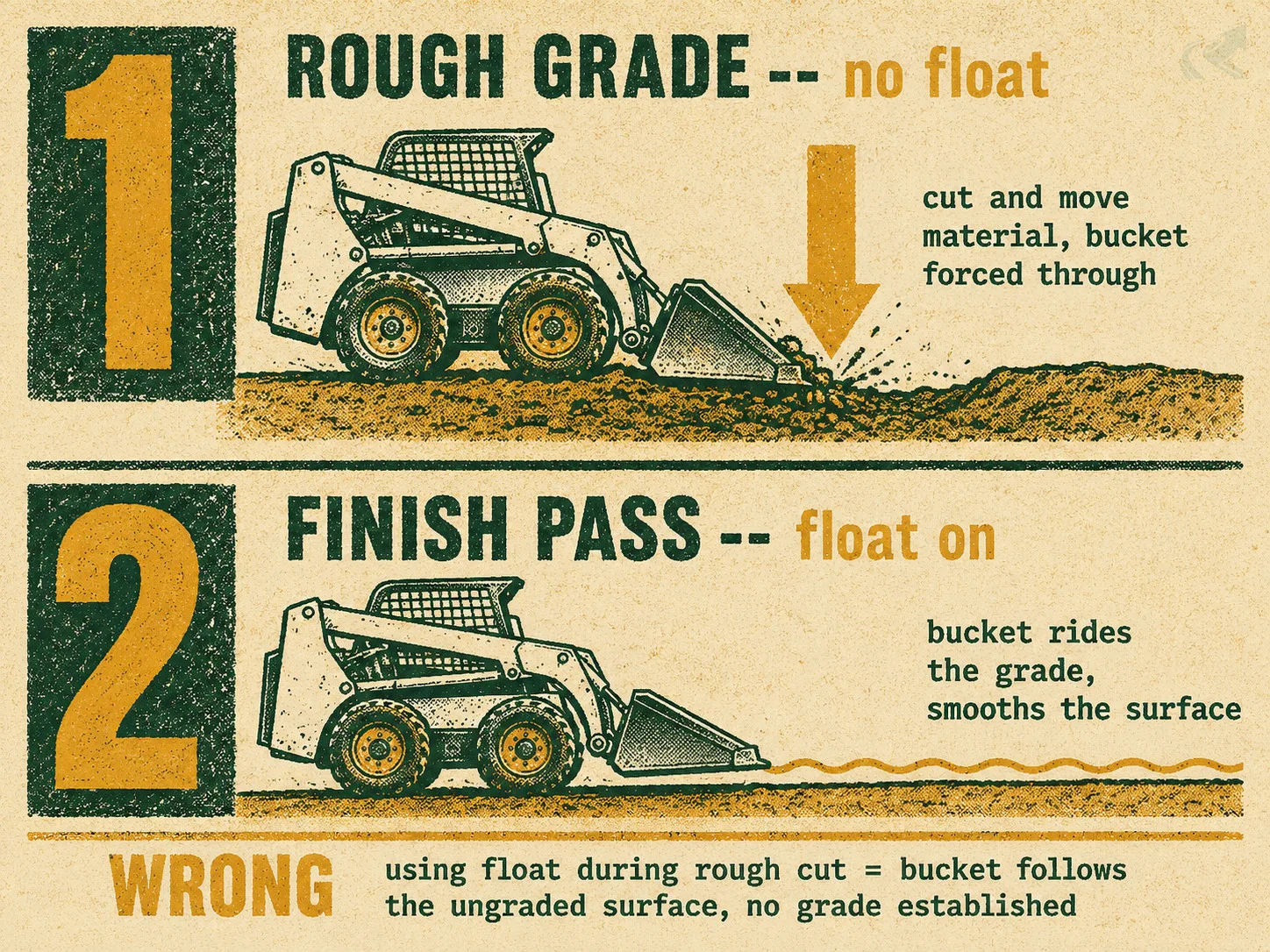
Float mode is for finish passes — not for cutting or moving material.
The correct pass sequence:
- Do the rough grade pass without float. Cutting and moving material requires machine control — the bucket needs to force its way through the soil, not ride it.
- Switch to float mode for the finish pass. The bucket is now riding the rough-graded surface, conforming to it and smoothing it.
- Make consistent, overlapping passes in the same direction. Overlapping prevents the ridges that form at the edges of individual passes.
- Check the grade slope with a level or slope meter after the finish passes are complete. Target a minimum 2% slope away from any structure.
Common mistake: using float mode for the entire job, including the initial cut. Float mode during cutting means the bucket follows the existing ungraded surface. The machine travels over the surface rather than grading it. The rough grade never gets established, and the finish pass has nothing to conform to.
A proof-roll with a loaded truck after subgrade work — and before the finish pass — also reveals soft spots that will settle unevenly later. That’s a separate step from float technique but part of the same correct sequence.
Asking About Float Technique When Hiring
One question reveals whether the operator uses float correctly and whether the machine has the capability.
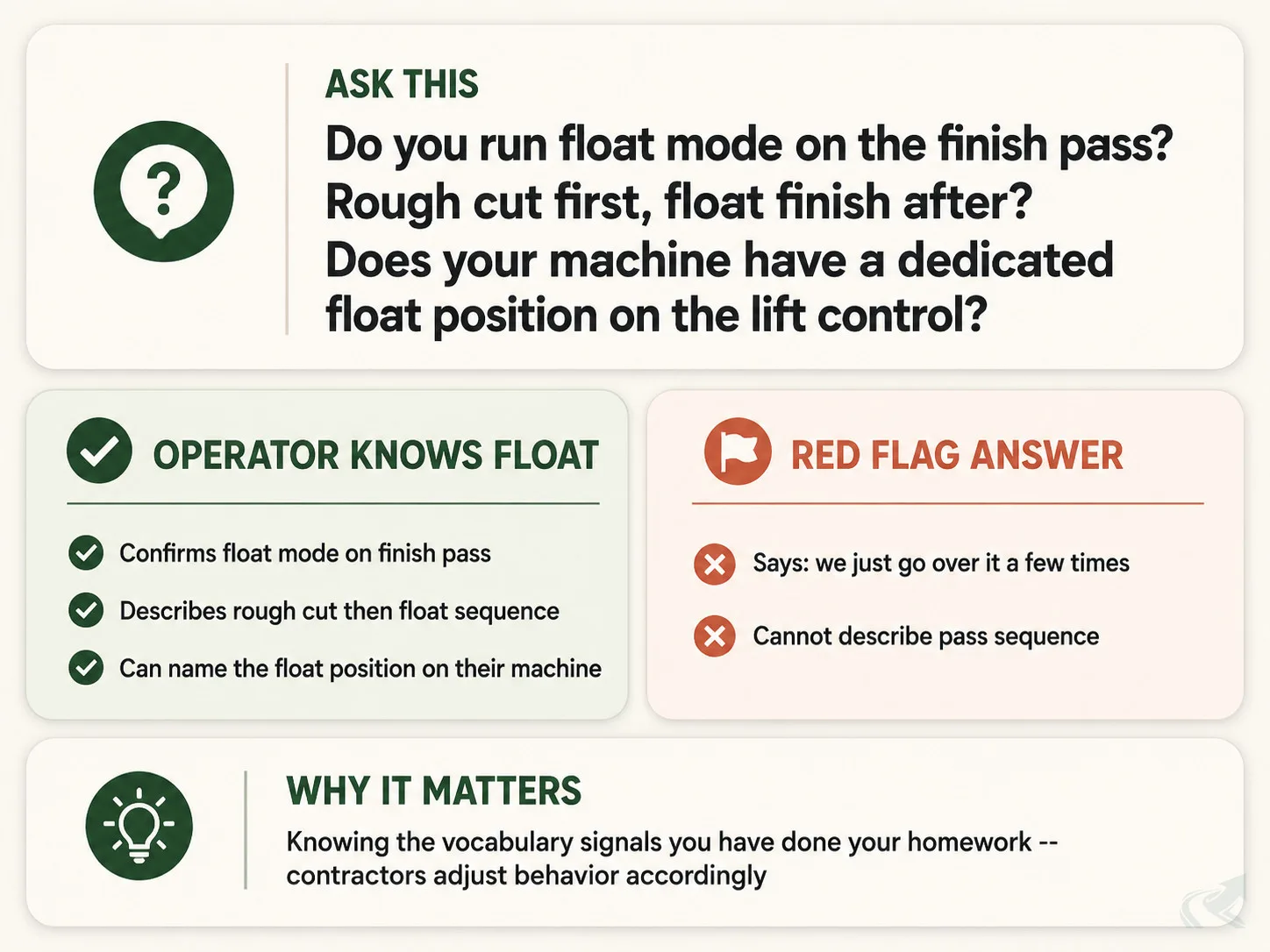
An operator who hears this and can answer it accurately is running the machine correctly. One who says “we just go over it a few times” is not using float technique — and the finish result will show it.
This question does something else, too. It signals to the operator that you’ve done your homework. Contractors who show warning signs in a grading bid tend to move faster when they realize the homeowner knows the vocabulary.
For a complement to float technique that addresses directional slope control, see heel grading as a complement to floating the bucket. For a plain-English definition you can save, see the float-the-bucket glossary definition.
If you’re comparing rented equipment options, mini skid steer rental for NC homeowners covers float mode availability across rental-class machine sizes.
When you’re ready to hire rather than DIY, hire a grading operator in North Carolina who can walk through pass sequence and float technique before the bid is written. For homeowners evaluating whether to hire or rent, start at the NC DIY grading triage page first.