
Why NC Clay Changes the DIY Calculation
She watched the French Drain Man tutorial. It looked achievable. Home Depot has the pipe and fabric, and she has the weekend.
Here is what the video did not cover: his soil is Michigan loam. Her soil is NC Piedmont red clay soil properties that behave nothing like the loam in the tutorial. The trench she digs will try to close in on itself if she does not backfill within a few hours. The clay will seal around geotextile fabric at a different rate than loam. The slope verification step — which the video shows with a level on a 2x4 — needs to be held to a tighter standard in clay because clay’s slow infiltration rate leaves less room for error.
This page is the NC-specific layer that the YouTube tutorials skip. It tells you exactly where the line is: what is genuinely achievable in Piedmont clay, what commonly fails, and when to stop planning and start calling a licensed operator.
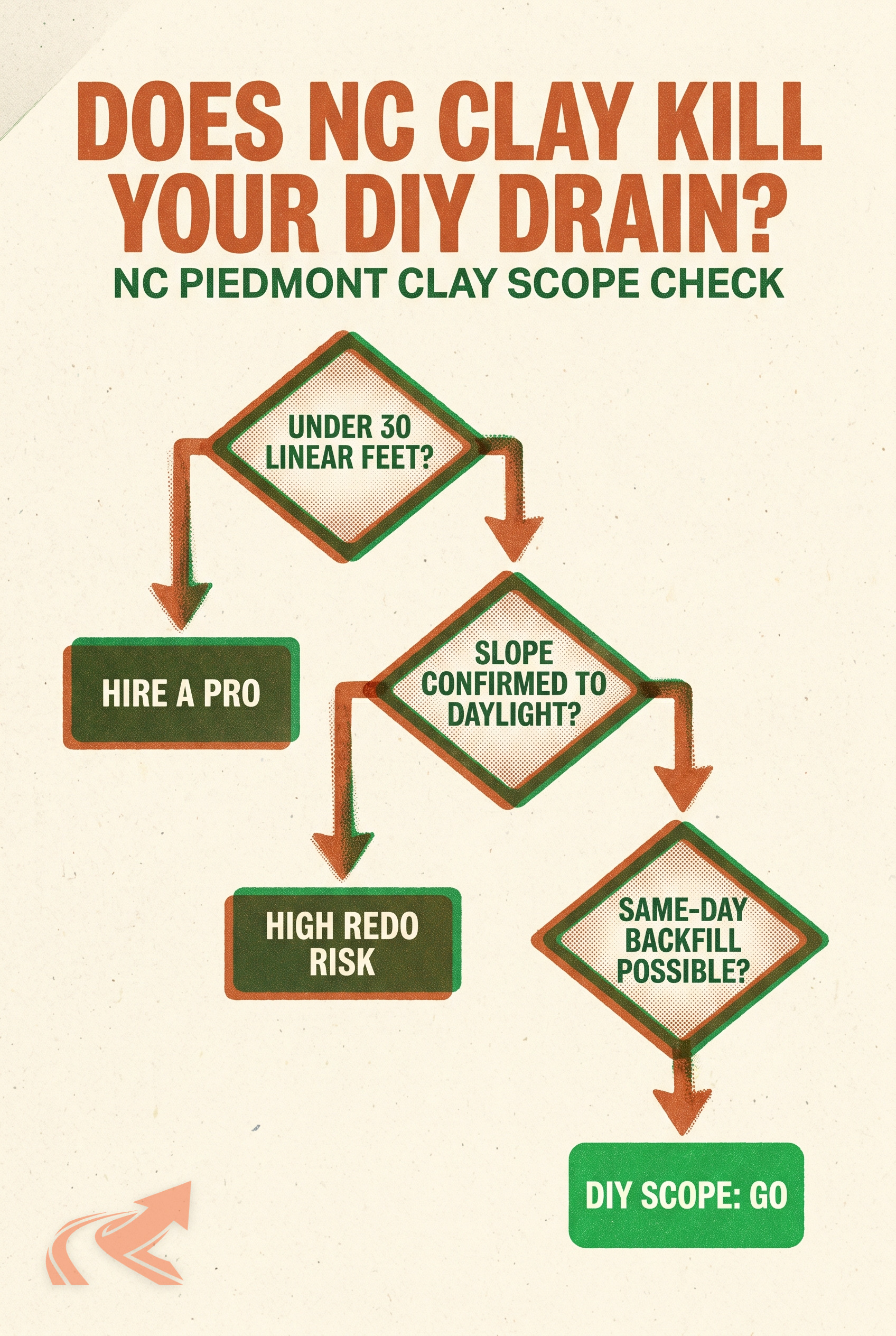
What NC Clay Does to DIY Projects
NC red clay behaves differently from the soil in most online drainage tutorials — specifically in three ways that change the DIY scope.
Understanding these three behaviors before you start is the difference between a working drain and a redo.
Trench wall stability. Clay trenches stay open for several hours in dry conditions. In wet conditions, the walls move faster. Dig, install pipe, backfill — same day. Most weekend project timelines don’t work that way. If you plan to dig Saturday and backfill Sunday, you are taking a gamble on wall slump that the YouTube tutorial did not flag.
Clay-fabric sealing. NC Piedmont clay has fine particles that migrate into geotextile fabric over time. A fabric spec that performs well in loam may clog within two to three seasons in NC clay. This is not a brand problem — it is a specification problem. The fabric weight and pore size that matches the soil matters more than the brand.
Surface repair after disturbance. Clay disturbed by grading or trenching does not re-establish natural grade on its own. The soil memory is gone. Re-compaction requires a plate compactor or equipment — not a hand tamper and a garden hose. Homeowners who skip this step end up with the same drainage problem reforming in six to twelve months.
Drain trench in NC clay: stable walls vs a collapse
Comparison. Stable trench: Trench walls hold clean and vertical; Pipe seated in an undisturbed stone bed; Bedding stays at the planned grade; Backfill goes in over a pipe that won't move. Collapsed trench: Clay wall slumps into the open trench; Slumping clay disturbs the stone bed; Pipe is shoved off line and off grade; Slope is lost before backfill even starts.
- Trench walls hold clean and vertical
- Pipe seated in an undisturbed stone bed
- Bedding stays at the planned grade
- Backfill goes in over a pipe that won't move
- Clay wall slumps into the open trench
- Slumping clay disturbs the stone bed
- Pipe is shoved off line and off grade
- Slope is lost before backfill even starts
An open trench in NC clay does not wait -- if walls slump before the pipe is bedded, the grade is already gone.
What NC Homeowners CAN Realistically Do Themselves
Small-scale surface grading, minor swale shaping, and trench prep on accessible sites are realistic DIY projects in North Carolina — with the right equipment and an honest read of your site conditions.
This is not a discouragement list. These are genuine DIY options in NC clay with clear conditions attached.
DIY French drain installation NC under 30 linear feet on accessible terrain. Doable with the right tools, a dedicated weekend, and a commitment to same-day backfill. Not realistic in rocky terrain, heavily-rooted ground, or areas with an established tree canopy. Slope must fall to daylight at 2% minimum — confirm this with a transit level or laser level before you buy a foot of pipe.
Swale shaping for surface drainage diversion. A small landscape swale is one of the more accessible NC yard drainage solutions a homeowner can attempt — directing water away from a foundation with hand tools if the existing grade is already close to correct. Machine work is faster and more precise. Hand work is an option when the scope is genuinely small — think under 20 feet of swale, minimal cut.
Topsoil redistribution under 500 square feet. Spreading delivered topsoil over a small area is achievable. Compaction and rough grading in clay is not hand-tool territory — that is where you need a plate compactor at minimum or a rented skid steer for anything larger.
Gravel top-dressing on an existing driveway. Spreading a delivered load of #57 stone or gravel on an existing driveway surface is DIY. Regrading the subgrade underneath is not — that requires equipment and compaction.
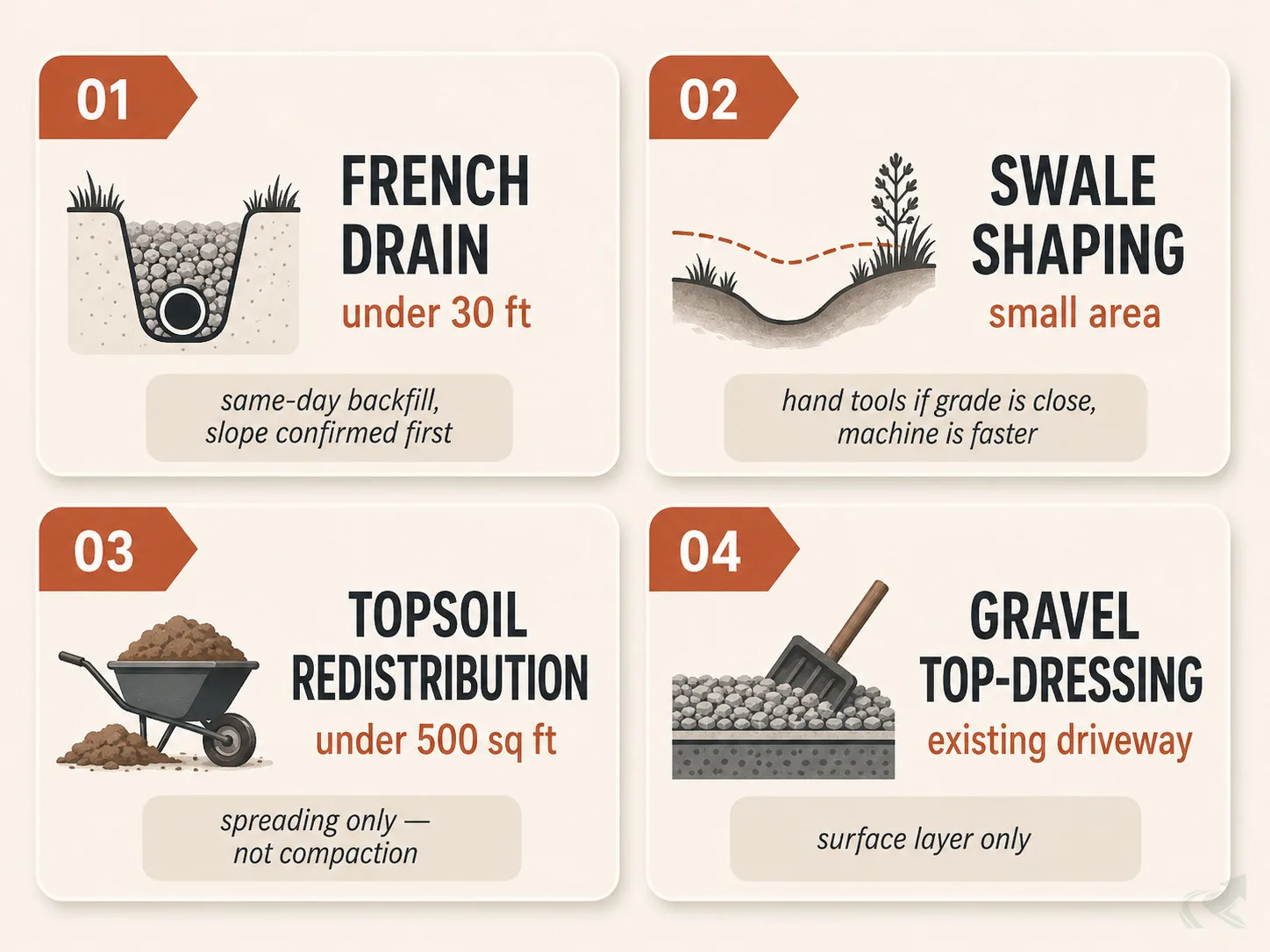
The DIY Scope Matrix
| Task | DIY realistic? | Condition |
|---|---|---|
| French drain under 30 LF, accessible terrain | Yes | Same-day backfill required; slope confirmed before purchase |
| French drain 30—50 LF | Marginal | Slope management over distance is difficult by hand; high redo risk |
| French drain over 50 LF | No | Hire |
| Swale shaping, small area | Yes | Machine work faster; hand tools viable if grade is close |
| Topsoil redistribution under 500 sq ft | Yes | Spreading only — not compaction or subgrade work |
| Gravel top-dressing on existing driveway | Yes | Surface layer only; subgrade regrading is not DIY |
| Rough grading, any machine work | No | Hire or rent with operator experience |
| Foundation-adjacent drainage | No | Hire — stakes too high for trial and error |
| Any work triggering a county permit | Verify | Permit thresholds apply to homeowners; see /resources/county-permits/ |
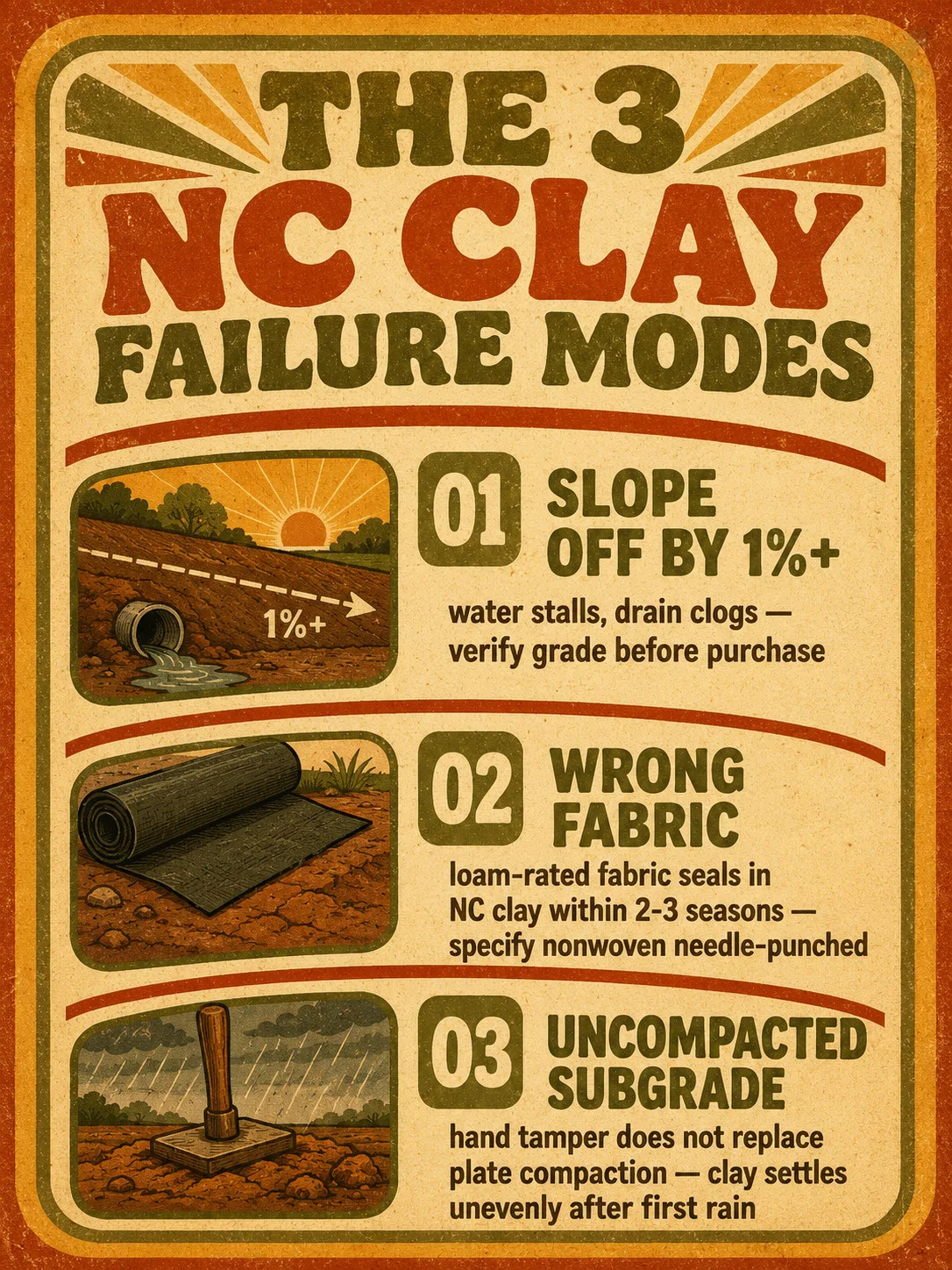
What Usually Goes Wrong — The NC Clay Failure Mode Patterns
The three most common NC clay DIY drainage failures are: wrong slope, clay-sealed fabric, and uncompacted subgrade that fails after the first significant rain.
These are not rare edge cases. They are the standard failure sequence.
Slope off by more than 1%. Water stalls. The drain either collects sediment and clogs or drains too slowly to do its job in a heavy NC rain event. In well-draining sandy soil, a near-miss on slope is recoverable. In Piedmont clay with slow infiltration, the margin is smaller. Verify slope with a laser level or transit before you install anything. A 2% fall to daylight is the minimum workable grade — do not assume it is there.
Fabric selected for loam, installed in clay. Standard woven geotextile fabric clogs within two to three seasons in NC red clay. Fine particles migrate through or into the fabric weave. The drain is now a sealed tube with no infiltration. That is a full redo — not a flush-and-fix situation. Look for nonwoven needle-punched fabric rated for high-clay applications when specifying for Piedmont soil.
Subgrade uncompacted. The surface looks flat when you finish. After the first one-inch rain, it is no longer flat. Clay without proper compaction settles unevenly, re-creating the low spots and ponding areas you were trying to eliminate. A hand tamper does not replace plate compaction on clay. If you cannot rent or borrow a plate compactor, factor that rental into your project budget before you start — not after.
Common Mistakes:
Using sandy-soil YouTube tutorials without translating them to NC clay. The soil behavior is genuinely different. Slow infiltration rates change drain sizing; clay wall behavior changes trench management. Translate the method — do not dismiss the research, but verify the assumptions match your soil.
Buying materials before measuring slope. Does your drain have a 2% fall to daylight? Confirm that first. Buy pipe and fabric second. Reversing the order is the most common expensive mistake.
Skipping compaction. A hand tamper is not plate compaction. Uncompacted clay settles. The redo cost will exceed the rental cost of a compactor — or the cost of hiring a verified NC grading contractor for the compaction pass.
Leaving the trench open overnight. Clay walls move. Backfill the same day.
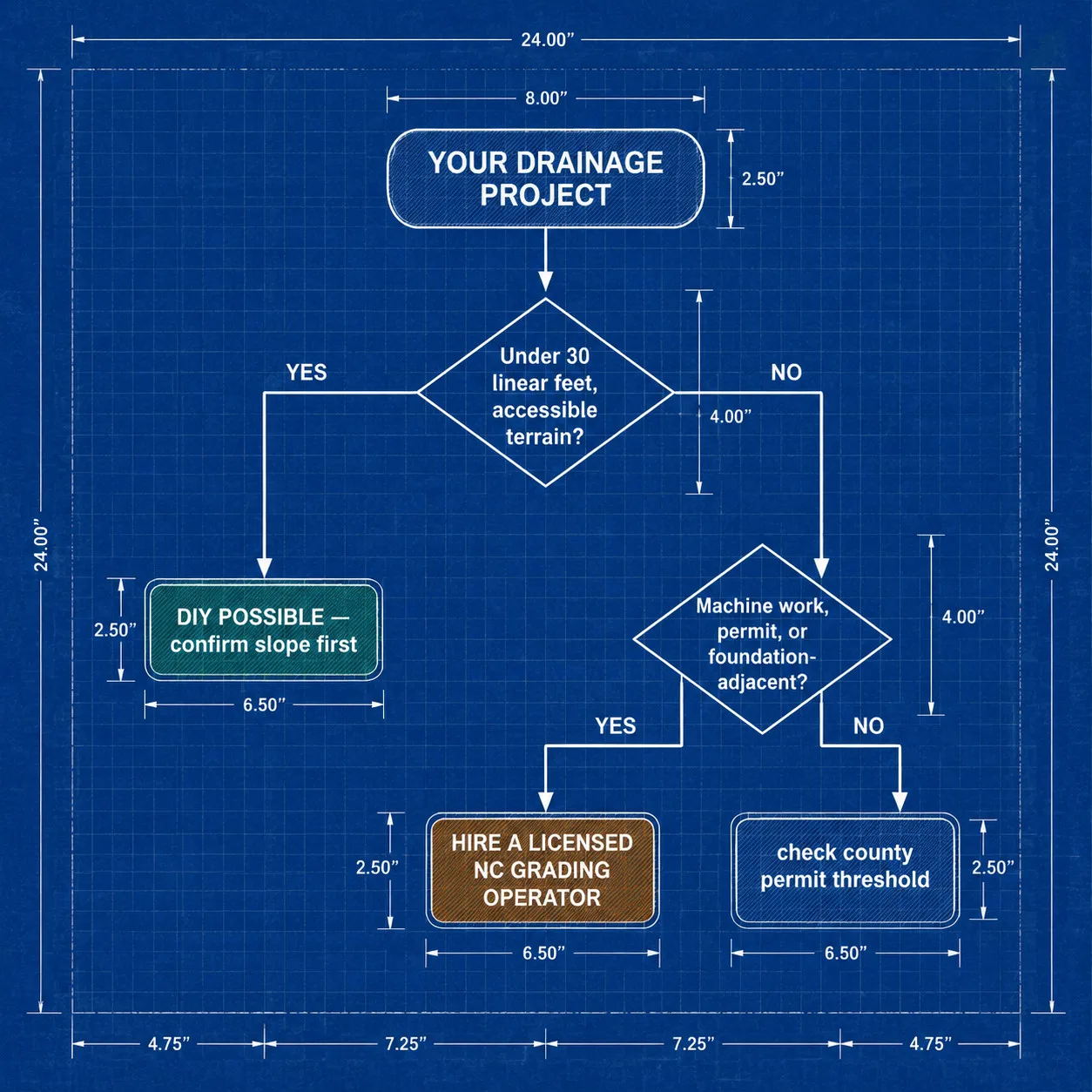
When to Hire Instead
If the project involves machine work, a permit requirement, or a drainage system routing water to a specific outlet, hire a licensed NC grading operator.
These are not edge-case triggers. They cover the majority of drainage projects that homeowners in North Carolina call about.
Any project requiring a skid steer, mini excavator, or CTL involves machine grading in clay. Rental equipment plus NC clay plus no operator experience is a reliable formula for surface damage and incorrect final grade. The machine cost is real; the redo cost is larger.
Any project crossing the county land-disturbance threshold requires a permit — and that threshold applies whether the work is done by a contractor or a homeowner. NC county thresholds vary: some trigger at 10,000 square feet disturbed, others at one acre. Check your county before you start. The county permit guide at /resources/county-permits/ has the state-level detail.
Any French drain longer than 50 linear feet: slope management over that distance is difficult to hold accurately without survey equipment. Hire or rent with full survey setup.
Any drainage work adjacent to a foundation: the stakes are too high for trial-and-error. A wrong outlet location or insufficient slope does damage that is expensive to diagnose and expensive to fix.
If starting over would cost more than hiring the work out in the first place, you are past the DIY envelope. Hire a grading contractor in North Carolina and get an itemized quote that breaks out material and labor.
What This Hub Links To
If the scope check tells you this project is within the DIY envelope, these pages give you the technique vocabulary you need before you rent equipment or buy materials.
- Mini skid steer rental for DIY grading in NC — what size, what attachments, what to expect renting in the Piedmont
- DIY French drain installation in North Carolina — trench method, fabric selection, slope verification, same-day backfill protocol for clay
- Equipment picker for NC DIY grading projects — matching equipment to scope for homeowners who have not operated before
- NC grading and drainage glossary for DIY homeowners — compaction, proof-roll, daylight, swale, silt fence — the vocabulary you need to read a quote accurately
- NC Piedmont red clay soil properties — infiltration rates, shrink-swell data, and what clay does to drainage timing
Each spoke page is scoped to NC conditions. The YouTube tutorials are a starting point. These pages are the translation layer.
If the scope matrix tells you this is a hire situation, the verified contractor directory is the next step. Get an itemized quote that breaks out material and labor separately — that structure makes it possible to compare quotes from different operators and spot the ones pricing blind.
Hire a licensed NC grading contractor — filter by county, verify an active license before calling.