
Monica found the Apple Drains FL channel on a Thursday night, somewhere around the third video. Chuck’s argument against fabric socks made immediate, intuitive sense: fabric traps sediment, sediment clogs the system, the drain dies. She forwarded the video to her contractor the next morning.
The contractor replied: “That’s for Florida. We’re in NC.”
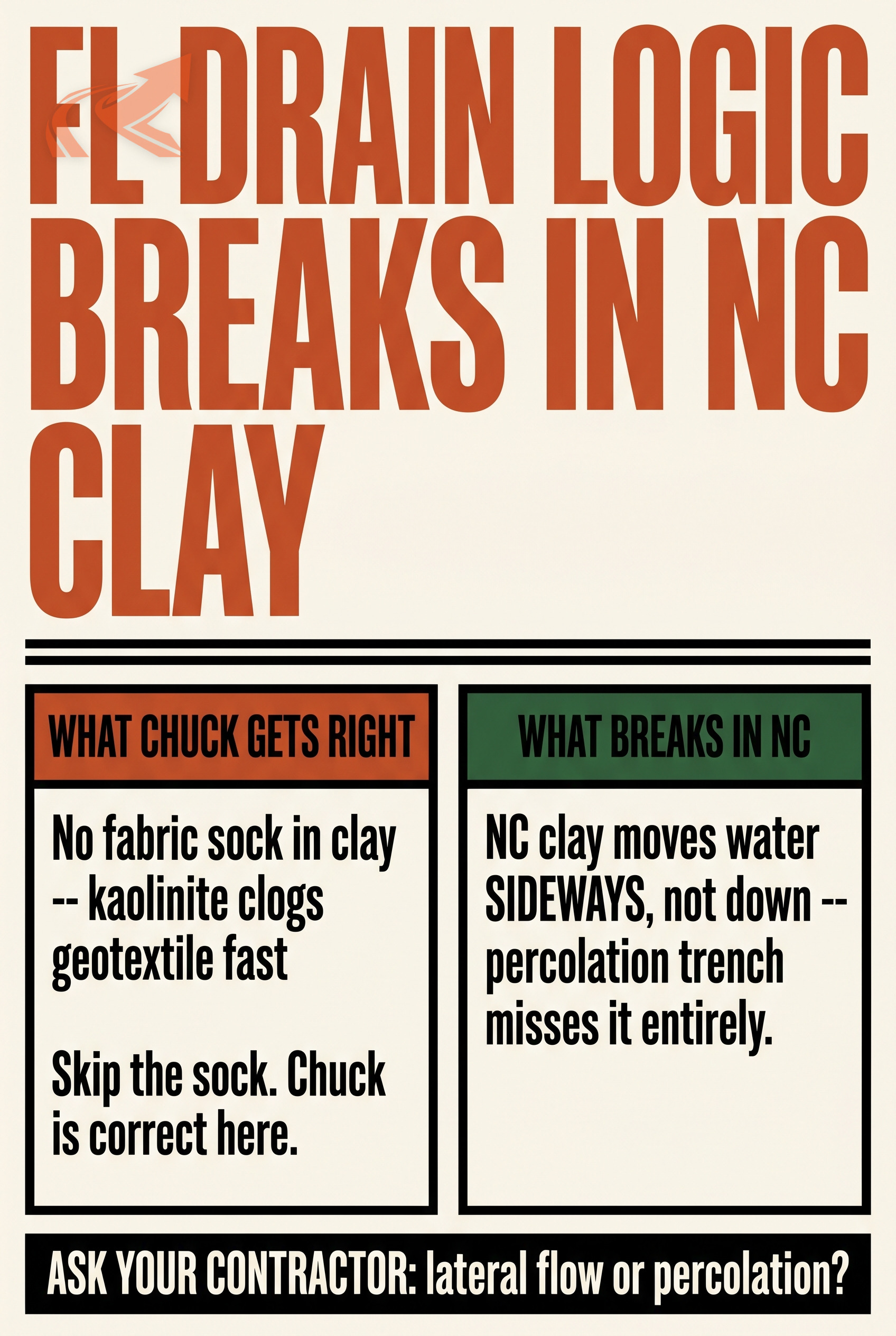
Monica wanted to know who was right. The answer is — both of them, depending on which specific claim you’re evaluating. Chuck is right about fabric in clay. The contractor is right that Florida drainage physics don’t map cleanly to North Carolina Piedmont clay. The disagreement is real, but it’s about different things.
This page works through it specifically: which parts of Chuck’s method hold up in North Carolina, which parts rest on soil assumptions that don’t exist here, and what you should walk away knowing before your next contractor conversation.
Who Chuck Is and What His Channel Covers
Apple Drains FL is a Florida-based drainage channel. Chuck’s methodology is developed for and filmed in Florida’s high-permeability sandy soils — which have hydraulic conductivity roughly 10 to 100 times higher than NC Piedmont clay.
The Apple Drains FL YouTube channel covers residential and light-commercial drainage installation, with a strong focus on French drain systems and outlet design. Chuck films in Florida, working in the sandy, high-permeability soils common to the Florida coastal plain.
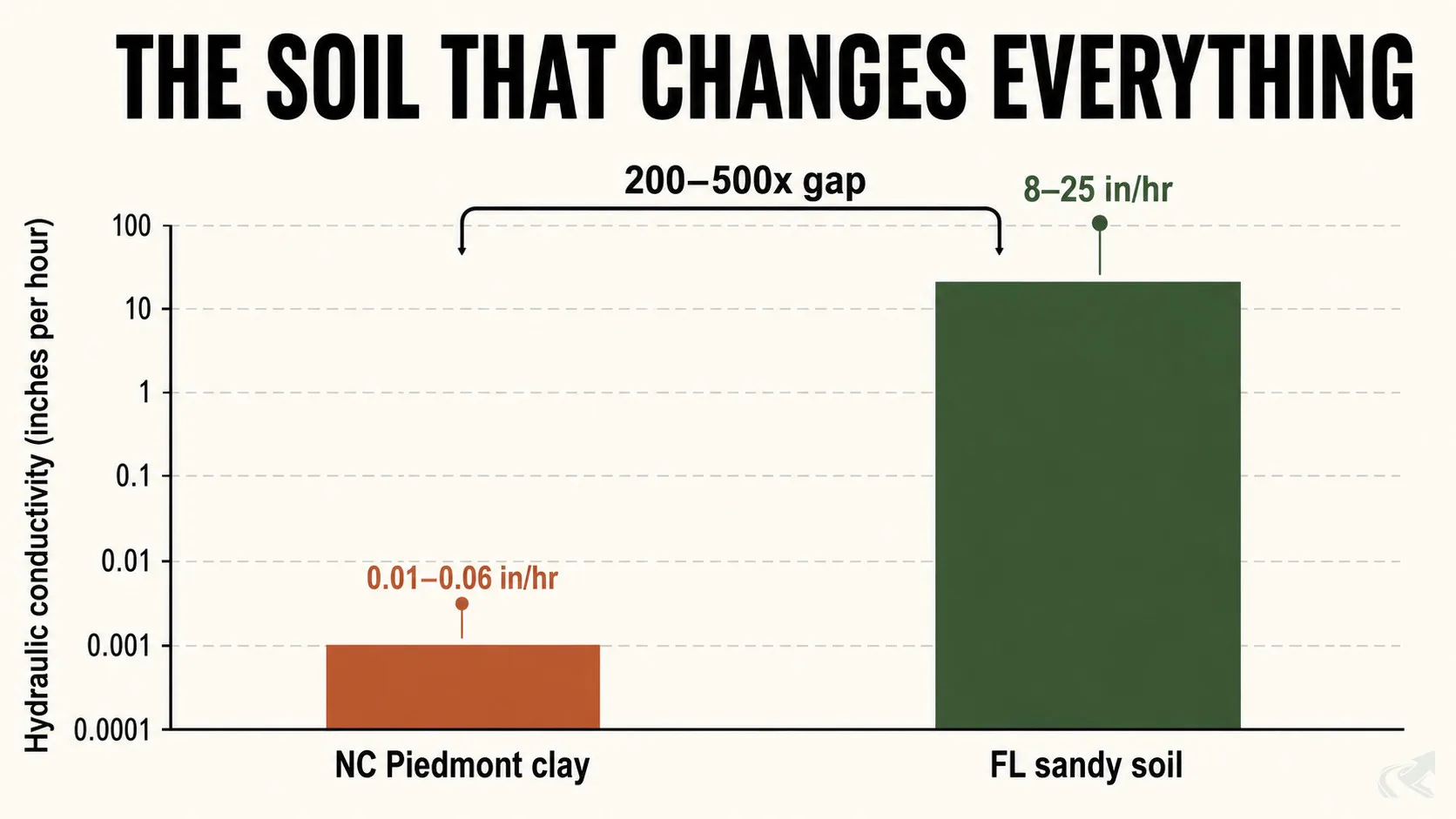
That soil context matters more than anything else on this page. Florida’s dominant sandy soils — Entisol and Spodosol series — have hydraulic conductivity in the range of 8 to 25 inches per hour. NC Piedmont clay, by contrast, runs 0.01 to 0.06 inches per hour (Cecil series, USDA Web Soil Survey data).
That is not a marginal difference. It is a 200-to-500x gap in how fast water moves through the ground. The drainage physics in those two environments are fundamentally different — and that gap is why some of Chuck’s advice translates to North Carolina and some of it doesn’t.
For context on why NC clay creates different drainage requirements, see the French drain methodology wars overview including FL methods.
What Chuck Gets Right: The Fabric-Sock Argument in Fine-Grained Soils
Chuck’s core claim — that geotextile fabric socks clog in fine-grained soils faster than they help — is supported by soil science and directly applicable to NC Piedmont clay.
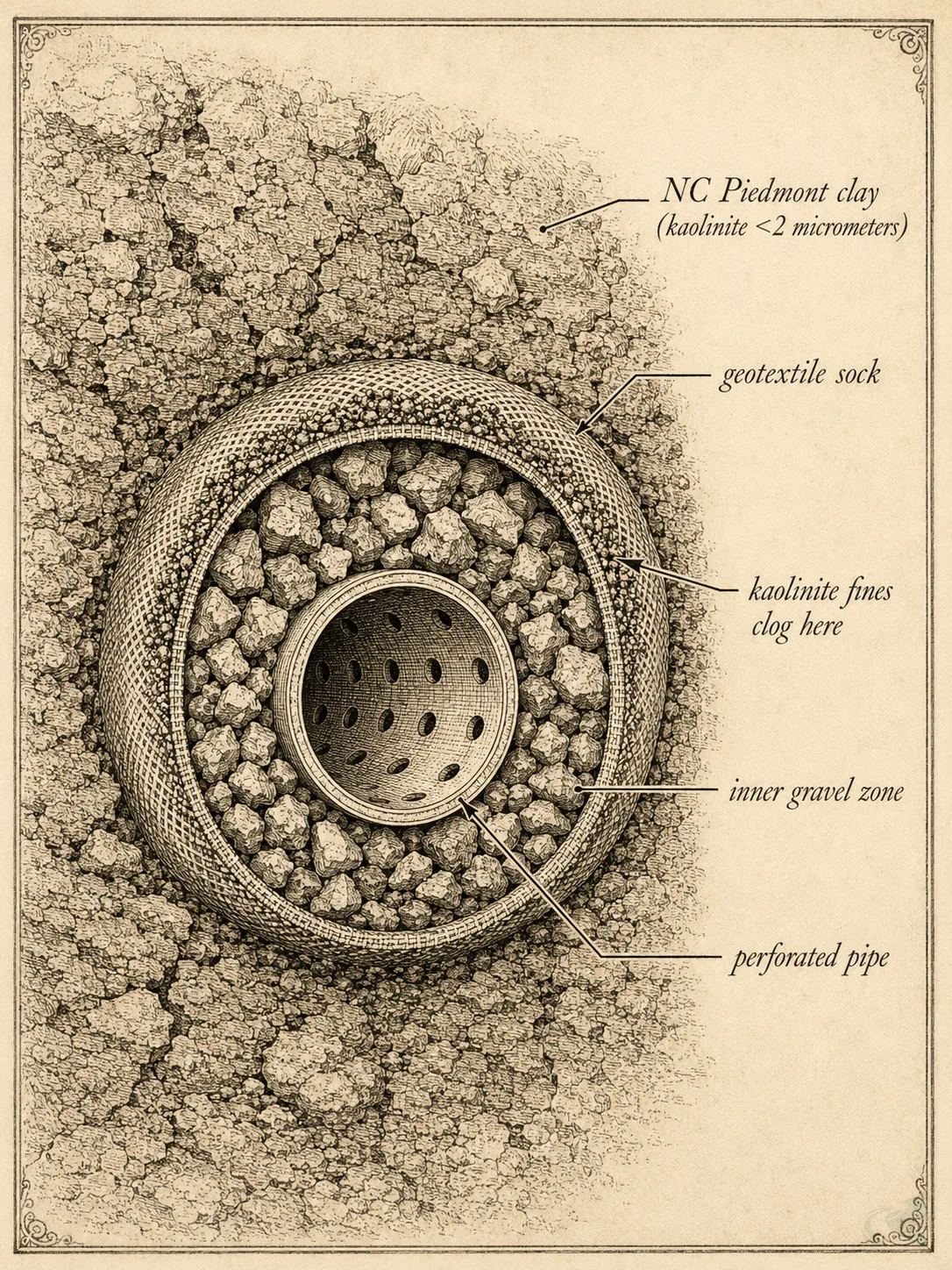
The no-fabric argument rests on a specific physical mechanism: when a pipe sock’s geotextile filter rating is not matched to the soil’s particle-size distribution, fine particles migrate into and through the fabric and eventually clog it. In clay-dominant soils, this failure mode is accelerated.
NC Piedmont clay is dominated by kaolinite — a clay mineral with extremely fine particle size, typically under 2 micrometers. Standard non-woven geotextile socks used on French drain pipe have apparent opening sizes that are not calibrated for kaolinite-dominant fines. Pores in the fabric that would filter coarser sand particles become pathways for clay-slurry migration, or clog under the sustained pressure of saturated kaolinite clay.
The result is a sock that reduces system permeability without meaningfully preventing fine-particle infiltration into the gravel trench. You get the liability of the fabric without its intended benefit.
Chuck’s instinct — skip the sock in fine-grained soil — is correct for this reason. The kaolinite particle-size argument in NC clay supports the same conclusion he reaches in Florida sand, even though the mechanism is somewhat different.
What you keep from Apple Drains FL: the no-fabric-sock position in the clay zone. See the clay-stops-water debate and NC red clay for the full kaolinite argument and soil science backing.
What Doesn’t Translate: Percolation vs. Lateral Flow
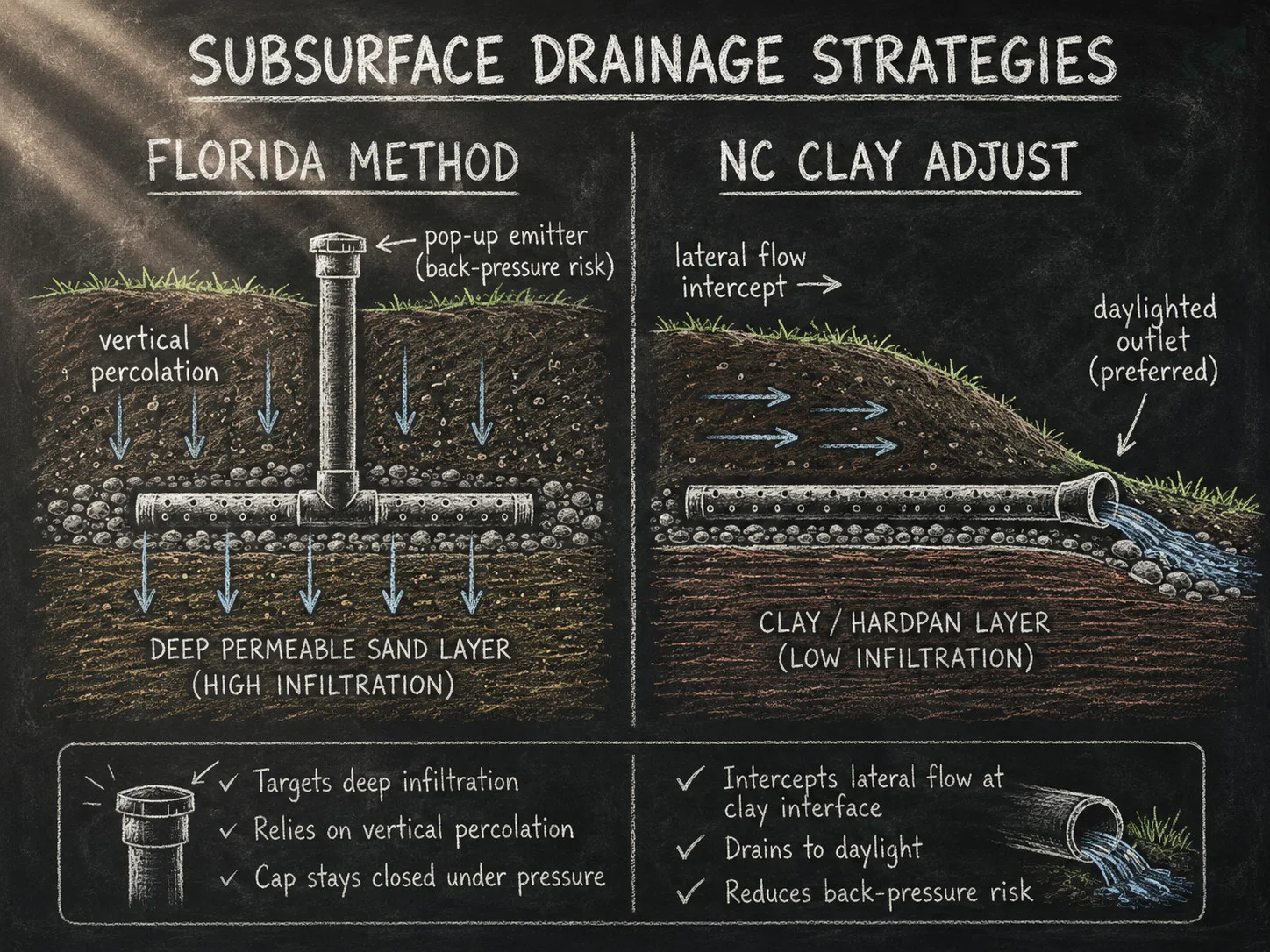
Chuck’s systems are designed for soil that accepts water from a gravel trench by vertical percolation — and NC Piedmont clay doesn’t do that. Water in NC clay moves laterally along soil horizons, not downward into a gravel bed.
This is the load-bearing design assumption that breaks in North Carolina. In Florida sandy soil, a gravel trench acts as a reservoir: water enters from the surrounding soil by percolating down and in, collects in the void space, and exits through the pipe. The trench is working as a collection basin for downward-moving groundwater.
NC Piedmont clay is an Ultisol with extremely low vertical hydraulic conductivity. When the soil saturates, water does not percolate down through the clay profile. It moves laterally — along the surface, along subsurface hardpan layers, along impermeable subsoil horizons. The dominant hydrologic pathway is horizontal, not vertical.
A gravel trench designed around vertical percolation will not intercept that lateral flow unless it is positioned and oriented to cut across the lateral flow path. Pipe placement depth, trench positioning relative to slope, and outlet location all change when you’re intercepting lateral flow rather than collecting percolating groundwater.
NC Piedmont install vs the Florida-method install
Comparison. NC clay install: Trench cuts across the lateral flow path; Pipe set to intercept flow at the clay-sand interface; No sock -- clay would clog it anyway; Outlet daylighted so water has somewhere to go. Florida-method install: Designed for water percolating straight down; Sock-wrapped pipe in permeable sand; Trench positioned for vertical, not lateral, flow; Misses the lateral flow moving through NC clay.
- Trench cuts across the lateral flow path
- Pipe set to intercept flow at the clay-sand interface
- No sock -- clay would clog it anyway
- Outlet daylighted so water has somewhere to go
- Designed for water percolating straight down
- Sock-wrapped pipe in permeable sand
- Trench positioned for vertical, not lateral, flow
- Misses the lateral flow moving through NC clay
In NC Piedmont clay water moves sideways, not down -- a Florida percolation design never intercepts it.
An interceptor trench in NC clay runs perpendicular to slope, positioned to cut off the lateral flow path before water reaches the foundation or low point. That orientation is different from a collector trench designed to catch percolating groundwater from below.
For the full NC clay soil science treatment, see why NC red clay demands different drainage methods than FL.
The Specific Techniques to Watch For
Two specific Apple Drains FL techniques need adjustment for NC clay: pipe depth and outlet type.
Chuck’s channel content, filmed in Florida, may reference pipe placement relative to the water table or soil layers that behave differently than NC Piedmont clay subsoil horizons. Watch for two specific adjustments:
-
Pipe depth. Florida systems may target a sand layer or permeable zone below the surface — a design that makes sense where vertical percolation exists. In NC Piedmont clay, the interceptor pipe needs to be positioned to catch lateral flow at the clay-hardpan interface, not to reach a permeable layer below. Ask your contractor what layer the pipe is designed to drain, and why that depth.
-
Outlet type. Pop-up emitters — the spring-loaded outlet caps that open under water pressure — can back up in NC clay systems under heavy saturation events. The clay surrounding the outlet may not drain fast enough to prevent back-pressure. NC clay drainage systems generally perform more reliably with daylighted outlets (open-end pipe exiting at grade into a ditch, swale, or daylight point) rather than pop-up emitters. If a proposal specifies pop-ups in a clay-zone system, ask why, and whether a daylighted outlet was considered.
These are not universal failures in Chuck’s system — they’re specific design assumptions that need translation when you’re working in NC Piedmont clay rather than Florida sand.
NC Homeowner Takeaway
Here’s what you keep from Chuck’s method when you’re in NC Piedmont clay — and what specifically changes.
This is not a dismissal of Apple Drains FL. The channel has real drainage expertise and Chuck’s soil-science instincts are sound. The translation work is about which instincts apply in NC and which rest on Florida soil assumptions.
-
Keep: No fabric sock in the clay zone. Chuck is right about this. Kaolinite fines clog geotextile faster than the fabric prevents migration in a clay-dominant installation. If a contractor insists on a fabric-wrapped pipe in the kaolinite zone without explaining why their geotextile spec is matched to clay particle sizes, push back.
-
Adjust: Don’t rely on the gravel trench as a percolation reservoir. In North Carolina clay, the trench intercepts lateral flow from upslope — the pipe needs to be positioned to capture that flow, not to collect from downward percolation. Where the trench goes, how deep, and which direction it runs should all follow the lateral flow path, not the water table.
-
Ask your contractor: “Is this system designed to intercept lateral flow or to collect percolating groundwater?” A contractor who understands NC Piedmont clay will answer this without hesitation. The answer tells you immediately whether their design assumptions match your soil. A blank look or a generic answer (“we just put it where the water is”) is diagnostic.
For the full NC clay synthesis, see why NC red clay demands different drainage methods than FL and the NC clay methodology for French drain installation.
Using This When You Evaluate a Contractor
If your contractor says “we always use fabric,” ask whether the fabric is in the clay zone or at a clay-sand transition. The answer matters more than the yes or no.
Fabric at a clay-to-sand transition can serve a legitimate purpose — preventing clay fines from migrating into and clogging a more permeable layer. Fabric in a kaolinite-dominant clay zone is a different proposition, and the geotextile spec needs to be sized for the actual particle distribution.
A contractor who knows this distinction can answer the question without hesitation. One who defaults to fabric everywhere — or never uses it without understanding why — is applying a rule without understanding the soil-science basis for it.
Use the questions on this page before signing any proposal: what layer is the pipe designed to drain, is the outlet daylighted or pop-up, and is the trench positioned to intercept lateral flow across slope or to collect percolating groundwater from below.
Find a grading contractor in North Carolina who can explain their soil-specific method before work starts.
Common Mistakes When Applying Apple Drains FL to NC
-
Applying the “no pop-up emitter” rule without understanding why. Chuck may have specific reasons for his outlet preferences that apply in Florida sand. NC clay needs daylighted outlets for a different reason — clay saturation prevents pop-up emitters from releasing under heavy loads. Know which problem the rule is solving.
-
Taking “no fabric” to mean “anything goes in the trench.” No fabric in the clay zone is correct; but the gravel spec, pipe perforation pattern, and slope still matter. An open-graded angular stone spec is not the same as “whatever’s on the truck.”
-
Assuming Chuck’s pipe depth recommendations translate directly. Florida systems may target a specific sand layer below the surface. NC clay does not have an equivalent permeable layer to target at the same depth. Ask what layer the pipe is designed to drain and why that depth suits your specific soil profile.