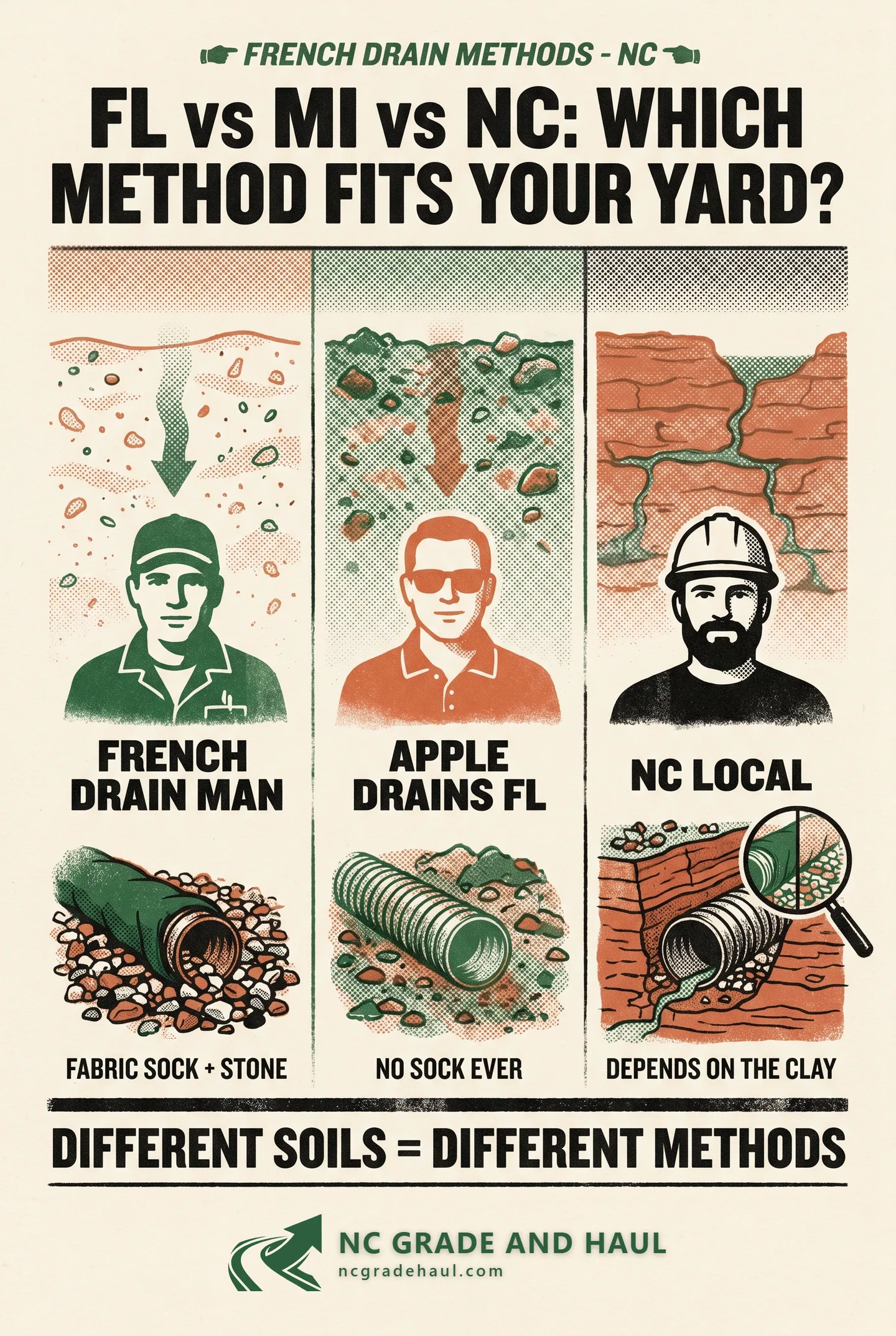
Heather watched three YouTube videos on a Tuesday night. French Drain Man said: use perforated pipe wrapped in fabric sock, pack it in angular stone, trench walls tight. Apple Drains FL said: no sock — ever — the sock clogs and kills the system. Dr. Drainz said something that didn’t quite match either. Then a local NC contractor quoted her a method that disagreed with all three.
Her confusion is rational. The experts are not giving conflicting signals because one of them is wrong. They’re solving different problems — problems shaped by the soil under their boots when they film.
This page untangles it. The methodology disagreement between YouTube’s biggest drainage channels is a predictable result of three soil types producing three different drainage physics. Once you understand why they diverge, you can extract what’s actually useful for an NC yard — and ask the one question that tells you whether a contractor knows your soil.
Why They Disagree: Soil Is the Variable They Never Say Out Loud
Each channel films in a different soil type — and soil type determines drainage physics. They’re not disagreeing about method; they’re describing different problems.
French drain design follows water. Where water goes depends almost entirely on soil permeability — how fast the ground absorbs and moves water below the surface.
Three soil types are in play across these channels. Florida sand has high permeability; water moves through it quickly, often draining down through the profile rather than running sideways. Michigan loam sits in the moderate range — slower than sand, but predictable, with enough vertical percolation to work with.
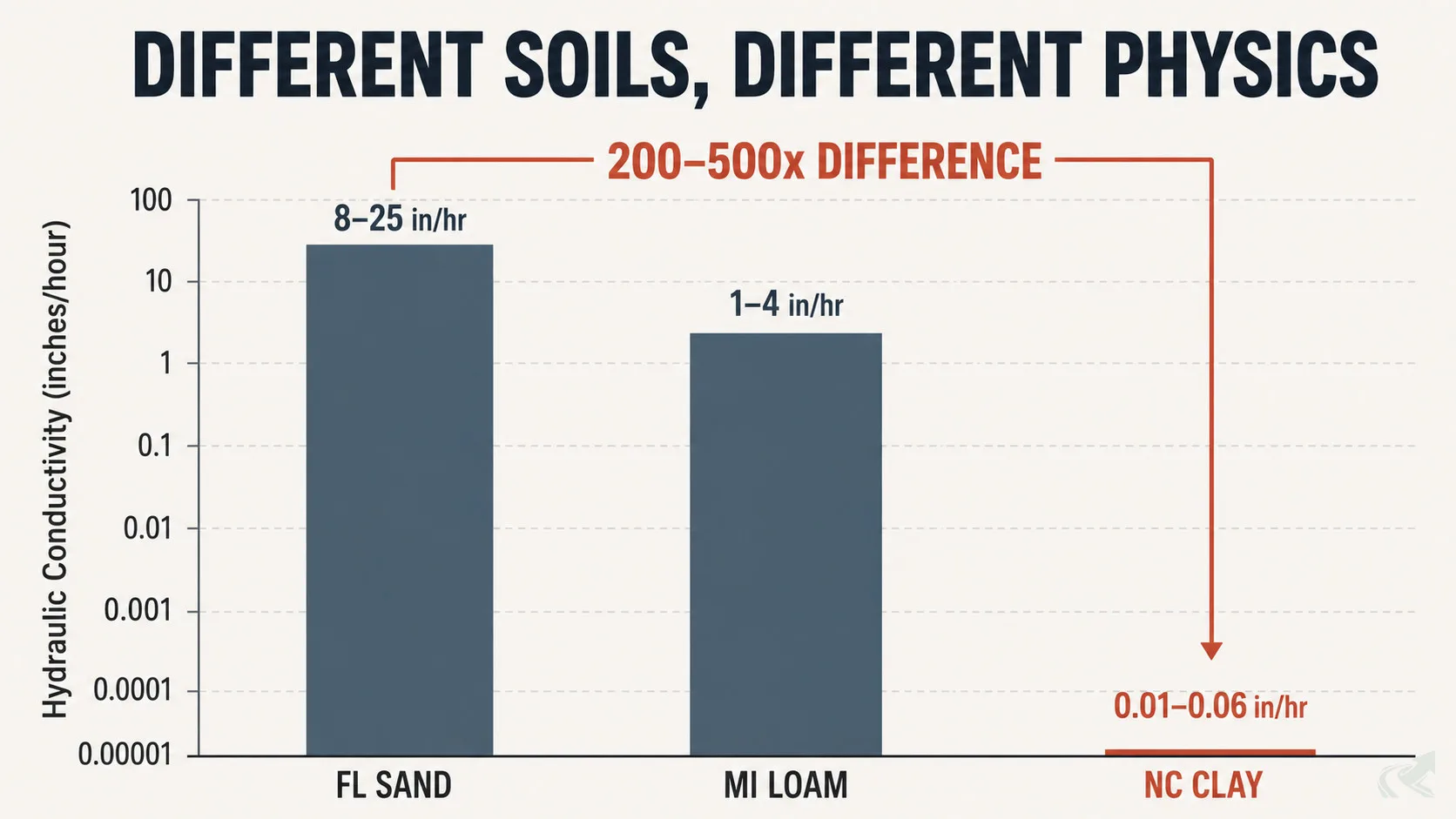
NC Piedmont clay is a different category. dominates the mineral structure. Hydraulic conductivity — the rate at which water moves through a saturated soil — runs approximately 0.01 to 0.06 inches per hour for NC Piedmont clay (Cecil series; verified against USDA Web Soil Survey data). Florida sand runs closer to 8 to 25 inches per hour.
That is not a rounding difference. It is a 200-to-500x gap.
A French drain designed around Florida’s percolation rate will not behave the same way in NC clay. The physics change. The experts are right — about their own soil.
For the full technical treatment, see why NC French drain methodology differs from other states and the NC Piedmont red clay science behind drainage differences.
The Four Channels and What Each One Gets Right
Each creator has real expertise — the question is whether their advice translates to NC clay. Here’s a one-paragraph summary of each, with the specific claim that needs adjustment for North Carolina.
Four drainage YouTube channels: location, soil, and NC applicability
| Creator | Channel | Location / Soil | NC Applicability | Full Critique |
|---|---|---|---|---|
| Chuck | Apple Drains FL | Florida / sand | Partial -- no-fabric doctrine needs adjustment for NC clay trench conditions | /resources/chuck-apple-drains-fl/ |
| (Dr. Drainz) | Dr. Drainz NC | NC / Piedmont clay | High -- closest to NC-right because he's actually filming in NC clay | /resources/dr-drainz-nc/ |
| Shawn | Gate City Foundation | NC / Guilford County clay | High -- NC operator working Piedmont conditions in the field | /resources/shawn-gate-city/ |
| Robert Sherwood | French Drain Man | Michigan / loam | Low-medium -- Michigan loam is not NC clay; fabric-sock and raked-wall methods require significant adjustment | /resources/french-drain-man-mi/ |
Chuck
- Channel
- Apple Drains FL
- Location / Soil
- Florida / sand
- NC Applicability
- Partial -- no-fabric doctrine needs adjustment for NC clay trench conditions
- Full Critique
- /resources/chuck-apple-drains-fl/
(Dr. Drainz)
- Channel
- Dr. Drainz NC
- Location / Soil
- NC / Piedmont clay
- NC Applicability
- High -- closest to NC-right because he's actually filming in NC clay
- Full Critique
- /resources/dr-drainz-nc/
Shawn
- Channel
- Gate City Foundation
- Location / Soil
- NC / Guilford County clay
- NC Applicability
- High -- NC operator working Piedmont conditions in the field
- Full Critique
- /resources/shawn-gate-city/
Robert Sherwood
- Channel
- French Drain Man
- Location / Soil
- Michigan / loam
- NC Applicability
- Low-medium -- Michigan loam is not NC clay; fabric-sock and raked-wall methods require significant adjustment
- Full Critique
- /resources/french-drain-man-mi/
Chuck — Apple Drains FL (Florida / Sand)
What he recommends: No fabric sock on the pipe, ever. Sock traps sediment and kills drainage systems. Use clean washed stone and let the system breathe.
Why it works in Florida: Florida sandy soil doesn’t load the trench with fine clay particles the way NC Piedmont clay does. In sand, the no-sock doctrine makes sense — the stone stays clean longer because the surrounding soil isn’t pumping fines into the void.
What doesn’t transfer to NC clay: In NC Piedmont clay, the trench environment is different. Kaolinite-rich soil behaves differently under saturation and load. The no-fabric position isn’t wrong on principle, but the aggregate selection and trench geometry that work in Florida sand need adjustment for clay conditions.
Read the full Apple Drains FL methodology summary and NC limits.
Dr. Drainz NC (NC / Piedmont Clay)
What he recommends: Methods calibrated to NC conditions — including the clay-specific aggregate and outlet strategies that don’t come up in channels filming on sandy soils.
Why it works: He’s filming in North Carolina. The soil under his boots is the soil under Heather’s yard. This is the channel where NC-specific advice is most likely to translate directly.
What to verify: Not every NC sub-region is identical. Piedmont clay in the Triangle differs somewhat from WNC rock/shallow-soil conditions. Confirm the specific soil zone matches your project.
Read the Dr. Drainz NC methodology overview.
Shawn — Gate City Foundation (NC / Guilford County)
What he recommends: Drainage work performed in Guilford County, North Carolina — hands-on Piedmont clay conditions, not theory from a sandier region.
Why it works: Guilford County sits squarely in NC Piedmont clay territory. Gate City Foundation’s Shawn is working the same soil type as most Triangle and Charlotte metro homeowners. His approach to positive drainage, outlet design, and aggregate spec comes from field work in actual NC clay.
What to verify: Methods are calibrated to Guilford County conditions. Adjacent counties share the same general soil profile, but always confirm outlet conditions and grade are right for your specific site.
Read about Gate City Foundation and Drainage Shawn’s method.
Robert Sherwood — French Drain Man (Michigan / Loam)
What he recommends: Perforated pipe wrapped in a non-woven geotextile (fabric sock), placed in clean angular aggregate, with attention to trench-wall preparation (“raking” the walls to open the soil face). National-scale methodology with a large following.
Why it works in Michigan: Michigan loam has moderate hydraulic conductivity. The raked-wall technique helps water enter the trench from loamy sidewalls. Fabric sock protects against sediment intrusion in a soil type that isn’t loaded with fine clay particles the way NC Piedmont is.
What doesn’t transfer to NC clay: Michigan loam and NC Piedmont clay are not the same material. The sock’s performance in NC clay depends heavily on the specific geotextile grade and aggregate size. Loam-calibrated methods require adjustment for a soil that swells seasonally and has hydraulic conductivity an order of magnitude lower than Michigan loam.
Read the French Drain Man Michigan national method summary.
Why NC Is the Exception
NC Piedmont clay has hydraulic conductivity in the range of 0.01-0.06 inches/hour — which means drainage systems that rely on soil permeability fail here even when they work flawlessly in Florida or Michigan.
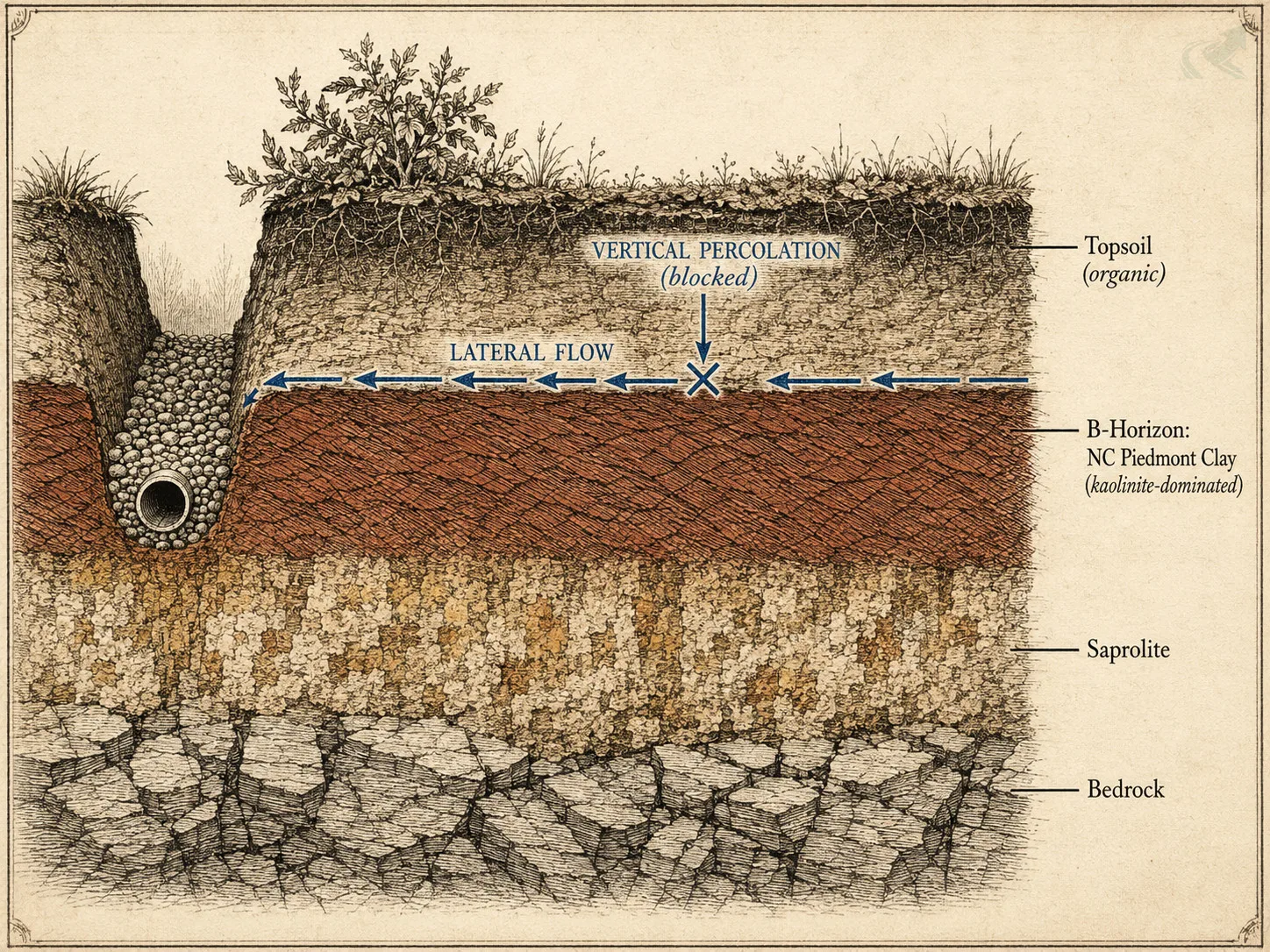
The core issue is kaolinite. The Cecil series — the dominant soil series across the NC Piedmont — is kaolinite-dominated. Kaolinite clay has low plasticity, low shrink-swell, and very low permeability. Water does not percolate down through NC clay the way it does in sandy or loamy soils.
What happens instead is lateral flow. When NC Piedmont clay saturates, water moves sideways — along the soil surface, along hardpan layers, along impermeable subsoil horizons — rather than draining vertically. A drainage system designed around vertical percolation will not intercept that lateral flow.
This changes how you size a system, where you daylight the outlet, how you select aggregate, and whether fabric sock is a liability or an asset. Seasonal swelling compounds it — NC Piedmont clay expands when wet and contracts when dry, which creates movement stresses that stable loam does not.
French drain in NC Piedmont clay: NC-adapted vs Florida-spec
Comparison. NC-adapted -- holds up: Clean gravel envelope, no fabric sock; Trench positioned to intercept lateral flow; Outlet daylights to a stable discharge point; Slope set for NC clay, not vertical percolation. Florida-spec -- backs up: Sock-wrapped pipe clogs with kaolinite fines; System waits for vertical percolation that never comes; No interception of the lateral flow under NC clay; Water backs up above the gravel with nowhere to go.
- Clean gravel envelope, no fabric sock
- Trench positioned to intercept lateral flow
- Outlet daylights to a stable discharge point
- Slope set for NC clay, not vertical percolation
- Sock-wrapped pipe clogs with kaolinite fines
- System waits for vertical percolation that never comes
- No interception of the lateral flow under NC clay
- Water backs up above the gravel with nowhere to go
The Florida method is right for Florida sand -- in NC clay the same install becomes a buried trench that holds water instead of moving it.
For the kaolinite-specific argument and the hydraulic conductivity comparison, see the clay-stops-water debate and why NC differs. For the full soil science treatment, see why NC French drain methodology differs from other states.
The NC Homeowner Takeaway
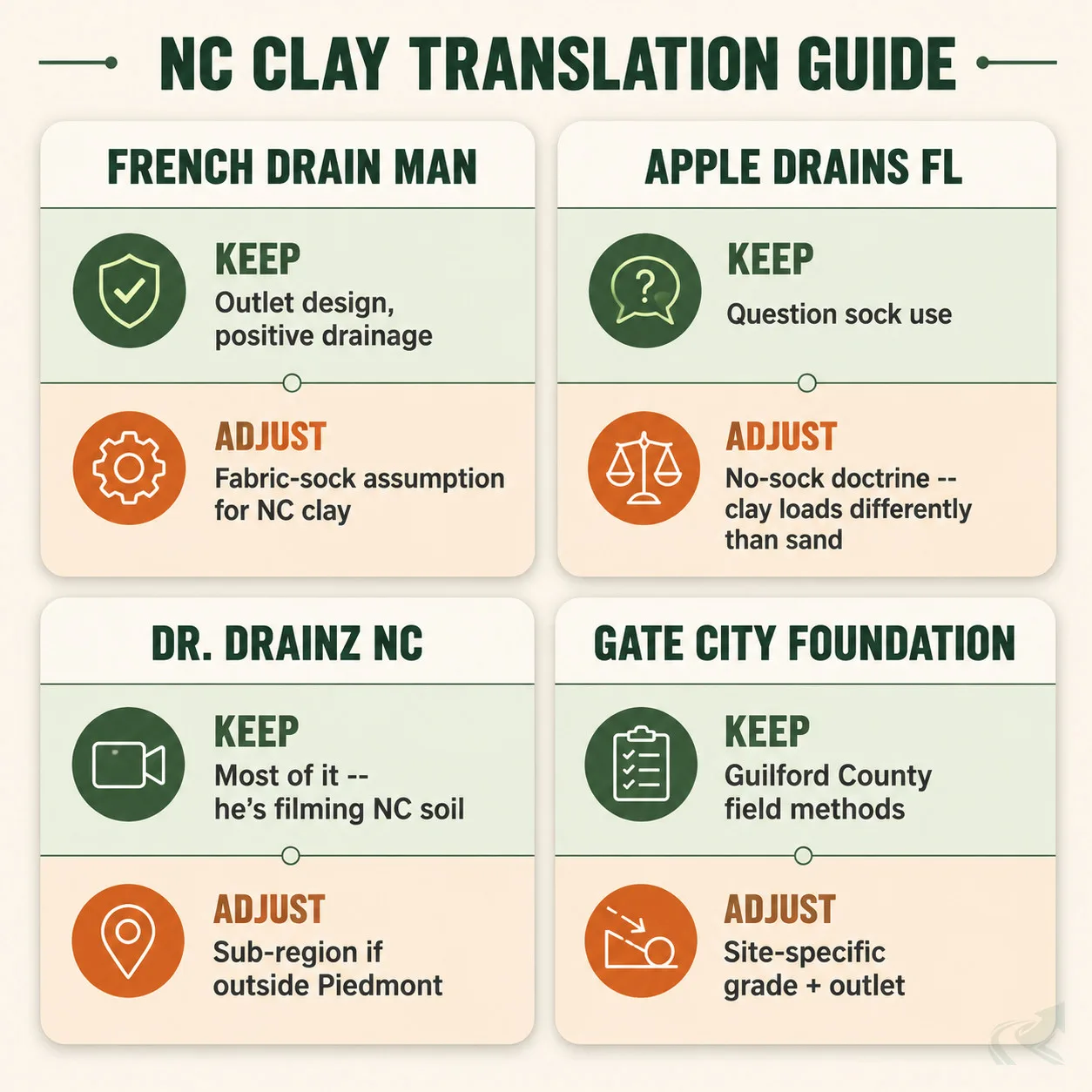
Here’s what you keep and what you adjust from each creator’s advice when you’re in NC clay.
None of these channels should be dismissed. Each one has real diagnostic vocabulary and genuine field experience. The translation work — not the dismissal — is what you’re doing here.
-
French Drain Man (Robert Sherwood): Keep the emphasis on outlet design and positive drainage — getting water to daylight is non-negotiable in any soil type. Adjust the fabric-sock assumption for NC clay; the specific geotextile grade and whether sock is appropriate depends on your aggregate and clay load, not just the presence or absence of fabric.
-
Apple Drains FL (Chuck): Keep the instinct to question sock use — clogged fabric is a real failure mode. Adjust the no-sock-ever doctrine to be NC-clay-specific rather than universal; the soil loading dynamics in a Piedmont clay trench are not the same as Florida sand, and the aggregate spec needs to account for that difference.
-
Dr. Drainz NC: Keep most of it. He’s working NC soil. Adjust for your specific sub-region if you’re outside the Piedmont (WNC rock-and-shallow-soil conditions are different again).
-
Gate City Foundation (Shawn): Keep the field-calibrated methods for Guilford County-type Piedmont clay. Adjust for site-specific conditions — grade, outlet location, and soil depth vary block by block.
The question you’re asking after reading any of these channels is not “who’s right.” It’s “which parts of this apply to NC Piedmont clay, and what has to change?”
If a contractor quotes you a method and can’t explain how it’s adapted for NC clay, that’s the question to ask before signing.
How to Use This When Vetting a Contractor
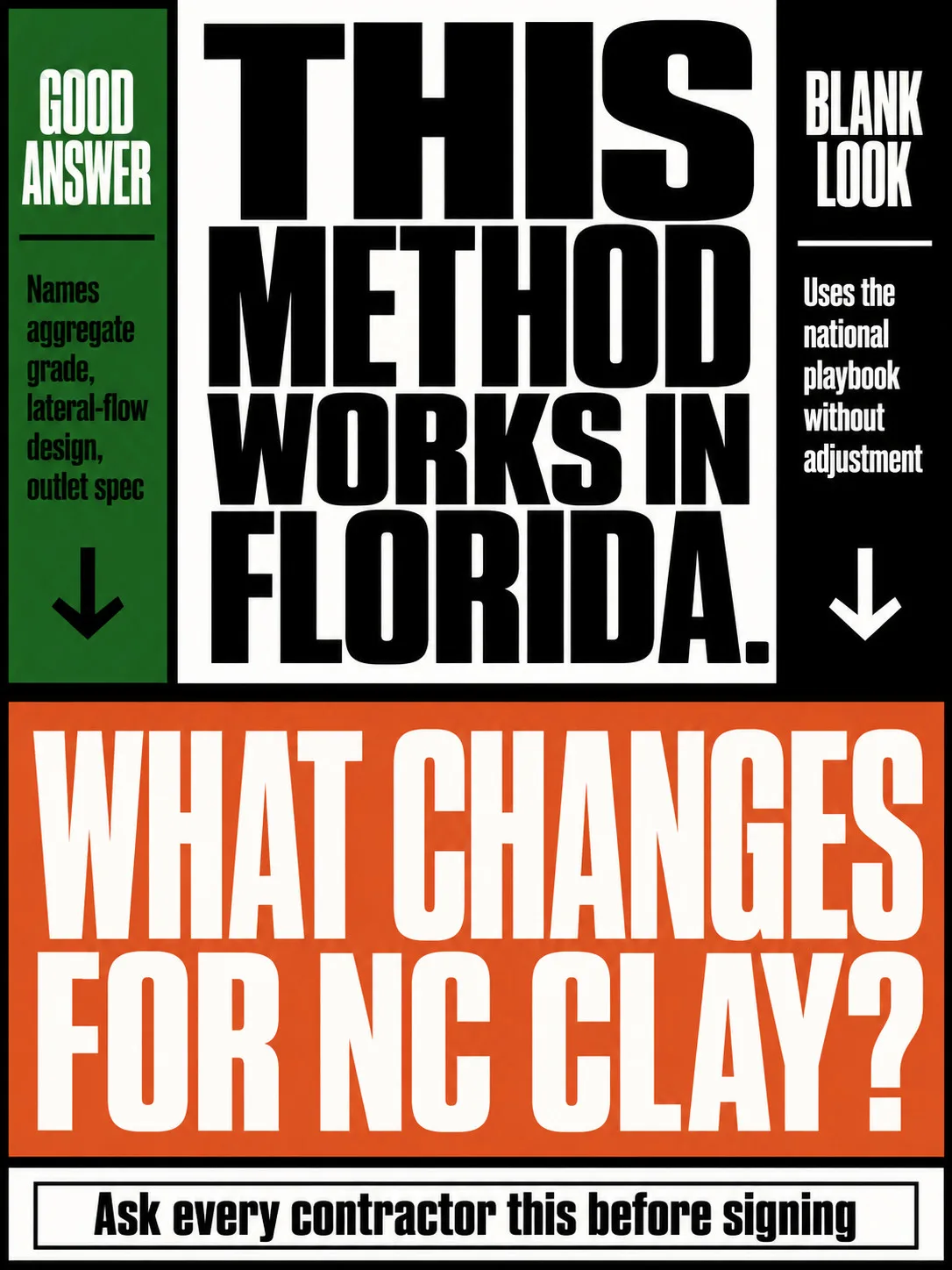
Ask any contractor you’re considering one question: “This method works in Florida — what specifically changes for NC clay?” A good answer tells you they know your soil. A blank look tells you something else.
A contractor who can answer that question — specifically, not in generalities — has worked NC Piedmont clay enough to understand why the national playbook doesn’t transfer wholesale. They know what aggregate grade to use. They know where to daylight the outlet. They know that positive drainage in NC clay means designing for lateral flow, not hoping for vertical percolation.
Ask for an itemized quote that names the aggregate spec, the pipe type, the outlet location, and the slope. Not a round number. Not a “French drain, 80 feet, $X.” Each line item is a verification point.
Find a grading operator in North Carolina working in your specific soil zone. Or read the NC clay-specific French drain methodology before the call so you can evaluate the answers.