
Two questions from the drainage debate
Does clay stop the water before it reaches the French drain fabric?
Partially -- and that's why the debate exists. NC Piedmont kaolinite clay has very low hydraulic conductivity, so water doesn't percolate down through it to reach the drain pipe. It moves laterally. Whether to use fabric depends on what's in the gravel zone, not whether the clay stops the water first.
Should you never use fabric sock in NC clay soil?
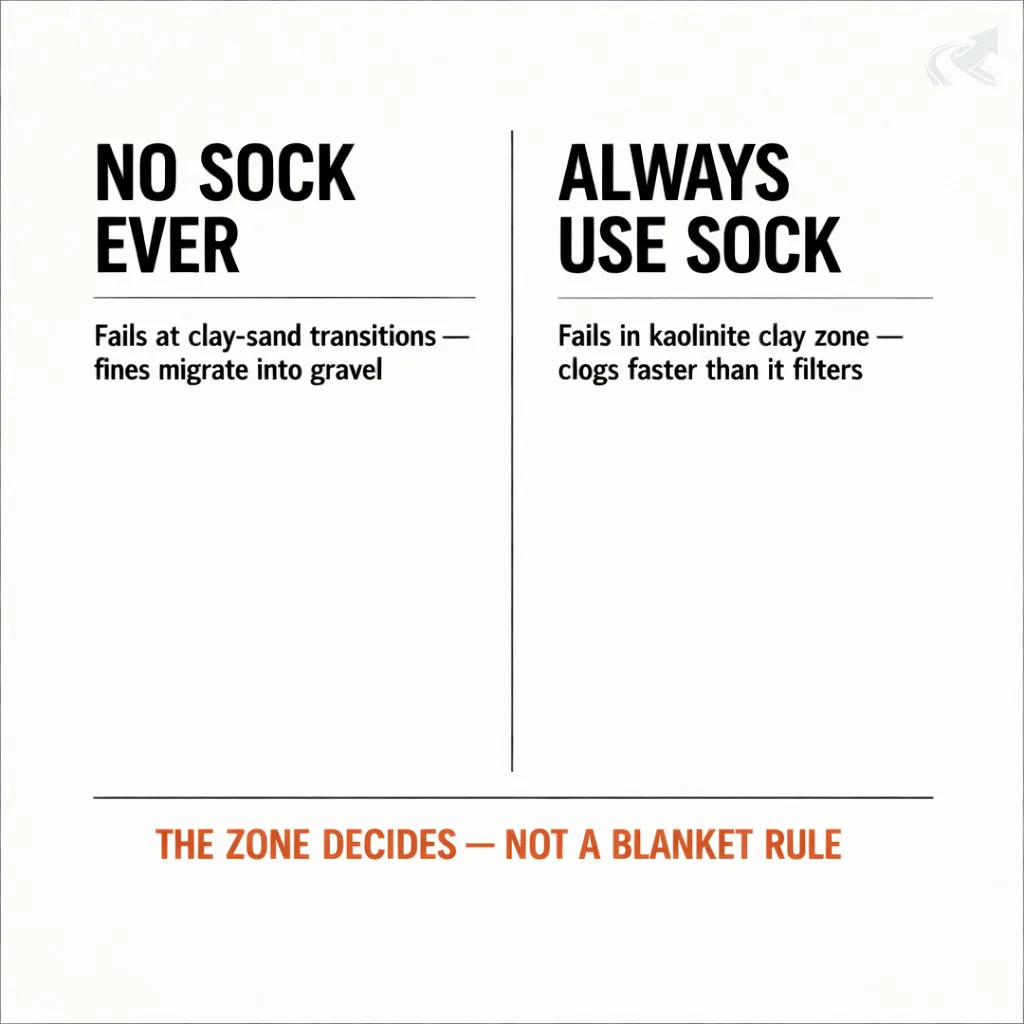
Not quite. No fabric inside a clay zone is usually correct -- kaolinite fines clog geotextile faster than the sock helps. But if your trench includes sandy backfill or crosses a clay-sand interface, fabric at that interface still prevents fine migration into the gravel. The zone matters more than a blanket rule.
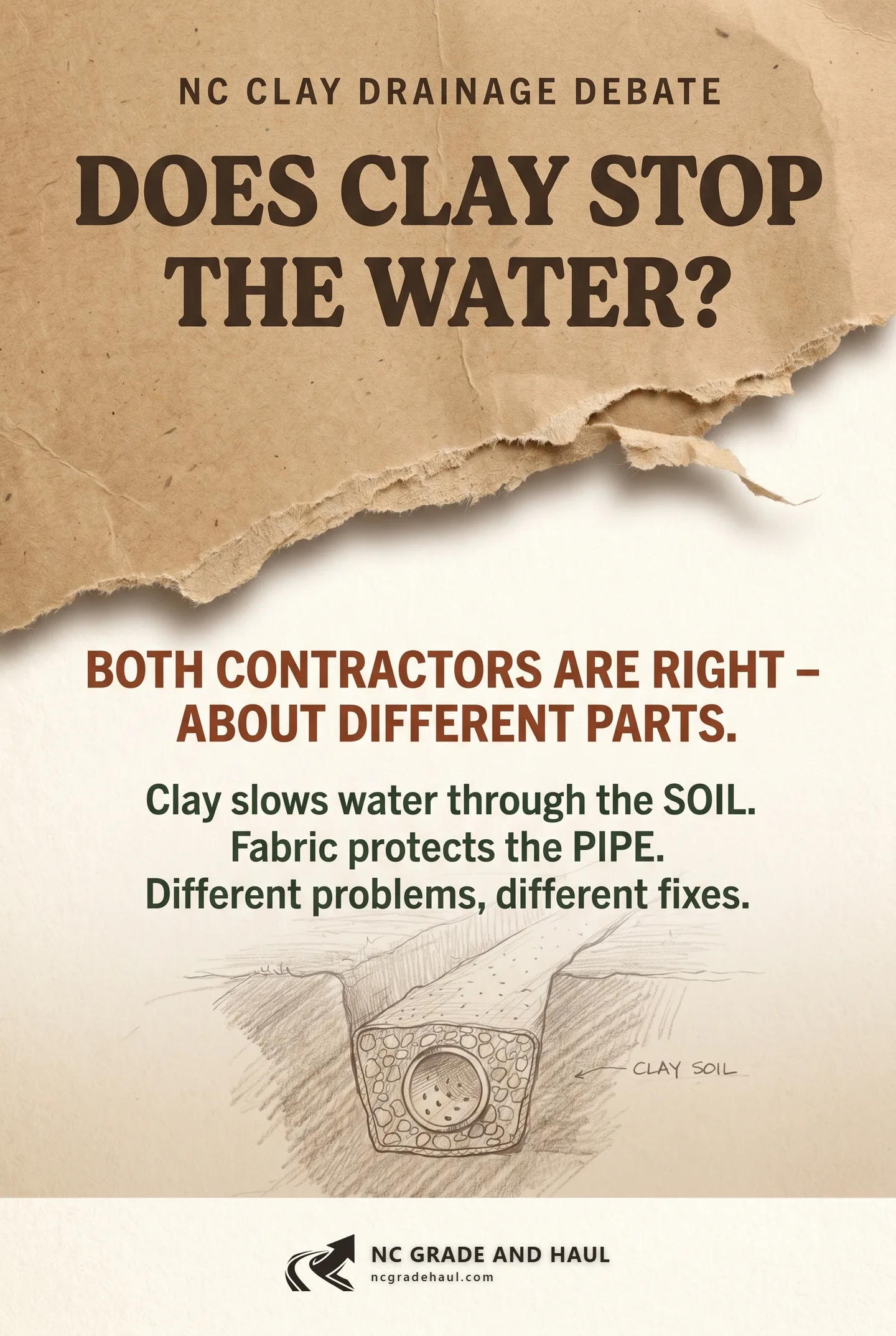
A YouTube comment in a drainage video reads: “In clay soil, the clay stops the water, not the fabric.”
Brenda screenshots it and texts it to two contractors. One replies: “Exactly right — that’s why I never use a sock in clay.” The other fires back: “That’s not how it works.” Both are referencing real phenomena. They’re talking about different parts of the same drainage system.
This page explains what the soil science actually says — not to declare a winner in the debate, but to give you the physics behind each position so you can evaluate any contractor’s reasoning.
The short version: the claim is partially correct, the “no fabric ever” conclusion is too blunt, and why NC clay changes the clay-stops-water debate is more nuanced than either camp typically admits.
The Claim: “Clay Stops the Water, Not the Fabric”
The claim is partially correct: NC Piedmont clay has low enough hydraulic conductivity that water moves laterally through it rather than percolating vertically into a gravel trench — which does reduce how much work the fabric has to do in some installations.
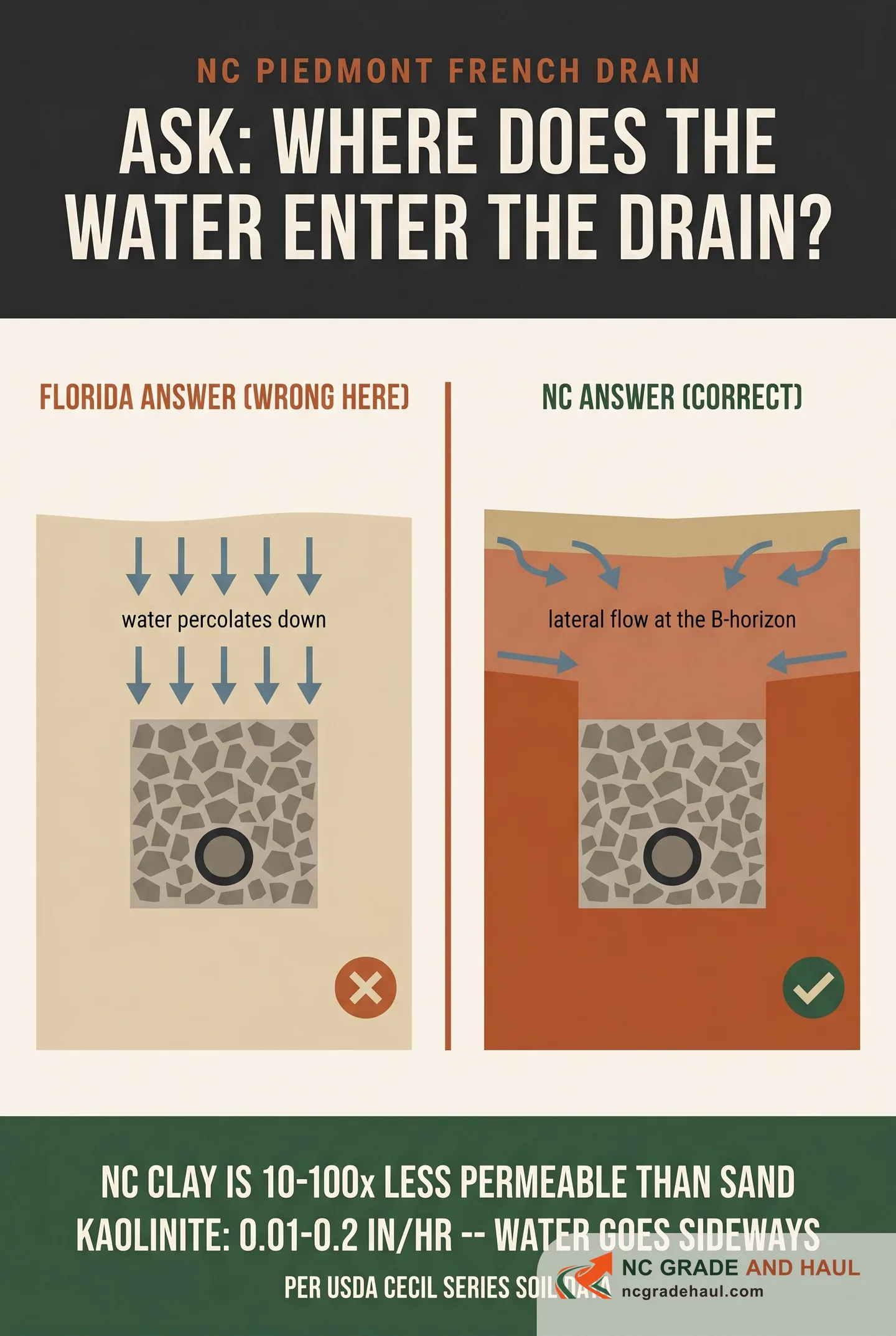
The “clay stops the water” camp is observing something real. In NC Piedmont soil, water pooling in a yard rarely percolates straight down through the clay layer to reach a buried drain pipe. It moves sideways — along the interface between topsoil and the dense clay below. A French drain in that zone intercepts lateral flow, not falling water.
The “fabric still matters” camp is also observing something real. In any trench that includes sandy backfill or transitions through a clay-sand boundary, fine particles can migrate into the gravel zone over time. A geotextile sock at that interface slows that process.
They’re both right about different failure modes. The disagreement is about which failure mode is more likely in a given install — not about whether the clay is real.
The Soil Science: Kaolinite and Hydraulic Conductivity
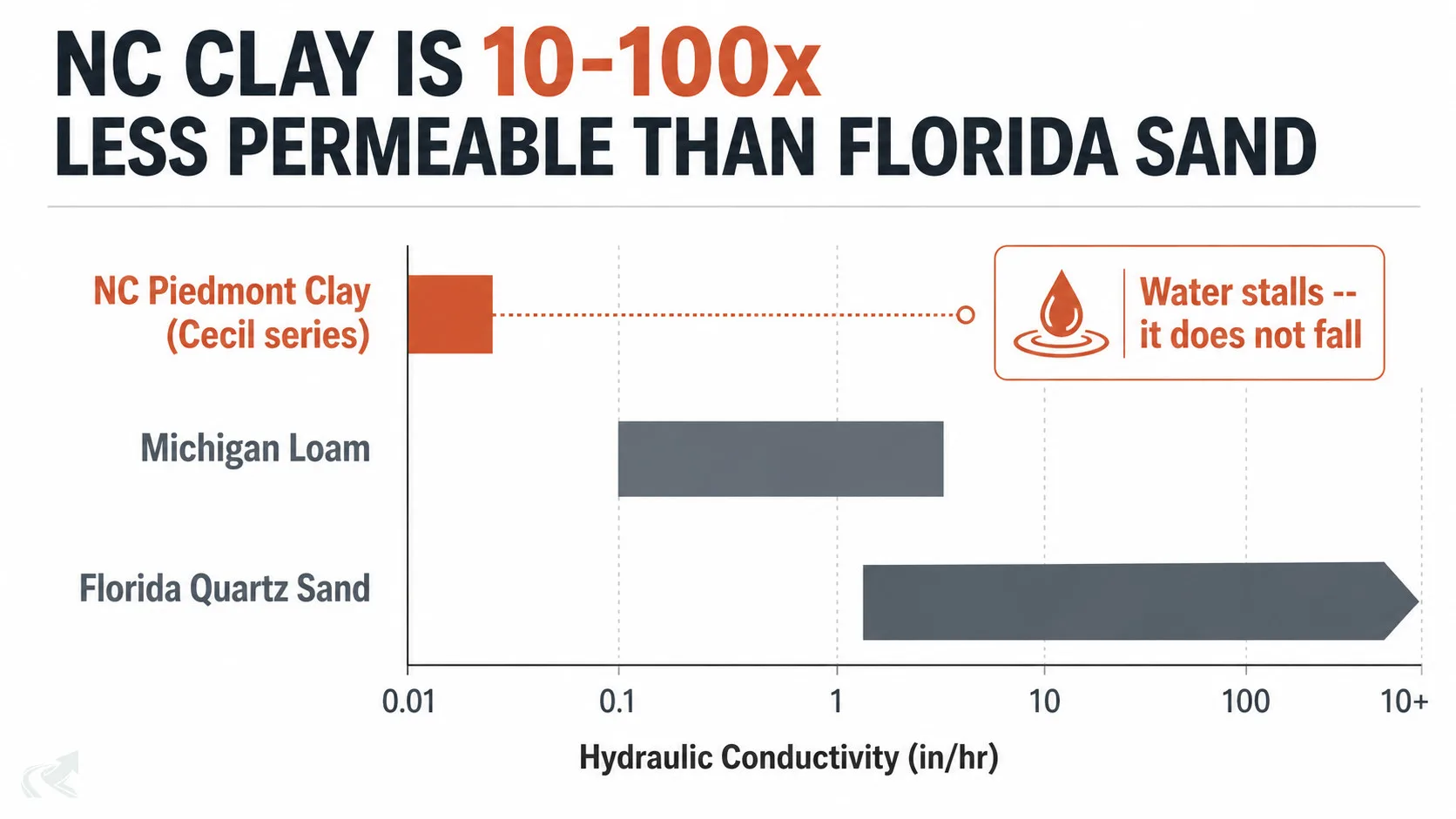
NC Piedmont clay is -dominant — a clay mineral with a flat, plate-like structure that stacks tightly and dramatically reduces water movement. (KC) in Cecil series soils typically runs 0.01—0.2 inches per hour.
That number deserves a reference point. Florida quartz sand runs 1—10+ inches per hour. The NC Piedmont is 10 to 100 times less permeable. Water doesn’t fall through kaolinite — it stalls.
Why does kaolinite behave this way? The crystal structure matters. Unlike illite or montmorillonite (the clay minerals dominant in other regions), kaolinite forms flat hexagonal plates that stack face-to-face. That stacking creates very small pore spaces and very long, tortuous flow paths. Water molecules have to squeeze around hundreds of plate edges to move one inch vertically.
This is not a theoretical concern. The — the USDA Natural Resources Conservation Service designation for the dominant Piedmont soil — is specifically characterized by a dense, low-permeability B-horizon created by kaolinite accumulation. It’s the defining feature of the soil that covers most of the NC Triangle, Piedmont, and Charlotte metro.
| Soil Type | Primary Mineral | Hydraulic Conductivity | What Stops the Water? |
|---|---|---|---|
| NC Piedmont clay | Kaolinite | 0.01—0.2 in/hr | Clay layer itself (lateral flow) |
| Florida sand | Quartz | 1—10+ in/hr | Fabric/gravel (percolation) |
| Michigan loam | Illite/mixed | 0.2—2 in/hr | Mixed — both mechanisms |
Sources: USDA Web Soil Survey, Cecil series official series description; comparative KC ranges from USDA NRCS Soil Survey Manual and peer-reviewed soil physics literature.
What the Clay Actually Does to a French Drain System
In NC Piedmont clay, a French drain in the middle of a clay zone is collecting water from the clay-sand interface and surface flow — not from percolating groundwater. That changes where you place the pipe, not whether you need fabric.
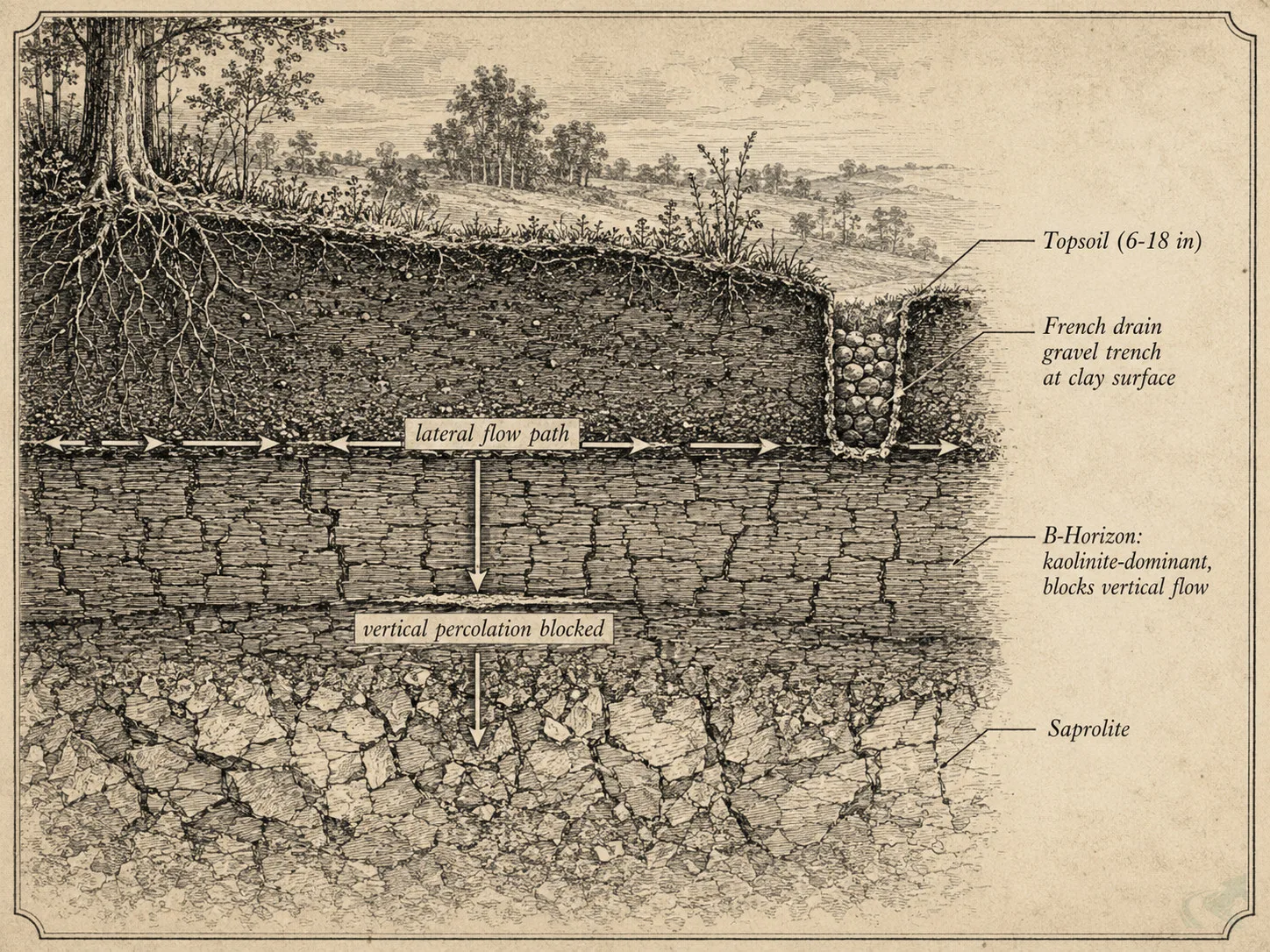
The sits just below the topsoil — typically 6 to 18 inches down in NC Piedmont profiles. Once surface water saturates the topsoil, it hits this clay barrier and moves sideways along the boundary, not down.
A well-placed French drain intercepts that lateral flow. The gravel trench creates a void that water flows into — not because it percolated through the clay, but because the drain trench intersects the path the water was already taking along the top of the clay layer.
This is why the “Florida drain” design (pipe buried deep in gravel, relying on the soil around it to filter through the gravel) often fails in NC. The water never reaches the gravel by percolation. The drain needs to sit at or near the clay layer’s surface, not below it.
The “clay stops the water” observation is physically accurate. The problem is that some contractors read it as “therefore the fabric sock doesn’t matter” — and those are two different claims.
What “No Fabric in Clay” Actually Means — and When It’s Right
The “no fabric in clay” recommendation is correct when the gravel zone is inside or adjacent to the clay — because a geotextile sock clogs faster in kaolinite fines than it does in sand, and a clogged sock is worse than no sock.
Here’s the failure mechanics. A non-woven geotextile (the typical pipe sock material) has an Apparent Opening Size rated to hold back particles above a certain micron threshold. Kaolinite particles are extremely fine — often sub-2 micron. Many standard geotextile filter ratings are too coarse to block kaolinite fines entirely, which means fines migrate through the fabric anyway, but at a slower rate. The fabric surface accumulates a kaolinite film. Flow rate drops. The drain underperforms.
French drain in NC clay: built right vs Florida-spec
Comparison. Built for NC clay: No sock in the clay zone -- nothing to clog; Lateral flow intercepted at the B-horizon; Gravel trench captures the sideways flow; Outlet daylighted to a real low point. Florida-spec in NC clay: Pipe sock clogs with sub-2-micron kaolinite; No lateral interception of B-horizon flow; Water pools above the trench; Pop-up emitter backs up.
- No sock in the clay zone -- nothing to clog
- Lateral flow intercepted at the B-horizon
- Gravel trench captures the sideways flow
- Outlet daylighted to a real low point
- Pipe sock clogs with sub-2-micron kaolinite
- No lateral interception of B-horizon flow
- Water pools above the trench
- Pop-up emitter backs up
A sock that works in Florida sand becomes a kaolinite filter cake in NC clay -- flow drops to nothing.
In a trench fully surrounded by kaolinite clay, a geotextile sock adds clogging risk without providing the filtration benefit it was designed for. The filtration benefit assumes particles large enough for the geotextile to actually stop. Kaolinite fines are too small. The clay soil itself is effectively self-sealing around the gravel zone — water enters through lateral flow paths, not by percolating through a filter.
When does a sock still make sense? When the trench includes sandy backfill or sits at a clay-sand interface where coarser sand particles can migrate into the gravel. At that boundary, particle sizes are large enough for a non-woven geotextile to actually intercept. That’s the install where fines migration is the real risk — and fabric helps.
For the full decision logic, see French drain fabric in the context of clay stopping water.
What the Debate Gets Wrong on Both Sides
Both camps miss the same point: the issue isn’t clay vs. fabric in the abstract — it’s whether the gravel zone is inside or adjacent to clay-dominant soil.
The “no fabric ever in clay” position fails in one specific scenario: a trench that transitions through clay into sandy subsoil, or that uses coarse sandy backfill inside the trench to improve drainage. In that case, the fines migration risk is real — and fabric at the clay-sand interface is the correct call. Blanket “no sock” advice applied to a transitional-zone trench creates a drain that gradually fills with migrated fines.
The “always use fabric sock” position fails in NC Piedmont clay because it applies a percolation-based design assumption to a lateral-flow soil. It adds clogging risk, reduces long-term performance, and treats the gravel zone as if it’s in a filtering relationship with the surrounding soil — when in kaolinite clay, it isn’t. The clay self-seals around the gravel.
The French drain methodology wars overview covers how this specific debate maps onto the broader conflict between national YouTube drainage advice and NC soil reality.
NC Homeowner Takeaway
Here’s what the soil science says about applying national drainage advice to NC Piedmont clay.
This is the section the YouTube comment section never reaches. Both sides are describing real mechanisms — they’re just not being precise about which soil conditions make each mechanism dominant.
-
Keep: The “clay stops the water” observation — it’s physically correct for NC Piedmont. Don’t expect a drain buried in a clay zone to work by vertical percolation through the soil. It won’t. Design for lateral interception at the B-horizon, not for collection of percolating groundwater.
-
Adjust: “No sock ever” is too blunt. If your trench includes sandy backfill, runs through a clay-sand transition zone, or uses coarser gravel that creates a true filter interface with adjacent sandy soil, fabric at that interface prevents fines migration into the gravel. The clay-dominant core of the trench doesn’t need it. The sandy transition zone does.
-
Use as a vetting question: Ask any contractor proposing a French drain in North Carolina clay to explain where the water enters the system. “From the soil percolating through the gravel” is a Florida answer. “From lateral flow along the clay layer, intercepted at the B-horizon” is an NC answer. The contractor who gives you the second answer understands your soil. The contractor who gives you the first answer is applying a design that works in sand.
The full NC synthesis — including how the kaolinite structure, the Cecil series classification, and the lateral flow behavior fit together — is at NC red clay dual nature and the clay-stops-water debate and the NC Piedmont red clay full engineering reference.
When you’re ready to talk to a verified NC contractor who can evaluate your specific clay zone and trench design, start at hire a grading operator in North Carolina. Ask for an itemized quote that specifies fabric spec and the reasoning behind it.
Common Mistakes
- Assuming “no fabric” is universally correct in clay. In NC Piedmont clay, no fabric in the clay zone is usually right — but transitions to sandy soil still need fabric at the interface.
- Assuming the percolation model applies to North Carolina. If the drain is surrounded by kaolinite clay, the gravel trench isn’t collecting percolating water — it’s collecting lateral flow. That’s a different design problem with different placement rules.
- Using the “clay stops the water” claim to skip trench depth or outlet placement. The claim is about fabric and percolation. It doesn’t change the need for a daylighted outlet, proper pipe slope, or adequate gravel depth. Those aren’t fabric questions.