
A homeowner in Cary installed a French drain based on a YouTube tutorial filmed in Florida. By the second wet season, water was backing up behind the gravel trench. The contractor shrugged and said the soil was “too tight.”
That phrase — “too tight” — is a translation failure. The soil wasn’t defective. The method was wrong for the soil. NC Piedmont clay follows different drainage physics than Florida sand or Michigan glacial loam. No amount of gravel compensates for a system built for the wrong physics.
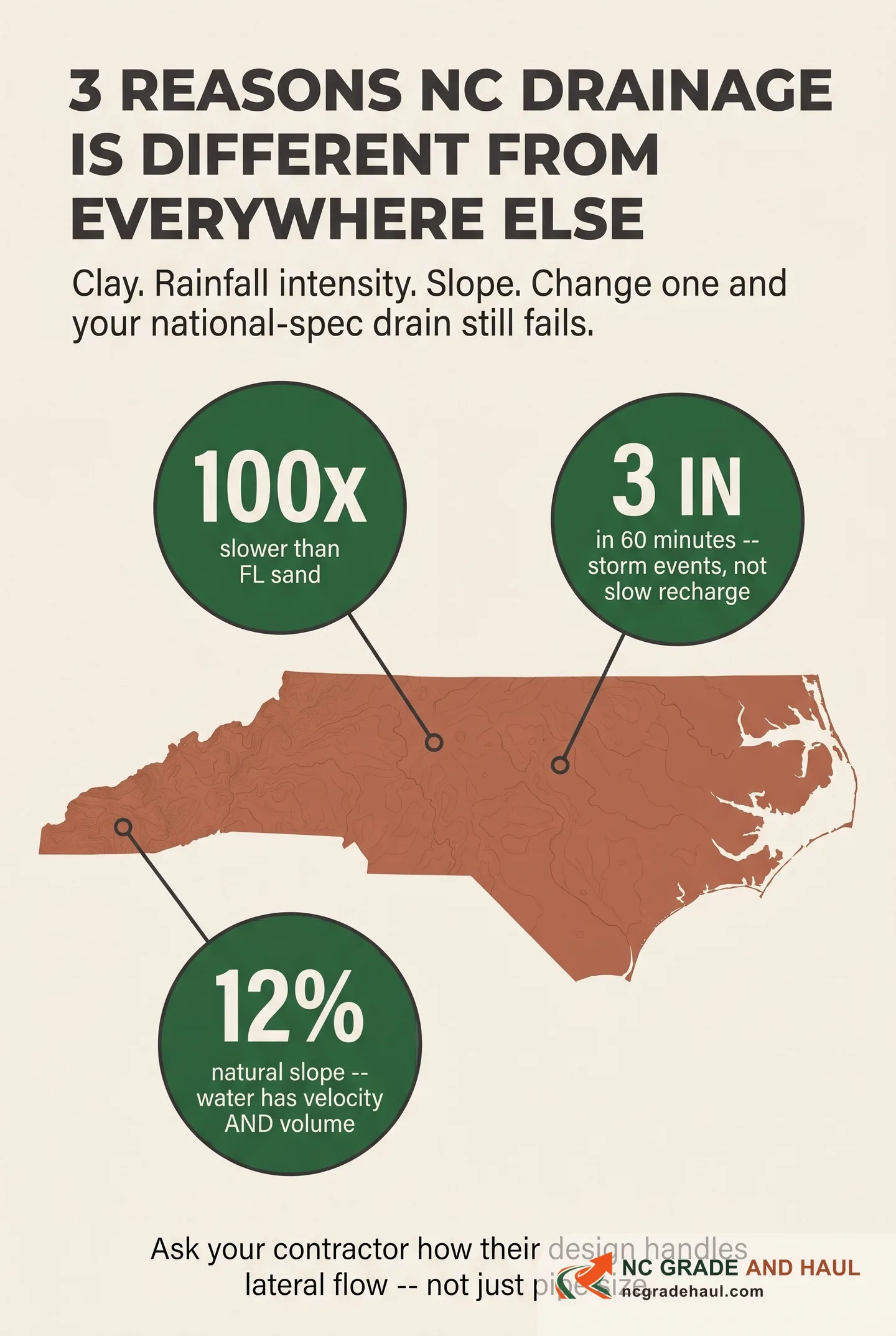
This page explains the three factors that make North Carolina different — clay mineral structure, climate intensity, and terrain slope — and what those factors require of any drainage system that actually works here.
NC Piedmont Clay: The Baseline Physics
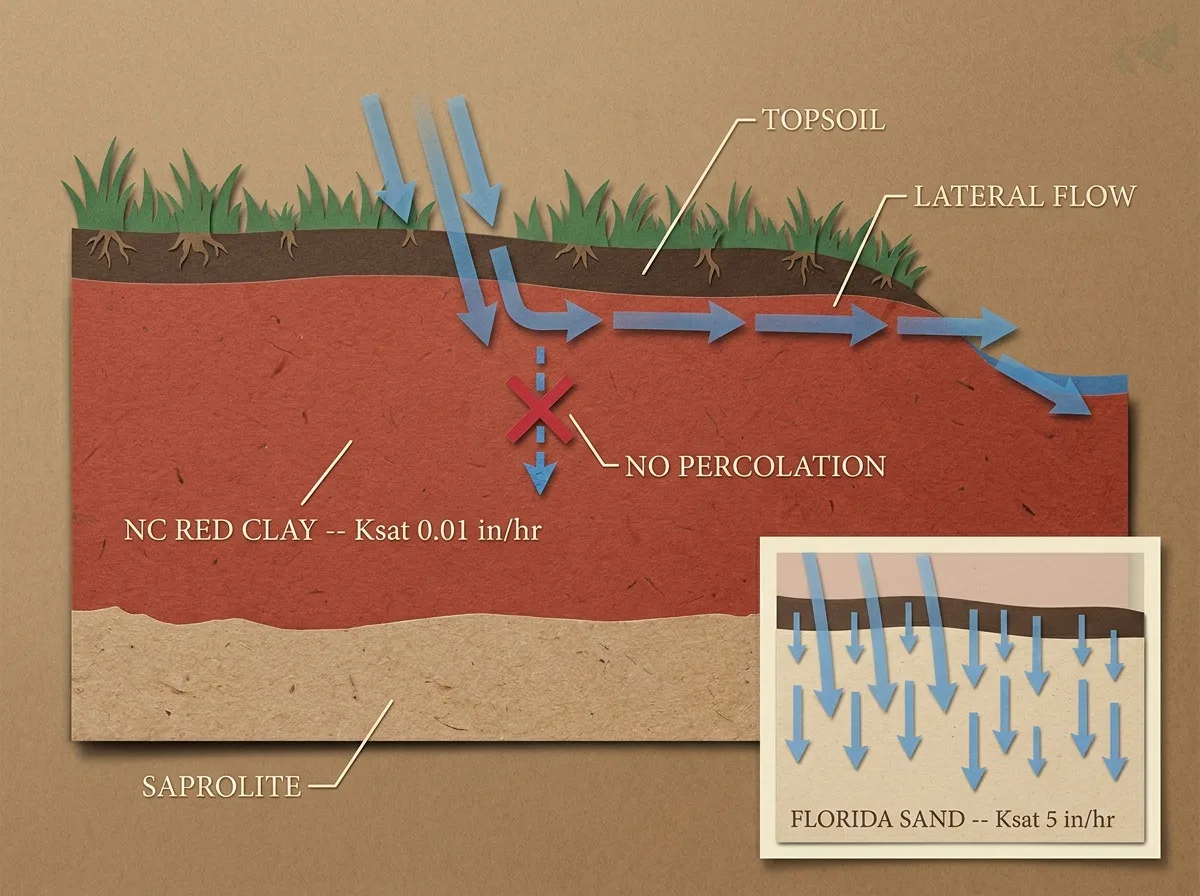
NC Piedmont red clay (primarily Cecil and Appling series) is kaolinite-dominant with typically in the range of 0.01—0.2 inches per hour. Water moves through it very slowly and primarily laterally, not downward.
soil survey data classifies the Cecil series — the signature red clay of the NC Piedmont — as a kaolinitic, thermic Typic Kanhapludult. Kaolinite is a low-activity clay mineral. Its flat, stacked crystal structure produces tight packing and minimal interlayer space for water to pass through vertically.
That’s why NC Piedmont clay is red: iron oxide coats the kaolinite particles after thousands of years of weathering under humid subtropical conditions. The color is a direct marker of the mineralogy.
The practical consequence: water moving into a saturated clay soil column doesn’t percolate downward through a gravel-filled trench. It encounters a permeability wall and deflects. It finds the path of least resistance, which is almost always lateral — along the soil horizon boundary between clay and the overlying sandy fill or topsoil.
A drainage system designed for vertical percolation simply redirects the problem. The trench fills, the pipe fills, and water finds its way around the structure rather than through it.
For the full soil science breakdown of the Cecil series — including the B-horizon clay pan depth, permeability by horizon, and how the iron-oxide coating changes water bonding — see NC Piedmont red clay soil properties.
Three-region soil and drainage comparison -- why the same method produces different results
| Factor | Florida (Sand) | Michigan (Loam) | NC Piedmont (Clay) |
|---|---|---|---|
| Dominant soil type | Sandy / high permeability | Loamy / moderate permeability | Kaolinite clay / low permeability |
| Hydraulic conductivity (Ksat) | High: 1--10+ in/hr | Moderate: 0.2--2 in/hr | Low: 0.01--0.2 in/hr |
| Primary drainage direction | Vertical percolation | Mixed vertical + lateral | Lateral flow along clay-sand interface |
| Pipe sock effectiveness | Moderate -- fines present but manageable | Common -- helps in loam | Clogs in kaolinite fines; counterproductive in clay zone |
| Key design difference | Deep trench, sock optional or recommended | Standard depth, sock common | Interceptor trench position, outlet daylighted, no sock in clay zone |
Dominant soil type
- Florida (Sand)
- Sandy / high permeability
- Michigan (Loam)
- Loamy / moderate permeability
- NC Piedmont (Clay)
- Kaolinite clay / low permeability
Hydraulic conductivity (Ksat)
- Florida (Sand)
- High: 1--10+ in/hr
- Michigan (Loam)
- Moderate: 0.2--2 in/hr
- NC Piedmont (Clay)
- Low: 0.01--0.2 in/hr
Primary drainage direction
- Florida (Sand)
- Vertical percolation
- Michigan (Loam)
- Mixed vertical + lateral
- NC Piedmont (Clay)
- Lateral flow along clay-sand interface
Pipe sock effectiveness
- Florida (Sand)
- Moderate -- fines present but manageable
- Michigan (Loam)
- Common -- helps in loam
- NC Piedmont (Clay)
- Clogs in kaolinite fines; counterproductive in clay zone
Key design difference
- Florida (Sand)
- Deep trench, sock optional or recommended
- Michigan (Loam)
- Standard depth, sock common
- NC Piedmont (Clay)
- Interceptor trench position, outlet daylighted, no sock in clay zone
NC’s Climate: Humid Subtropical and Why It Matters
North Carolina’s humid subtropical climate delivers 45—55 inches of annual rainfall with intense summer thunderstorm events. Drainage systems here face large short-duration volumes — not the gradual soil recharge that Michigan and Florida drainage methods are sized for.
The Piedmont region receives roughly 43—50 inches of annual rainfall. The Mountains receive 50—70 inches. The Coastal Plain averages 48—55 inches. These numbers sound similar to Florida, but the event shape is different.
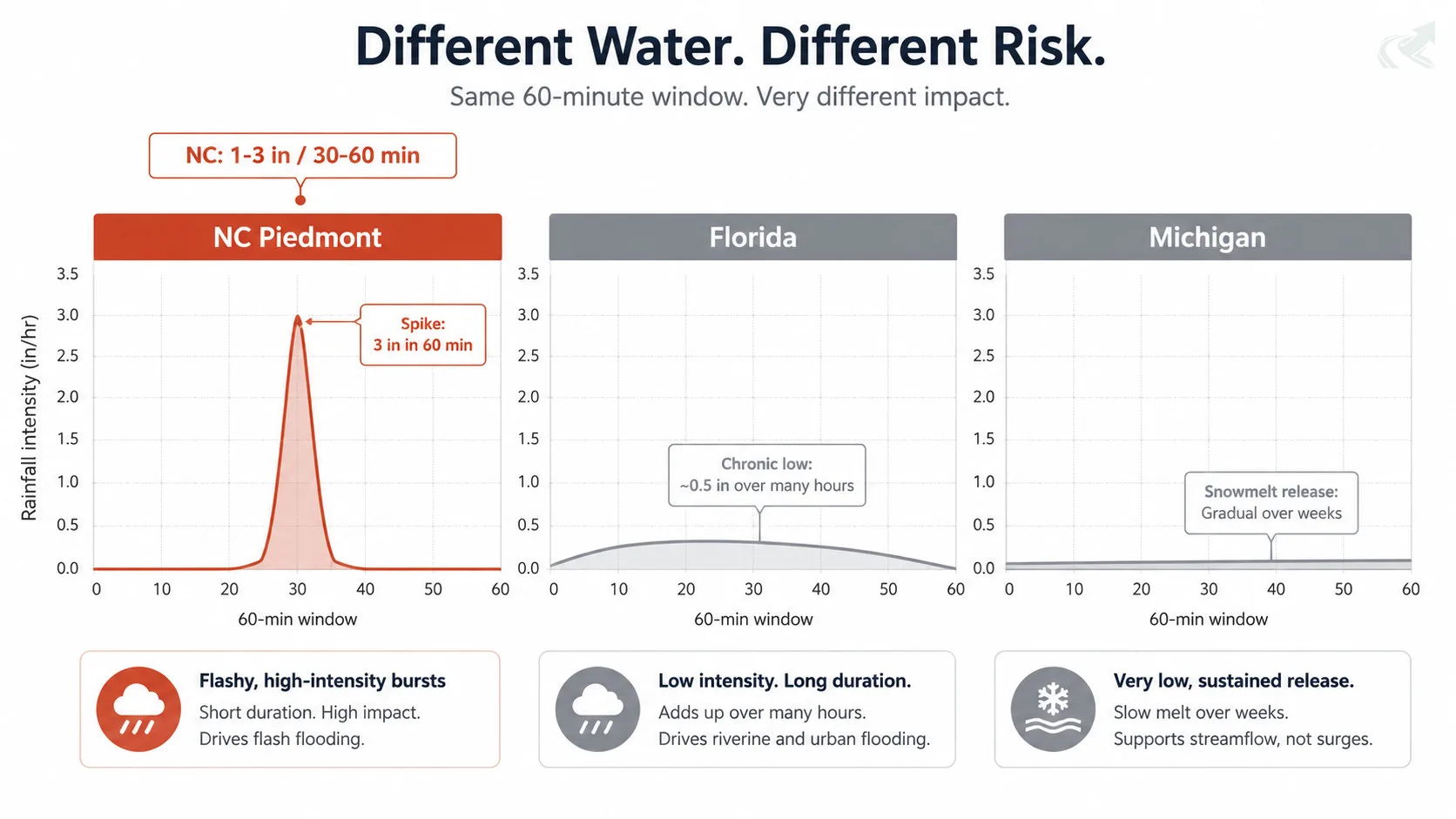
NC summer thunderstorms routinely deliver 1—3 inches in 30—60 minutes. That volume hits clay soil that is already near saturation from spring rains. The soil can’t accept the inflow rate. Surface runoff and near-surface lateral flow dominate within minutes of storm onset.
Florida drainage problems are often chronic saturation issues — high water tables, low-gradient fields, slow steady infiltration over time. Michigan drainage is often snowmelt-driven — a gradual, weeks-long release with moderate peak-flow rates.
NC drainage problems are acute: volume spikes during thunderstorms, clay that can’t accept the rate, and slopes that accelerate lateral movement. A system sized for gradual recharge will be overwhelmed on the first summer afternoon with a real storm cell.
NC Topography: Piedmont Slope and the Lateral Flow Problem
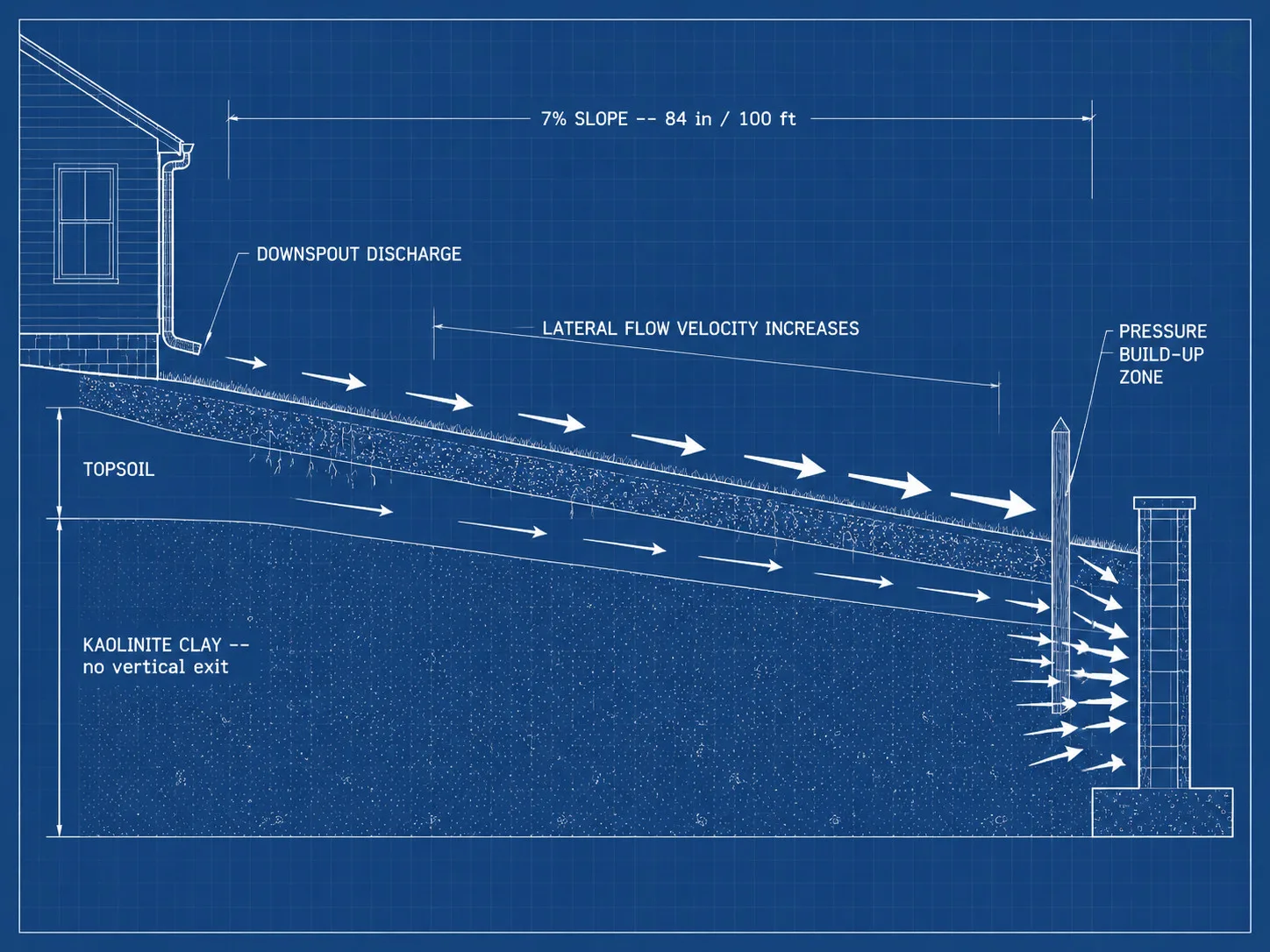
The NC Piedmont sits on dissected terrain with natural slopes typically in the 3—12% range. Water running across low-permeability clay has both volume and velocity — which creates surface and near-surface lateral flow that perforated-pipe systems are not designed to intercept.
The NC Piedmont is not flat. It’s the remnant of an ancient eroded plateau, cut over millions of years into rolling hills with defined ridge lines and drainageways. A typical residential lot in Wake, Guilford, or Mecklenburg County has 4—8% natural slope across some portion of the yard.
That slope matters when paired with kaolinite clay. Water that can’t enter the soil moves downslope. The lateral pressure builds behind any obstruction — a fence line, a house foundation, a retaining wall, the edge of a concrete pad. Perforated pipe running along the low side of a slope without any interceptor above it doesn’t capture that lateral flow. It sits in the wet zone and slowly fills with fine kaolinite particles that travel with the moving water.
Western NC compounds the Piedmont problem. Appalachian topography produces steeper slopes, shallower rock, and different soil structure. Western NC mountain soils and shallow rock covers what changes when you’re working in Buncombe or Henderson County.
On the coast, the physics reverse: sandy soils with high permeability and low slope. NC Coastal Plain sandy soils and drainage covers why the methods that fail in Piedmont clay actually work on the coast.
What National Methods Assume That NC Clay Doesn’t Deliver
Florida and Michigan drainage methods assume water will percolate downward through the soil into a gravel bed. NC clay doesn’t do that — which makes gravel-bed French drains function differently here, and fail when installed the Florida way.
Three specific design assumptions break down in NC Piedmont clay:
Assumption 1: The soil will accept water from the gravel trench by percolation. In sandy Florida soil, the gravel bed acts as a buffer that gives water a place to sit briefly before percolating down through the sand. In NC clay, the gravel bed fills quickly and the clay-soil interface at the trench wall has Ksat near 0.05 in/hr. Water doesn’t leave the trench downward. It backs up to the pipe.
Assumption 2: A fabric sock prevents clogging by excluding fines. In sand, a sock does help. Kaolinite particles are smaller and more negatively charged than most sand fines. They adhere to geotextile fabric, bind together, and form a clogging cake within 2—5 wet seasons in North Carolina clay. The sock that protects a Florida pipe destroys an NC pipe. See the clay-stops-water debate and why NC differs for the kaolinite-specific evidence on this point.
Assumption 3: The outlet can be placed at the same relative depth as the pipe. In flat or gently sloped terrain with high-permeability soil, outlet placement is flexible. In NC, slope and lateral-flow velocity mean the outlet must be daylighted to positive drainage — not terminated with a pop-up emitter into lawn, which creates a pressure-relief point that only works when the pipe isn’t already backing up.
French drain in NC clay: NC-adapted interceptor vs Florida-method
Comparison. NC-adapted interceptor: Trench captures lateral flow at the clay-sand interface; Outlet daylights to positive drainage; Slope set for lateral movement, not percolation; Placed up-slope, before water overruns the area. Florida-method in NC clay: Pipe at the bottom of a deep trench, waiting on percolation; Fabric sock clogs with kaolinite fines in 2-5 seasons; No interception of the lateral flow that NC clay produces; Water pools above the gravel with no daylighted outlet.
- Trench captures lateral flow at the clay-sand interface
- Outlet daylights to positive drainage
- Slope set for lateral movement, not percolation
- Placed up-slope, before water overruns the area
- Pipe at the bottom of a deep trench, waiting on percolation
- Fabric sock clogs with kaolinite fines in 2-5 seasons
- No interception of the lateral flow that NC clay produces
- Water pools above the gravel with no daylighted outlet
The national playbook assumes water percolates down into the gravel -- NC clay moves it sideways, so the drain has to intercept lateral flow instead.
How NC-Adapted Systems Are Different
An NC-adapted French drain intercepts lateral flow rather than relying on percolation — which changes pipe slope, outlet placement, gravel-to-pipe ratio, and whether a sock helps or hurts.
Three major differences between a Florida-spec install and an NC-adapted one:
Interceptor trench positioning. An NC system is placed up-slope, where lateral flow is moving toward the problem zone. A Florida-style system sits down-slope, at the low point, after the water has already overrun the area you were trying to protect. The physics of lateral flow require capturing it before it arrives, not after it pools.
Daylighted outlets. NC Piedmont slopes are steep enough that a properly positioned interceptor trench can daylight its outlet to a stable discharge point — a creek channel, a roadside swale, or a protected slope edge. Pop-up emitters close off under back-pressure. A daylighted outlet maintains positive drainage even during peak storm flow.
No fabric sock in the clay zone. The kaolinite mineral fraction in NC Piedmont clay passes through or coats fabric socks within a few wet seasons. An NC contractor who removes the sock in the clay-run portion of a trench and uses clean #67 stone with careful aggregate sizing is following the physics. A contractor who insists on a sock because “that’s how it’s always done” is following a national template designed for different soil.
For the full methodology — pipe sizes, slope calculations, aggregate specification, and the specific cases where a sock is appropriate in the sand-transition zone — see NC clay-specific French drain methodology.
NC Homeowner Takeaway
Here’s what of each national approach still applies in North Carolina — and what doesn’t.
This section exists because the YouTube creators who taught you about drainage are not wrong about their local physics. They’re filming in a different state with different soil. Translating their method to North Carolina requires knowing which parts carry over and which parts invert.
French Drain Man (Michigan loam): Keep the raked-wall trench concept — that geometry works anywhere there’s a clear flow path. Keep the emphasis on outlet elevation. Adjust: don’t rely on lateral drainage into the gravel bed in NC clay — the Ksat won’t support it. Use the trench to intercept surface and near-surface lateral flow, not to create a percolation sump.
Apple Drains FL (Chuck Arnold): Keep the no-sock-in-clay instinct — he’s right that socks clog in fine-grained soils and his Florida videos show real clogged socks as evidence. Adjust: Florida pipe slopes and outlet depths assume faster percolation than NC Piedmont clay allows. Pipe slope and outlet daylighting need to be more aggressive in NC because you’re designing for lateral interception, not percolation-assisted drainage.
The general red-flag phrase to watch for: any system design that includes “the water will find its way down through the soil” is a failure mode in NC Piedmont clay. It won’t. There needs to be a designed outlet path that works by gravity and slope, not soil permeability.
Ask any drainage contractor: “How does your design account for lateral flow in NC clay rather than vertical percolation?” A contractor who can answer that question specifically — describing interceptor position, outlet type, and sock decision for your soil zone — understands your site. A contractor who pivots to talking about pipe size and gravel depth without addressing lateral flow is working from a national template.
Contractor vetting question — copy and use
”Ask any drainage contractor: ‘How does your design account for lateral flow in NC clay rather than vertical percolation?’”
How to Use This Knowledge When Evaluating a Quote
A contractor who can’t explain how their design adapts for NC clay lateral flow — not just vertical drainage — is either working from a national template or doesn’t understand your soil.
When you’re reviewing quotes, ask specifically: where is the interceptor positioned relative to the slope? Where does the outlet daylight? Is the sock included or excluded, and why for your specific soil zone?
A good contractor in NC Piedmont clay has answered those questions hundreds of times. The answers should be specific and immediate. If the contractor talks about pipe size and gravel depth without addressing lateral interception, that’s useful information about their mental model.
A perc test (percolation test) is useful for confirming your site’s actual Ksat before design — especially if you’re in a soil-transition zone between Piedmont clay and the Sandhills. Some NC counties require perc tests for certain permit applications. Ask your contractor whether a perc test is warranted for your site before design is finalized.
Find a grading contractor in North Carolina who works regularly in Piedmont clay and can explain their lateral-flow design rationale. Get an itemized quote that names the pipe type, aggregate specification, sock decision, and outlet location — not a single-line number.
French drain methodology wars overview covers the full creator-by-creator comparison if you want to trace which claims from specific YouTube sources hold up in NC soil.